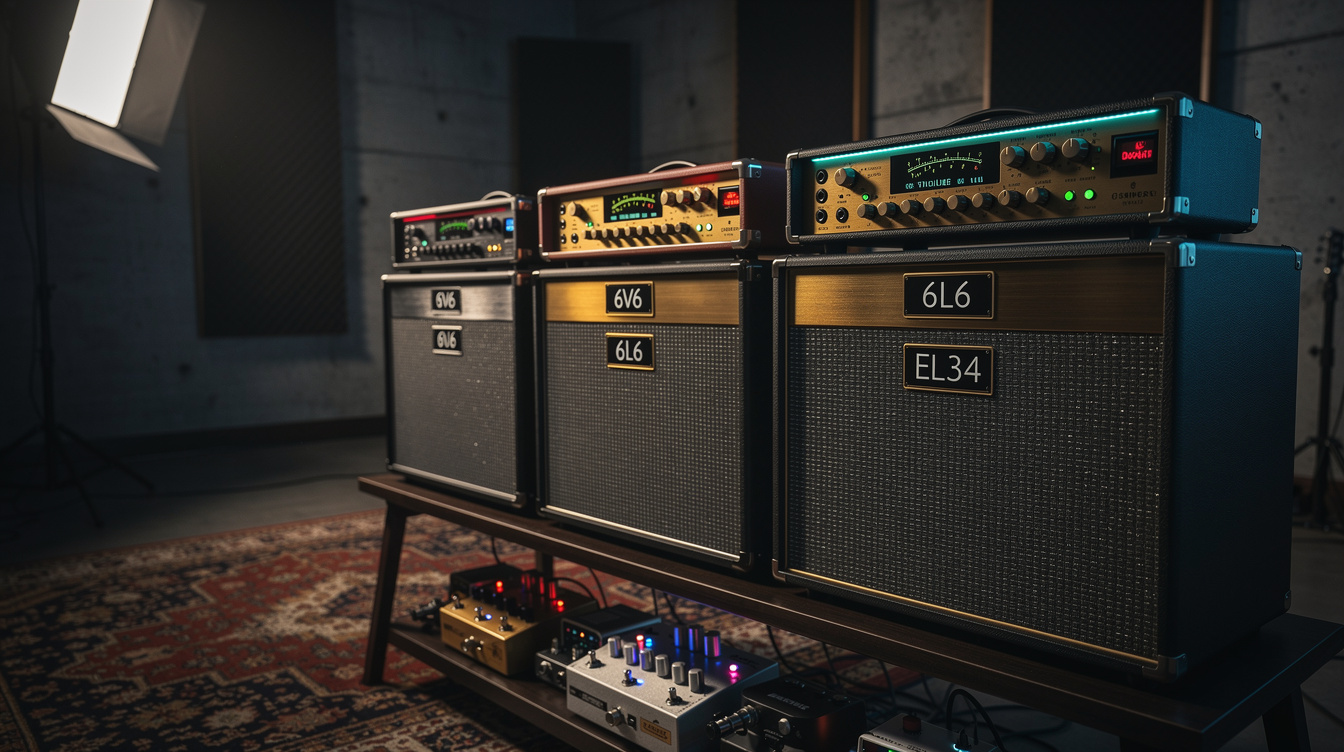
What the power tube actually does: It sets the amp's headroom (how loud it gets before distorting), its breakup character (the texture of that distortion), and its compression behavior (how the amp responds when you dig in). It does NOT set the amp's voicing — that's the preamp tubes, the EQ circuit, and the speaker. A 6V6-equipped amp and a 6L6-equipped amp built around the same preamp will have a similar fundamental voice but different headroom ceilings and different feel under your fingers. The EL34 changes more, because it's a different design philosophy entirely.
The conversation about power tubes tends to overstate the audible differences. You'll see forum posts describing 6V6s as "warm and chimey," 6L6s as "scooped and American," and EL34s as "British and aggressive" — language so loaded that it's easier to feel the difference than to hear it. After running different tube sets through my Deluxe Reverb over the past year and comparing notes against a friend's Twin and a borrowed JCM800, here's what I actually hear.
The differences are real. They're also smaller than the marketing suggests, and they're located in specific, identifiable parts of the playing experience.
The Three Tubes at a Glance
| Tube | Typical wattage (pair) | Common in | Sonic signature |
|---|---|---|---|
| 6V6 | 15–22W | Fender Deluxe Reverb, Princeton Reverb, smaller blackface combos | Breaks up sooner; the compression feels spongy, like the amp is breathing with you |
| 6L6 (and 5881) | 40–60W | Fender Twin, Bassman, Mesa, Soldano | Stays clean louder; the low end is tighter and more controlled |
| EL34 | 50–100W | Marshall (most), Hiwatt, Vox AC30 (paired with EL84), Diezel | Mids push forward; more harmonic overtones in the saturation |
These are the categories. The actual differences between brands of the same tube type (a JJ 6V6 vs. a Tung-Sol 6V6 vs. a vintage RCA 6V6) are often as significant as the differences between tube types within the same amp.
What the Power Tube Actually Controls
The power tube sits at the end of the amp's signal chain. By the time the signal reaches the power tubes, it has already been shaped by:
- The preamp tubes (most of the amp's gain character)
- The tone stack (the bass/mid/treble interaction, which is amp-design specific)
- The phase inverter (a specific tube and circuit topology)
The power tubes' job is to take that already-shaped signal and amplify it to a level that can drive a speaker. In doing so, they introduce three kinds of color:
Headroom. The maximum signal level the tubes can pass before they begin to distort. A 6V6 pair starts compressing at much lower volumes than a 6L6 pair. This is why a Deluxe Reverb with a 6V6 set "breaks up at 5" while a Twin Reverb with 6L6s "stays clean at 8." The number on the volume knob is misleading — what's happening is the 6V6 set is reaching its compression threshold sooner.
Compression character. When the tubes do start to compress, the way they soften and saturate is different per tube type. 6V6s have a softer, almost "spongy" compression that responds to playing dynamics. 6L6s compress more firmly, with a tighter low-end. EL34s have a particular harmonic complexity in the mid-range that some players describe as "singing" or "vocal."
Sag. The amount the power supply is "pulled down" when the tubes draw current under load. This affects how the amp feels to play — how it responds to a hard pick attack, how it bloomed after the initial transient. We covered the physics of amp sag in detail; the power tube type contributes to it but is not the only variable.
What the power tube does NOT control:
- The amp's overall voicing. A 6V6 in a Marshall JCM800 (rare, but possible with modifications) doesn't make the JCM800 sound like a Deluxe Reverb. The voicing comes from the preamp circuit and tone stack.
- The high-end character. That's mostly speaker and EQ.
- The midrange shape. Mostly preamp and tone stack.
The power tube changes how the amp feels at a given volume more than how it sounds at a given volume. That distinction matters.
The 6V6: Soft Compression, Early Breakup
The 6V6 is a lower-power tube that runs efficiently at moderate volumes. In a Deluxe Reverb (15W with a pair of 6V6s), the tubes start to compress noticeably around 4 on the volume knob and reach their saturation peak around 6–7. Beyond that, the breakup gets more aggressive but the volume doesn't increase much.
The character: a warm-sounding compression that responds to playing dynamics with what I'd describe as a slight "give." When you dig in with a pick, the amp gives back a little — not in a way that feels like volume loss, but like a soft cushion under the note. When you back off, the note rings cleaner. This responsiveness is one of the reasons 6V6 amps are loved for blues and jazz where dynamic touch matters.
The 6V6's limitation is headroom. Above its compression threshold, it doesn't get cleaner — it gets dirtier. For a player who needs a clean tone at higher volumes (loud stages, drummer-with-no-headphones rehearsal rooms), the 6V6 amp will start running out of clean before the room is full. This is the trade-off.
For my Deluxe Reverb specifically, I use Tung-Sol 6V6s. They sound fuller in the low-mids than the JJ 6V6s I had previously, and they have what I can only describe as a more vocal upper-midrange character — the note feels like it has a syllable to it, rather than just a frequency. Brand-to-brand differences are real and worth experimenting with.
The 6L6 (and 5881): More Headroom, Firmer Low-End
The 6L6 is a higher-power tube. A pair of 6L6s in a Twin Reverb produces 85 watts — significantly louder before compression than a 6V6 pair. The tube stays clean longer, and when it does compress, it does so with more low-end firmness than the 6V6.
The character: the 6L6 has the cleanest low-end of the three tube types covered here. The bass note attack is firmer, and the sustained low-end energy doesn't smear. This is why 6L6 amps are favored for clean Fender-style tones, country, and country-adjacent rock — the low-end definition matters in those genres.
When pushed past clean, the 6L6 distortion is more aggressive than the 6V6 but still has American-amp character: less midrange complexity than an EL34, more upper-midrange snap than an EL84. It does not have the singing midrange of a Marshall.
The 5881 is a 6L6 variant with slightly different specifications — sometimes used as a direct sub for 6L6, sometimes treated as a separate tube. Practically, in most amps, you can swap between them with a bias adjustment and not hear a dramatic difference.
For the Twin and Bassman, the 6L6 is the "right" tube — those amps are designed around its characteristics. Substituting other tube types (with appropriate amp modifications) is possible but produces a different amp character than the designer intended.
The EL34: British Voice, Different Animal
The EL34 is the European tube tradition. Most Marshall amps use it, as do Hiwatts, and many British-voiced amps from manufacturers like Diezel, Bogner, and Friedman.
The EL34's voicing is more midrange-forward than the American 6L6. This is partly the tube and partly the amplifier circuits that surround it (Marshall and Hiwatt designs are different from Fender designs in the phase inverter, output transformer, and feedback networks). When you compare an EL34-equipped Marshall to a 6L6-equipped Fender at matched volume, the Marshall sounds more "midrange-present" and the Fender sounds more "scooped" — but separating how much of that comes from the EL34 itself vs. the surrounding circuit is difficult.
What the EL34 specifically contributes is a complex harmonic structure under sustained notes. A note held through an EL34 amp at moderate breakup has overtones that ring out longer and with more harmonic density than the same note through a 6L6 amp. This is the "singing" quality that British amp lovers describe.
The EL34 also has a different distortion onset character. It doesn't compress as soft as a 6V6, but it doesn't compress as firm as a 6L6 — it has its own breakup that's specifically associated with classic Marshall tones from Plexi-era to JCM-era amps.
EL34s tend to have shorter operational lifespans than 6L6s and 6V6s due to the higher operating voltages used in many EL34-equipped amps. Plan to rebias and replace EL34s more frequently.
What You Can Hear in a Tube Swap (Vs. What Marketing Says)
If you're in an amp where multiple tube types are an option (some amps allow 6L6/EL34 substitution with a bias change), here is what you'll likely actually hear:
You will hear:
- A change in headroom (different volume at which breakup begins)
- A change in compression character (softer or firmer)
- A small but real change in overall harmonic complexity (especially with EL34)
- A change in bias-related noise floor (different tubes have different idle characteristics)
You will probably not hear:
- A radical change in the amp's overall voicing
- A change in EQ shape
- A complete personality transplant
Many tube-swap reviews online conflate the difference between tube types with the differences between specific tube brands and ages. A vintage RCA 6L6 sounds noticeably different from a current-production Sovtek 6L6, even though both are nominally "6L6." Some of what gets attributed to the tube type is actually attributable to vintage-vs.-current-production manufacturing.
The Surprised Finding
I expected the 6L6 to 6V6 swap I did in a borrowed Bassman (a clone, modified to accept either tube type) to produce a major audible difference. The forums had me expecting the 6L6 set to sound like the Bassman I knew and the 6V6 set to sound like a "smaller, warmer" version of the same amp.
What I actually heard was a significantly earlier breakup point and a softer compression character — both expected — but the overall voice of the amp didn't shift as much as I'd expected. The Bassman still sounded like a Bassman. It just broke up sooner.
The lesson: the power tube changes the response curve (how the amp responds to your input level) more than it changes the frequency curve (the EQ shape). For players accustomed to thinking about tone in EQ terms, this is a surprising frame shift. The power tube swap is a feel change first, a sound change second.
For the Deluxe Reverb, which is a 6V6 amp by design and where 6L6 substitution would require significant modification, the question becomes: which brand of 6V6, and how does that brand interact with the rest of the amp's voicing? That's where the real audible differences live for most players.
It is also worth knowing which part of that voicing the tubes are not responsible for. The mid scoop people often try to fix with a tube swap is set by the tone circuit ahead of the power stage, and on most blackface Fenders it is held in place by a fixed resistor where a Middle knob would go — which amps have that knob and which don't is a separate question from what is in the power sockets, and swapping tubes will not move it.
If your amp's tubes are aging and you're choosing replacements, the honest answer is: stay within the tube type your amp was designed for, choose a current production brand that matches your sonic preferences (Tung-Sol for fullness, JJ for compression, Mullard reissue for brightness), and have the amp re-biased by a tech after installation. The cost of getting this right is a few hours of a tech's time and a $40–80 set of tubes. The result is the amp working at its design center — which is where it sounds best regardless of marketing language about tube character.