The five frequencies to fix: Piezo "quack" lives at 2–4 kHz (cut 3–5 dB with a narrow Q). Brittleness lives at 6–8 kHz (high-shelf cut 2–4 dB). Missing body lives at 100–200 Hz (small boost or replace the lost low-mid information). Boxiness lives at 300–500 Hz (cut 2–4 dB). Air lives above 12 kHz (gentle high-shelf boost 1–2 dB if the pickup rolls off). Apply these five moves with a parametric EQ before adding any reverb or compression and the acoustic-through-a-pickup tone gets dramatically more natural.
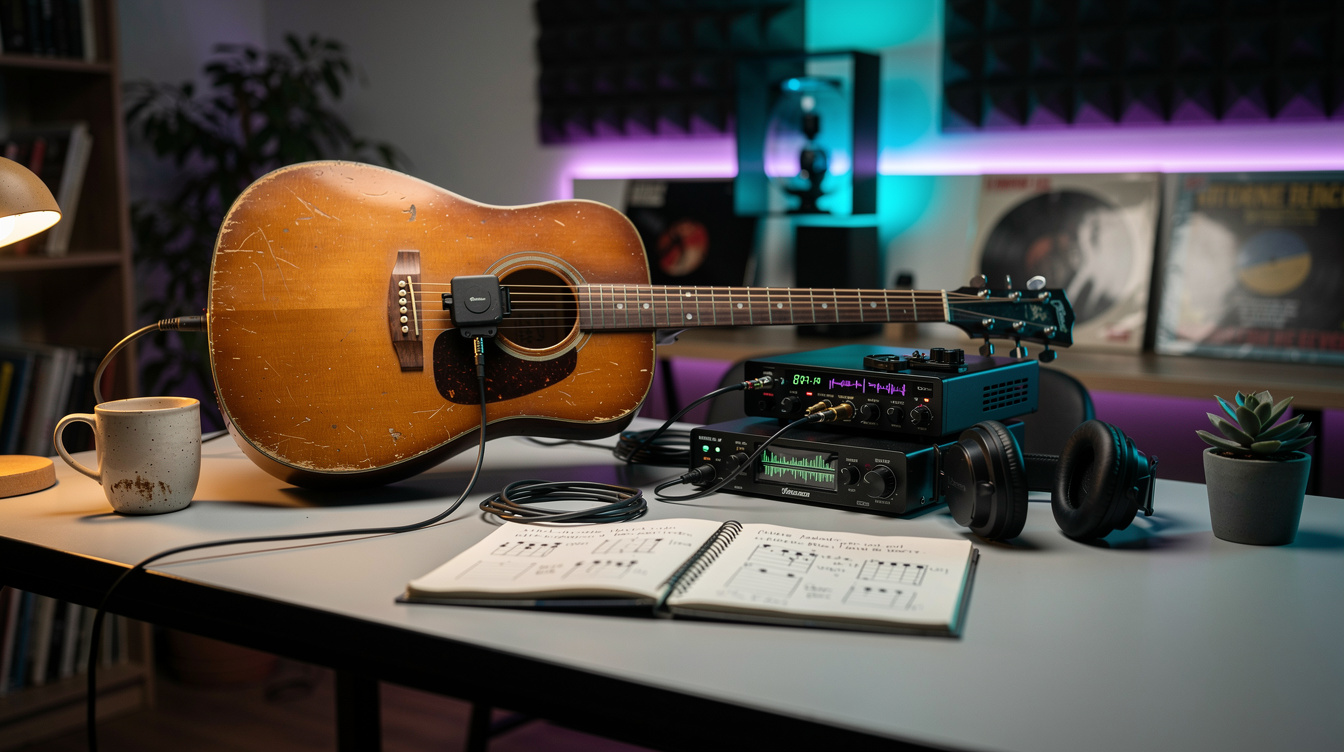
The first time I plugged my friend's acoustic into my Scarlett interface to record an idea, I genuinely thought something was broken. The piezo pickup made the guitar sound like it was being played underwater through a kazoo — quacky, harsh, no body, and somehow simultaneously too bright and too dull. We had spent an hour trying to write a song. I spent the next three hours trying to make the recording sound like a guitar.
The thing nobody tells you about acoustic pickups is that they are not microphones. They translate the string and body vibration into an electrical signal through a piezo crystal or a magnetic coil, and the result has frequency content that doesn't match what a microphone in front of the guitar would capture. The pickup is missing some frequencies, has too much energy in others, and emphasizes harmonics that a microphone wouldn't pick up at all. The default sound is distorted relative to the actual instrument.
The fix is EQ. Not a fancy DI box, not a special preamp — just five specific cuts and boosts in a parametric EQ. Here's the breakdown.
First, Rule Out a Dead Battery
Before you reach for the EQ, there's one failure that masquerades as a tone problem: a dying 9V. If your acoustic-electric has an active onboard preamp — most undersaddle systems with a built-in EQ do — that preamp runs on a battery, and as the voltage sags the output goes weak, thin, and slightly distorted on hard strums. It reads exactly like a bad pickup or a brittle interface input, and you'll waste an afternoon chasing frequencies that aren't the problem. Swap in a fresh battery first. If the weak, farty quality clears, the EQ below is for fine-tuning a healthy signal, not rescuing a starved one. The full story on how long those batteries last and what fails when they drain is in living with a 9V in your guitar.
What the Pickup Actually Captures (And What It Misses)
A piezo pickup mounted under the bridge saddle reads the mechanical pressure of the strings against the saddle. This produces an electrical signal proportional to that pressure — but the relationship between bridge pressure and the sound a microphone in front of the guitar captures is non-linear.
Specifically:
- The pickup over-emphasizes the 2–4 kHz region. This is the "quack." A microphone hears the body resonance at this frequency mixed with attack noise from the strings; the pickup hears mostly the bridge pressure spike, which has more energy in this range than the actual airborne sound.
- The pickup under-represents the body resonance. The body of an acoustic guitar resonates strongly in the 80–200 Hz range, and a microphone captures that air movement. A pickup mounted at the bridge captures only the small portion of that resonance that travels back through the bridge as mechanical vibration. The result: the pickup signal sounds "thin" or "missing low-mids."
- The pickup may have a high-frequency rolloff above 8–10 kHz. Depending on the pickup design, the very top end (the "air" of an acoustic guitar) may be missing entirely.
Magnetic soundhole pickups have a different problem: they capture a more electric-guitar-like frequency response (peaked midrange, less brittleness, but also less acoustic character). They sound more like a clean Telecaster than an acoustic guitar by default.
In both cases, what you're hearing through the interface is not what the guitar sounds like in the room. It's a translated, frequency-shifted approximation that needs correction.
The Five Frequency Fixes
Apply these in order with a parametric EQ. I use the stock EQ in Ableton; any DAW's stock EQ or a free plugin like ReaEQ will work.
Fix 1: Cut the Quack at 2–4 kHz
The quack is the most distinctive complaint about piezo pickups. It's a hardness in the upper midrange that doesn't exist in the acoustic guitar's actual sound.
EQ move: Parametric cut, center frequency around 2.5–3 kHz, Q of about 2.0 (moderately narrow), reduction of 3–5 dB.
The exact center frequency depends on the pickup. Sweep around 2–4 kHz with a narrow boost first to find the most offensive peak, then cut at that frequency by the same amount.
This is the single biggest fix. Most of the "this doesn't sound like an acoustic" complaint is solved by this cut alone.
Fix 2: Tame the Brittleness at 6–8 kHz
After the quack cut, you may notice a separate harshness in the upper highs — a brittleness that makes pick attacks feel sharp.
EQ move: High-shelf cut starting around 6 kHz, reducing by 2–4 dB.
This is gentler than the 2–3 kHz cut. The goal is to soften the top end without making the guitar sound dull. Start with 2 dB of cut and add more if needed.
Fix 3: Replace the Missing Body at 100–200 Hz
Once you've removed the upper-midrange harshness, the lack of body becomes more apparent. The guitar sounds light and disconnected from its physical instrument.
EQ move: Bell boost, center frequency around 150 Hz, Q of about 1.5, boost of 2–4 dB.
This adds back some of the body resonance that the pickup didn't capture. Don't overdo it — too much boost here makes the guitar sound boomy or muddy. Start small and add gradually.
If your monitoring environment is bass-light (small speakers, untreated room), be careful with this boost. It will sound right in the small speakers and too heavy on a full-range system.
Fix 4: Cut the Boxiness at 300–500 Hz
After the body boost, you may hear a "cardboard box" quality — a constrained, hollow midrange that makes the guitar sound like it's being played inside a small enclosure.
EQ move: Bell cut, center frequency around 400 Hz, Q of about 1.5, reduction of 2–4 dB.
This frequency range is where the pickup signal often has too much energy. The cut opens up the midrange and lets the body boost from Fix 3 sit more naturally.
Fix 5: Add Air Above 12 kHz (If Needed)
Some pickups roll off the very top end. If your acoustic sounds dark or lacking shimmer after the previous four fixes, a gentle high-shelf boost above 12 kHz can restore the perceived "air."
EQ move: High-shelf boost starting around 12 kHz, boost of 1–2 dB.
This is the smallest move on the list. Many pickups don't need it at all. Only apply this if the recording still sounds dark after the other adjustments.
The Order Matters
I tried a lot of orderings before settling on the one above. The key insight: cut before you boost.
If you boost the body first (Fix 3) before cutting the quack (Fix 1), the boosted low-mids will be muddied by the still-present upper-midrange harshness. The combination sounds worse than either move alone.
If you cut the quack first, then boost the body, then cut the boxiness, the moves work additively. Each one solves a separate problem and the cumulative result sounds more like a guitar than any single move would.
This is general EQ practice, but it's especially relevant for piezo pickups because the corrections are larger than typical mix EQ. You're not fine-tuning a good signal — you're fundamentally reshaping a flawed one.
What About a Direct Box or Acoustic Preamp?
Dedicated acoustic preamps and DI boxes (LR Baggs Para Acoustic DI, Fishman Aura, Boss AD-10) have built-in EQ tailored for acoustic pickups, plus features like notch filters for feedback control and microphone modeling that simulates the response of a real microphone in front of the guitar.
For live performance, a dedicated preamp is worth the money. The notch filter alone solves feedback problems that EQ cuts alone can't address.
For recording, the EQ approach above gets 80–90% of the way to a good acoustic tone for free, using whatever EQ plugin is in your DAW. The acoustic preamps add convenience and feedback management; they don't add fundamentally different EQ capabilities.
The Fishman Aura is a special case. It uses convolution (similar to cab IRs for electric guitar) to overlay the captured sound of a microphone in front of various guitars onto the pickup signal. This is the closest the technology gets to "making a pickup sound like a microphone." For someone who needs a microphone-like acoustic tone but can't use a microphone (touring, live worship, recording in a noisy environment), the Aura is genuinely useful. For bedroom recording, the EQ approach is enough.
My Bedroom Recording Chain for Acoustic
I rarely play acoustic — my main rig is a Stratocaster and a Jazzmaster — but I record acoustic occasionally for ambient guitar pieces. My signal chain when I do:
- Acoustic guitar (Yamaha FG800 with a Fishman Sonitone undersaddle pickup) → 1/4" cable
- Focusrite Scarlett 4i4 instrument input
- Ableton Live 11 with the stock EQ Eight applied as Insert 1
- EQ moves: −4 dB at 2.5 kHz (Q 2.0), +3 dB at 150 Hz (Q 1.5), −3 dB at 400 Hz (Q 1.5), high-shelf −3 dB at 6 kHz, high-shelf +1.5 dB at 12 kHz
- Valhalla Supermassive (Andromeda mode, mix at 25%) for ambient texture
- Light compression (1.5:1 ratio, slow attack) on the bus
The result sounds like an acoustic guitar in a small room. Not like a microphone'd Martin in Studio A, but like a real instrument that someone could plausibly hand to you. For ambient layered work, that's enough.
If I were releasing the recording to a wide audience and wanted reference-quality acoustic tone, I'd put a small-diaphragm condenser microphone on the guitar and use the pickup as a secondary signal blended in for body. But for the bedroom-producer use case, the pickup-with-EQ chain is genuinely sufficient.
The pickup-versus-microphone question gets framed as a quality choice, but most of the time it's a frequency-correction question. The pickup signal needs surgical EQ work to sound like the instrument it's attached to. Five cuts and boosts get you most of the way. The remaining work — feedback management, microphone modeling, mic-and-pickup blending — is what dedicated acoustic preamps add. Start with the EQ. The rest is optional.