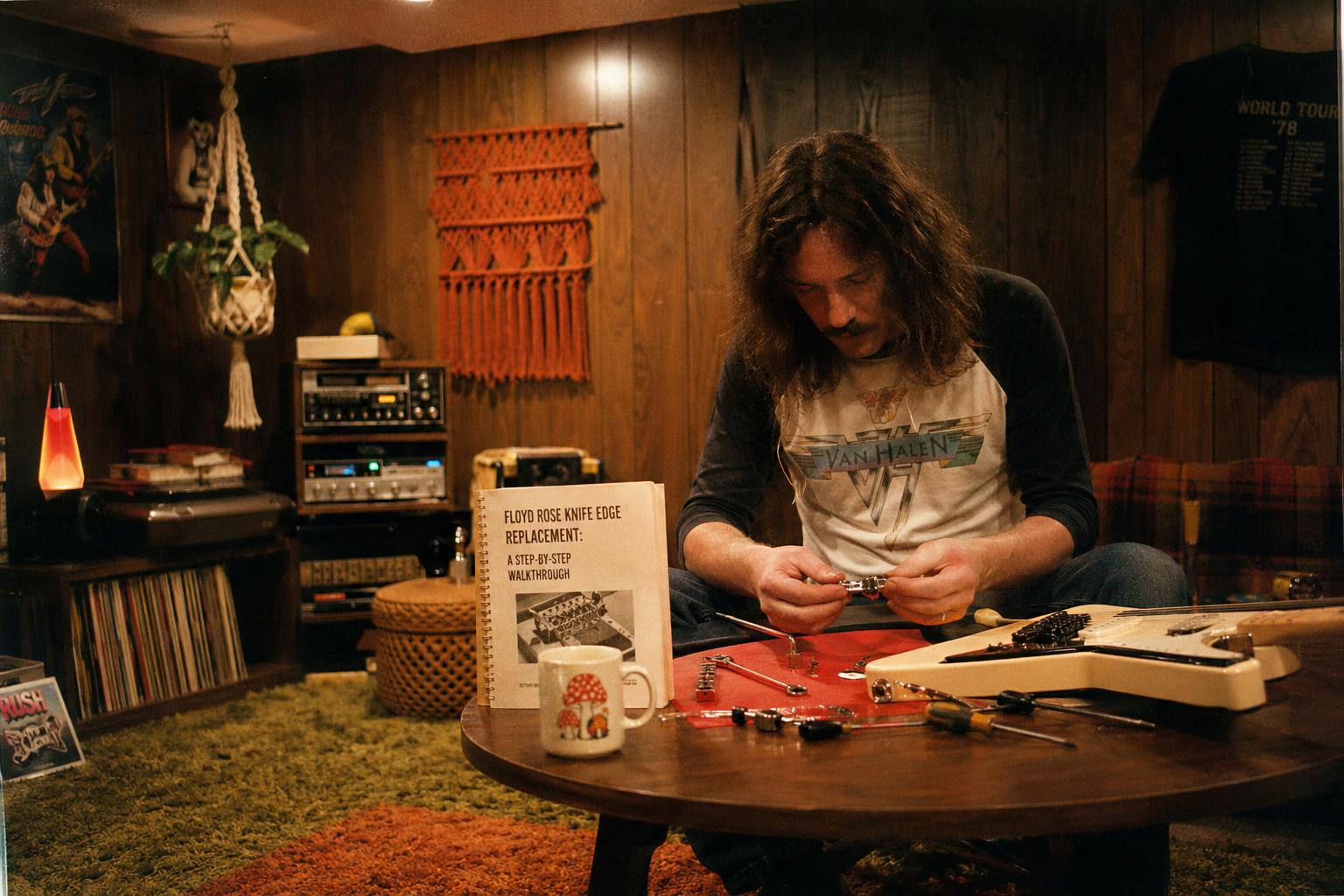
The short version: A Floyd Rose knife edge replacement is a baseplate swap, not a knife edge sharpening. You remove the strings, lift the bridge off the studs, transfer the saddles and intonation to the new baseplate, and reinstall. The work itself takes about 90 minutes if you've never done it. The hard part isn't the procedure — it's verifying you've ordered a baseplate that matches your bridge's locking nut spacing, post spacing, and string spacing. Get that right first, and the rest is patient screwdriver work.
A Floyd Rose with worn knife edges does not stay in tune. You can do a perfect setup, replace every spring, level the bridge, and the moment you use the trem it pulls sharp on one side and flat on the other. The diagnostic post on Floyd Rose knife edge wear walks through how to know you're past the point of re-dressing. This post is what comes next.
I've done this on three guitars over the years. Once on my own Charvel, twice on customers' instruments at the church where I do informal repair work after the Sunday service. The first time took me four hours and I stripped a saddle screw. The third time took 90 minutes and went smoothly. The difference was patience and getting the parts right before I started.
Here's the procedure.
Before You Order: Verify Compatibility
A Floyd Rose isn't one bridge. There are at least eight common variants — Original, Special, Pro, 1000, 1500, 1984 reissue, plus the various licensed copies (Schaller, Gotoh, Edge Pro, Lo-Pro). The baseplate dimensions vary across these. Ordering wrong is the most expensive mistake you can make on this job.
| Spec to check | Why it matters | How to measure |
|---|---|---|
| Post spacing | Determines whether the new baseplate fits your existing studs | Measure center-to-center between the two pivot studs in millimeters |
| String spacing at saddles | Determines whether the saddles will line up with the nut slots | Measure center-to-center between the outer two saddle screws |
| Locking nut R-value | The neck radius your locking nut is cut to (R2, R3, R4) | Look at the bottom of your locking nut for an R# stamp |
| Brand-to-brand compatibility | Some baseplates accept any saddles; others don't | Check the bridge manufacturer's parts list before ordering |
The safest path is replacing the baseplate with the same model. A Floyd Rose Original baseplate replaces a Floyd Rose Original. A Schaller Lockmeister baseplate replaces a Schaller Lockmeister. The dimensions and saddle interface match guaranteed.
The cost-saving path — putting a Floyd Rose Special baseplate on what used to be a Floyd Rose Original — works in some cases but not all. The post spacing usually matches; the saddle interface usually matches; but the studs themselves can have different threading. Verify before you order.
What You'll Need
A small set of tools. None of this is exotic.
- A new Floyd Rose baseplate (verified against the specs above)
- The 2.5mm and 3mm Allen wrenches that came with your guitar (or any quality metric set)
- A small flathead screwdriver for the saddle locking screws
- A clean workbench or a guitar stand with a workmat
- A pencil and a small piece of paper for noting saddle positions
- A digital tuner (clip-on is fine)
- One full set of fresh strings — replace strings during this job, don't try to reuse old ones
- A coffee. The job takes 90 minutes minimum.
You don't need a luthier's setup jig, a fret rocker, or any specialty Floyd Rose tools. The bridge itself is the most precise piece of metal in the operation; everything else is patience.
Step 1: Document the Current State
Before you take anything apart, write down what's currently working. This becomes your reference for getting the new bridge intonated quickly.
On the small piece of paper, draw six saddle positions. Note the approximate position of each saddle on the baseplate — measure from the back edge of the baseplate to the center of each saddle in millimeters, or just note the visual position relative to a reference mark. The new baseplate's saddle positions should end up close to these positions for the guitar to be roughly in tune before you start fine-tuning.
Take a photo of the bridge with your phone from above. This captures the saddle order, the visual position, and any saddle screw orientation details you might need later.
Note the spring count and claw position. Look at the back of the guitar through the trem cavity. Count the springs (three is most common on a Floyd Rose; four for heavier strings; two for lighter). Note where the spring claw screws are positioned — measure how many threads are exposed on each claw screw. You want the new bridge to balance with the same spring tension, so the claw position should return to about the same place when you're done.
Step 2: De-tension and Remove the Strings
Loosen the locking nut clamps with the 3mm Allen. Detune all six strings until they're slack. Cut the strings with side cutters and remove them entirely.
Once the strings are off, the trem will pull forward (toward the headstock) because the spring tension is now unbalanced — the springs are pulling but no string tension is pulling back. This is fine. Just let the bridge sit forward.
Open the trem cavity cover on the back of the guitar. Note the spring claw position one more time, then loosen the two claw screws until the springs come free of the bridge block. Set the springs aside on a magnetic dish or a folded paper towel — they tend to spring across the room if you drop one.
The bridge is now floating loose on the two pivot studs.
Step 3: Lift the Bridge Off the Studs
The Floyd Rose lifts straight up off the studs. There is no clip, no retainer. The knife edges sit on the stud caps under string tension; with the strings off and the springs disconnected, the bridge weighs about 8 ounces and lifts straight up with two fingers.
Set the bridge on the workmat with the saddles facing up. Take a moment to look at the worn knife edges in good light — you'll likely see the divots, flat spots, or rounded leading edges that brought you to this job. This is your last look at the old bridge as a unit. Take a photo for your records if you do this kind of work.
Step 4: Transfer the Saddles
This is where the patience matters. The saddles on a Floyd Rose are interchangeable between bridges of the same model, but the order matters and the intonation is set by the saddle screw position.
Use the 3mm Allen to back out the saddle hold-down screws on the old bridge — the small Allen screws on top of each saddle that hold it to the baseplate. Don't remove them entirely; just loosen them enough that each saddle slides forward off its mounting position.
Slide each saddle off the old baseplate one at a time. Lay them in order on your workmat — low E saddle on the left, high E saddle on the right, in playing order. Keep the small intonation screws in their threaded positions on each saddle so you don't lose them.
The string locking blocks (the small metal clamps inside each saddle that grip the string ball end) come with the saddle. Don't disassemble them.
Now reverse the operation on the new baseplate. Place each saddle in its corresponding position. Tighten the saddle hold-down screws snug but not over-torqued — you'll be adjusting saddle position for intonation later, and a too-tight screw makes that adjustment harder.
Step 5: Reinstall the Bridge
Set the new bridge onto the pivot studs the same way the old bridge came off. The knife edges should rest cleanly on the stud caps. If the bridge rocks unevenly, one of the studs may need a height adjustment — the studs thread into a base ferrule and the height is set by how far the stud is screwed down.
For the bridge to sit level (parallel to the body), the two studs should be at equal height. Use a small ruler or a fret rocker to check.
Reattach the springs to the bridge block in the trem cavity. Three springs in the standard configuration: one centered, one on each outer claw hook. Tighten the spring claw screws until you've returned to roughly the same exposed-thread count you noted in Step 1.
The bridge is now mechanically reinstalled. You can move on to stringing.
Step 6: String, Tune, and Set Bridge Level
String the guitar normally. Use the same gauges you had before — changing string gauge changes the spring tension equation and complicates the setup.
Tune to pitch slowly. The bridge will pull back toward the body as string tension comes up. Tune from low E to high E in passes, going around once at the open string then around again to refine, then around a third time. The trem is interactive — tightening one string changes all five others.
After three or four tuning passes, check the bridge level. The Floyd Rose baseplate should sit parallel to the body of the guitar — neither tilted forward (toward the headstock, indicating not enough spring tension) nor tilted back (toward the bridge, indicating too much spring tension).
To balance: if the bridge tilts back, loosen the spring claw a half-turn at a time until level. If it tilts forward, tighten the claw a half-turn at a time. After each adjustment, retune and reassess.
Step 7: Intonate
With the bridge level and the guitar at pitch, intonate each string. The procedure is the standard intonation process — compare the open string note to the 12th-fret harmonic and the 12th-fret fretted note. If the fretted note is sharp relative to the harmonic, slide the saddle backward (toward the bridge end). If flat, slide it forward.
On a Floyd Rose, sliding a saddle requires loosening the saddle hold-down screw, sliding the saddle, and re-tightening. Loosening the saddle hold-down screw also detensions the string slightly, so you'll need to retune after each saddle move.
Work one string at a time. Low E first, then A, then D, then G, then B, then high E. Each one will take two or three iterations to get within 2 cents of perfect.
This is the part where I always remind myself that the strings don't need to be in tune while I'm intonating. It's tempting to keep tuning to pitch between every saddle adjustment, but you're chasing your tail. Get the saddle close, retune to pitch once, recheck, adjust, retune, recheck. Three iterations per string is plenty.
Step 8: Final Checks
Before you call the job done, run through the verification checklist.
- Bridge sits parallel to the body (pull a small test bend, release, the bridge should return to level)
- All six strings stay in tune through three full divebombs
- Locking nut clamps are tight (don't overtighten — finger-tight plus a quarter turn with the Allen)
- Saddle hold-down screws are snug, not torqued
- Spring claw screws are equal exposure on both sides
- Pickups have not shifted height during the work (humbuckers in a Floyd-equipped guitar can move slightly when the bridge is removed)
Plug the guitar in and play through the full pitch range. Bend strings at the 12th and 14th frets, do a few wide vibrato moves, and pull the trem arm down to flat for a few seconds. Anything that doesn't return to pitch on this last test means the new bridge isn't seating cleanly on the studs — go back to Step 5 and check stud height.
A Floyd Rose knife edge replacement isn't a complicated job. It's a careful one. The procedure is mostly verification — verifying the part you ordered fits, verifying the saddles transferred correctly, verifying the bridge sits level. The screwdriver work is straightforward; the patience is what makes the difference between a good outcome and a third trip to the parts store.
If the diagnostic process led you here and the bridge is past re-dressing, the replacement is worth the time. A guitar with a fresh baseplate stays in tune for years. A guitar with worn knife edges goes out of tune every time you bend a string. The math favors the replacement.