Most players who ask about Floyd Rose spring count never ask about spring angle. The count matters (we covered that in the spring count guide), but the angle of the springs affects how the system feels and responds in ways that a different number of springs won't fix.
It's a small thing. But it's the kind of small thing that makes a setup feel right or slightly wrong without being able to name why.
What the Angle Options Are
A Floyd Rose has a spring claw at the back of the tremolo cavity and a spring block at the back edge of the bridge. Springs hook between them. There are three common configurations:
Parallel: all springs run straight and horizontal, perpendicular to the bridge. The claw sits horizontal, the springs pull straight back.
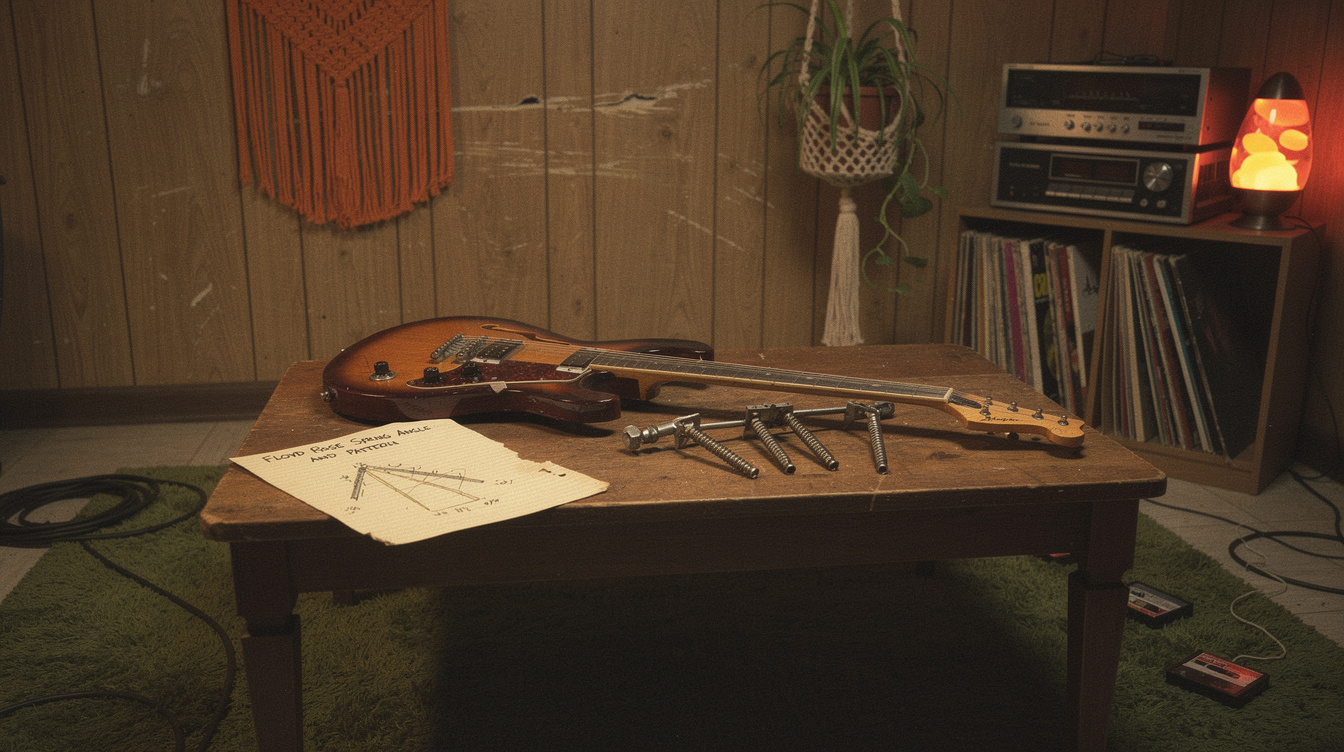
Diagonal (V-pattern): the outer springs angle inward toward the center. From above, the springs form a V shape, with the wide end at the bridge block and the narrow end toward the claw.
Reverse diagonal (inverted V): the outer springs angle outward. Less common, occasionally used with heavier string gauges and only two springs to balance tension distribution.
Most Floyd Rose documentation recommends parallel as the default. Most experienced players end up settling on the diagonal. Neither is wrong; they're different, and the difference is real.
What the Angle Does
Spring tension comes from the spring's resistance to being stretched. Parallel springs pull straight back. Diagonal springs pull at an angle, which distributes the force slightly outward across the spring block rather than concentrating it at a single center point.
The practical effects:
Return to pitch after a dive: Diagonal springs return slightly faster. The angled geometry adds a small amount of lateral pre-load to the bridge block, which creates a quicker snap back to neutral. The difference is small (not dramatic), but players who use full dive-and-release moves notice it.
Feel at the bridge: Parallel springs have a more even, linear pull through the full range of arm travel. Diagonal springs feel slightly firmer at the center (neutral position) and slightly springier at the extremes. Some players describe parallel as "smoother through the travel" and diagonal as "snappier at rest."
Sustain and resonance: This is where I expected it to matter and found it didn't, at least not enough to measure. Parallel springs have a slightly longer free vibration path, which theoretically transmits more energy into the body. In practice, through an amp at playing volume, I couldn't reliably distinguish the two by ear.
Which to Use
Three springs, diagonal: the most common setup, and a good starting point for most players. It gives the faster return and the firmer center feel without requiring adjustment from the standard claw position.
Three springs, parallel: better for players whose primary use of the arm is slow vibrato or pitch drops rather than full dives. The smoother, more even pull fits a slower, more controlled style of tremolo use.
Two springs, diagonal: common for lighter string gauges (.009–.010) where three springs would make the bridge too stiff to depress. The diagonal angle provides the stability that would otherwise come from the third spring.
If your guitar came from the factory with parallel springs and the setup feels right, there's no reason to change it. If your dive-and-release feels slow or the return to pitch is inconsistent, try diagonaling the outer springs before adjusting spring count or claw position.
How to Change the Angle
You need a Phillips screwdriver. The spring claw is held by two screws at the back of the cavity.
- Loosen both claw screws until the claw is floating but still attached.
- Reposition the claw to create the angle you want. For a V-pattern, the claw should angle slightly toward the neck on the treble side and away from the neck on the bass side, so the spring endpoints spread apart at the bridge block.
- Re-hook the springs at the bridge block if needed. The hooks at both ends should seat fully.
- Tighten the claw screws evenly, check that the bridge is level (parallel to the body), and retune. The springs are part of the tension system, so any position change will shift string pitch.
The full Floyd Rose setup process covers leveling the bridge and setting intonation after any spring adjustment. If you're changing angle as part of a fresh setup, do the angle first and the bridge leveling second.