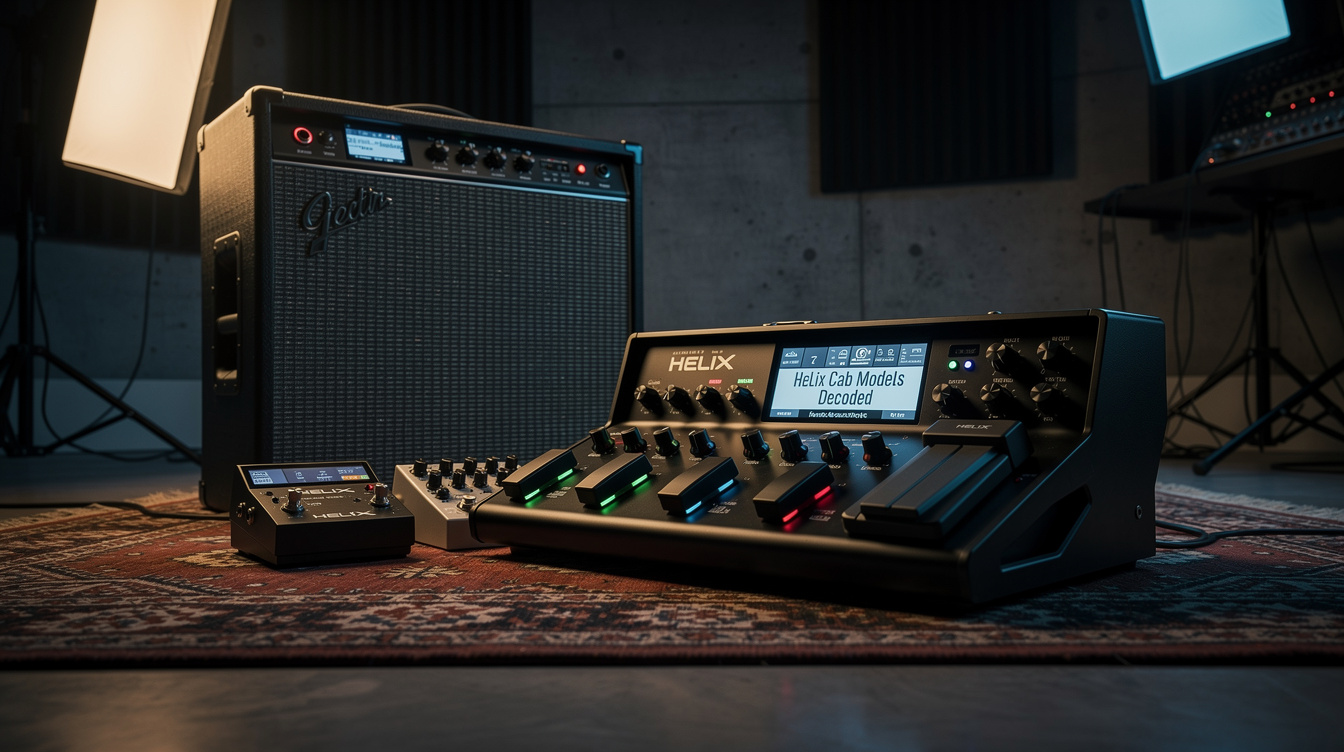
The short version: Helix cabinet model names are fictionalized to avoid trademark conflicts. The display name bears little resemblance to the actual enclosure it models. This guide maps the most commonly used stock Helix cabs to their real-world origins and gives you practical starting points for each.
If you've spent time in Helix's cab block selection screen, you've seen names like "4x12 Brit T75," "2x12 Wishbook," and "1x12 Silver Bell." You can probably guess what some of them are. Others are less obvious. And a few will surprise you if you look them up.
This reference covers the full major-cabinet portion of the Helix stock library (the cabs you'll actually reach for when building a preset) and gives you the amp pairing logic that makes each one work.
Note: Line 6 updates the Helix firmware periodically and adds new cabinet models. This guide reflects the library as of firmware 3.x. Verify names against your current version's cab list if you're on a recent update.
How to Use This Guide
Two ways to use this:
Top-down (start with the cab): If you've landed on a Helix amp model and want to know which cab was designed to match it, use the "Best With" column. The amp model name and its real-world origin are covered in the companion post Helix Amp Model Cheat Sheet.
Bottom-up (start with the speaker): If you know what speaker sound you're after (Celestion Greenbacks for classic rock, Fane for full-bodied British clean, V30s for modern crunch), the Speaker column lets you filter by speaker type.
Helix Cabinet Models: The Full Reference Table
1x8 and 1x10 Cabinets
| Helix Display Name | Real-World Cabinet | Speaker | Tone Character | Best With |
|---|---|---|---|---|
| 1x8 Tweed | Fender Champ 5E3 (1x8) | Jensen P8R | Warm, mid-forward, compressed at the bottom | Fender tweed amp models, small clean tones |
| 1x10 Gibtone | Gibson GA-40 Les Paul (1x10) | Jensen P10Q alnico | Clear, slightly bright, vintage American | Gibson-style clean amp models, archtop/jazz tone |
| 1x10 G10 Vintage | Vox AC10 (1x10) | Celestion Blue (alnico) | Chime, mid-cut, slight compression | Vox Top Boost-style models, jangle clean |
1x12 Cabinets
| Helix Display Name | Real-World Cabinet | Speaker | Tone Character | Best With |
|---|---|---|---|---|
| 1x12 British Black | Marshall Bluesbreaker-style 1x12 | Celestion G12H-30 | Round low-end, present mids, smooth breakup | Marshall JTM45/Bluesbreaker models |
| 1x12 Field Coil | 1940s vintage field coil speaker cab | Jensen field coil | Soft, vintage, slightly hollow | Pre-CBS Fender and vintage ribbon-EQ models |
| 1x12 Gibtone 12 | Gibson GA-40 Les Paul (1x12 variant) | Jensen P12Q alnico | Warm, woody, smooth | Clean jazz and country models |
| 1x12 Lead 80 | Marshall Lead 1x12 | Celestion G12-80 | Tight, scooped low, punchy mids | JCM800 models and 1980s British rock |
| 1x12 Recto | Mesa/Boogie Rectifier 1x12 | Celestion V30 | Mid-forward, scooped bass, full-range crunch | Mesa Rectifier models, all high-gain |
| 1x12 Silver Bell | Vox AC15 1x12 | Celestion Silver (alnico) | Chime, airy top-end, natural compression | All Vox-type models, chimey cleans |
| 1x12 US Vintage | Fender Princeton Reverb 1x12 | Jensen C12N | Clear, slightly bright, Fender open-back | Fender blackface Princeton and Deluxe models |
2x12 Cabinets
| Helix Display Name | Real-World Cabinet | Speaker | Tone Character | Best With |
|---|---|---|---|---|
| 2x12 Double C | Fender Twin Reverb 2x12 | Jensen C12N | Full, clear, very clean headroom | All high-headroom Fender clean models |
| 2x12 Match H30 | Matchless DC30 2x12 | Celestion G12H-30 | Balanced, chimey, smooth mids | Matchless and boutique British models |
| 2x12 Stealth | Friedman Runt 2x12 | Celestion Vintage 30 | Tight, modern British, punchy | Friedman and modern boutique amp models |
| 2x12 US Field Coil | Fender Dual Professional 2x12 | Jensen field coil (period) | Warm, round, vintage American | Pre-CBS Fender and brownface models |
| 2x12 Wishbook | Vox AC30 2x12 | Celestion Blue alnico | The defining Vox chime and mid-cut | All Vox AC30 models; non-negotiable pairing |
4x10 Cabinet
| Helix Display Name | Real-World Cabinet | Speaker | Tone Character | Best With |
|---|---|---|---|---|
| 4x10 Tweed Bass | Fender Bassman 4x10 | Jensen P10R | Open, woody, classic American | Fender Bassman models, blues, low-gain rock |
4x12 Cabinets
| Helix Display Name | Real-World Cabinet | Speaker | Tone Character | Best With |
|---|---|---|---|---|
| 4x12 Brit T75 | Marshall 1960A | Celestion G12T-75 | Scooped, aggressive, modern classic rock | JCM800, JCM900, Plexi models (especially live) |
| 4x12 Brit V30 | Marshall 1960AX | Celestion Vintage 30 | Mid-forward, full-range crunch | All Marshall models; most high-gain tones |
| 4x12 Greenback 20 | Marshall 1960 (vintage) | Celestion G12M-20 Greenback | Warm, ragged, compressed bottom | JTM45, Plexi, early classic rock |
| 4x12 Greenback 25 | Marshall 1960 (standard) | Celestion G12M-25 Greenback | Balanced, full, classic rock mid-range | All Marshall models; more headroom than G12M-20 |
| 4x12 Hiway | Hiwatt SE4123HW | Fane Crescendo/Fane Special | Full, clean, clear high-end, British authority | Hiwatt/Britt models, David Gilmour-style clean |
| 4x12 Jumbo | Ampeg VT-40 style | Eminence Legend | Extended low-end, full body | Bass-forward clean models; soul/R&B rhythm tones |
| 4x12 Recto | Mesa/Boogie Rectifier Standard 4x12 | Celestion Vintage 30 | Modern, scooped-friendly, full crunch | Mesa Rectifier, Uberschall, and similar high-gain |
| 4x12 XXL V30 | Bogner Uberkab 4x12 | Celestion Vintage 30 | Tight, aggressive, modern progressive | Bogner and modern British high-gain models |
Which Cab to Start With by Tone Goal
Rather than scrolling through the full list, use this as your entry point.
For Fender-Style Clean Tones
Start with 1x12 US Vintage (Fender Princeton with C12N). It's accurate to the blackface open-back character; the open-back design lets the low-end breathe and produces that slightly hollow, clear Fender clean. If you want more body and weight, switch to 2x12 Double C (Twin Reverb). The 4x10 Tweed Bass works well for brownface and tweed models where you want the Bassman's open American character.
For Vox / Chimey British Cleans
The 2x12 Wishbook (AC30 with Blue alinicos) is the correct pairing for any AC30-style amp model. The Celestion Blue's compressed natural character and alnico magnet chime are a large part of why Vox amps sound the way they do. Separating the cab from the amp model changes the character significantly. For smaller Vox-style models (AC10, AC15), the 1x10 G10 Vintage and 1x12 Silver Bell are the correct pairings respectively.
For Worship AC30 Tones (Chime vs. Wash)
Modern worship guitar is built on the AC30, but the cab choice splits it into two families. Pair the AC30 amp model with a Celestion Blue alnico 2x12 for chime — the bright, sparkling, edge-of-breakup voice behind tones like What a Beautiful Name and Way Maker. Swap to a G12M Greenback 4x12 for a warmer, woollier wash that sits under a dense mix without turning into an ice pick — the voice behind Goodness of God. Same amp block, opposite character, and the room can decide which one is right: a full breakdown of when to pick each is in Alnico Blue vs. Greenback in an AC30.
For Classic Rock (Marshall Crunch)
4x12 Greenback 25 is the classic starting point. The Celestion G12M-25 Greenback is the speaker most associated with 1970s Marshall rock tone. It has a mid-range peak that contributes directly to the "singing" quality in classic rock leads. For more modern classic rock (1980s style), 4x12 Brit T75 (Marshall 1960A with G12T-75s) produces the scooped, aggressive sound associated with the JCM800 era. If you need to choose one all-purpose Marshall cab for both styles, start with 4x12 Greenback 25 and A/B with 4x12 Brit T75.
For High-Gain and Metal
4x12 Brit V30 (Marshall cabinet with Vintage 30s) is the dominant choice and a reasonable default for most high-gain tones. V30s have a mid-forward peak that adds definition and prevents the fizz that plagues high-gain tones on lower-fidelity cabs. For modern metal (Rectifier-style), 4x12 Recto (Mesa V30 configuration) will pair more accurately with Mesa amp models. The Recto cabinet's V30 configuration and closed-back design produces a slightly different response than the Marshall V30 cab despite using the same speaker.
For Warm, Full British Clean
4x12 Hiway (Hiwatt with Fane speakers) produces the most full-range, authoritative clean sound in the library. The Fane Crescendo speaker is what defines the Hiwatt clean tone: open, balanced, and detailed without the chime of alnico or the aggression of G12T-75. It's the correct pairing for the Hiwatt-based amp models and also works well as a neutral reference cab for tones that need to be neither bright nor dark.
The Mic Position Variable
Selecting a cab is only the first decision. Helix applies a default mic position to each cab (typically an SM57 slightly off-axis), but you can change it in the cab block's advanced settings.
Mic choices and their effect:
| Mic | Character | When to Use |
|---|---|---|
| 57 on-axis | Bright, forward, the studio standard | Starting point for most rock and high-gain tones |
| 57 off-axis | Slightly rounded, less fizz | High-gain tones with too much top-end bite |
| 421 dynamic | Warmer, more body in the low-mid | Blues, jazz, and warm clean tones |
| 87 condenser | Full, detailed, room-like | Studio-reference clean tones; ambient applications |
| 414 condenser | Extended high-frequency response | Single-coil cleans where air is desired |
| Ribbon (121) | Very warm, slow transient, almost polite | Vintage clean tones; acoustic-adjacent applications |
Distance: Moving the virtual mic farther from the cab (increasing the Distance parameter) adds room ambience and softens the attack. For live tones going direct to PA, a small amount of distance (1–3 inches) can add depth without committing to a separate reverb. For studio-reference tones where you want maximum clarity, keep Distance at 0.
A Note on Third-Party IRs vs. Stock Cabs
The Helix stock cab library is genuinely usable for most applications. The cabs are accurate to their real-world counterparts and have been refined across multiple firmware updates. That said, the reasons players load third-party IRs are:
- Specific production references. If you need the exact cab sound from a specific studio at a specific session, a custom IR captured in that room with that mic and that chain may get closer than any modeled alternative.
- More mic options. The stock library doesn't include every possible mic combination; commercial IR packs often offer 50+ combinations per cab.
- Different cab variants. The 4x12 Brit V30 models one specific version of that cabinet; a third-party IR from a different year, break-in level, or loading condition may behave differently.
For most players building functional presets, the stock cabs are sufficient. Use the table above to match the cab to the amp model, set the mic for the tonal direction you need, and spend your time on the amp and gain staging settings rather than chasing IR packs.
This table is also your map for re-cabbing a finished take. If you tracked a dry DI, you can swap any of these cab models onto the recorded part after the fact — load the DI on a track, pick the amp model, and audition speakers from this list in real time without re-playing a note.