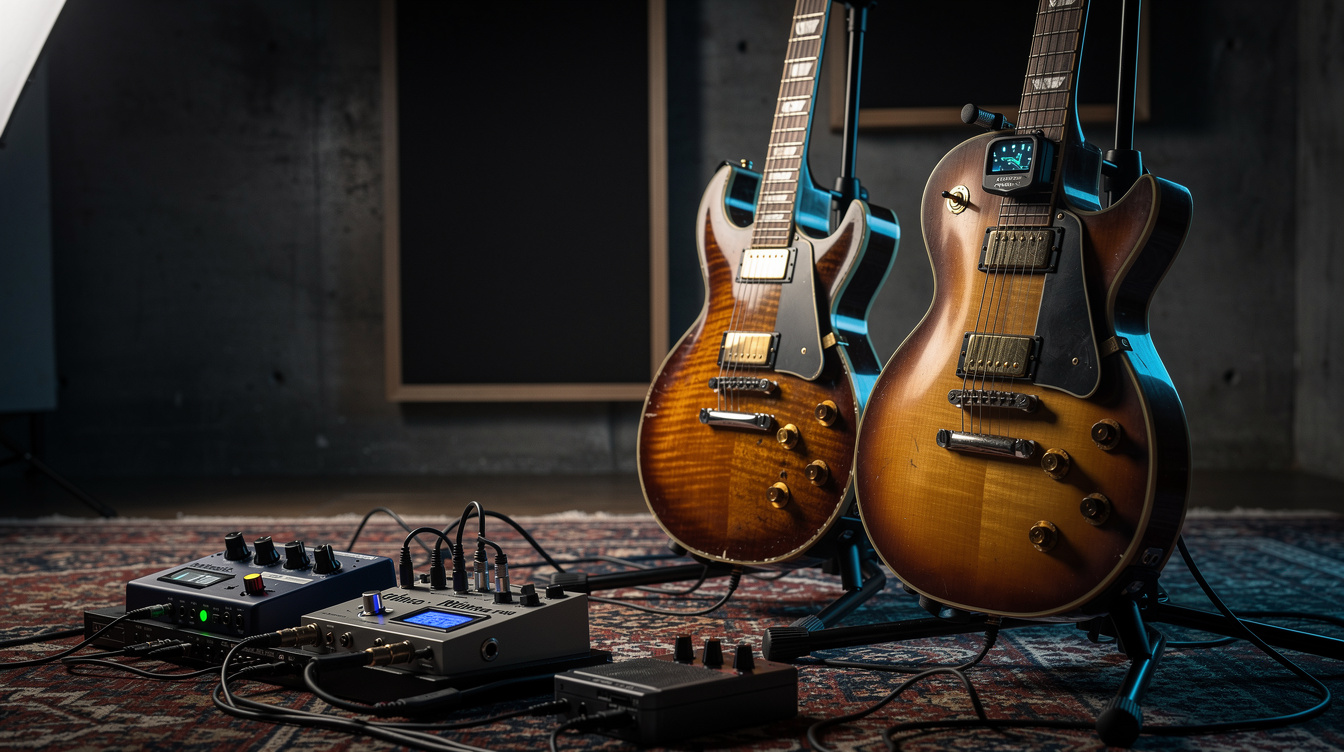
Both players tune up. Both tuners go green. First chord of the song, and something is wobbling.
Everybody looks at their own headstock, retunes the string they think is the problem, and it does not get better. Usually somebody blames the room. Sometimes somebody blames the cheap guitar. Both guitars are fine and both tuners are working.
The tuner did the job it was built for. It made each guitar agree with a fixed reference. Nothing in that process makes two guitars agree with each other, and that is a different job.
First, How Far Out Is Audible
Two notes close in pitch produce a beat — a slow pulse in the volume as the waves drift in and out of phase. The beat rate is the difference between the two frequencies. That is arithmetic, not opinion, and it tells you exactly how much error you are allowed.
| Difference | Open G (196 Hz) | Open B (247 Hz) | High E at the 12th (659 Hz) |
|---|---|---|---|
| 2 cents | one beat per 4.4 s | one per 3.5 s | 0.8 beats/s |
| 4 cents | one per 2.2 s | one per 1.8 s | 1.5 beats/s |
| 6 cents | one per 1.5 s | one per 1.2 s | 2.3 beats/s |
| 10 cents | 1.1 beats/s | 1.4 beats/s | 3.8 beats/s |
Two things fall out of that table.
Four cents is enough. That is not a big number. It is well inside the range two carefully tuned guitars land in on a normal day.
The same error gets worse as you go up. Beat rate scales with frequency, so a difference that produces a lazy wobble on an open G string produces an obvious warble an octave higher. If one guitar is playing low open chords and the other is playing a part up around the twelfth fret, the guy up high hears it first and gets blamed for it. He is usually not the problem. He is just the one in the register where the problem is audible.
The Five Reasons This Happens
1. The tuner said in tune, not identical
Accuracy specs vary more than people assume. Peterson rates its strobe units to a tenth of a cent. TC Electronic claims better than that in strobe mode. A basic clip-on does not publish a figure at all, and the working estimate for those is around a cent.
That is the accuracy. The display window is a separate thing, and it is wider. The green light on most tuners covers a band, not a point, because a light that flickered on a two-cent drift would be unusable. So two guitars can both sit in the green and be several cents apart before either player has done anything wrong.
Same brand of tuner on both guitars narrows this. Two different tuners, one clip-on and one pedal, is the worst case.
2. Somebody's reference pitch moved
This one is dumb and it is common. Most tuners let you set the reference from 440 to 445, usually with a button that is easy to hit by accident in a gig bag.
A tuner set to 442 instead of 440 puts that whole guitar about eight cents sharp. Every string. Reading perfectly in tune. Nothing on the display tells you anything is wrong unless you go looking for the reference setting.
Check this first. It takes ten seconds and it explains the cases where retuning never helps.
3. The two guitars are intonated differently
Open strings are set at the nut. Fretted notes are set at the saddle. Those are separate adjustments, and two guitars with saddles in different positions will agree perfectly on open strings and disagree by the fifth fret.
This is why tuning open and then playing a song up the neck together is the classic version of this failure. The tuning was correct at the only place you checked it.
A capo on one guitar and not the other adds the same problem from a different direction, since the capo stretches the strings sharp by an amount nobody measures. The capo split post covers that arrangement decision; here it is just one more reason the two instruments disagree.
If one guitar has a floating trem, add another variable — string gauge changes and spring tension shift the whole thing. Saddle-by-saddle intonation is the fix, and it is a bench job, not a between-songs job.
4. Nut height and how hard you press
A string sitting too high in its nut slot goes sharp when you fret it in first position, because you are stretching it further to get it down to the fret. How much sharp depends on the slot depth, which is different on every guitar.
Two players with different hands make it worse. Somebody who squeezes will push first-position chords sharper than somebody with a light touch, on the same guitar, on the same day.
The G string usually shows it first. It is the thickest plain string, so it takes the most stretch to fret and it moves the most. If your two guitars disagree and the disagreement is loudest on a G, look at nut slot depth before you look at anything else.
5. One set of strings is older than the other
Strings wear unevenly. Grime and pitting change the mass along the length of the string, and a string with uneven mass does not play the same pitch at every fret. Old strings go false.
A guitar with three-week-old strings and a guitar with new strings will disagree in ways that no amount of tuning fixes, because the old one is not producing a consistent pitch to tune.
If one guitar in the band always sounds slightly off and nothing you adjust helps, change its strings before you change anything else.
What I Had Wrong About This
For years I assumed one of the two guitars was the problem. Find it, fix it, done. Usually the cheaper one, if I am honest about how I was thinking.
Then I ran a check with a strobe tuner on both instruments, expecting to find the offender. Both guitars were within a cent of correct on every open string. Both. And they still beat against each other on a first-position D chord.
The error was not in either instrument. It was in the fact that the two of them were compensating differently at the nut, and neither guitar was wrong on its own terms. There was nothing to fix. There was only something to match.
That reframed the whole problem for me. Two guitars in a band are not two independent instruments that each need to be correct. They are one instrument with twelve strings, and what matters is whether the twelve agree.
The Fix: Tune to Each Other
Get both guitars close on the tuner first. That handles agreement with keys, horns, backing tracks and anything else that is not going to bend. Then do a second pass by ear.
- Pick the reference. It is whichever guitar is harder to change. Capoed guitar, acoustic, twelve-string, anything in an altered tuning — that is the reference. It does not move. If both guitars are ordinary electrics in standard, the reference is whoever is not going to be busy at the top of the song.
- Pick the note you actually share. Not an open E because it is easy. The note both parts land on in the chorus. That is where it has to be right.
- Both play it. Let it ring. Listen for the pulse, not for pitch. You are counting a wobble, not judging whether something is sharp.
- The non-reference guitar moves. Turn the tuner slowly. If the wobble speeds up, go the other way. Slow it down until it stops.
- Check a second note higher up. If they agree open and fight at the twelfth fret, that is intonation, and no tuning peg fixes it. Note it for the bench and split the difference for tonight.
- Retune both from the tuner between sets, then redo step three. Temperature moves everything, and the two guitars will not move by the same amount.
The whole thing takes about a minute once you have done it twice. It is faster than the five minutes of both players retuning independently and getting nowhere.
One Thing Not to Do
Do not have both players chase it at the same time. Two people adjusting toward each other overshoot, and you end up further out than when you started with everybody convinced the other guy is wrong.
One guitar is the reference. It sits still. The other one moves. That is the entire rule.
When It Is Not Fixable Tonight
Some of this is a setup problem and you cannot solve it in a rehearsal room. If two guitars agree open and disagree above the fifth fret, that is intonation and it needs a bench. If a guitar goes sharp in first position no matter what, that is nut height and it needs files.
What you can do in the room is decide which register matters for the song and tune for that. If the part lives in open chords, tune to agree in open position and accept whatever happens up high. If the two parts meet at the tenth fret, tune there and let the open chords be slightly off, because nobody is playing them together anyway.
The cleanest long-term answer is not to have the two guitars in the same register in the first place, which is an arrangement problem rather than a tuning one. Splitting two guitars by register is the version of this fix you make at rehearsal instead of at soundcheck.
That is not a compromise you should have to make every week. It is a perfectly good thing to do on a Friday night.
Two guitars that agree with each other and disagree slightly with a tuning fork sound better than two guitars that are each perfect and fight. The audience is not checking your reference pitch. They are hearing whether the chord is one sound or two.