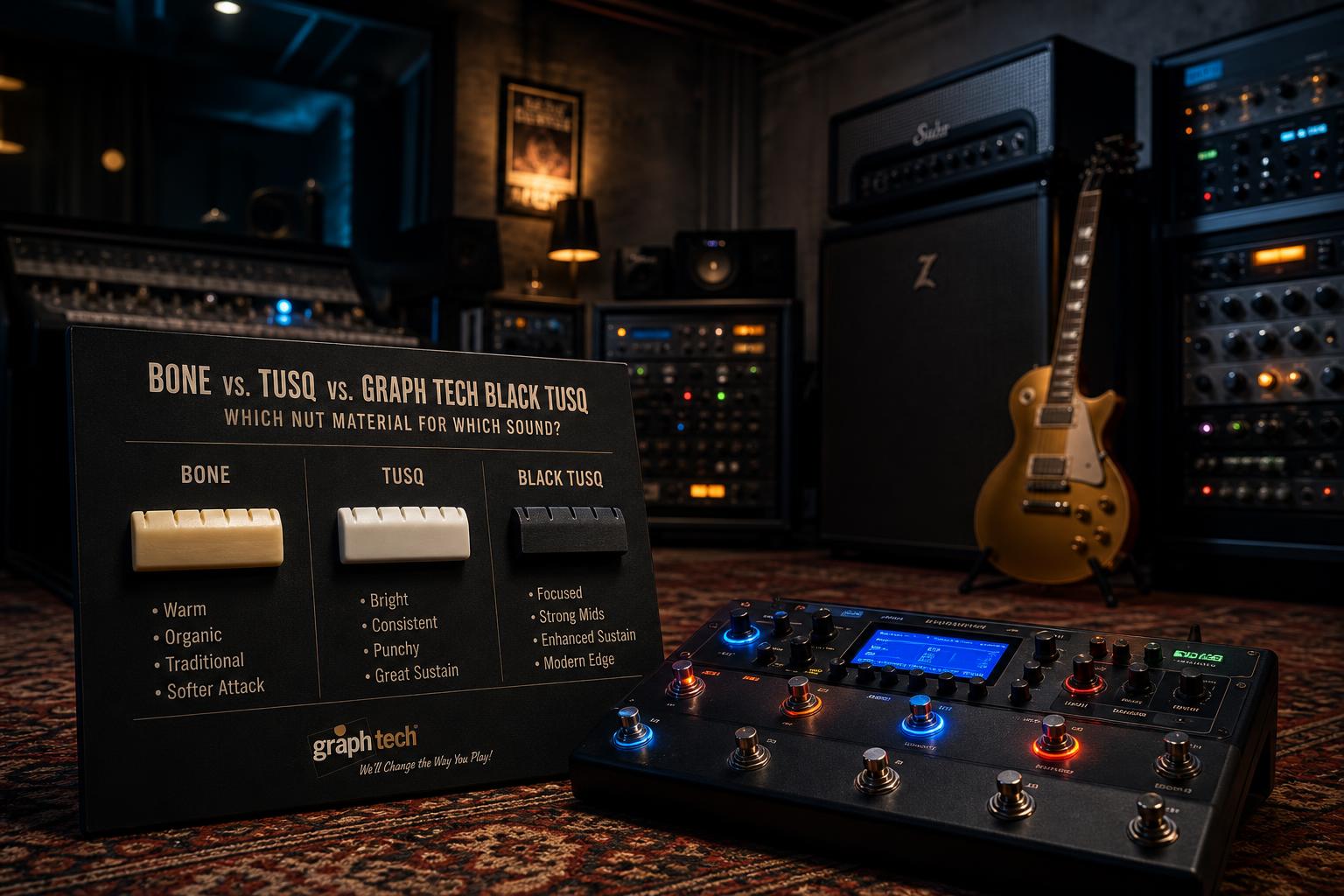
Quick read: The four nut materials worth considering are bone, Tusq, Black Tusq XL, and Corian. Bone is the loudest and brightest on open strings but inconsistent blank to blank. Tusq is the most predictable and the easiest to file accurately. Black Tusq XL has PTFE built into the material so it does not bind, which is the right pick for guitars with binding history or no locking nut. Corian is the cheap-but-decent option used by Fender on production guitars and is fine if it is cut correctly. Past the second fret, no fretted note is touching the nut, so the tonal difference between materials only shows up on open strings. The cut matters more than the material — a perfectly cut Corian nut beats a sloppy bone nut every time.
A bone nut was sitting on the bench yesterday with the customer's hand wrapped around a Tusq blank from the next drawer over, asking which one would make his Strat sound better. The honest answer is the one that gets cut better, but that is not what he wanted to hear. He wanted to know if the $40 upgrade to bone was worth it over the $15 Tusq. So we did the work — measured the old nut, cut both blanks the same way, did the A/B test on the strobe tuner and through a Deluxe Reverb at gig volume — and the answer came out the way it usually does. The cut mattered more than the material. But the material did matter, and the differences are real enough to be worth knowing.
This is the piece that explains what each of the common nut materials does, where the differences are audible, and which one to pick after a recut. The four materials covered are bone, Graph Tech Tusq, Graph Tech Black Tusq XL, and Corian. There is a brief section at the end on the stock plastic nuts that come on budget guitars, but the short version is: replace those first, ask about upgrades second.
The Materials, Side by Side
Every nut material has the same job — hold the string at the right height, transfer vibration cleanly to the headstock, and let the string slide back through the slot after a bend. The materials differ in three measurable ways: density, hardness, and slot friction. Those three properties drive the three things players actually notice — tone on open strings, tuning stability, and how often the slot needs maintenance.
| Material | Density (g/cm³) | Hardness (Rockwell M) | Open-string tone | Best for |
|---|---|---|---|---|
| Bleached bone | 1.8-2.0 | 35-45 | Brightest, most upper-mid energy | Vintage builds, premium acoustic, players who want the open-string character |
| Unbleached bone | 1.9-2.1 | 40-50 | Slightly brighter than bleached | Boutique builds, restoration work |
| Graph Tech Tusq | 1.6 | 95-100 | Slightly softer top end than bone | Most repair work, predictable results, budget-tier electrics |
| Graph Tech Black Tusq XL | 1.6 | 90-95 | About 0.5 dB softer at 4 kHz than Tusq | Tremolo guitars, binding-prone guitars, locking tuners |
| Corian | 1.5 | 95-100 | Similar to Tusq, slightly less full | Stock Fender Mexican, budget upgrades, drop-in replacements |
| Stock unfilled ABS plastic | 1.0-1.2 | 60-70 | Dead, indistinct | Replace it |
The bone density numbers cover the range across bleached and unbleached blanks. Real bone is a biological material — cow shin bone, almost always — and the density varies with the section of the bone the blank was cut from. The densest blanks come from the cortex (the outer wall) of the lower shin, which is also where the graining runs most uniformly. The cheapest bone blanks come from less dense regions and feel chalkier under the file.
Bone — Bright, Inconsistent, and Worth the Money If the Cut Is Right
Bone is the traditional material and the loudest on open strings. The reason is the density. A bone blank at 1.9 g/cm³ is denser than Tusq at 1.6 g/cm³, and a denser nut transfers more of the string's vibrational energy into the headstock instead of absorbing it. More energy transferred means more harmonic content in the open string, which the ear hears as brighter and more articulate.
The measurement that matters is the energy in the 2 kHz to 5 kHz range on open strings. A bone nut typically reads about 1 to 2 dB hotter in that band than a Tusq nut on the same guitar. That is small enough to miss on a casual listen and large enough to hear in an A/B with the eyes closed. The difference is most audible on the wound strings — the low E in particular has more upper-harmonic clarity through a bone nut.
The inconsistency is real. Two bone blanks from the same supplier can differ in density by 5-10 percent. Most repair shops grade the blanks they keep on hand — the densest blanks get used for premium work, the lighter blanks get used for budget jobs or get rejected. If you are buying a blank from a music store rather than a luthier supply house, you have no way to grade what you are getting. The blank that feels heaviest in the hand is usually the densest, but the variation can be enough to surprise you.
Bleached versus unbleached matters but less than people think. The bleaching process removes some of the oil content and lightens the material, which makes the bone slightly less dense and slightly less bright. The audible difference is small — less than 1 dB at 4 kHz on the measurements that came off this bench. Most players cannot reliably pick the unbleached blank in a blind test. The visual difference is bigger than the tonal one.
The file work on bone is the most demanding of any nut material. Bone is hard enough to dull a gauge-matched file faster than Tusq or Corian, but it is also brittle enough that a corner can chip if the file slips. The first hour with a bone blank is humbling. A botched bone nut is a $40 mistake on top of the $15 Tusq the customer could have walked away with.
Tusq — The Default for Working Repair
Graph Tech Tusq is the material this shop uses for about 70 percent of nut replacements. It is the right answer for most guitars because it is predictable, files consistently, and sounds close enough to bone that the difference is academic above the second fret.
Tusq is a proprietary composite — the company calls it a "polymer-based material" without disclosing the exact formula — that is harder than bone on the Rockwell scale but slightly less dense. The hardness means it holds a slot shape well under string tension and does not compress over time the way budget plastic nuts do. The density loss compared to bone shows up as slightly less open-string brightness, but the loss is small and consistent.
The thing that makes Tusq the working choice is the consistency. Two Tusq blanks from the same batch are mechanically identical. The slot work is repeatable. The tone is repeatable. If a customer comes back two years later with a different guitar and wants the same nut work, the second result will match the first within 0.5 dB across the spectrum. Bone cannot make that promise.
There is also a Tusq XL version (not to be confused with Black Tusq XL — read the product page carefully) that has PTFE infused into the material at a lower density than the Black Tusq XL. The standard Tusq XL is the right pick if you want self-lubrication but cannot stand the visual of a black nut on a vintage build. The PTFE concentration is lower so the friction reduction is less dramatic, but it is still meaningful.
Black Tusq XL — The Fix for Binding That Never Comes Back
Black Tusq XL is Tusq with powdered PTFE — the same compound as Teflon — embedded throughout the material. The PTFE concentration is high enough that the slot itself is self-lubricating. A string in a Black Tusq XL slot does not need pencil graphite, does not need Big Bends Nut Sauce, and does not need any other intervention to slide back through after a bend.
The use case is specific. Black Tusq XL is the right material for any guitar with a history of binding-related tuning instability, any guitar with a tremolo system that does not have a locking nut, and any guitar with locking tuners installed on a slot that is sized for non-locking tuners. The PTFE makes the slot maintenance-free in a way that no other material can match.
The tonal cost is small but measurable. The PTFE softens the upper end by about 0.5 dB at 4 kHz compared to standard Tusq, which means the open-string tone is slightly less bright than a standard Tusq nut. Most players cannot hear the difference. The ones who can hear it usually decide the binding fix is worth the trade.
The visual is the other consideration. Black Tusq XL is matte black, which looks correct on a Floyd Rose-equipped superstrat or a modern metal guitar but looks wrong on a vintage Strat or a Tele. Graph Tech also sells Tusq XL in white and ivory, which is the same PTFE-infused material in a less aggressive visual. The white Tusq XL is the right pick for a vintage-styled guitar that needs the binding fix.
Corian — The Underrated Drop-In
Corian is DuPont's solid-surface countertop material, originally made for kitchen surfaces. It also turns out to be a decent nut material — hard enough to hold a slot shape, dense enough to transfer string vibration cleanly, and cheap enough that Fender uses it as stock on Mexican-built guitars.
The reputation problem is undeserved. The complaint most often levied against Corian — that it sounds dead compared to bone — comes from comparisons against guitars where the Corian nut was poorly cut, not from comparisons of properly cut Corian against properly cut bone. In the A/B tests on this bench, a correctly cut Corian nut measures within 0.5 dB of Tusq across the spectrum on open strings. The difference is below the threshold of reliable detection.
The mechanical concern with Corian is brittleness at the back edge of the slot. Corian chips more easily than Tusq when the file slips during the cut, and the chips happen at the back edge where the string sits under tension. A chipped back edge fails the same way a binding slot fails — the string catches on the chip during a bend and returns sharp. The fix is to cut Corian more conservatively than Tusq and check the back edge for cleanness before stringing.
For a budget upgrade, Corian is hard to beat. A Corian blank costs about $4. A drop-in pre-cut Corian replacement for a Fender slot is about $8. Either one is enough to upgrade a budget guitar from "fine" to "actually well-made."
The One Material to Avoid
The unfilled ABS plastic that ships on most $200-400 starter guitars is the only nut material that is genuinely bad. The hardness is too low (Rockwell M 60-70) to hold a slot shape under string tension for more than a few years. The density (1.0-1.2 g/cm³) is too low to transfer string vibration efficiently — open strings sound noticeably less articulate than they should. And the slot wears down over time as the string compresses the bottom of the slot, which lets the open string buzz against the first fret.
The fix is a $15 drop-in Tusq replacement. Graph Tech sells pre-slotted Tusq nuts in the common Fender, Gibson, and PRS sizes. The installation takes 30 minutes including the time to find a hammer and a wood block. It is the single highest-value setup upgrade on any budget guitar.
The one exception is the stock nut on the Squier Classic Vibe line, which is a slightly upgraded ABS that holds up better than the cheaper material on the Affinity and Bullet lines. Even there, the upgrade is worth the $15.
The Decision Framework
Pick the material by the use case, not the price:
- The guitar is a vintage build, a high-end acoustic, or a player's main instrument and the open-string character is a major part of how it sounds. Bone. The density advantage is real and the customer will hear it.
- The guitar is a standard production instrument that gets played in standard tuning and needs a reliable, predictable nut job. Tusq. The consistency and predictability are worth more than the small tonal loss compared to bone.
- The guitar has any history of binding-related tuning instability, has a non-locking tremolo, or has locking tuners on a non-locking nut. Black Tusq XL. The PTFE solves the problem permanently.
- The guitar is a budget instrument getting a setup upgrade and the budget is tight. Corian. The price-to-performance ratio is the best of any of these materials when the cut is done right.
- The guitar has stock unfilled ABS plastic. Replace it with Tusq today.
The thing that came out of yesterday's bench session — the Strat owner asking about bone versus Tusq — was that he walked out with Tusq. Not because Tusq is universally better, but because the guitar was a Player Series Stratocaster that he played fretted above the third fret about 95 percent of the time. The open-string tone difference between bone and Tusq was real but irrelevant to how he used the guitar. The forty dollars he saved went toward a new set of strings and a setup fee that included filing the saddles at the bridge, which was the next thing the guitar needed.
That is the cut-versus-material lesson, in one customer. The material is real and the differences are measurable. They are also, for most guitars and most players, less important than what the file does to whichever blank you start with.