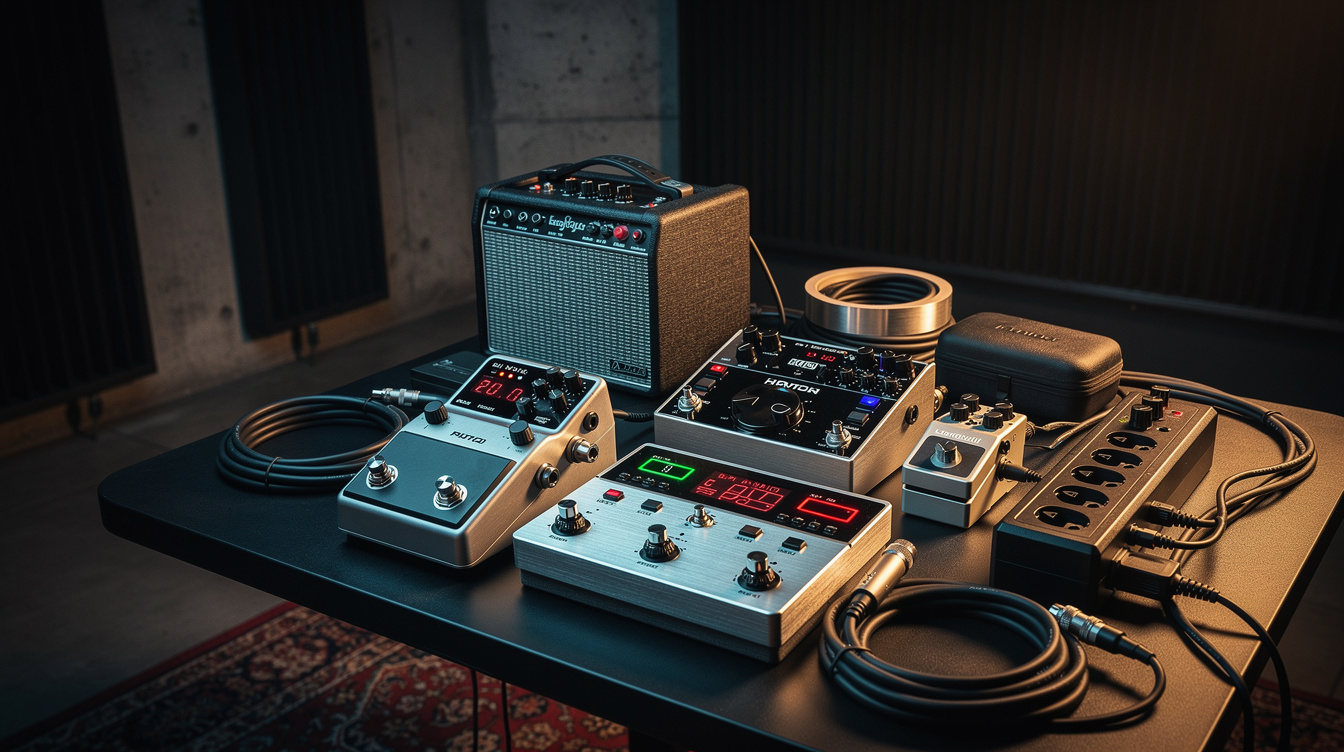
A set doesn't usually die from something dramatic. It dies from a cracked solder joint in a cable, or a 9V that gave up between soundcheck and the second song. The failures are boring, they're cheap, and they're predictable — which means you can carry one small item for each of them and never lose a show to the five-dollar part again.
This is the kit. One item per way a set dies. Most of it fits in the front pocket of a gig bag.
The Kit, by Failure
| What fails | What you hear | The item | Cost |
|---|---|---|---|
| Instrument cable | Crackle or dropout when you move | One spare cable | ~$15 |
| 9V in a pedal or active guitar | Weak, farty, then silent | Spare 9V battery | ~$3 |
| Broken string | You'll know | The right single string + winder | ~$3 |
| Clip-on tuner battery | Tuner won't power up | Spare CR2032 coin cell | ~$2 |
| Strap button / strap slip | Guitar swings or drops | Strap locks + the screwdriver | ~$15 |
| Lost pick | Scrambling mid-song | Picks taped to the mic stand | $0 |
| Loose output jack | Crackle right at the jack | A multi-tool or the right wrench | ~$10 |
Under fifty dollars, total. Less than one boutique patch cable. Let me go through the ones that matter most.
The Cable Is the One That Gets You
If you carry one thing, carry a spare instrument cable. An intermittent cable is the most common dead-set failure there is, and it's the cruelest because it doesn't fail clean — it crackles, drops out when you turn, comes back when you stand still, and convinces you something expensive is broken.
I've watched a band pull a half-stack apart looking for a dead power tube when the real problem was a cracked solder joint at the cable's tip, a part you could replace for the price of a coffee. The amp was fine. The cable had a hairline break that only opened up when the cord flexed a certain way.
So a spare lives in the bag, and the swap is the first move, not the last. The fix takes ten seconds: pull the suspect cable, plug in the spare, keep playing. Buy a cable with molded or properly strain-relieved ends — that's where they crack — and you'll need the spare less often. A solid budget cable is part of building a rig that doesn't quit on you; the spare is the insurance on top.
Batteries: Two Kinds, Both Silent Killers
Two things in your rig run on batteries and both die without much of a warning.
The 9V. Any battery-powered pedal, and any guitar with active pickups or an onboard preamp, runs on a 9V that fades before it quits. A sagging 9V doesn't go straight to silence — it makes the pedal or the active pickup sound weak and farty first, and that symptom reads like an amp problem or a bad cable, so you go chasing the wrong thing. That whole failure curve — what dies, in what order, and the trick of unplugging the cable to stop the drain — is worth understanding before it bites you; the onboard 9V rundown covers it. The fix in the bag is a fresh 9V and the discipline to swap it on a schedule instead of waiting for the fart.
The coin cell. Your clip-on tuner runs on a CR2032, and that one fails completely silent. No warning, no fade — you reach for the tuner between songs and it's a black screen. A spare coin cell is two dollars and lives in the bag next to the picks.
The String, and the Honest Version of It
Carry the right single string and a winder, not a full set you have no time to install. A broken string mid-set is a 90-second job if you have the one string and a winder, and an impossible one if you're digging for a full pack and a pair of pliers in the dark.
The honest version: the real fix for a broken string mid-set is a second guitar. If you have one, you switch, you finish the song, you restring on the break. The single string in the bag is the answer when you only brought one guitar — which, on most stages, is most of us. Bring the string. Better, learn to change it fast in low light, because that's the actual skill.
Strap Locks Earn Their Keep Slowly
A strap button doesn't fail on the night. It backs out over months — every load-in, every set, every time the guitar swings — until one night the screw is loose enough that a stock strap walks off the button and your guitar heads for the floor.
Strap locks remove both halves of that: the strap can't slip off, and installing them is the moment you notice the screw was loose. Fifteen dollars, and carry the small screwdriver that fits them so you can snug a button down at soundcheck. Checking the button screws before a show is a ten-second habit that has saved more guitars than any amount of careful playing.
When the Sound Dies: The Order to Check
Having the kit is half of it. Knowing what to check, in order, is the other half. When the sound cuts out, don't guess — bisect the chain from the cheap, common end toward the expensive, rare one.
- Tap the strings against the pickups. Hear that thump through the amp? Then the guitar and the amp are both alive, and the fault is somewhere between them. That single test cuts the problem in half.
- Swap the instrument cable. Most common cause, cheapest fix, so it goes first. Pull it, plug in the spare.
- Bypass the pedals. Take them out of the path — go guitar straight to amp if you can. If the sound comes back, a pedal or a patch cable is the culprit, and a fading 9V is the prime suspect.
- Wiggle-test at the jacks. A crackle that responds to wiggling at the guitar's output jack means a loose jack nut — tighten it with the multi-tool. A crackle at the amp end points back at the cable.
Work that order and you find the fault in under a minute, on stage, without tearing the rig apart. The temptation is always to suspect the expensive thing first. The expensive thing is almost never it.
The Stuff That Isn't in the Kit
A noise that won't quit isn't usually a failure you fix with a spare part — a buzz that follows you around the stage is more likely a grounding or stage-hum problem, and a squeal you can't kill is feedback you manage with position and EQ, not a dead component. Those are worth knowing cold, because reaching for the cable bag won't fix them and you'll waste the song trying.
Everything else — the cable, the batteries, the string, the strap locks — is a part that wears out and a part you can carry. A set rarely dies from bad luck. It dies from a consumable you didn't replace, in a way you could have seen coming. Carry the kit. Check the strap screws. Swap the cable first.