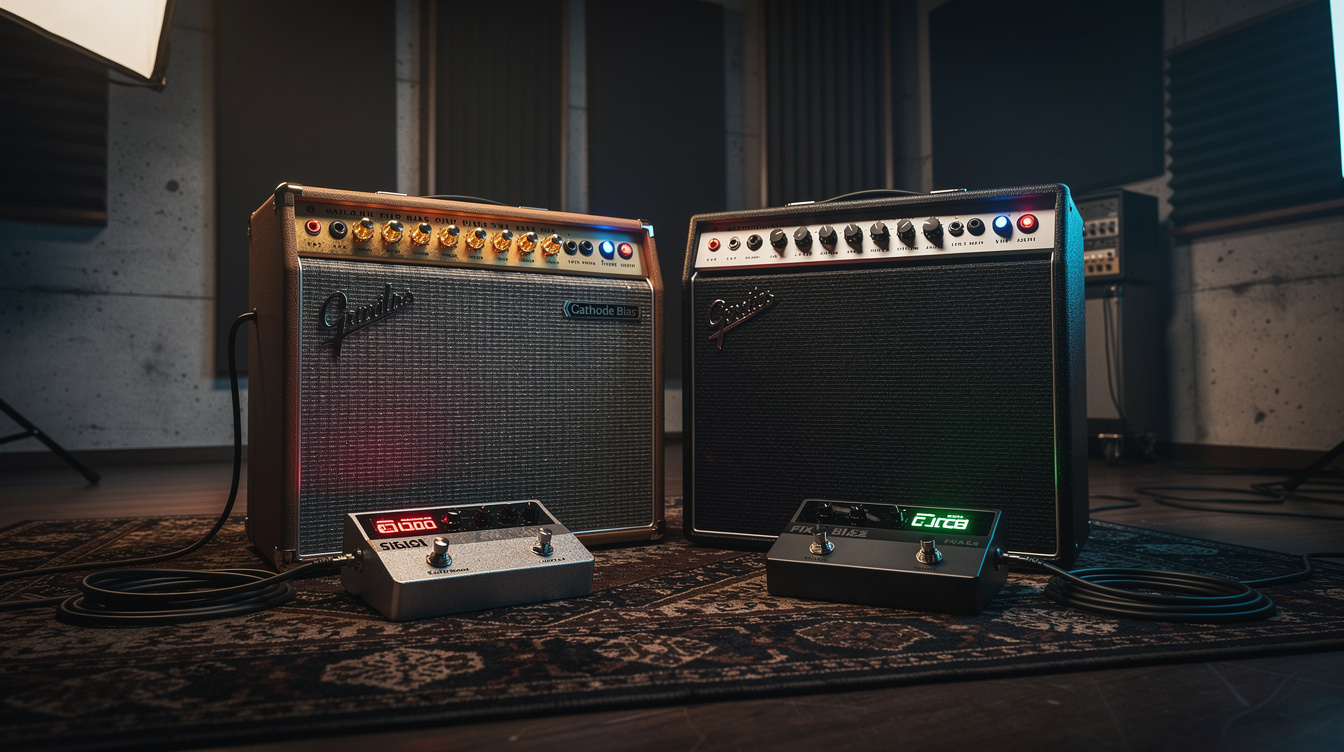
The short version: Cathode bias sets the operating point automatically using a resistor at the output tube's cathode (no manual adjustment required), and the amp develops a slightly softer, more compressed character. Fixed bias applies a precise negative voltage directly to the control grid, requires manual adjustment when tubes are replaced, and produces a tighter, more linear response with more headroom. The difference is real and audible in the context of feel, sustain, and dynamic response.
Both terms describe how a tube amplifier establishes the quiescent operating point of its output tubes (the voltage and current conditions that define where the tube sits on its characteristic curve before any audio signal arrives). Getting this right determines how efficiently the tubes work, how much they distort under load, and how the amp feels to play.
The Comparison at a Glance
| Characteristic | Cathode Bias (Self-Bias) | Fixed Bias |
|---|---|---|
| How it works | Cathode resistor creates automatic bias voltage | Separate negative supply applied to the control grid |
| Manual adjustment needed | No; tracks tube aging automatically | Yes; required when tubes change |
| Headroom per watt | Less | More |
| Dynamic character | Softer attacks, more compression, sag-like feel | Tighter, more linear, snappier response |
| Tube class | Typically Class A or near-Class A | Typically Class AB |
| Common in | Low-power combos, Vox-type amps, boutique amps | High-power heads and combos, most Fenders, Marshall |
| Tube replacement | Easier; no rebiasing required | Requires rebiasing with a multimeter or bias probe |
What Cathode Bias Actually Is
In a cathode-biased amp, the output tube's cathode is connected to ground through a resistor (and usually a parallel bypass capacitor). When the tube conducts, current flows through that resistor, and because current times resistance equals voltage, a small positive voltage appears at the cathode. Since the control grid is at ground potential, the cathode is now more positive than the grid, which is the equivalent of the grid being negative relative to the cathode. This is the negative grid bias the tube needs to operate.
The operating point drifts with tube wear, temperature, and production variation, but the circuit compensates automatically. As a tube ages and draws more current, the cathode voltage rises, which pushes the operating point in a direction that partially compensates for the change. The amp adapts over the tube's life without human intervention.
This self-correcting behavior also explains the compression characteristic. When a transient arrives and the tube draws a sudden surge of current, the cathode voltage rises briefly, which effectively reduces the drive signal to the tube for that instant. The attack is softened. The amp yields slightly to the pick rather than reproducing it with full linearity. This behavior is often described as "giving" or "responding well"; it's the cathode resistor reacting to the current demand, not the power supply sagging (though both can occur simultaneously in the same amp).
What Fixed Bias Actually Is
Fixed bias uses a separate negative voltage supply (typically derived from a small transformer winding) that's applied directly to the control grid. The term "fixed" is slightly misleading: the voltage is adjustable, but it doesn't move in response to conditions during play. You set it once (after tube installation), and it stays where you put it.
Because the bias point doesn't shift during transients, fixed-bias amps can drive the output tubes harder and more linearly before they hit their distortion region. More of each watt is useful; the amp operates closer to Class AB, where pairs of tubes take turns handling alternating halves of the waveform, which produces more efficiency and more headroom per watt than the single-ended or parallel Class A operation typical of cathode-biased designs.
The trade-off is that fixed bias requires discipline at the tech bench. When you swap output tubes, the new tubes may have a different characteristic curve than the old ones (different idle current draw, different optimal operating point). Without rebiasing, the amp might run the tubes too hot (shortened life, increased distortion) or too cold (crossover distortion, thin sound). Swapping tubes in a properly maintained fixed-bias amp is not plug-and-play.
The Feel Difference
This is the reason the bias topology matters to players rather than just technicians.
Cathode-biased amps feel softer in the pick attack. This isn't distortion; it's a slight rounding of the transient that makes aggressive playing feel more forgiving. The amp seems to respond to how hard you play, with a compression that scales with the attack level. Players describe this as "touch-sensitive" or "dynamic," which is accurate, because the cathode bias circuit is responding to the instantaneous current demand. The Vox AC30 is cathode-biased, and much of its characteristic feel comes from this property alongside its other design choices.
Fixed-bias amps feel tighter. The initial attack is more precisely reproduced, the note definition is clearer, and the amp doesn't soften the transient in the same way. A Marshall JCM800 running correctly biased output tubes responds to pick attack more linearly; you get back what you put in. This suits players who want clarity, palm mute definition, and headroom for a clean platform.
Neither is objectively better. A cathode-biased amp at 15 watts with the right overdrive pedal in front produces one of the most responsive and expressive tone combinations available. A fixed-bias 100-watt head at similar settings produces a different expressive vocabulary: more headroom, more control over dynamics through playing technique rather than circuit compression.
Which Amps Use Which
| Amp | Bias Type | Output Stage Notes |
|---|---|---|
| Vox AC15 | Cathode bias | Two EL84s, the AC15's signature compressed jangle |
| Vox AC30 | Cathode bias | Four EL84s in parallel (this surprises many players) |
| Fender Champ | Cathode bias | Single 6V6, Class A, very small power supply |
| Fender Princeton / Princeton Reverb | Cathode bias | Two 6V6s, the warmer/softer of the Fender small combos |
| Fender Tweed Deluxe (5E3) | Cathode bias | Two 6V6s, the tonally compressed tweed character |
| Matchless DC-30 | Cathode bias | EL84-based, boutique cathode-bias construction |
| Marshall 18-Watt | Cathode bias | EL84-based, British cathode-bias alternative |
| Fender Deluxe Reverb | Fixed bias | Two 6V6s (same tubes as Princeton, different bias method) |
| Fender Twin Reverb | Fixed bias | Four 6L6s, massive headroom, clean platform |
| Marshall Plexi | Fixed bias | Four EL34s or KT88s |
| Marshall JCM800 2203/2204 | Fixed bias | Four EL34s |
| Mesa/Boogie Rectifier (modern) | Switchable | Silicon vs. tube rectifier changes sag behavior; bias itself is fixed |
| EVH 5150 III | Fixed bias | Four 6L6s (50-watt) or six 6L6s (100-watt) |
| Fender Bassman (4x10 tweed) | Fixed bias | Four 6L6s |
The Mesa/Boogie rectifier note is worth expanding: the amp offers a switch between a silicon rectifier and a GZ34 tube rectifier. The silicon rectifier tightens the power supply response; the tube rectifier introduces sag by allowing the power supply voltage to droop under load. This is power-supply sag rather than bias-type compression, but the felt result has some overlap, which is why "rectifier" and "sag" get conflated in discussions of Mesa tone.
What This Means on a Modeler
Most modelers include a Sag parameter in their amp models. Understanding bias topology helps clarify what Sag is actually modeling.
The Sag control on a Helix or Quad Cortex represents the combination of bias type compression and power supply sag (the overall "softness" of the amp's response to transients). A cathode-biased amp at low power is a high-Sag scenario. A fixed-bias amp with a solid-state rectifier and a stiff power supply is a low-Sag scenario.
| Sag Setting | What It Approximates |
|---|---|
| Low (1–3 on a 1–10 scale) | Fixed-bias, stiff power supply, tight response (JCM800, 5150 style) |
| Medium (4–6) | Fixed-bias amp with tube rectifier, moderate compression (Deluxe Reverb style) |
| High (7–10) | Cathode-bias and/or very soft power supply (AC30, Champ, tweed Deluxe style) |
These are reference points, not universal calibrations. Different modeler brands interpret the parameter differently. The general principle holds: higher Sag = more compression and softness on transients, lower Sag = tighter and more linear.
Tube type matters alongside bias method. EL84 tubes have a characteristic harmonic profile different from 6V6 or EL34 tubes. A cathode-biased EL84 amp (AC30) sounds and feels different from a cathode-biased 6V6 amp (Princeton Reverb), even though both have that characteristic compression. The Sag parameter approximates the power supply response; the tube type parameter (where modelers offer one) approximates the harmonic character.
What This Doesn't Explain
Bias topology is one variable in a complex system. It explains some of the feel difference between a Princeton Reverb and a Deluxe Reverb (both using the same 6V6 output tube, at similar wattages, with different bias methods and different power supply designs). It doesn't fully explain the difference between a Fender and a Vox, because those amps differ in circuit topology, tube type, transformer design, tone stack placement, and speaker choice.
Players sometimes talk about cathode bias as if it's synonymous with "sounds better." It's not. Fixed-bias amps can produce extraordinary clean tones, dynamic response, and musical distortion. What cathode bias offers is a specific compression behavior that suits specific playing contexts. Understanding which is which lets you choose more deliberately.
The companion piece on amp sag and power supply behavior covers the power supply side of the equation (the part that overlaps with but is distinct from the bias method). If you're setting Sag parameters on a modeler, both concepts together give a more complete picture.