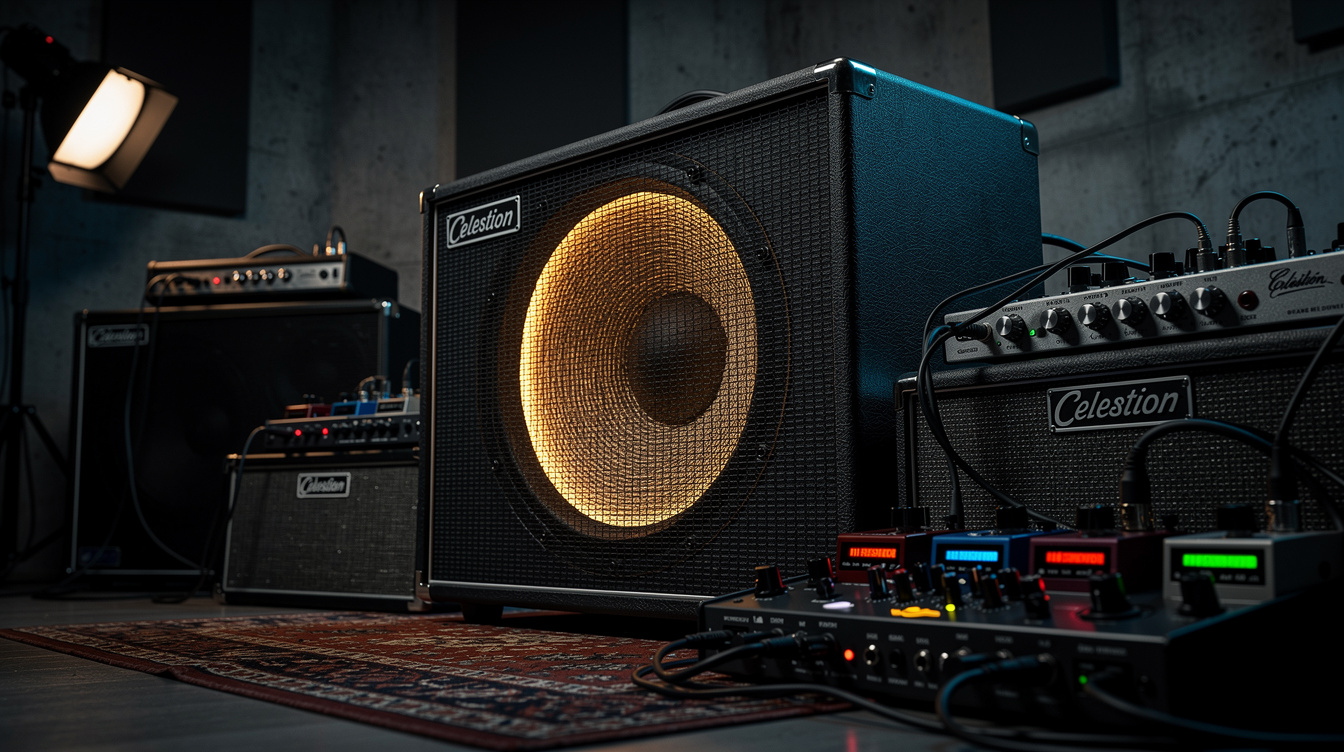
The quick version: The Greenback is thick through the low mids, breaks up early, and gives up above 5 kHz. The Blue Alnico is clear and chimey with extended sparkly highs. The Vintage 30 is aggressive in the upper mids with a characteristic 2–3kHz presence peak that cuts through a mix. The G12T-75 is smoother in the mids and the most neutral on top — and, by Celestion's published figures, the one that reaches least low, trading extension for headroom. None of these is universally better. Each is optimized for a different tonal goal.
The guitar speaker is not a passive conductor of sound. It's an electromechanical transducer that has its own frequency response curve, breakup behavior, and harmonic character, and that character profoundly affects the final tone that reaches the air. Two identical amplifiers, identical guitar signals, identical rooms, running through two different Celestion speakers will sound meaningfully different.
This comparison covers the four speakers that define the majority of the British rock and vintage-into-modern tone landscape: the G12M Greenback, the Blue Alnico, the Vintage 30, and the G12T-75. All four are Celestion designs. All four are in active production. All four appear in major amp brands as original equipment. And all four behave very differently.
At a Glance
| Speaker | Wattage | Magnet | Published range / Fs | Freq Character | Best For | Price (per speaker) |
|---|---|---|---|---|---|---|
| G12M Greenback | 25W | Ceramic (AlNiCo in some reissues) | 75–5000 Hz / 75 Hz | Thick low-mids, gives up above 5kHz | Classic rock, blues, crunch | ~$100–130 |
| Blue Alnico | 15W | Alnico | 75–5000 Hz / 75 Hz | Clear, extended highs, chimey, smooth midrange | Clean tones, Vox, chime | ~$200–220 |
| Vintage 30 | 60W | Ceramic | 70–5000 Hz / 75 Hz | Aggressive upper mids (1.5–3kHz peak), tight bass | Classic rock, hard rock, lead | ~$120–150 |
| G12T-75 | 75W | Ceramic | 80–5000 Hz / 85 Hz | Neutral upper mids, smooth top, least reach | Modern high-gain, metal, bright rigs | ~$100–130 |
Street prices as of April 2026. Single-speaker pricing; cabinet configurations multiply accordingly.
G12M Greenback: The Classic British Voice
The Greenback is the oldest design of the four, originating in the late 1960s as the speaker installed in Marshall 1960A and 1960B cabinets. It defined the tone of the Super Lead through a generation of British rock recordings.
What it sounds like: The Greenback has a prominent low-midrange warmth, a smooth midrange through about 2kHz, and a natural rolloff beginning around 5kHz. There is no aggressive presence peak. The speaker emphasizes the guitar's fundamental and lower harmonics rather than upper-harmonic sizzle. At low to moderate volume it sounds full and round. Under high power it begins to break up mechanically (the cone itself distorts), producing a gritty texture that becomes part of the sound rather than a failure mode.
What it doesn't do well: The Greenback's low wattage rating (25W) limits how hard you can push it before compression and cone breakup become significant. In high-gain contexts at stage volume it can sound woolly. The upper mids that give modern high-gain amps their definition are exactly what the Greenback's natural rolloff suppresses. It's also not the right tool for headroom-requiring clean platforms.
What amps it ships in / historically used with:
- Marshall 1960A and 1960B cabinets (vintage production)
- Marshall SV20H Studio Vintage cabinet
- Orange Rocker 15 (standard configuration)
- Preferred by Angus Young and Pete Townshend for most of their recorded work
The surprised discovery: Running a Greenback through a modeler into a guitar cab (rather than with FRFR) reveals how much the speaker is doing the tonal work. The Greenback softens the top end of amp models that would be harsh through a flat-response system. Modeler users who feel their cab sim sounds "too fizzy" sometimes find that a real Greenback behind it solves the problem better than EQ adjustments within the signal chain.
Blue Alnico: The Chimey Outlier
The Blue Alnico uses an alnico magnet (a magnesium alloy that produces a different electromagnetic field than ceramic magnets, resulting in different cone behavior). It's the most expensive of the four and the most specific in its application.
What it sounds like: The Blue is associated with Vox-style chime: clear, sparkling high-frequency extension with a smooth midrange and a slightly softer low end compared to ceramic designs. It handles clean and edge-of-breakup tones with unusual clarity. Single-note lines retain their distinct harmonic character at lower volumes better than ceramic speakers, which tend to compress the upper partials under light touch.
What it doesn't do well: The Blue's 15W rating makes it impractical for high-stage-volume applications. It's not a speaker for a Rectifier into a 4x12; it's a speaker for a 15-watt combo or a carefully padded application. It also carries a premium cost that positions it as a specialty item rather than a utility driver.
What amps it ships in / historically used with:
- Vox AC15 (current production uses Blue or Greenback depending on configuration)
- Certain Vox AC30 configurations
- Bell Custom Series
- Historic preference: The Beatles, Queen (Brian May's AC30 and related recordings)
The surprised discovery: The Blue's extended high frequency clarity can make certain overdrive pedals sound edgy or sharp in a way they don't through a ceramic speaker. Playing a Klon-style overdrive through a Blue Alnico requires a Treble setting lower than what works through a Greenback. The speaker retrieves harmonic information that the Greenback absorbs, making the top-end character of the pedal much more audible.
Vintage 30: The Aggressive Mid-Forward Driver
The Vintage 30 is the most widely installed speaker in production guitar cabs after the G12T-75. Its design dates to 1986, and its characteristic upper-midrange presence peak (roughly in the 1.5–3kHz region) is both its most valuable property and its most polarizing one.
What it sounds like: The V30 has an assertive presence that cuts through a band mix. Single-note lead lines on a V30 have a vocal, nasal quality — closer to a voice pushing through a doorway than to a speaker in a box. Chord work has a complex, layered character due to the speaker's complex resonance behavior in the upper mids. It handles medium to high gain well; the presence peak adds clarity to distorted tones that can otherwise become compressed and indistinct.
What it doesn't do well: At high volumes, the V30's presence peak can become fatiguing. Extended sessions through a 4x12 with V30s at stage volume in a live context can produce listening fatigue in a way that Greenbacks or T-75s don't. The V30 also doesn't pair well with amp models that have an aggressive upper-mid peak of their own. The two peaks stack, and the result is a 2kHz shout that makes the mix exhausting. Mesa/Boogie ships the Rectifier cabs with V30s, and the standard advice in metal contexts is to replace them or EQ around the peak depending on your amp model's character.
What amps it ships in / historically used with:
- Marshall DSL series (4x12 cab)
- Mesa/Boogie Rectifier cabs (standard configuration)
- Peavey 6505+ 4x12 cab
- Many boutique amp makers use them as a premium stock driver
- Associated with: Carlos Santana, Joe Bonamassa, many modern classic rock players
G12T-75: The Neutral High-Output Driver
The G12T-75 was introduced in 1978 and became the standard speaker in the Marshall JCM800 cabinets. It was designed to handle the higher output of later-era Marshall heads without the cone breakup issues that affected the lower-rated Greenback under those conditions.
What it sounds like: The T-75 is the most "neutral" of the four in the sense that it has a smoother upper-midrange response (less of the V30's presence peak, more even through the 1–4kHz region). Its low end has more weight than the Greenback at volume, though not more reach — see the correction below. The high frequencies are smooth rather than chimey. It doesn't add a strong character of its own, which makes it a useful tool when the amp is providing the tonal character and you want the speaker to stay out of the way.
What it doesn't do well: Because it doesn't add a strong tonal character, it can make amps that are already neutral or somewhat scooped sound blank. A very clean, flat-response modeler signal through a T-75 in a live context can sound less interesting than the same signal through a V30 or Greenback. The T-75 rewards amps with strong preamp character, not passive clean platforms that rely on the speaker for texture.
The low-end correction: an earlier version of this comparison described the T-75's low end as extending further than the Greenback's. Celestion's published figures say the opposite. The T-75 is listed at 80–5000 Hz with a resonance of 85 Hz; the Greenback, the Blue and the V30 all sit at a 75 Hz resonance, and the V30's published range starts at 70 Hz. Output falls away below resonance, so of these four the T-75 is the one that reaches least low — and its 85 Hz resonance is above the open low E's 82.41 Hz fundamental.
What the T-75 does have is a 75-watt rating against the Greenback's 25. At stage volume into a 100-watt head the Greenback is thermally compressed and mechanically softening while the T-75 is still linear, so more of the low end it produces survives to the room. That is the weight players describe, and it is real — it is headroom rather than extension, and the two get conflated constantly because at gig volume they feel identical. The full set of published numbers for the common speakers, set against the notes they are asked to reproduce, is in what a guitar speaker actually passes below 100 Hz.
What amps it ships in / historically used with:
- Marshall 1960A and 1960B cabinets (current production standard)
- Many Marshall heads from the 1980s onward
- Associated with: the JCM800 era generally, early Metallica (Master of Puppets through Justice For All recordings)
Amp Pairing Guide
Choosing a speaker depends on the amp's existing frequency character. The goal is complementary shaping, not identical frequency profiles stacked on top of each other.
| Amp Type | Recommended Speaker | Why |
|---|---|---|
| Marshall JCM800 | Greenback or V30 | T-75 is neutral, Greenback adds warmth, V30 adds definition to high-gain |
| Fender-style clean platform | Blue Alnico or Greenback | Extends the amp's natural warmth (Greenback) or enhances its chime (Blue) |
| Vox AC30 | Blue Alnico | Designed together; the Blue's character and the AC30's circuit are a complete system |
| Mesa/Boogie Rectifier | T-75 or mix (T-75 + V30) | Reduces the cumulative upper-mid buildup of V30-only configuration |
| Modeler into a guitar cab | V30 or Greenback | Neither is perfectly "neutral," but V30 adds useful presence; Greenback adds warmth |
| High-gain modern metal head | T-75 | Its smooth top end prevents harsh fizz from accumulating in the upper mids |
Mixing Speakers in a 2x12 or 4x12
Running different speakers in the same cab is a technique most commonly associated with certain boutique builders and the Joe Bonamassa "married cab" approach (one V30 and one Greenback in a 2x12). The two speakers interact acoustically and electrically, and the result is often a tone that has qualities of both without the excesses of either.
The most common and effective mix:
- Greenback + V30 (2x12 or half-stack 4x12): The Greenback's low-mid thickness and the V30's upper-mid presence combine into a balanced profile. This is the standard mix for many boutique cab builders.
- T-75 + V30 (4x12): Common in live metal contexts where the V30's definition is wanted but needs tempering with the T-75's neutral top. This is effectively what the standard "mixed cab" Mesa and Framus configurations attempt.
- Blue + Greenback (2x12): Higher cost but produces a chimey quality with more midrange warmth than an all-Blue configuration.
The modeler equivalent (mixing cab impulse responses) follows the same principle. Loading one V30 IR and one Greenback IR into two parallel paths and blending them gives the combined character without requiring a real mixed cab. The Helix cab models reference identifies which IR names correspond to which Celestion model family if you're trying to build this digitally.
One thing the mixed cab adds that an all-matched cab doesn't: a real choice of which speaker to put a mic on. In a married V30/Greenback cab, the speaker you record is the tone decision — V30 for cut, Greenback for warmth — and the rest of the cab is just along for the ride. Which speaker to mic on a multi-speaker cab walks through finding the right one and where to aim the mic once you have.