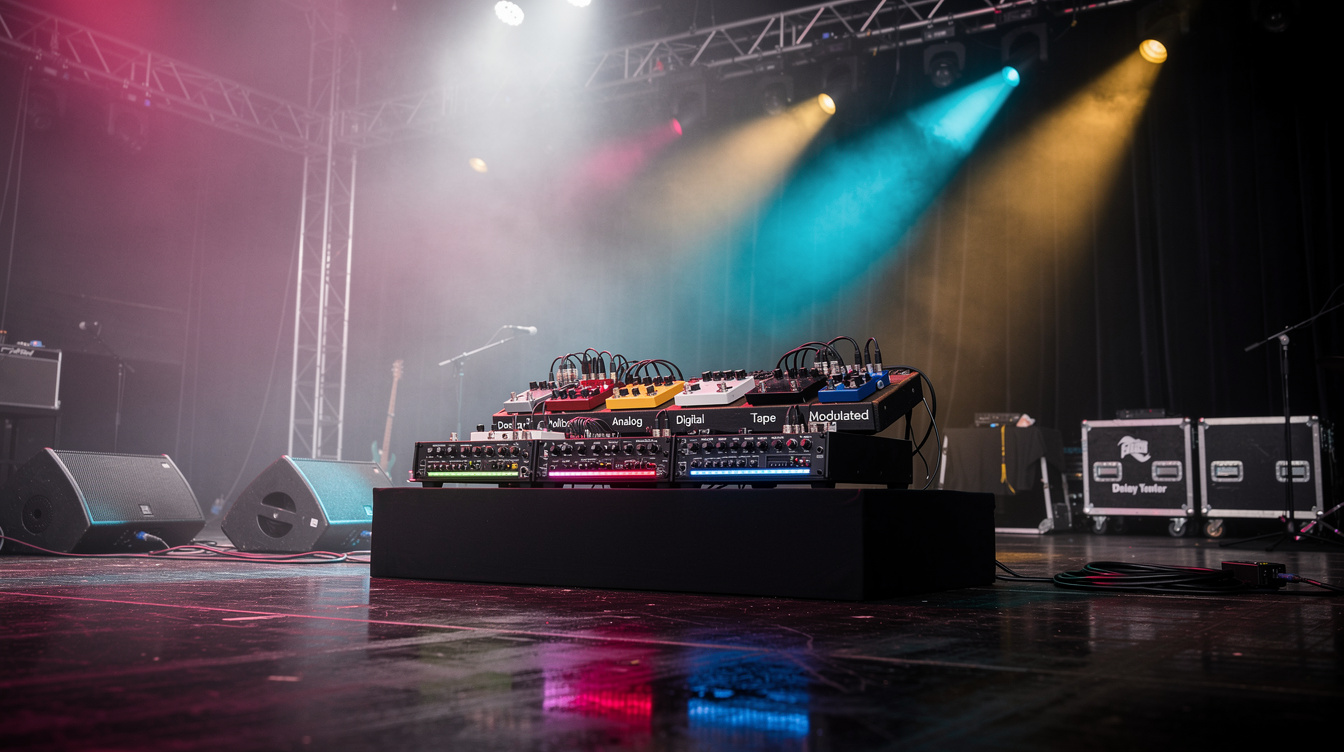
Start Here: The three main delay types (analog, digital, and tape) each have a distinct character and a context where they shine. This guide covers how each one sounds, why it sounds that way, and which situations call for which. If you're specifically trying to choose a delay pedal for live use, the Live vs. Studio Considerations section addresses that directly. If you want to understand the underlying differences first, start from the beginning.
Why Delay Type Matters More Than You Might Think
A delay pedal's job sounds simple: play back what you just played, slightly later. But the way different delays accomplish that task creates sounds that are meaningfully different from each other, not in a subtle, audiophile way, but in a you-can-hear-it-in-the-context-of-a-song way. The warm, slightly degraded repeats of an analog delay sit differently in a mix than the crystal-clear echoes of a digital one. The wow and flutter of a tape delay creates motion that neither of the others can replicate.
These aren't interchangeable tools. Choosing the right type for your playing context matters as much as choosing the right delay time or feedback setting. Understanding why each type sounds the way it does makes that choice cleaner.
Analog Delay
How It Works
Analog delay uses a bucket-brigade device (BBD) chip, a series of capacitors that pass voltage charges from one to the next like a bucket line, each capacitor holding a very short sample of the signal. The audio "travels" through hundreds or thousands of these capacitors before being mixed back with the dry signal. Every transfer between capacitors introduces a small amount of degradation: the high frequencies roll off slightly, there's a gentle compression, and the timing has a very slight natural randomness built in.
The result is repeats that are audibly different from the original signal: warmer, slightly softer in the top end, with a natural quality that degrades further with each repeat.
How It Sounds
Analog delay has what I'd describe as a soft landing quality. The first repeat is warm but still recognizable. The second is warmer and slightly smaller. By the fourth or fifth repeat, you're hearing something that sounds like music heard through a wall, still pitched correctly, still rhythmically accurate, but gentle and distant.
The high-end rolloff is the defining characteristic. Analog delay doesn't compete with the dry signal in the same frequency range because the repeats have less treble presence. In a live service context (where I'm running a mix of clean guitar, light modulation, and delay) analog delay disappears into the music gracefully. The repeats fill the sonic space without demanding attention.
The limitation: maximum delay time on most analog BBD pedals tops out around 300–600ms before you start hearing the audio quality degrade to a point that's noticeable. Longer delay times (anything approaching a full second or dotted-eighth ambient swells with significant gap) typically need digital.
Best Contexts for Analog Delay
- Blues, classic rock, country: The warm degradation suits genres where the guitar's natural character should be front and center
- Ambient fills and pads at moderate tempos: Analog delay fills space without getting clinical
- Slapback (40–120ms, zero or near-zero feedback): The warmth makes slapback feel natural rather than processed
- Any situation where you want delay that stays out of the way
Digital Delay
How It Works
Digital delay converts the audio signal to digital, stores it in memory, and plays it back at a set delay time. Modern digital delay chips can store and reproduce the audio at very high fidelity; in an ideal implementation, the repeat is nearly indistinguishable from the dry signal on the first pass. The "degradation" of subsequent repeats is typically determined by the feedback loop, which recirculates the delayed signal, and each pass through the A/D and D/A conversion chain introduces some processing.
Most digital delay pedals offer control over this: some modelers simulate "tape" or "analog" characteristics through algorithms that add modulation, high-frequency rolloff, or saturation. Others deliberately maintain pristine fidelity across all repeats.
How It Sounds
Clean digital delay is exactly that: clean. The repeats are clear, bright, and present. At short delay times (50–150ms) with no modulation, it can feel almost clinical; you hear the echo as a distinct, separate event rather than as a texture blending into the dry signal. At longer delay times with more feedback, the repeats stack up with full harmonic content intact, which creates a different quality than analog: thicker and louder, not softer and warmer.
This is a feature in contexts where precision matters. For dotted-eighth delays (the technique popularized by The Edge on The Joshua Tree, essential in contemporary worship music) digital delay is the most reliable implementation. The rhythmic precision of a dotted-eighth pattern depends on the repeats being metronomically accurate and clearly audible. Analog delay's natural timing variation and high-end softening make it a less precise vehicle for that technique.
I've had analog delays drift slightly over the course of a 90-minute service. It's not dramatic, but it's audible. Digital delays don't drift.
Best Contexts for Digital Delay
- Dotted-eighth rhythmic patterns (U2/worship-style ambient): Precision is essential; digital wins here
- Long ambient swells (500ms and beyond): Digital handles longer delay times more cleanly
- Recording contexts where the delay needs to be edited or loop-synced: Clean repeats are easier to work with in post
- Any application requiring perfect tempo accuracy across extended sets
Tape Delay
How It Works
Original tape delay (the Echoplex, the Roland Space Echo, the Watkins Copicat) uses a literal piece of magnetic tape running in a loop past a recording head and one or more playback heads. The distance between the record and playback heads, and the speed of the tape, determines the delay time. The tape itself introduces wow and flutter (subtle pitch variation from tape speed inconsistencies), as well as frequency response changes, saturation when the tape is driven hard, and natural noise (tape hiss).
Modern tape delay pedals and modelers simulate this behavior digitally or through elaborate analog circuits. The Strymon El Capistan, the Chase Bliss Tonal Recall, and the Fulltone Tube Tape Echo (actual tape) are common implementations. Modeler tape delay blocks vary in quality, but the better ones (Helix, Fractal) capture the wow/flutter character convincingly.
How It Sounds
Tape delay has a quality that neither analog nor digital can fully replicate: motion. The wow and flutter introduce a subtle pitch variation that makes the repeats feel alive in a way that static delays don't. It's not out of tune; it's more like the difference between a photograph and a film clip. The repeats breathe slightly. They move.
The saturation that authentic tape delay introduces when driven hard adds a warmth and harmonic content that goes beyond what even a BBD analog delay produces. There's a reason the Space Echo specifically appears in so many genre-defining recordings; it contributes more than just time-based repetition.
The limitation is practical: actual tape delay units require maintenance (tape replacement, head cleaning, calibration), and they can be temperamental about temperature and humidity. For a recording studio or a boutique player who's part of their aesthetic, that's acceptable. For a live musician running three services every Sunday and a Wednesday rehearsal, it's a different calculation.
Best Contexts for Tape Delay
- Recording studio work where you want the most authentic vintage character
- Genres where the texture IS the point: vintage country, rockabilly slapback, psychedelic rock
- Players for whom gear maintenance is part of the relationship with the instrument
- Modeled tape delay (El Capistan, Helix tape blocks) in live contexts: Gets the motion without the maintenance
Live vs. Studio Considerations
The choice of delay type looks different depending on whether you're on stage or in a recording environment.
Live Playing Priorities
Reliability is non-negotiable. Analog delays, particularly older or boutique BBD units, can have temperature sensitivity and, occasionally, timing drift. Digital delays don't have these issues. In a live context (especially in worship music, where a timing drift mid-service can be audibly disorienting) I trust digital.
Tap tempo precision matters more live than in studio. In the studio, you can edit. On stage, if your delay tempo is slightly off, the audience hears the disconnect in real time. Digital delays are more accurate at holding tempo across a set.
Monitoring environment is unpredictable live. Analog delay's high-end rolloff can be helpful when you're unsure how the PA will handle your signal; the softer repeats are less likely to create harsh frequency stacking. Digital delay in a poorly tuned room can stack overtones and create harshness.
Studio Recording Priorities
Character matters more than consistency. In the studio, you can choose the delay type that sounds best for the song, then work around its quirks. Tape delay's wow and flutter are a feature, not a problem. Analog decay is a specific aesthetic, not a limitation.
Longer delay times are more common in studio work. Ambient, textural playing in a recording context often uses delay times from 500ms to 1 second or longer, territory where digital handles more cleanly than analog.
Post-production options change the equation. If you're recording into a DAW, a digital delay's clean output gives you more flexibility in post. An analog delay's character is baked into the performance, which is exactly right when that character is intentional.
Choosing Between Them: A Decision Framework
Start with these questions:
1. What's your primary playing context?
- Live, consistent sets → Digital delay (reliability, precision)
- Recording, texture-forward → Tape delay or analog (character, motion)
- Both, with budget for one pedal → Digital with analog/tape modeling (best of all)
2. What delay times do you use most often?
- Short (under 300ms), slapback, moderate dotted-eighth → Analog or digital, either works
- Long (500ms and beyond), ambient → Digital or tape (analog degrades at longer times)
3. How important is touch dynamics in your playing?
- Very important, guitar-volume control is part of your technique → Analog, the softer rolloff is more responsive
- Precision and clarity first → Digital
4. What genres are you referencing?
- Classic rock, blues, vintage country → Analog or tape
- Worship, ambient, post-rock → Digital
- Psychedelic, experimental → Tape (or modeled tape)
Frequently Asked Questions
Can a digital delay simulate analog delay convincingly? Many modern digital delays include analog simulation modes that add BBD-style high-frequency rolloff and subtle timing variation. They're close, and for most live contexts the difference is imperceptible. For a discerning recording application where you want the actual BBD character, the simulation is a reasonable approximation but not an exact replacement.
Why does my digital delay sound too bright or harsh in a band context? Digital delay's pristine repeats can compete with the dry signal in the upper frequency range, especially with longer delay times and higher feedback. Solutions: lower the feedback, cut high frequencies on the delay (if your pedal offers this), reduce the mix level, or try a shorter delay time.
Is there a delay that does all three types well? The Strymon Timeline and the Line 6 Helix/HX Stomp delay blocks offer the most convincing implementations of all three types in one unit. If you're a modeler player or want a single comprehensive delay unit, either of those is a reasonable answer.
What delay time should I use for dotted-eighth notes? The formula is: (60,000 / BPM) × 0.75. At 120 BPM, that's 375ms. At 100 BPM, it's 450ms. Most digital delays with tap tempo will calculate this for you if you tap quarter notes and then select the dotted-eighth subdivision.
Does analog delay work for worship music? It can, particularly for less tempo-strict passages and ambient fills. The challenge is the dotted-eighth rhythmic technique that defines much of contemporary worship guitar; that technique depends on precision that digital handles more reliably. If you're using a looper or playing over a fixed click, digital delay gives you more consistency.