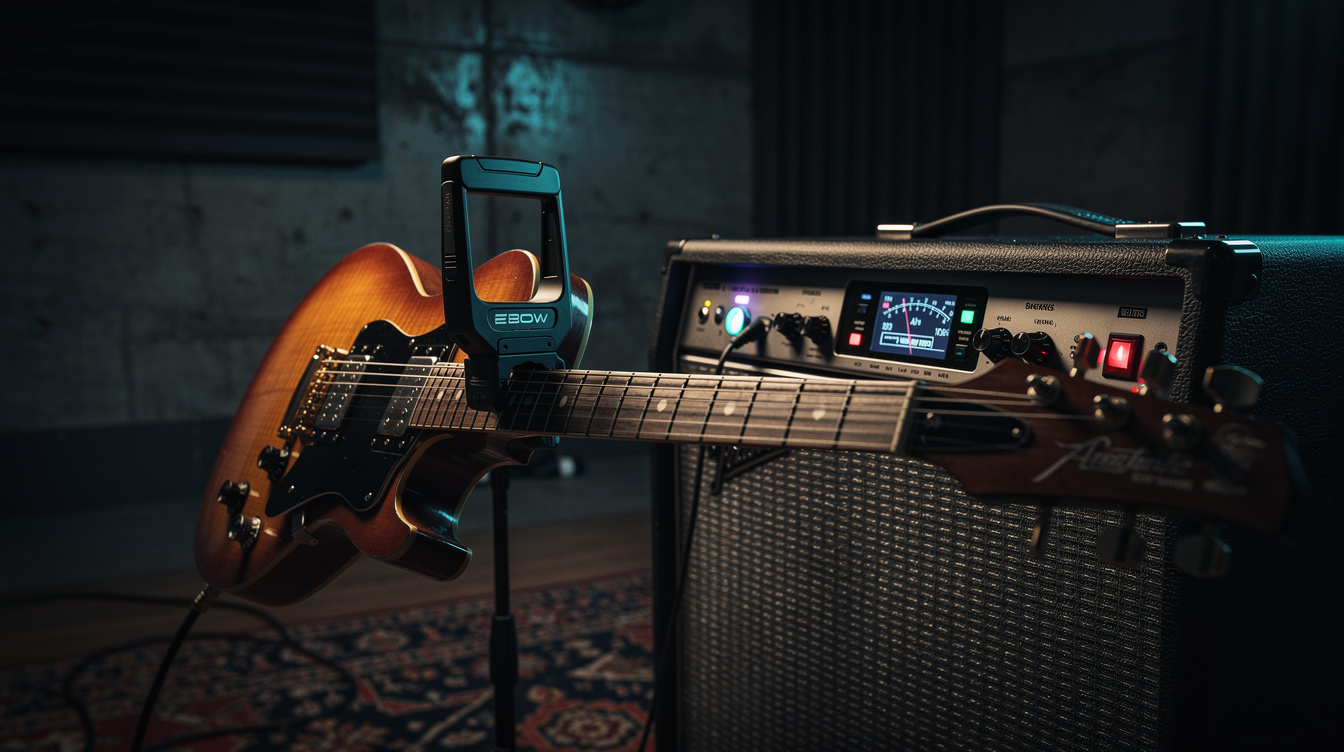
Hold a single note on a guitar and it starts dying the instant you pick it. That decay is so fundamental to the instrument that we build whole techniques around fighting it — vibrato to keep the string moving, feedback to feed it from the amp, compression to flatten the fall. The EBow does something stranger and simpler: it removes the decay entirely. You play one note and it just stays, holding and blooming like a bowed cello or a held breath, for as long as you want it to. The first time you hear your own guitar do that, it reorganizes what you think the instrument is for.
The Short Version
| You want | What the EBow gives you | The catch |
|---|---|---|
| Endless sustain on a single note | Infinite hold, no decay, no pick attack needed | One string at a time — no chords |
| Bowed, violin-like swells | A natural attack as you lower it onto the string | Your free hand is occupied |
| Flute / whistle harmonics | The Harmonic-mode switch (Plus model) | Takes practice to land cleanly |
| A pad or chord bed | Not this — use a looper or a freeze pedal instead | Monophonic by design |
The EBow is not a pedal and it has no knobs. It's a handheld electromagnet you hold over one string. Everything below is about where to hold it, what the one switch does, and how to make the thing sing instead of squeal.
What It's Actually Doing
Inside the little plastic shell are two coils. One senses the string's movement; the other drives it. The sensor reads where the string is, the circuit flips that signal back in phase, and the driver coil nudges the string in the direction it's already going. Do that a few thousand times a second and the string never stops — every cycle gets topped back up before friction can steal it. That's the whole trick. It's the same positive-feedback idea as a guitar screaming in front of a cranked amp, except it lives in your hand and it's aimed at exactly one string.
Which is why it only works on one string at a time. The driver coil is small and focused. Float it over the B string and the B string sings; the strings on either side stay dead. This is the single most important fact about the EBow, and it's the thing that trips people up when they unbox one expecting a chord machine. It is a monophonic instrument. Make peace with that and it becomes one of the most expressive tools you can put on a guitar. Fight it and you'll be frustrated in ten minutes.
How to Hold It
This is where most people go wrong, and it's almost entirely about hand position.
Rest the EBow so the two grooved rails on its underside straddle the string — the string sits in the channel between them, and the EBow hovers maybe a few millimeters above it, not touching. Keep it level. If you tilt it, you'll catch the neighboring strings and get a muddy double-voice. Position it over the string somewhere between the end of the fretboard and the pickups.
Now slide it along the string and listen to the voice change:
- Toward the bridge — the tone brightens and thins, more upper harmonics, more of a reedy, vocal edge. This is where the "human voice" quality lives.
- Toward the neck — rounder, darker, fuller, more fundamental. This is the cello register.
- Closer to the pickup — the drive gets stronger and the note jumps to life faster.
You steer the tone with inches of travel. There's no knob for this; the knob is your hand. Once that clicks, the EBow stops being a one-trick drone box and turns into something you play.
The Swell Is in Your Hand
Here's what surprised me, and it changed how I use the thing. I assumed I'd need a volume pedal to get those slow, bowed attacks — the swell-up that makes a guitar sound like a string section. I set one up, reached for it out of habit, and then realized I wasn't touching it.
The swell is built into how you start the note. Lower the EBow onto a string from above and the drive ramps the string up from silence — a soft, gradual bloom with no pick transient, exactly the attack a bow gives a violin. Lift it away and the note fades. You're playing the dynamics with the height and angle of your hand, the same way a bow player controls a note with bow pressure and speed. A volume pedal does one specific thing the EBow can't — let you swell a fretted, picked note. But for swelling the EBow's own voice, the pedal was redundant. The instrument already does it.
That's the moment the EBow goes from gimmick to instrument: when you stop triggering notes and start bowing them.
The Harmonic Switch
The EBow Plus has a three-position slider: off, Standard, and Harmonic. Standard drives the string at its fundamental — the note you fretted, sustained. Harmonic mode shifts the drive so the string locks onto an overtone instead, and the note leaps up an octave or more into a glassy, flute-like or whistle-like register. It's the same string, the same fret, but suddenly it's singing in a voice that doesn't sound like a guitar at all.
This is the sound people hear on records and assume is a synth or a keyboard. It isn't — it's a guitarist with an EBow in Harmonic mode and a hand that knows where to put it. Harmonic mode is fussier; the string has to settle onto the overtone, and exactly which harmonic you get depends on where you place the EBow along the string. Move it slightly and the note can jump to a different partial. That unpredictability is either a bug or a feature depending on the day — sometimes the wrong harmonic is more beautiful than the one you were aiming for.
The Supporting Rig
The EBow needs almost nothing, but a few things make it bloom. Run a clean amp and favor the neck pickup — the EBow's voice is already bright and harmonically busy near the bridge, and the neck pickup keeps it from going brittle. A gentle compressor smooths the volume as the note swells up and holds, so the bloom doesn't lurch. Then give the sustained note somewhere to live: a long reverb or a slow stacked reverb wash turns a single held note into something architectural. Delay works too — the EBow is a perfect input for the kind of rhythmic, dotted-eighth patterns that turn one note into a pulsing texture.
| Rig piece | Setting | Why |
|---|---|---|
| Pickup | Neck | Warms the EBow's naturally bright voice |
| Amp | Clean, a little headroom | Distortion fights the sustain's purity |
| Compression | Light — about 2 o'clock ratio, gentle | Evens the bloom, no pumping |
| Reverb | Long — hall or modulated, mix to taste | Gives the held note a space |
It sounds like Bill Frisell's most patient playing — a single line that behaves like a voice, not a fretted instrument. The sustained EBow note on a record like U2's "With or Without You" is the texture under everything, the part you don't notice until it stops. That's the EBow's natural home: not the solo, but the line that holds the whole song in place.
The One Thing It Can't Do — and What to Use Instead
It can't play a chord. If you want a sustained pad — a held chord under your playing — the EBow is the wrong tool, and no amount of technique changes that. For that, you want a freeze or synth-pad approach, which samples a chord and holds it polyphonically. The trade is expression: a freeze pedal gives you a frozen, static block of sound; the EBow gives you one living, breathing, bendable voice.
So the honest decision is about what role you're filling. Need a chord bed? Freeze pedal or a looper. Need a hands-free sustained lead for the stage? A built-in sustainer. Need a single expressive voice that swells, sings, and does the flute thing — and you've got a free hand and a quiet moment to use it? Nothing else does what the EBow does, and it's been doing it, basically unchanged, since the 1970s. That kind of longevity usually means a tool got something right the first time.