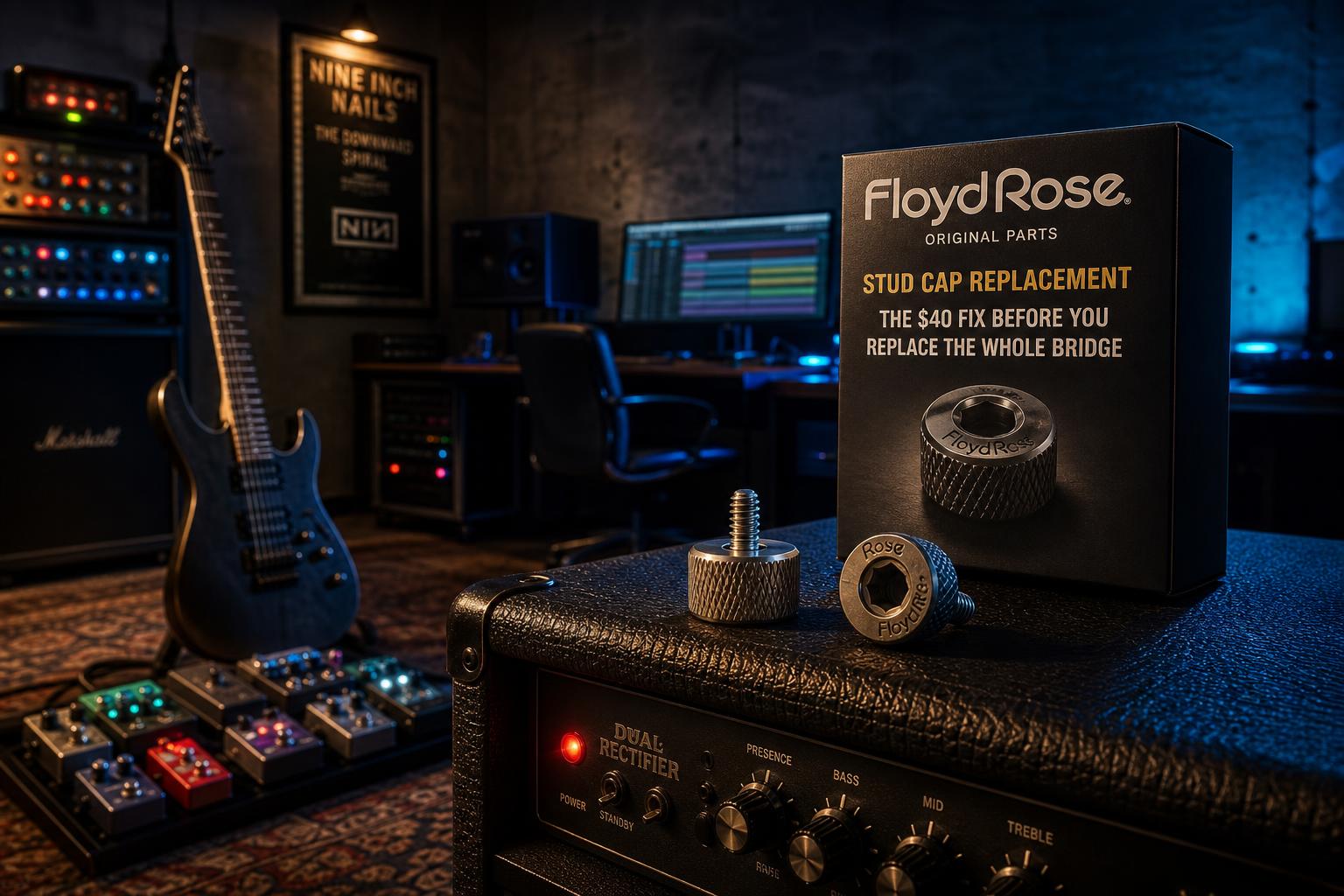
Quick read: Floyd Rose tuning instability is usually blamed on worn knife edges, but the wear point that fails first is the stud caps (the steel cups at the top of the threaded posts the bridge pivots on). Stud caps cost $30-60 to replace, take 30 minutes, and restore most of the tuning stability that worn studs had eaten before you ever consider a $200 baseplate swap. The three replacement options worth buying: Floyd Upgrades stainless studs, KAT instrument-grade studs, and Schaller original-spec replacements. Skip the cheap eBay sets; the metallurgy is what matters here.
| Replacement Stud | Material | Hardness | Price (pair) | Best For |
|---|---|---|---|---|
| Floyd Upgrades stainless steel | 17-4 PH stainless | Rockwell C 44 | $50 | Most players, all Floyd Original models |
| KAT instrument-grade | Hardened tool steel | Rockwell C 60+ | $60 | Heavy whammy users, drop-tuned guitars |
| Schaller original-spec | Stock metallurgy | Rockwell C 38 | $35 | Restoring a vintage Schaller-licensed Floyd |
| Floyd Rose factory | Stock metallurgy | Rockwell C 38 | $40 | Replacing matched-set OEM hardware |
| Generic eBay sets | Soft steel | Below Rockwell C 30 | $15-25 | Skip; they wear faster than what you are replacing |
What Stud Caps Do, and Why They Wear
A Floyd Rose tremolo pivots on two threaded studs anchored in the body. The bridge's baseplate has two knife-edge contact points (one on each side of the bridge) that ride on the rounded top of each stud. When you push the whammy bar down, the baseplate rotates forward on the stud caps; when you pull up, it rotates backward. The stud caps are the bearing surface for that rotation.
Over thousands of whammy bar cycles, two things happen at the stud caps:
- The cap surface deforms. The knife edge presses into the cap with the full string tension behind it (~80 lbs on a standard six-string in E). Small craters form where the knife edges sit, and over time the bridge develops a "memory" position it returns to, but only roughly. A stud cap with a worn craters loses the precise pivot point that lets the bridge return to exact pitch.
- The cap becomes scarred and rough. Microscopic ridges and burrs form on the cap surface, which the knife edge has to climb over each time the bridge moves. These surface defects produce inconsistent friction during whammy bar use, which manifests as tuning instability. The bridge does not return to exactly the same position twice in a row because it is hung up on different ridges each time.
The knife edges on the baseplate also wear, but they wear slower than the stud caps because the baseplate is typically harder than the studs (especially on mid-tier Floyd Special and OFR copies). The studs are the soft side of the bearing pair, which means they take most of the wear. This is the same principle as a hardened crankshaft against a softer bearing shell. The soft component is sacrificial and intended to be replaced first.
The takeaway: if your Floyd is having tuning return problems, replace the studs first. If you replace the baseplate without replacing the studs, the new baseplate will start wearing immediately because the worn studs are still abrading it.
How to Identify Stud Cap Wear
You do not need a microscope. Two tests will tell you whether the studs are the problem.
Test 1: Visual inspection. Loosen all the strings, remove the trem springs from the back of the guitar, and lift the bridge off the studs. Look at the top of each stud under bright light. A new or unworn stud cap is smooth, slightly domed, with a polished surface where the knife edge contacts it. A worn stud has visible craters, scratches, or a flattened area at the contact point. If you can see a defined rectangular impression on the cap surface, the stud is worn enough to cause tuning problems.
Test 2: The tuning return test. With the guitar restrung and tuned, push the whammy bar down hard (a half-step dive) and let it return. Check tuning. Pull the whammy bar up (a half-step bend) and let it return. Check tuning. Repeat 5-10 times. If the tuning drifts by more than 5 cents per cycle on any string, your bridge has a return-to-zero problem. The most common cause is worn stud caps; the second most common cause is binding at the nut (which is a separate diagnostic).
Players who rely heavily on the whammy bar will hit stud cap wear after 2-4 years of regular playing. Players who use the bar occasionally can go 8-10 years before wear becomes a problem. Players who keep the bridge floating but rarely whammy can go decades. The total life depends on how many cycles the bearing surfaces see.
Floyd Upgrades Stainless Studs (The Default Recommendation)
Floyd Upgrades has been making aftermarket Floyd Rose hardware since the early 2000s. Their stainless steel studs are the most commonly recommended upgrade because they use 17-4 PH stainless steel hardened to Rockwell C 44, meaningfully harder than the original Floyd Rose stud metallurgy (Rockwell C 38) but not so hard that they will accelerate baseplate wear.
The design is dimensionally identical to a stock Floyd Rose Original stud. Same thread pitch, same overall length, same cap diameter. They drop into the existing inserts in the body and the bridge sits on them with no modification.
What you get for the upgrade:
- About 2-3x the wear life of a stock Floyd Original stud
- A polished cap surface that takes longer to develop the friction-causing ridges
- Stainless construction, so they do not corrode over time the way some plated stock studs do
What you do not get:
- A noticeable tone change (some players claim brighter sustain; this is debatable and within measurement noise)
- A solution for a worn baseplate (the studs are one half of the bearing pair)
- Compatibility with Floyd Rose Special bridges (these use a smaller stud diameter; check before ordering)
Price: $50 for the pair on Floyd Upgrades' direct site. Available through Reverb at the same price; some Sweetwater listings show similar pricing but stock is intermittent.
KAT Instrument-Grade Studs (For Heavy Use)
KAT (Kahler/Allparts/Truss) makes a tool-steel stud set that is meaningfully harder than the Floyd Upgrades stainless option (Rockwell C 60+), which is up in the territory of high-end machine tooling. These are the studs to buy if you whammy aggressively, play in drop tunings (which put more lateral force on the studs), or have already worn through one set of replacement studs in less than 3 years.
The trade-off with the harder studs is that they are now harder than the baseplate on most Floyd Rose models. This means the wear pattern reverses: the baseplate knife edges become the sacrificial component, and they will wear faster against the harder studs than they would against stock studs. For most players this is acceptable because baseplates last 5-10 times longer than studs even under accelerated wear, but it is a consideration if you specifically want to extend the baseplate life.
KAT studs are dimensionally compatible with Floyd Original and most licensed Floyd Rose bridges. They are not compatible with Floyd Special bridges due to the smaller post diameter on the Special. If you have a Floyd Special and want a tool-steel upgrade, the Floyd Upgrades Special-specific replacement set is the only option.
Price: $60 for the pair on the KAT direct site. Allparts carries them in some stores at similar pricing.
The Install Procedure
Total time: 30-45 minutes for a player familiar with basic guitar maintenance. First-timers should budget an hour.
Step 1: Detune and Remove Strings
Loosen all six strings until they go slack. Remove them. The bridge needs to be unloaded for the next steps because the trem springs need to come off.
Step 2: Remove the Trem Springs
Open the spring cavity cover on the back of the guitar. Use needle-nose pliers to unhook each spring from the spring claw and the trem block. Set them aside in order; they will go back in the same configuration.
The bridge will now be loose. It is held in place only by gravity and the small amount of contact with the studs.
Step 3: Lift the Bridge Off the Studs
Lift the bridge straight up. The two knife-edge contact points should release from the stud caps cleanly. If the bridge is stuck (sometimes the knife edges have worn into the stud caps deeply enough to create a mild interference fit), gently rock the bridge side to side while lifting. Do not pry against the body finish.
Set the bridge aside on a clean surface. Do not let the saddles or the fine tuners hit anything; the saddles are the second-most-easily-damaged part of a Floyd Rose after the knife edges.
Step 4: Remove the Old Studs
The studs thread into a brass insert pressed into the body. Use a 3mm hex wrench or a flat-blade screwdriver (depending on your stud's drive style; most have a slot or a hex socket on the top of the cap) to unscrew each stud from its insert. They should come out with light to moderate resistance.
If the stud is completely seized, do not force it. A seized stud usually means the insert has been over-tightened against the body wood and is now binding. Apply a single drop of penetrating oil at the stud-insert junction, wait 10 minutes, and try again. If it still will not move, you are into luthier territory and should stop and seek professional help.
Step 5: Install the New Studs
Thread the new studs into the inserts by hand first to confirm they engage smoothly. Tighten them with the wrench until the cap is at the correct height for the bridge to sit level. The "correct height" for a Floyd is typically 14-15mm from the body face to the top of the stud cap, but the exact height depends on the bridge model and the desired action.
The standard procedure for setting stud height:
- Set both studs to the same height initially. Measure with calipers if you have them, or eyeball with a ruler
- Reinstall the bridge (Step 6)
- Restring and bring the guitar to tension
- Adjust each stud independently to set the action and the bridge level
Most players over-tighten the studs initially and then back them off. Over-tightening can crack the body finish around the insert; back the stud off until the cap rotates freely with no friction against the body.
Step 6: Reinstall the Bridge
Lower the bridge onto the studs. The knife edges should drop into position on the new stud caps. The bridge should sit level and rock smoothly when pressed down at the back edge.
Step 7: Reinstall Strings and Springs
Restring the guitar with new strings. Reinstall the trem springs in the same configuration they came out (typically 3 springs in a triangular pattern, but this varies). Tune to pitch slowly: bring all six strings up incrementally rather than tuning one at a time, because the bridge tension changes with each string and pulling a string fully sharp before the others are at tension causes uneven loading.
Once all strings are at pitch, set the spring claw screws so the bridge sits parallel to the body face. Re-tune. Check the action and intonation. Re-tune again. Floyd Roses settle for 24-48 hours after any disassembly.
The Wear You Can't See
Most players assume that worn stud caps will be obviously worn: visible craters, deformed caps, surface roughness you can feel with a fingernail. The reality is that the wear that causes tuning problems can be invisible to the naked eye.
A bench test with a 10x loupe on a set of studs from a Jackson Soloist that was returning to zero with about 8 cents of error per cycle showed the stud caps looked nearly identical to a new set under casual inspection. Under the loupe, there were small ridges visible around the edge of where the knife edge had been contacting the cap, about 50 microns tall, roughly the diameter of a human hair. That was enough to disrupt the bridge's return path and cause the tuning drift. Replacing the studs cleared the tuning problem; the baseplate did not need to be touched.
The implication: if your Floyd has return problems and the studs look fine to your eye, they may still be the cause. Replace them before you spend money on a new baseplate. Stud caps are a $40-60 fix; baseplate replacement is a $200+ fix and the full procedure is involved.
Stud Bushing vs. Stud Cap
A common point of confusion: the "stud bushing" and the "stud cap" are different parts.
- Stud cap is the rounded top of the stud where the bridge knife edges sit. This is the part that wears in normal use and the part this post addresses.
- Stud bushing (also called the "insert" or "anchor") is the brass sleeve pressed into the body wood that the stud threads into. This rarely needs replacement unless the wood around the bushing has been damaged, usually from over-tightening or from a body finish issue.
Replacing the stud bushing requires removing the bridge, the studs, and the bushings themselves (which are pressed into the body). This is a luthier-level repair and out of scope for this post. Most "Floyd is broken" diagnostics resolve at the stud cap level.
When Stud Replacement Will Not Fix the Problem
Stud replacement fixes tuning return problems caused by worn stud caps. It does not fix:
- Binding at the nut. The most common false-positive. Players blame the bridge when the strings are catching at the locking nut. Loosen the nut clamp, lubricate the slots with graphite or Big Bends Nut Sauce, and re-test.
- Worn baseplate knife edges. If the knife edges are visibly chipped or rounded, the baseplate needs replacement. Stud replacement will help marginally but will not solve the underlying wear.
- Loose locking nut clamp screws. Check that the clamp screws are tight before chasing bridge issues.
- Spring claw imbalance. If the trem springs are pulling unevenly, the bridge can drift out of parallel and produce return problems that look like wear but are actually setup issues.
- Stripped insert threads. If the studs spin in the inserts without engaging, the body insert is damaged. This is a luthier-level repair.
The diagnostic order: nut binding first, spring balance second, stud caps third, baseplate fourth. Most "my Floyd is junk" complaints resolve at the first two steps and never need hardware replacement at all.
Bottom Line
Floyd Rose tuning instability has a well-defined wear progression. The stud caps go first, the baseplate goes second, and the locking nut clamp screws need periodic attention throughout. The smart maintenance order is to address the cheapest, highest-impact wear point before the expensive ones. That means stud replacement before baseplate replacement, every time.
Floyd Upgrades stainless steel studs at $50 are the right default for most players. KAT tool-steel studs at $60 are the upgrade for heavy whammy users. Skip the eBay generic sets; the metallurgy is the whole point and the cheap sets do not have the right material spec. The install takes 30 minutes and restores most of the tuning stability worn studs had eaten.
For deeper coverage of the next-tier maintenance (full baseplate replacement), see our Floyd Rose knife edge replacement post. For the underlying mechanical wear story, see our Floyd Rose knife edge wear explainer.