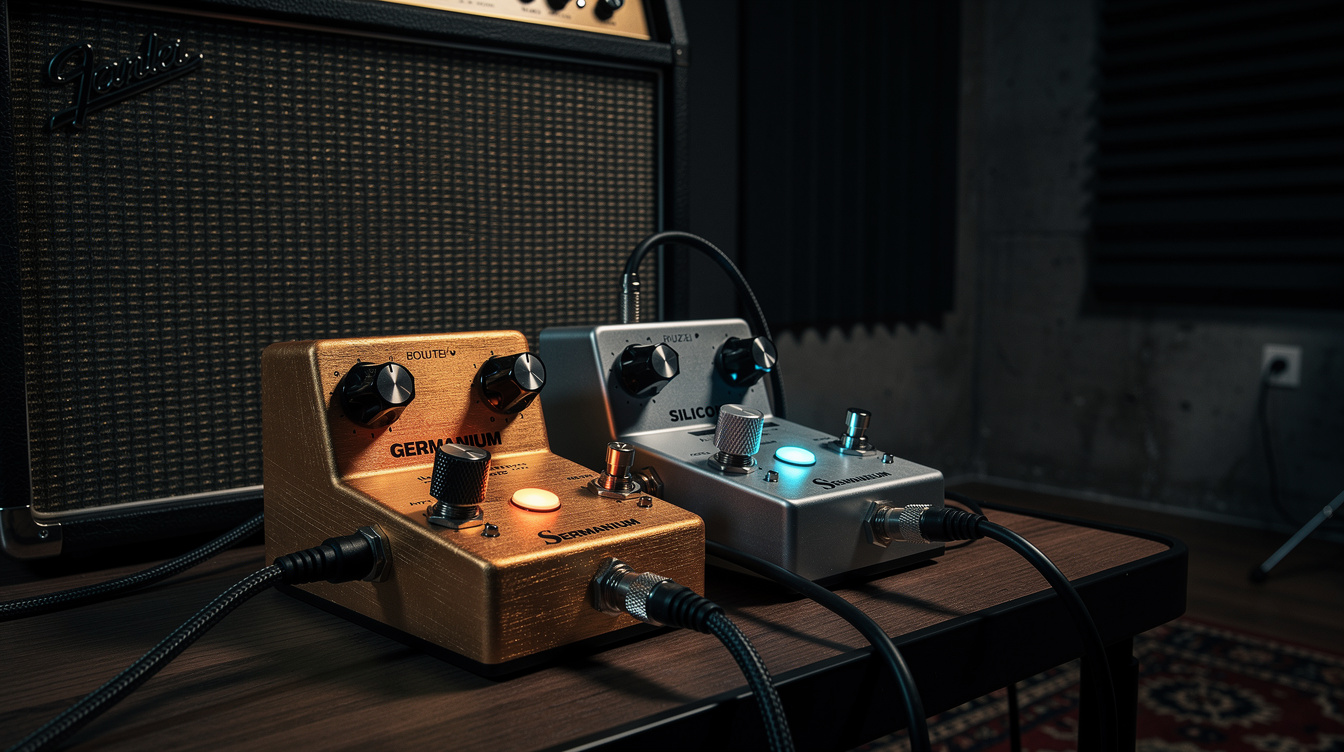
Start Here: Germanium and silicon fuzz pedals use different transistor technologies that produce meaningfully different sounds and behave differently in a signal chain. This guide explains what those differences actually are, not in terms of mysticism and "mojo," but in terms of circuit behavior and tone. The practical choice guide is in Which One to Choose.
A Little History First
The transistor changed the world twice. First in 1947, when Bell Labs invented it, and again in the early 1950s when germanium transistors made small, battery-powered consumer electronics possible. Every early transistor radio, guitar amplifier with a transistor preamp, and fuzz pedal from the 1960s used germanium.
Germanium didn't last long as the dominant transistor technology. By the mid-1960s, silicon transistors were taking over. They were more stable, more predictable, cheaper to manufacture, and didn't have germanium's weakness: extreme sensitivity to temperature. An AC128 germanium transistor (the type in a Dallas Arbiter Fuzz Face) will sound noticeably different at room temperature versus in a hot car. A silicon transistor doesn't care.
The guitar world didn't fully abandon germanium transistors, though. The Fuzz Face models that Jimi Hendrix used were the early germanium versions. When Dallas Arbiter switched to silicon transistors in the early 1970s, many players noticed the change and didn't like it. The germanium sound had become an aesthetic (warm, interactive, touch-sensitive) that the silicon version didn't replicate precisely.
Decades later, the two transistor technologies represent two distinct fuzz flavors. Understanding the actual difference is more useful than the mysticism that tends to surround the germanium conversation.
What Germanium Transistors Actually Do
Germanium transistors (the AC128, AC126, and related types used in vintage fuzz pedals) have different electrical characteristics than silicon transistors in three ways that matter for tone.
Lower forward voltage. Germanium transistors turn on (begin conducting) at a lower voltage than silicon. This means they clip differently. The clipping is softer, more gradual, producing more even-order harmonics (octave-related content) that the human ear hears as warm and musical.
Lower gain. Vintage NOS (new old stock) germanium transistors typically have lower and more variable hFE (gain) ratings than silicon transistors. This lower gain creates the specific Fuzz Face dynamic that most players associate with germanium: it responds more to what's driving it. Guitar volume at 10 produces full saturation; guitar volume at 6 produces something closer to a warm overdrive. The interactive quality is partly a function of the lower transistor gain.
Temperature sensitivity. Germanium transistors are significantly affected by temperature. The same circuit at 65°F and at 95°F will have noticeably different bias points, which affects the sound. Some players consider this a feature (the pedal "wakes up" as it warms). Others consider it a liability (inconsistency on stage, especially outdoors). Both assessments are accurate.
What Silicon Transistors Actually Do
Silicon transistors (BC108, BC109, and related types used in post-1970 Fuzz Faces and many modern fuzzes) clip harder. The forward voltage is higher, so the transition from clean to clipped is more abrupt. This produces more odd-order harmonics: the gritty, aggressive, square-wave-adjacent content that characterizes a silicon fuzz.
Silicon transistors are also temperature stable and have consistent, predictable gain ratings. A well-built silicon fuzz circuit sounds the same on a winter stage in Minneapolis and a summer outdoor festival in Texas. That's not nothing.
The silicon Fuzz Face has a particular character that's been used deliberately: the aggressive, biting quality on Jack White's early White Stripes recordings is a silicon fuzz through a cranked Marshall. It doesn't sound like germanium Hendrix. It sounds like its own thing, and it's been used brilliantly by a different set of players who wanted exactly that quality.
Side-by-Side: How They Sound
| Germanium | Silicon | |
|---|---|---|
| Clipping character | Soft, gradual, warm | Hard, abrupt, aggressive |
| Harmonic content | More even-order (warm) | More odd-order (gritty) |
| Guitar volume rollback | Cleans up beautifully | Cleans up, but transitions are harder |
| Touch dynamics | Highly responsive | Moderately responsive |
| Temperature behavior | Tone changes with temperature | Stable |
| Sustain at full settings | Moderate | Higher |
| Overall character | Warm, interactive, organic | Aggressive, consistent, defined |
The single most meaningful difference in playing terms is the guitar volume rollback behavior. A germanium Fuzz Face at guitar volume 6–7 is a different pedal than at 10. It's genuinely in overdrive territory, with the specific harmonic content of a pushed germanium circuit. The silicon Fuzz Face at 6–7 is just a quieter, slightly less saturated version of itself. It cleans up, but the territory is smaller and less distinct.
Hendrix used the guitar volume trick constantly. It's audible in live recordings, and it's how he moved between rhythm and lead within a phrase without using a footswitch. That technique is built on germanium circuit behavior. On a silicon Fuzz Face, the technique works, but the range is narrower and the quality of the cleaned-up sound is different.
The Temperature Question
Germanium fuzz pedals are genuinely temperature sensitive. The AC128 transistors in a vintage or well-built modern germanium Fuzz Face will be biased differently at cold temperatures than at warm ones. Cold temperature often pushes the bias out of its operating range, producing a gated, broken-up effect rather than smooth fuzz. This can sound interesting and occasionally wonderful. There's a specific texture to a cold germanium fuzz that's been used intentionally by certain players. But it can also mean your pedal sounds wrong for the first 15 minutes of a winter gig until it warms up to room temperature.
This is why professionally built modern germanium fuzzes (the Analogman Sunface, the Jam Pedals Fuzz Phrase) often include a bias trim pot: a small screwdriver adjustment that lets you correct the operating point as conditions change. Without a bias pot, you're at the mercy of the circuit physics.
A silicon fuzz doesn't have this issue. It sounds the same at 45°F and 85°F. For a touring musician, or anyone who plays in unpredictable environments, that consistency has real value.
The NOS Transistor Situation
Here's where the conversation gets genuinely complicated. Not all germanium transistors are created equal, and the best-sounding vintage Fuzz Face circuits used carefully selected transistors with specific gain (hFE) values, typically between 70 and 90 for the type used in those circuits. Too high and the circuit becomes unstable; too low and it doesn't sustain or saturate properly.
NOS (new old stock) matched germanium transistors (the type pulled from old consumer electronics and tested individually before being used in a new fuzz circuit) are what separates a $90 germanium Fuzz Face clone from a $250 Analogman Sunface. The Sunface uses hand-matched NOS AC128s selected for the correct gain range. The cheap clone uses whatever germanium transistors are currently available from secondary markets, which vary considerably.
This isn't audiophile mythology. The matched transistor selection genuinely affects the circuit's bias point and dynamic behavior. If you're going to spend money on a germanium fuzz, spend it on one that uses measured and selected transistors.
Silicon fuzz circuits don't have this complexity. The transistors are consistent enough that selection isn't required. A $80 silicon Fuzz Face clone uses essentially the same transistors as a $300 one.
Which One to Choose
Choose germanium if:
- The guitar volume rollback cleaning technique is part of your playing, and specifically, if you want the widest possible range of tonal territory across the volume knob
- Your musical reference is vintage Hendrix, early Clapton, vintage British blues-rock
- You're playing in a stable indoor environment (home studio, controlled stage temperature)
- You're willing to spend $200–$350 for a quality NOS germanium build, which is what the component quality requires
- The unpredictability of temperature variation doesn't concern you or is part of the aesthetic
Choose silicon if:
- Reliability and consistency across all playing environments matter more than the specific warm/interactive germanium character
- Your musical reference is Jack White, grunge-adjacent, punk-influenced, or any application that benefits from the aggressive silicon character
- You want to spend $80–$150 on a reliable fuzz that works the same every night
- You're playing outdoors, in changing temperature environments, or in any context where the temperature sensitivity of germanium would be a problem
Both are the right answer for different reasons. The germanium circuit in a well-built Fuzz Face does something the silicon version genuinely doesn't. That's not nostalgia, it's circuit physics. The silicon circuit does something the germanium doesn't: it's consistent and aggressive in a way that serves different musical contexts.
Players who care about this distinction and can afford both usually have both. A warm, interactive germanium for touch-sensitive playing at manageable volumes; a hard, consistent silicon for high-volume environments or genres where the aggressive character is the point.
A Few Words on Modern Germanium Fuzzes
The market for new germanium fuzz pedals has grown considerably in the past two decades, and the quality range is wide. Several builders have built reputations specifically on the careful sourcing and selection of germanium transistors:
Analogman Sunface. One of the most respected germanium Fuzz Face implementations available. Uses matched NOS germanium transistors and offers several variants based on vintage pedal circuit revisions. There's typically a wait list. The price reflects the component sourcing.
Jam Pedals Fuzz Phrase. Greek builder with excellent component selection and build quality. The versions are based on different circuit periods, from the earliest germanium Fuzz Faces to the transitional versions.
Fulltone '70. Silicon, not germanium, but included because its circuit design mimics some of the germanium dynamic behavior. A useful option if you want something close to the germanium character without the temperature sensitivity.
Dunlop Hendrix Fuzz Face (germanium versions). More affordable, uses AC-type germanium transistors, but with less component selection rigor than the builders above. A reasonable entry point.
Frequently Asked Questions
Is germanium always better than silicon for fuzz? No. Germanium has a specific set of characteristics that are better for specific applications, particularly touch-sensitive, interactive playing at moderate volumes with guitar volume control techniques. Silicon has a different set of characteristics that are better for high-volume, aggressive, consistent applications. Neither is categorically superior.
How do I know if my Fuzz Face is germanium or silicon? Check the transistor markings. Germanium transistors (AC128, AC126, NKT-275 types) are typically labeled with an "AC" or have germanium-specific designations. Silicon types (BC108, BC109, 2N types) are labeled accordingly. A quick look inside the pedal or a search for the serial number and production year will confirm.
Why do vintage germanium Fuzz Faces cost so much? NOS transistors are finite, and the specific transistors that work correctly in these circuits (AC128, AC126 in the right gain range) are increasingly scarce. Beyond that, a 1967 Dallas Arbiter Fuzz Face that still works has survived for nearly 60 years; the survival itself adds value. A well-preserved example with original components represents a specific moment in the circuit's history that can't be replicated, only approximated.
Do any modelers capture the germanium vs. silicon difference convincingly? Some modeler implementations (particularly the Fractal Audio and Line 6 Helix fuzz models) approximate the character difference through their algorithms. They don't fully replicate the transistor-level physics, but for players using modelers, the germanium models are warmer and more touch-sensitive than the silicon ones, in ways that parallel the real differences.
What strings and picks pair best with germanium fuzz? Lighter strings (9s or 10s) and medium picks tend to let the touch dynamics of germanium fuzz breathe. Heavier strings with a thick pick can overdrive the input of the circuit more aggressively, which reduces the dynamic range the circuit is known for. This isn't a rule; plenty of players use heavy strings through germanium fuzzes intentionally. But it's worth knowing the directional relationship.