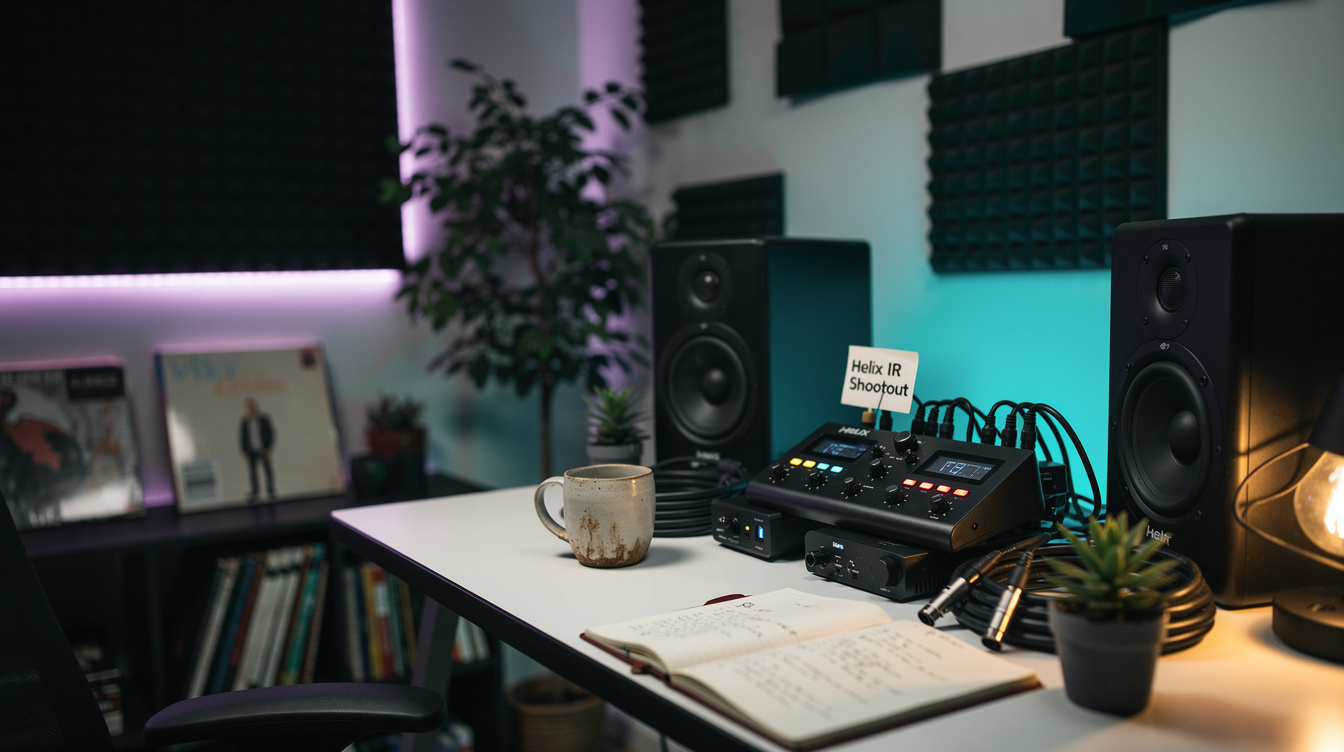
Start Here: The Helix's stock cab simulations are built from real measurements. Third-party IRs give you more variety and sometimes more character. Whether the difference matters depends on your use case. Here's the breakdown by specific scenario.
The stock cabs in a Helix are not afterthoughts. Line 6 captured them from real cabinets with real microphones in real rooms. They're IRs the same way third-party files are IRs, with the same underlying technology. The question of whether to replace them is a question of variety and character, not fundamental quality.
That said: variety and character matter. Let me walk you through what I found when I ran a structured comparison.
How I Set Up the Comparison
Before the results mean anything, the methodology has to be transparent.
Test environment:
- Line 6 Helix Floor (firmware 3.70)
- Yamaha HS8 studio monitors at 85dB reference level
- Same amp block for every test: US Deluxe Nrm (Fender Twin model), gain at 4.5, bass 5.0, mid 5.5, treble 5.5, master 7.0
- Every IR level-matched to within 0.2dB using a reference tone before listening
Level matching is non-negotiable. Louder always sounds better, and IR comparison tests that don't control for level are not testing what they think they're testing. I cannot stress this enough. The 0.2dB tolerance I used still introduces some bias (at some point I'll automate this better), but it's close enough for practical comparison.
What I listened for:
- Low-end definition (does the low end feel controlled or loose?)
- Midrange character (presence, honk, scooped quality)
- High-frequency content (air, harshness, smoothness)
- How well it sat in a rough mix reference track (clean rhythm over drums and bass)
Third-party sources tested:
- Ownhammer (paid, $20 packs)
- Celestion Plus (official Celestion IRs, $10-15 per speaker)
- Fremen Preset Pack IRs (free community collection, widely recommended on TGP)
- ML Sound Lab MIKKO (paid software-based IRs, capturing from real cabs)
- Helix CustomTone community uploads (free, user-submitted)
The Helix Stock Cabs: What You're Actually Getting
The Helix ships with IR-based cab simulations under names like "412 Greenback 25s," "212 Silver Bell," and "112 BF Nrm." These are actual impulse responses captured from physical cabinets. They're not the same type of processing as the amp modeling blocks; they're convolution-based captures of real mic-on-cab measurements.
The stock cabs have specific characteristics:
Strengths:
- Balanced, non-hyped frequency response; they sit well in a mix without aggressive post-EQ
- Good low-end definition on the 4x12 options
- Fast to use: no file management, no loading, no organizing
Weaknesses:
- Limited microphone variety: most stock cabs simulate one mic position, typically an SM57 on-axis or near-center
- Less character: the stock cabs are designed to be broadly useful, which means they avoid the distinctive colorations that make specific cab/mic combinations interesting
- The British-sounding cabs (Greenbacks, Vintage 30s) are competent but don't have the midrange presence that makes those speakers distinctive in a live context
I expected the stock cabs to be noticeably inferior and was willing to write that. What I actually found was that in a solo listening context, the gap between stock and good third-party IRs was real but smaller than I assumed. In a mix context (listening to the guitar against drums and bass), the gap narrowed further. This doesn't mean third-party IRs don't matter. It means the stock cabs aren't embarrassing.
How Third-Party IRs Compare
Ownhammer: More Mic Variety, More Options to Get Wrong
Ownhammer captures multiple mic positions (SM57, Ribbon mics, condensers, various distances) and sells them as packs. This is their value proposition: one cabinet, many different sonic possibilities depending on microphone choice.
The best Ownhammer IRs I tested (specifically the 412 Vintage 30 pack, SM57 close-on-axis) had noticeably more midrange character than the comparable Helix stock cab. The midrange honk that makes Vintage 30s distinctive in a room was present and usable. The stock Helix "412 Greenback 25s" is a cleaner, flatter representation of that same speaker category.
The risk: Ownhammer also sells IR packs with more distant and room-captured options that are specifically designed for recording contexts with full mix integration. If you load one of those into a live rig and wonder why your tone sounds like it's in a different room than the audience, that's why.
Verdict: Worth it for recording applications and for players who want specific mic character. Not a requirement for live use where the stock cabs are delivering the necessary frequency balance.
Celestion Plus: Official IR Captures of Specific Speakers
Celestion now sells official IR captures of their own speakers (the physical Vintage 30, Greenback, Gold, and others). These are interesting because they're the authoritative source: if you want to know what a Celestion Vintage 30 actually sounds like captured correctly, here it is.
The Celestion Plus Vintage 30 IR compared against the Helix stock "412 Vintage" option: there's a specific upper-midrange presence peak around 2–2.5kHz in the Celestion capture that's more pronounced than the stock IR. In isolation, this sounds more exciting. In a mix, this same peak can become aggressive and requires EQ management.
I expected the official Celestion capture to sound definitively better. It sounded different. Whether different is better depends entirely on context.
Verdict: The official Celestion IRs are a useful reference and produce distinct sounds. They're not universally better; they're more pronounced, which is useful in some contexts and problematic in others.
Fremen and Community IRs: Free, Variable, Occasionally Excellent
Community-sourced IRs vary dramatically in quality, and this is where the due-diligence requirement is highest. Some of the Fremen pack IRs I tested were excellent, particularly the 4x12 Mesa Rectifier cab captures, which had a defined low end and controlled high-end response that sat well in a mix. Some others were clearly captured in non-ideal conditions and introduced room artifacts that shouldn't appear in a cab simulation.
Verdict: Worth downloading the free packs and auditioning them. Have a systematic screening process: load each IR, run a reference tone through it, check for obvious peaks or problems before committing time to a full listen.
Head-to-Head Summary: Stock vs. Third-Party
| Scenario | Stock Helix Cabs | Third-Party IRs |
|---|---|---|
| Live playing through FRFR | Excellent; designed for this | Good, but verify frequency balance at volume |
| Studio recording | Competent; may need post-EQ | More variety; better mic character options |
| Direct to PA/FOH | Works well; balanced response | May require more attention to eq/tailoring |
| Quickly building a preset | Faster: no file management | Requires IR management workflow |
| Specific speaker character | Generic representations | More accurate captures of specific speakers |
| Extended-range/metal | 4x12 stock cabs work | Dedicated extended-range IR packs help |
When to Actually Buy Third-Party IRs
The cases where third-party IRs meaningfully improve the result:
Recording metal or high-gain guitar. The difference between a well-captured Mesa Rectifier 4x12 IR and the Helix stock version is audible in a recording context. The stock cabs work; the dedicated captures have more character and typically require less post-EQ to sit correctly.
Emulating a specific speaker. If you need a guitar that sounds like it came from a 1968 Marshall 4x12 with greenbacks, the Helix stock "412 Greenback 25s" is a general approximation. A dedicated vintage cab IR is a more accurate representation.
You're happy with your amp model but the cab is the problem. If your amp block sounds right but the final result is too dark, too bright, or missing the character you want, this is a cab problem and a third-party IR from a different mic position might solve it faster than EQ adjustments.
Cases where third-party IRs aren't worth the effort:
- Live use where the stock cabs are already working
- Players who want simple, fast presets without file management overhead
- Contexts where you can't control the monitoring environment enough to hear the difference
Once you've decided a third-party pack is worth it, the next question is which one, and the libraries are not interchangeable — Ownhammer, York Audio, and ML Sound Lab each have a distinct voicing. Our cab IR library roundup breaks down which fits which use case. And since most of what separates one IR from another is the mic and where it sat, our SM57 vs. ribbon vs. condenser breakdown explains the mic character you're really choosing between when you pick a capture.
How to Audition and Load IRs Into the Helix
The Helix accepts mono 24-bit 48kHz WAV files, up to 2048 samples long. Here's the workflow:
- Download your IR packs. Keep them organized: folder per source, subfolder per speaker type.
- Open HX Edit (free desktop app from Line 6).
- Navigate to the IR section. You can store up to 1024 IRs on the Helix.
- Drag files in, or use the import function.
- In your preset, replace any cab block with an "IR" block and select the imported file.
- Level-match against your existing cab block before A/B comparison.
A note on sample length: Helix supports up to 2048 samples. Some third-party packs include longer captures (4096 or even 8192 samples) that need to be converted. Ownhammer provides Helix-compatible versions in their packs. If you download from other sources, check the specs before importing.