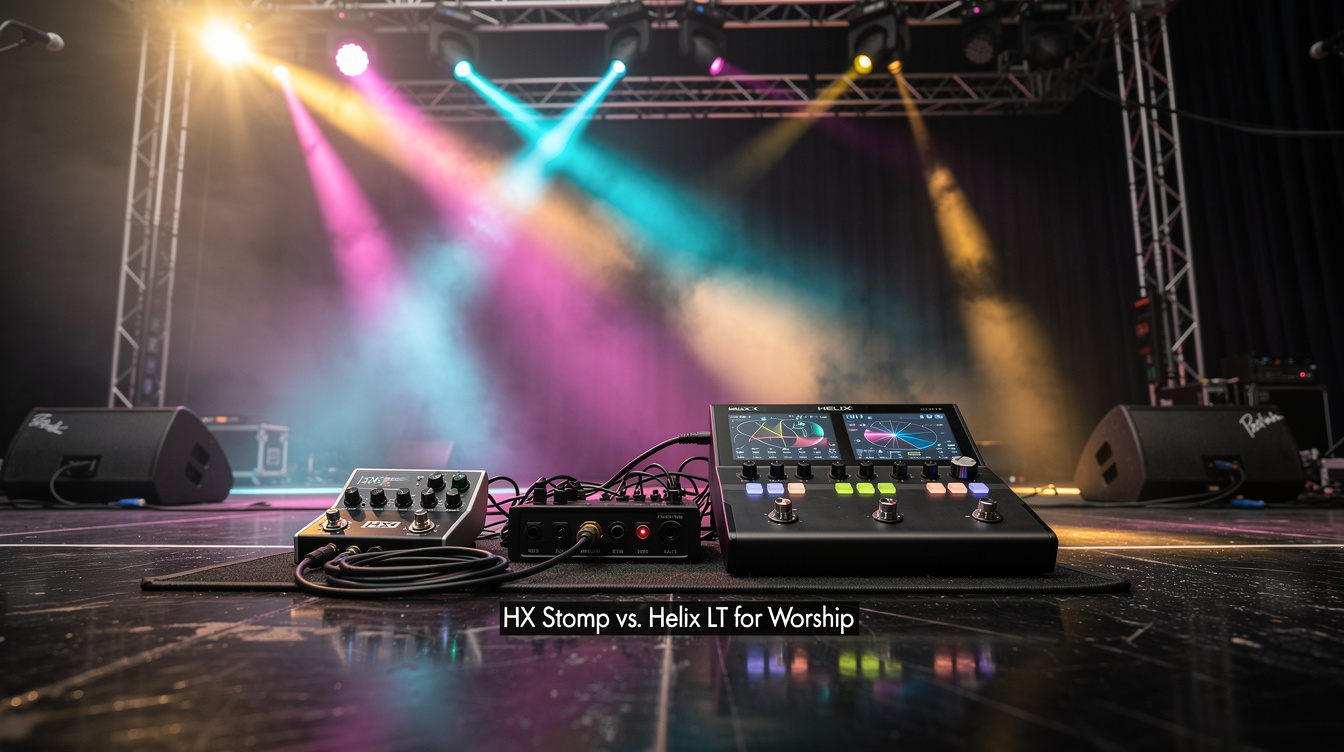
The question comes up almost every time I talk to a worship guitarist who's thinking about going direct: HX Stomp or Helix LT?
Both run Line 6's HX processing engine. Both sound the same. The amp models, the effects algorithms, the IRs are identical. The differences are physical and practical, which means the right choice depends entirely on how you play and what your stage looks like.
Here's how I'd think through it.
Quick Decision Guide
| If this describes you | Choose this |
|---|---|
| Simple worship rig, want compact and direct | HX Stomp |
| Run a full pedalboard alongside the modeler | HX Stomp (it fits in a chain) |
| Need more than 8 simultaneous blocks | Helix LT |
| Use a lot of presets and switch between them live | Helix LT |
| Need dedicated expression pedal on the unit | Helix LT |
| Playing in more than one venue with different rigs | Helix LT |
| Budget is a real constraint | HX Stomp |
If you're using three or four presets on a Sunday morning and running direct, the HX Stomp does everything you need for less money. If you're building complex multi-patch setups or need the flexibility of a full floorboard, the Helix LT is worth the investment.
What's Actually the Same
This matters more than most comparisons acknowledge. The HX Stomp and Helix LT run the same:
- Amp models (including all the Fender, Vox, Marshall, and boutique options)
- Effects algorithms (every reverb, delay, chorus, and drive)
- IR loading (512 custom IR slots on both)
- Signal routing architecture
- HX Edit software and preset sharing
If you build a worship preset on the HX Stomp, it will sound identical on the Helix LT. The tone is not a variable in this decision. That's worth saying clearly, because it's easy to assume the larger unit sounds better. It doesn't. It just does more.
Block Count: The Most Important Practical Difference
The HX Stomp runs up to 8 simultaneous DSP blocks (raised from the original 6 in firmware 3.15 — make sure yours is updated). The Helix LT runs up to 32.
For a standard worship clean tone (amp model, a light drive for leads, delay, reverb, maybe a chorus), you're looking at five to six blocks. The HX Stomp handles that with room to spare. A Vox AC30 model with a Strymon-style delay, a BigSky-style reverb, and a JHS Morning Glory equivalent lands you around six blocks, comfortably inside the eight.
Where the Stomp starts to strain: when you want ambient swells alongside your clean tone alongside your lead drive alongside a longer tail reverb, plus a shimmer pad built from a pitch block into its own reverb. Stack all of that and you're past eight blocks, and the Stomp will ask you to make sacrifices.
The Helix LT never makes you choose. You can build a preset with parallel reverb paths, a separate ambient pad layer, and still have room for the drive chain. For complex worship arrangements where the guitar is doing atmospheric work, that headroom is real.
Footswitch Layout on Stage
The HX Stomp has three footswitches. The Helix LT has ten.
Three footswitches sounds limiting until you understand how the Stomp uses them. In Stomp mode, each switch toggles an individual effect. In Preset mode, you navigate patches. With an external dual switch (a $30 accessory), you can control up to five functions.
The honest reality for most Sunday morning worship guitarists: you're switching between two or three sounds (clean, lead, ambient swell). Three to five footswitches handles that. You don't need ten.
Where ten footswitches matter: if you use Snapshots. The Helix LT allows you to assign eight snapshots per preset: eight different "states" of your entire signal chain stored in a single preset, switchable by footswitch without any gap in audio. This is the feature that makes the LT compelling for live worship specifically. You can move from a quiet verse clean tone to a bridge wall of sound by tapping a single switch, with every parameter (delay mix, reverb decay, drive gain, amp level) all changing simultaneously. No patch gap. No silence.
The HX Stomp does have Snapshots, but only three per preset. That covers verse/chorus/bridge. If your arrangements have more states than that, or if you want dedicated footswitches for each snapshot without juggling modes, the LT's layout is meaningfully better.
Expression Pedal
The Helix LT has a built-in expression pedal. The HX Stomp does not; you'd need to add an external expression pedal (about $50-80) to get the same function.
If you use a volume swell technique, or if you want to control reverb mix or delay feedback dynamically during a service, the expression pedal is more than a convenience. It's the thing that turns a good worship tone into a responsive one.
The Stomp can accept an expression pedal via its EXP jack. So it's not absent; it's a separate purchase and a separate cable and another item on the floor. For some setups that's fine. For a compact board where the whole point is simplicity, adding an expression pedal starts to undermine the reason you chose the Stomp in the first place.
I/O and Integration
Both units have stereo I/O. Both have XLR outputs for direct to PA. Both work as audio interfaces via USB.
The Helix LT adds:
- Two expression pedal inputs (vs. one on the Stomp)
- A dedicated variax input (if you use Line 6 guitars)
- More send/return options for integrating external pedals
The HX Stomp fits into a pedalboard chain more naturally. Because it's small, you can run a few physical pedals alongside it (maybe a wah you prefer over the modeled version, or a specific drive), and the Stomp handles the amp and effects. This hybrid approach is practical and sounds great.
The Helix LT is more self-contained. The assumption is that the LT is the rig, not part of one.
Real Worship Stage Scenarios
Scenario 1: Single player, small church, running into the PA The HX Stomp is the right answer. You need three or four presets, a few effects, and a clean output to the front of house. The Stomp does this beautifully, costs less, and takes up less space on whatever surface it sits on. I've seen this setup serve congregations of 100 people flawlessly.
Scenario 2: Multi-piece worship band, mid-size church, complex arrangements The Helix LT earns its money here. The Snapshots workflow means your transitions between sections don't require thinking; you've pre-programmed the transition, and a single tap executes it cleanly. The extra blocks mean your ambient layers and rhythmic delays coexist without compromise.
Scenario 3: Worship guitarist who also does session work or rehearsal rooms The LT's flexibility is worth it. You're adapting to different monitoring situations, different rooms, different song arrangements every time. The extra DSP headroom and expression pedal mean you're never stuck.
Scenario 4: Budget-first, starting out on a direct rig HX Stomp. Start there, learn what you actually need, upgrade if you outgrow it. Most players who buy the Stomp don't outgrow it. The ones who do usually know exactly why they need the LT by the time they decide.
Price and Value
The HX Stomp retails around $399 (street price as of early 2026). The Helix LT is around $899.
That's a $500 difference. If you're running a simple direct worship rig, that $500 doesn't change your output. If you're running a complex Snapshots-based arrangement system, that $500 buys something you'll use every week.
The calculus is straightforward: what does your actual Sunday morning rig require? Not your hypothetical future rig; your current one. Buy for that.
The Tier Below Both: POD Go
Before you land on the HX Stomp, it's worth knowing there's a cheaper Line 6 option under it, because for a lot of volunteers it's the right one. The POD Go runs around $459 (street price as of mid-2026) and uses the same HX models as both units — the same amps, the same cabs, nearly all the same effects. What you give up is flexibility: a partly fixed signal chain, four freely assignable effect blocks instead of the Stomp's freeform six-to-eight, and four snapshots instead of eight.
Here's why that matters less for worship than it looks. A worship set needs four sounds — clean, pad, drive, lead — and POD Go's four snapshots hold exactly that. The core chain is a compressor, one drive, a delay, and a reverb, which is exactly four free blocks, with the volume pedal built in as a fixed block for your swells. The one place it bites is two-stage drive for big leads; you pick one drive or drop the compressor to fit a second.
So the real ladder is three rungs, not two. POD Go for the volunteer who wants one simple, gig-ready box and a fixed worship chain. HX Stomp for the player who wants freeform blocks and a compact board. LT for the multi-guitarist, multi-mood setlist that needs eight snapshots and dual paths. The full POD Go build — block by block, with the snapshot layout — is in the POD Go worship setup guide.
My Setup for Reference
I run a PRS Silver Sky into a Strymon Timeline and BigSky, into a Vox AC30 for big rooms. On Sundays where I'm direct to PA, I use an HX Stomp to replace the Timeline and BigSky with modeled equivalents, and run the AC30 model through the Stomp to the board.
That's four blocks: amp, delay, reverb, drive for leads. The HX Stomp handles it with room to spare. The three footswitches cover clean/lead/ambient swell, the three states I actually use in a service. If you want the exact blocks and snapshot assignments for that kind of preset, the worship Helix preset walkthrough builds it from an empty patch.
If I were running a band with multiple guitarists and needed to match sounds precisely across a set list with a lot of variation (different moods, different tempos, different reverb environments), I'd be on the LT.