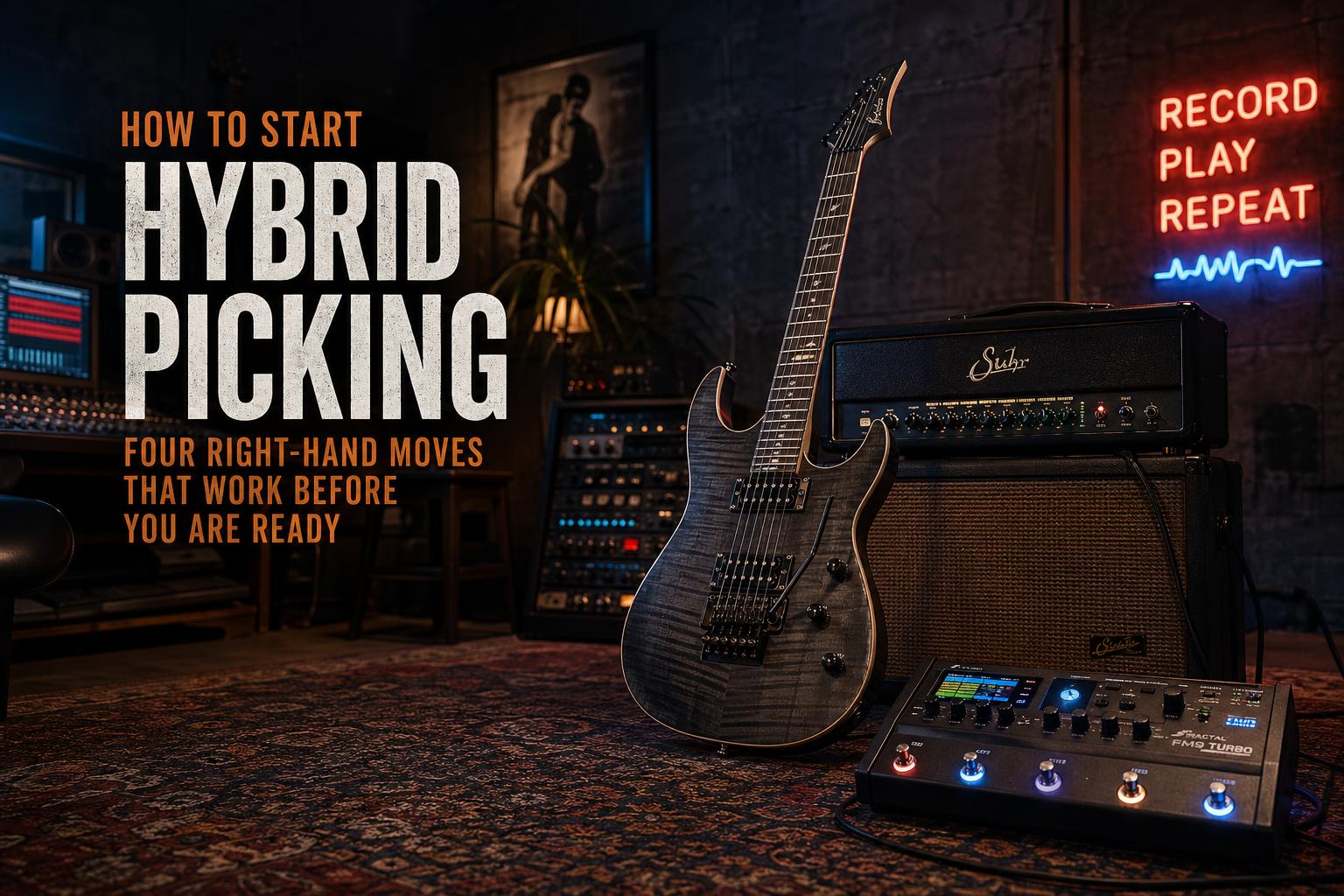
The four moves: (1) Pick a downstroke on the D string, pluck the G string with the middle finger. (2) Pick a downstroke on the A string, pluck the G string with the middle finger and the B string with the ring finger together as a chord. (3) Alternate-pick a single string while the middle and ring fingers tap the strings underneath as ghost notes. (4) Play a chord shape and pluck the top three strings as an arpeggio with pick-middle-ring on consecutive notes. Do these four every day for two weeks. You'll be hybrid picking. Most "exercises" online are way more complicated than they need to be.
Hybrid picking is the technique where you hold a pick between your thumb and index finger and use your middle, ring, and (occasionally) pinky fingers to pluck additional strings. It's the right hand of country lead playing. It's also how Mark Knopfler gets that Sultans of Swing sound, how Albert Collins fingerpicks single-note runs while keeping the pick available for chord work, and how a lot of jazz-rock fusion players play voicings that pure flat-picking can't reach.
I avoided hybrid picking for the first twenty years I played guitar because I thought it was a country thing and I wasn't a country player. The day I tried to copy a Knopfler lick and realized he wasn't using a thumb pick; he was using exactly the same picking grip I was, just with two extra fingers. That was the day I figured out I'd been wrong about this for two decades. The technique is for everyone. Picking it up at 50 felt the same as picking up barre chords at 16. Awkward for two weeks, then permanent.
If you've been putting this off because you don't play Nashville, stop. Here's how to start.
What You Actually Need to Know Before You Start
| Question | Answer |
|---|---|
| What pick? | Whatever you already use. Heavier picks (1.0mm+) make the technique easier, but anything works. |
| What guitar? | Telecaster is the canonical choice but any guitar works. Single-coil guitars give you more attack clarity, which helps when you're learning. |
| Acoustic or electric? | Either. Acoustic is harder because the strings are heavier and the action is higher, but it teaches you a stronger right hand. |
| Pick grip? | Same as you always use. Don't change anything. |
| Finger position? | Middle, ring, and (later) pinky float about an inch above the strings, ready to pluck. Don't anchor anything. |
| How long until I can use this? | Two to three weeks of 10 minutes a day. You'll have it forever after that. |
The most common mistake at the start is changing too much at once. Don't switch picks. Don't change your guitar. Don't relearn your grip. The only new thing is what your middle and ring fingers are doing. Everything else stays the same.
Move One: Pick + Pluck
This is the fundamental gesture and the only one that actually matters for the first few days.
Hold a chord (start with a simple G chord, root on the low E). You're going to pick a downstroke on one string and pluck a higher string with your middle finger at the same time. The pick goes down on the D string. The middle finger pulls up on the G string. Both strings sound at the same time.
Try it slow. Pick the D, pluck the G. Pick the D, pluck the G. The middle finger doesn't reach up to the string and back; it lives just above the strings already, and the motion is a small downward push followed by a recoil. Think of it like flicking a small bug off a tabletop.
Once you can do this without missing the string with the finger, do it as a steady eighth-note rhythm. Pick-pluck, pick-pluck, pick-pluck. The two notes happen simultaneously. They're not a roll, they're not an arpeggio; they're a single doubled-up gesture.
Spend three days here. Don't move on until the doubled gesture feels natural and you don't have to think about which finger is plucking. You're building a new motor pattern from nothing, and the pattern needs to set before you add anything else to it.
Move Two: Pick + Pluck + Pluck (Three Notes at Once)
Now add the ring finger.
Same chord. Pick a downstroke on the A string. Pluck the G string with the middle finger AND the B string with the ring finger at the same time. Three notes sound simultaneously: the picked note, the middle-finger note, and the ring-finger note. This is your basic country chord roll setup, and once you can do it cleanly, you can play half of every country lead line ever recorded.
The ring finger is going to feel weak and uncoordinated. That's correct. The ring finger is the weakest finger on most people's right hand and it's also the one with the least independent motor control. Don't fight it. Just do the gesture slowly enough that the ring finger has time to make the pluck cleanly, and over a few days the strength and coordination will arrive.
A lot of the discussion online about hybrid picking dwells on whether you should use the middle finger only, middle plus ring, or middle plus ring plus pinky. The honest answer is: start with middle, add ring once middle is automatic, and worry about the pinky maybe never. Most of the great players use middle and ring most of the time and only break out the pinky for specific four-note voicings. You don't need the pinky to play hybrid-picked country leads.
When the three-note gesture is clean, try it across different chord shapes. C chord. D chord. A chord. The geometry of which strings the fingers reach changes with the chord, and that's part of what you're training: the right hand learning to find the right strings without looking.
Move Three: Pick a String, Ghost the Others (Chicken Pickin' Foundation)
This is where the technique starts to feel useful for lead playing instead of just chord work.
Play an alternate-picked single-note line on the B string. Just a chromatic exercise: B, C, B, C, B, C, alternate picking on the B string. While you're doing that, lightly tap the G string with your middle finger and the high E string with your ring finger on every beat. Don't pluck them clean; just tap them while they're muted by your left hand. The muting comes from your left hand fingers laying lightly across the strings you're not playing.
What you should hear: the B string ringing the alternate-picked notes, plus a percussive "click-cluck" from the muted G and high E strings on every beat. This is the foundation of chicken pickin': the percussive cluck against the melodic line. The middle and ring fingers are providing rhythm; the pick is providing melody.
This is the gesture that hooked me on the technique. Once I could do it slowly (alternate-picking a melody while the middle and ring fingers added rhythmic clucks), I realized why country players like Brent Mason and Brad Paisley sound the way they do. The right hand is playing two parts at once: a melody line on the picked string and a percussion track on the muted strings.
I covered the chicken pickin' technique and the hybrid picking for rock and blues context in earlier posts. This drill is the building block for both. Get this one solid and you can apply it to anything.
Move Four: Pick-Middle-Ring Arpeggio
The fourth move is the smoothest one and the one that opens up the most musical territory once you have it.
Hold a chord (a D shape works well). Pick the D string with a downstroke. Pluck the G string with the middle finger. Pluck the B string with the ring finger. Three consecutive notes, one after another, fast.
This is an arpeggio gesture and it's the bread-and-butter of folk-rock and country lead playing. Sultans of Swing is built on this kind of figure. Joe Walsh's solo on Hotel California uses it. Half of every Brad Paisley lead line uses it. You play a chord shape and roll through the strings as a three-note flourish.
The trick is the sequencing. Pick first, middle second, ring third. The pick lands first, the middle finger has the next note, the ring finger has the third. Each finger plucks immediately after the previous one, almost simultaneously, but not quite. The result sounds like a small cascade of notes rather than three notes hit at once.
Once you can do the three-note arpeggio cleanly, you can extend it. Move the chord shape up the neck. Reverse the order (ring, middle, pick; that's harder). Add the high E string by using the pinky (this is where the pinky earns its keep, if you decide to use it). The basic gesture is the same; the variations are infinite.
Practice this for two minutes a day for two weeks. By the end you'll have a working hybrid-picking arpeggio in three different chord shapes and you'll start to hear it in songs you've heard a thousand times without recognizing what was happening in the right hand.
Putting the Four Moves Together
Here's the practice routine I'd give someone who asked me how to start:
| Day | Move | Time |
|---|---|---|
| 1–3 | Move One only (pick + pluck) | 10 minutes |
| 4–7 | Move One + Move Two (add ring finger) | 10 minutes split between the two |
| 8–10 | Move Three (ghost notes) added | 10 minutes split across three |
| 11–14 | Move Four (arpeggio) added, all four in rotation | 10–15 minutes total |
| 15+ | Apply to actual songs | As long as you want |
The whole thing takes about two weeks of ten minutes a day to build a foundation that holds. You won't be Brad Paisley at the end of two weeks. You will be hybrid picking. The difference between someone who is and isn't a hybrid picker is that the hybrid picker has the right-hand motor pattern available; everything after that is repertoire and refinement, but the gesture itself is binary; you either can or you can't.
Don't try to learn songs while you're learning the gesture. Songs are a distraction at this stage. The brain is learning the right-hand pattern and it can't simultaneously learn melodic content. Drill the four moves until they're automatic, then start applying them to songs.
What to Avoid While You're Learning
A few things I see new hybrid pickers do that slow them down:
Don't anchor your hand. Some players anchor their pinky on the pickguard or the bridge while they hybrid pick. This is a hard habit to break later and it limits the range your fingers can reach. Float the hand. Train the right hand to support itself.
Don't watch your right hand. Watch the chord you're holding with your left hand if you need to look at anything. The right hand needs to learn to find the strings by feel. If you watch it, you'll teach yourself to need to watch it forever, and you can't watch your right hand and read music at the same time.
Don't switch to fingerpicks or thumbpicks early. Some players use a thumbpick instead of a flatpick for hybrid work. This is a legitimate choice for some genres but it changes the gesture meaningfully and it's not what most rock/blues hybrid pickers use. If your goal is country bluegrass picking specifically, the thumbpick conversation is worth having later. For now, use what you already use.
Don't try to play fast. The technique scales to high tempos eventually but only after the slow foundation is rock-solid. Players who try to play fast hybrid lines without doing the slow drills end up with a sloppy, inconsistent right hand that they have to unlearn later.
Don't expect it to feel right at first. The middle and ring fingers will feel weak, awkward, and uncoordinated. This is true for everyone, and it's the single biggest reason people quit before they get past the first week. The gesture becomes natural through repetition. You can't think your way around the awkwardness; you have to drill through it.
What Three Weeks Actually Buys You
I always assumed hybrid picking required some kind of formal training (a country teacher, a Nashville chart-reading background, a year of bluegrass camps). What I actually found, when I sat down at 50 to learn it from scratch, was that the four basic gestures took about three weeks of daily ten-minute practice to become automatic. After that, every musical application I tried (playing a Knopfler line, adding a hybrid-picked arpeggio to a Stones song, getting a percussive country cluck out of a blues lead) was just applying the gestures I already had to new contexts.
The lesson, which probably applies to most "advanced" guitar techniques: the technique itself is usually small. The repertoire and musical application is huge. Don't confuse the two. Drilling the gesture is a few weeks of motor learning. Applying the gesture to different musical contexts is years of playing experience that you accumulate naturally once the gesture is in your hands.
I should've learned this twenty years earlier. Don't make the same mistake.
The four moves are everything. Drill them slow, drill them daily, and don't add musical content until the gestures are clean. Two weeks from now you'll be a hybrid picker. A year from now you won't remember what it was like to not have this technique available. The investment is small and the return is permanent. Worth doing.