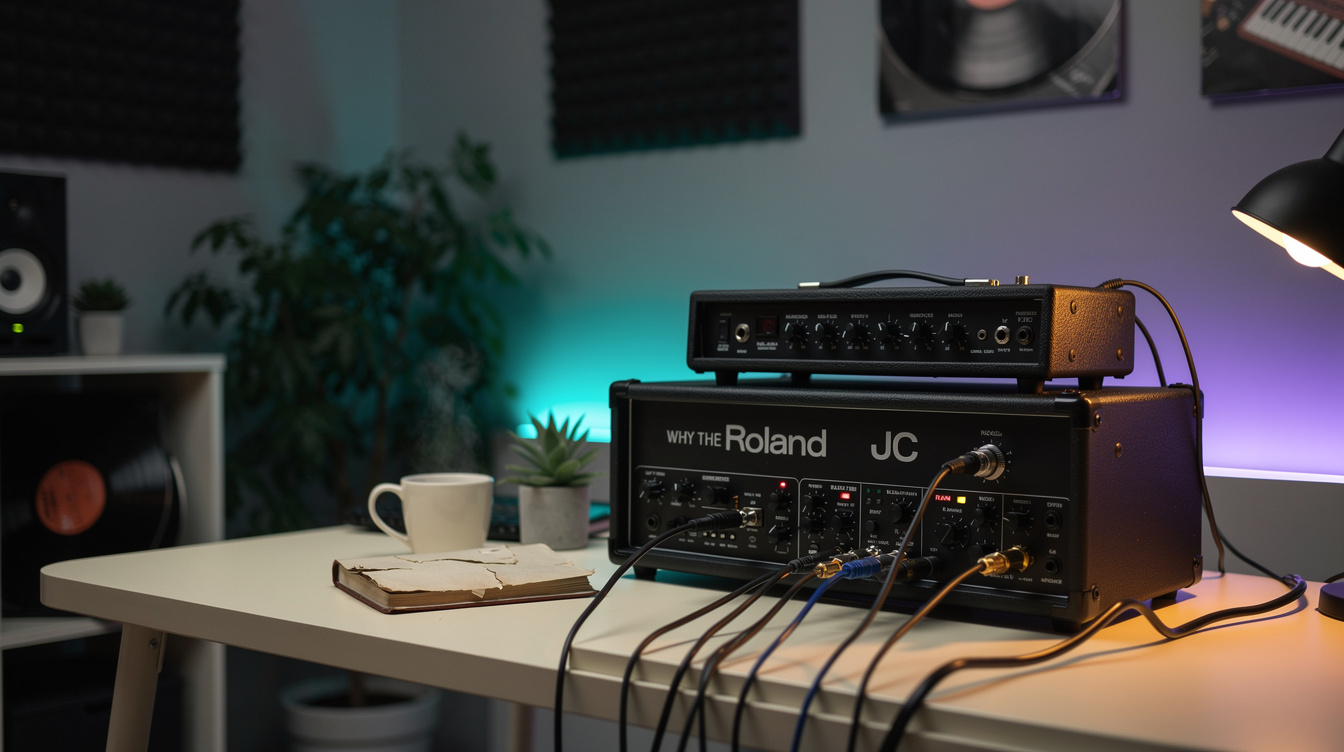
Our Roland JC-120 settings guide includes a caveat at the end about modeler approximations. That caveat deserves a full post, because the JC-120 is one of the few amps where the gap between the real thing and a digital model is structural, not just a matter of better algorithms or more processing.
Most amp modeling falls short in ways that are measurable but contextually acceptable. Power-tube sag, harmonic saturation, speaker cone breakup: these are things modelers approximate with varying success, and the results are often close enough that the question becomes "close enough for what?" The JC-120's situation is different, because the core character of the amp is built around an analog circuit that works the way it does because of how it samples audio at a physical level.
What the BBD Circuit Actually Does
The Roland JC-120's chorus effect uses a bucket brigade device (BBD) chip, a type of analog sampler where audio signal is passed as electrical charge through a series of capacitors in sequence, like water passing through buckets in a chain. The delay between input and output creates a copy of the signal that's slightly shifted in time; modulating that delay time with a low-frequency oscillator creates pitch variation, which is how the chorus effect is produced.
What makes this different from a digital chorus effect:
The signal path is analog all the way through. In a digital modeler, the incoming signal is converted to digital (ADC), processed, and converted back (DAC). The JC-120's BBD circuit processes the signal while it's still analog: charge moving through capacitors, not numbers moving through registers.
Leakage and noise are part of the character. Each stage in a bucket brigade chain transfers charge imperfectly. A small amount of the charge leaks at every stage, adding a characteristic noise floor and a slight high-frequency rolloff as the signal passes through more stages. This isn't distortion; it's a texture that changes how the wet signal blends with the dry signal at an analog mixer stage.
The wet and dry signals are combined before the power amp. In the JC-120's circuit, the BBD output and the direct signal are blended before they hit the power amplification stage. In a modeler, chorus is applied as a block after the amp model. The location of the mix point changes how the two signals interact under the power stage's influence.
The Solid-State Power Stage: A Different Headroom Problem
The JC-120 uses bipolar transistors in its power stage (not tubes). This matters because the power stage's behavior under load is fundamentally different from any tube amp model.
Tube amps compress as they approach clipping, which softens the attack at high output levels and produces harmonically rich breakup. The JC-120's solid-state power stage clips hard with no compression rounding. The headroom ceiling is abrupt. At any volume below that ceiling, the output is completely linear: no compression, no saturation, no even-harmonic content from the power stage.
This is why the JC-120 is described as "pristine" or "clinical" by players who don't like it, and as "perfectly transparent" by players who do. At moderate volumes, the amp adds essentially nothing to the signal beyond amplification. The character is entirely in the BBD chorus circuit and the 12-inch speakers.
For modelers, this creates a problem: amp models are specifically designed to add the characteristic behavior of the modeled amp. A Jazz Rivet 120 model in Helix adds a solid-state response approximation, but the clean headroom of the original is hard to model because it's defined by the absence of the saturation behavior that most amp models are built to capture.
I ran my Strandberg through both a JC-120 at a rehearsal space and the Helix Jazz Rivet 120 model through my HS8s and recorded both. The modeled version was close enough that I initially thought I'd misidentified which file was which in my DAW. The difference showed up in two places: the high-frequency content of the chorus (the model was cleaner and less rounded at the top), and the behavior when I dug in hard with a pick attack on a chord. The real amp pushed back slightly in a way the model didn't.
The Stereo Driver Coupling Problem
The JC-120 runs two 60-watt power sections into two 12-inch speakers in a single cabinet, in a stereo configuration. The BBD circuit creates left-right separation by running one signal path direct and one through the delay chain; the pitch variation in the delayed path produces the stereo spread.
The two speakers are approximately 24 inches apart inside a single cabinet. At that proximity, they share air pressure. The output of one driver affects the acoustic environment the other driver is operating in. This physical coupling creates comb-filtering artifacts at specific frequencies that are part of the JC-120's characteristic width and shimmer.
When you run a modeler through two separate studio monitors separated by three or four feet, or through an FRFR at any distance, this coupling is absent entirely. The stereo image is accurate but the acoustic interference is different; it's room-dependent rather than cabinet-dependent.
This is the hardest part to approximate, and it only becomes obvious when you hear a JC-120 at close range in a room and compare it to any monitor-based reproduction of the same signal.
Best Approximations by Platform
Helix
The Jazz Rivet 120 model is the starting point. For the chorus, use the Helix Chorus block with these settings as a baseline:
Run the signal path in stereo. Pan the dry and wet paths to L80 / R80 rather than hard L/R. The JC-120's stereo spread is wide but not fully hard-panned in practice. Roll a low-cut filter into the wet path at 120–150 Hz to reduce the low-mid accumulation that makes digital chorus sound thick rather than wide.
Quad Cortex
The Quad Cortex doesn't have a dedicated JC-120 model. The Fender Twin Reverb or clean Vox models approximate the solid-state headroom behavior better than high-gain clean models. For the chorus, use the QC's BBD Chorus block (Rate: 0.65 Hz, Depth: 38%, Mix: 42%, Stereo Width: 75%).
The better option: search Cortex Cloud for JC-120 Neural Captures. Community captures record the actual amp's output behavior rather than modeling it from circuit analysis. The captures for the clean preamp and power stage are accurate. The caveat: captures don't include the BBD chorus circuit; you still add the chorus block separately, and you're still using a digital approximation for the part that matters most.
Plugins
For bedroom or studio use, two things together get closer than either alone:
- Neural DSP Archetype: Cory Wong: the clean models have genuinely solid-state-style headroom. It's not a JC-120 model, but the clean headroom response is similar in character.
- AudioThing Filteria (or the Dimension D plugin if you can find it): the Dimension D was Roland's studio rack version of the BBD chorus architecture used in the JC-120. It's not identical, but the circuit philosophy is similar, and the result has more of the BBD texture than generic chorus plugins.
When the Gap Actually Matters
The difference between a JC-120 and a modeled approximation is most audible in:
- In-room listening at moderate volumes: the physical speaker coupling is absent from any monitor or FRFR reproduction
- Close-mic'd recording through the actual amp: a microphone captures the acoustic driver interaction; that information isn't in any IR
- High-volume live use: the power stage's solid-state linear behavior at loud volumes is distinctive and hard to replicate on platforms that model tube-style power stages
The gap is least audible in:
- Headphone monitoring or IEM use
- FOH-only signal paths where the output goes direct to PA
- When the chorus depth is set lower than the JC-120's factory default
For anyone playing worship or ambient music through IEMs and a direct signal, a good Helix or QC approximation is entirely serviceable. For anyone recording the amp with a microphone in a room, or performing in a context where in-room amp tone is the product, the real amp is doing something that no modeler is currently solving. It's worth understanding why rather than assuming better firmware will close the gap.