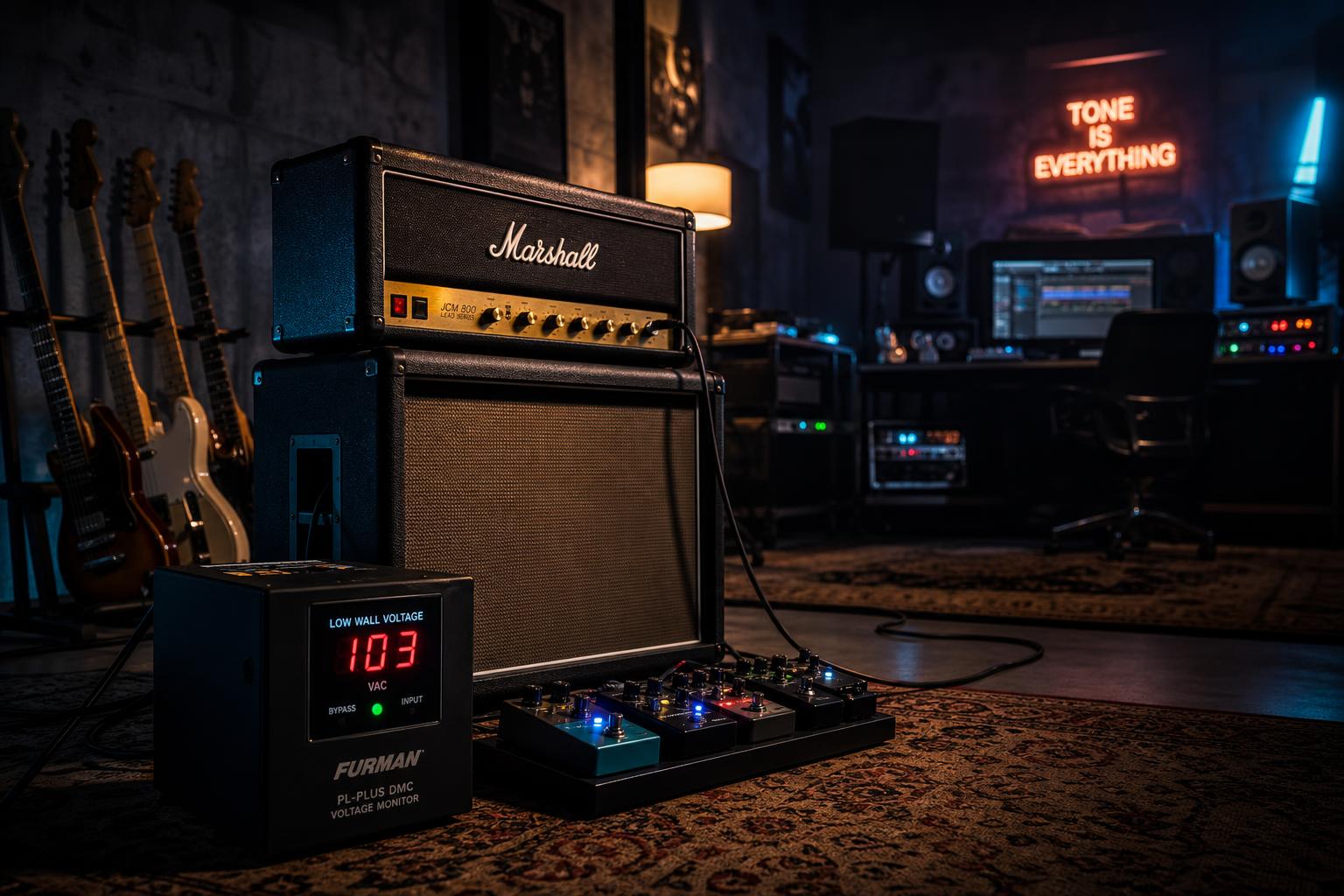
Quick read: Wall voltage at a venue varies more than most players realize — anywhere from 105V to 130V depending on the building and the load. A tube amp's feel changes with the voltage. Low voltage makes the amp spongier and earlier into compression; high voltage tightens the response and raises the headroom. A $25 Kill-A-Watt meter tells you what the actual voltage is at the outlet you are plugged into. The real fix is a voltage regulator (Furman P-2400 AR, Brown Box) that holds the amp at a constant voltage regardless of what the wall is doing. The cheap fix is to adjust the master volume up or down a notch and stop chasing the same settings on every stage.
You set up the same amp the same way every night and it sounds different in every room. Most players blame the room. The room is part of it. But there is a thing that nobody talks about until they have toured enough to notice it, and that thing is the wall voltage.
The amp at the venue in Atlanta last Wednesday was reading 108 volts at the outlet behind the cabinet. Same amp at the room in Birmingham two nights later read 124 volts. Same settings, same guitar, same cable. Wednesday it sounded soft and pillowy and would not get tight no matter where you set the master. Friday it was clear and punchy with more headroom than I knew the amp had. The difference was 16 volts on the wall.
This is the piece about why that happens, how to measure it, and what to do about it. The short answer is that a tube amp's feel is tied to its plate voltage, and the plate voltage tracks the wall voltage almost one-to-one. Change the wall, change the feel.
What the Wall Is Actually Delivering
US nominal voltage is 120 volts. The standard that utilities operate under (ANSI C84.1, if anyone cares to look it up) allows the voltage at your service entrance to be anywhere from 114 volts to 126 volts and still be considered normal. That is a 12-volt range right out of the gate, before any of the building's internal wiring gets involved.
Then there is everything else that drops the voltage between the service entrance and the outlet behind your cab. Long runs of building wire. Other loads on the same circuit — refrigerators, HVAC, lighting dimmers, the bar's blender. Old wiring with corroded connections. A breaker panel from 1962. By the time the voltage reaches the outlet you are plugged into, the 120 volts from the utility can be 105 volts at peak load on a Saturday night in a small club.
Going the other direction, an off-peak hour in a building with light loads can see voltage climb to 128 or 130. The wall is not a stable thing. It moves around all day long.
I keep a Kill-A-Watt in my gig bag now. It costs about $25 at any hardware store. You plug it into the wall, you plug your amp into it, and the display reads the actual voltage and current the amp is drawing. The number matters more than I thought it would the first time someone showed me.
| Voltage range | What you'll hear |
|---|---|
| 105-110V | Spongy, slow attack, breaks up early, less headroom |
| 110-115V | Slightly soft but useable; most players cannot pick this out |
| 115-122V | The amp sounds the way the amp is supposed to sound |
| 122-128V | Tighter, more headroom, breakup point pushed up the volume knob |
| 128-132V | Aggressive, almost too tight, can sound brittle on bright amps |
| 132V+ | Stop. Tube life is shortening and the filter caps are unhappy. |
What Low Voltage Does to a Tube Amp
A tube amp's plate voltage — the voltage on the plate of the output tubes that determines how hard the tubes are biased and how much power they can deliver — tracks the wall voltage almost linearly. A 10 percent drop on the wall is roughly a 10 percent drop in plate voltage.
Lower plate voltage means:
- Lower maximum clean output. The amp clips earlier. A 50-watt amp running on 108 volts behaves more like a 35-watt amp.
- Earlier saturation. The breakup point on the master volume knob moves down. A setting that was clean at 125 volts is on the edge of crunch at 108.
- More compression. The power section sags more readily, which adds the spongy feel that some players seek out and others avoid.
- Slower response to transients. The power transformer's stored energy is lower, which means fast attacks have less authority and held notes bloom more slowly.
The amps where this is most noticeable are the ones with the least headroom to start with. A tweed Deluxe or a Princeton Reverb at 108 volts is a different amp than the same one at 125 volts. The breakup is earlier, the touch sensitivity is different, the dynamics change.
The amps where it is least noticeable are the high-headroom designs — a Twin Reverb, a JCM800 100-watt, anything with a stiff power supply and plenty of plate voltage to spare. The Twin still has 90 percent of its headroom at 108 volts. The breakup point on the volume knob barely moves. The amp feels almost the same.
What High Voltage Does
The other end of the swing is less talked about but just as real. A 50-watt Marshall at 128 volts is closer to a 60-watt amp than to its nameplate rating. The headroom is higher. The breakup point on the volume knob is further up. The response is tighter and more aggressive on the attack.
For some amps this is what you want. A Plexi running hot on a high-voltage night is the sound that defined British rock guitar. The amp is doing the thing it was designed to do, just with a little more push than nominal.
For other amps it can be too much. A bright amp like an AC30 or a Bandmaster at 128 volts can start to feel sharp around the edges — the top end has too much energy, the cymbal-crash quality of the open chord turns into glass. The fix on a high-voltage night is to roll the treble back half a notch or use a darker speaker, but you have to know what is happening to know to make the adjustment.
How to Tell What the Voltage Is Doing
The Kill-A-Watt is the easy answer. Plug it in, read the number, know what you are working with.
Without a meter, the signs are still readable if you know what to look for:
- The amp feels different than it did at sound check. The room temperature has not changed, you did not move anything. The voltage probably moved.
- The same settings sound different from last night's gig. Same amp, same room, same player. The variable is the building.
- The amp gets tighter as the night goes on, or looser. Voltage at a venue drops as the building's load increases (bar in full swing, kitchen running, HVAC working harder) and recovers when the load drops. A noon sound check can read 124 volts; the same outlet at 10 PM can read 110.
If you tour with the same amp regularly, you start to develop an internal sense of what the voltage is doing. The amp tells you. Once you have the language for it, you can hear it.
The Real Fix: A Voltage Regulator
If you want the amp to feel the same every night regardless of what the wall is doing, you need a voltage regulator. This is different from a power conditioner — the conditioner cleans up the AC noise and surge-protects the amp, but it does not change the voltage. A voltage regulator actively adjusts its output to deliver a target voltage regardless of what comes in.
The two options worth knowing about:
Furman P-2400 AR. A true voltage regulator in a rack-mount form factor. Input range of 97 to 137 volts; output held at 120 volts within about 5 percent. Costs around $1,200. Rack-mountable, which is convenient for any rig that has a rack already.
Brown Box (and similar variacs). A passive voltage adjuster — essentially a variac with selectable output taps for 100, 105, 110, 115, and 120 volts. The Brown Box does not regulate (the output voltage tracks the input minus a fixed offset), but it lets the player intentionally underpower the amp for the spongy feel, or compensate for high wall voltage by selecting a lower tap. About $250-400 depending on the model. Not a regulator in the strict sense, but it does the job for most touring contexts and is cheaper than the Furman.
A regulator is the right tool for the player who wants the amp to feel identical at every gig. The Brown Box is the right tool for the player who wants to dial in the voltage by ear and is comfortable making the decision at each venue.
A regulator does not fix every voltage problem. It cannot compensate for badly distorted AC (the kind that comes off a generator or a building with a failing transformer) or for ground problems. It also adds a small amount of heat to the rig — the regulator is doing real work to step the voltage up or down. But for the day-to-day swing between 108 and 128 volts that touring amps actually see, a regulator solves it.
The Cheap Fix: Adjust by Ear
If a $1,200 regulator is not in the cards, the practical alternative is to adjust the amp by ear at each gig. Three rules:
- Sound check matters more than soundcheck. The wall voltage at 5 PM is not the same as at 9 PM. Set the amp at the level the band will be playing at, with the lights and PA running. Whatever the voltage is doing then is what the amp will be working against during the set.
- Master volume goes up on a low-voltage night, down on a high-voltage night. A half-notch on the master is roughly equivalent to a 10 percent voltage swing. If the amp feels soft, add a touch. If it feels too aggressive, back off.
- Stop chasing the same knob settings. The settings that worked last night at the room you played in Birmingham are not the settings for tonight in Atlanta. The amp is the same. The wall is not.
The lesson worth learning the hard way and then not having to learn again is that a Plexi at 102 volts will not get above the breakup point no matter where you set the master. The fix on that kind of night is the smaller amp out of the truck, and the second fix is a meter the next time around so the surprise does not happen again.
What the Engineer Sees
I have asked a few touring front-of-house engineers what they notice on the FOH side when wall voltage changes. The consistent answer is that they hear the amp's breakup point shift but the player rarely tells them about it. The amp sounds spongier in the mix on a low-voltage night, and the engineer has to add a touch of compression to even things out. On a high-voltage night the amp is tighter and louder for the same knob setting, so the channel fader comes down by 1-2 dB.
The engineers also notice that the same amp at the same room can sound different night to night, and the cause is almost always the wall, not the amp.
The lesson worth taking away is that the amp's behavior is not just about the amp. The thing the amp is plugged into matters too. A meter, a regulator, and a habit of paying attention to the wall solve a problem most touring players have been hearing for years and blaming on the room.