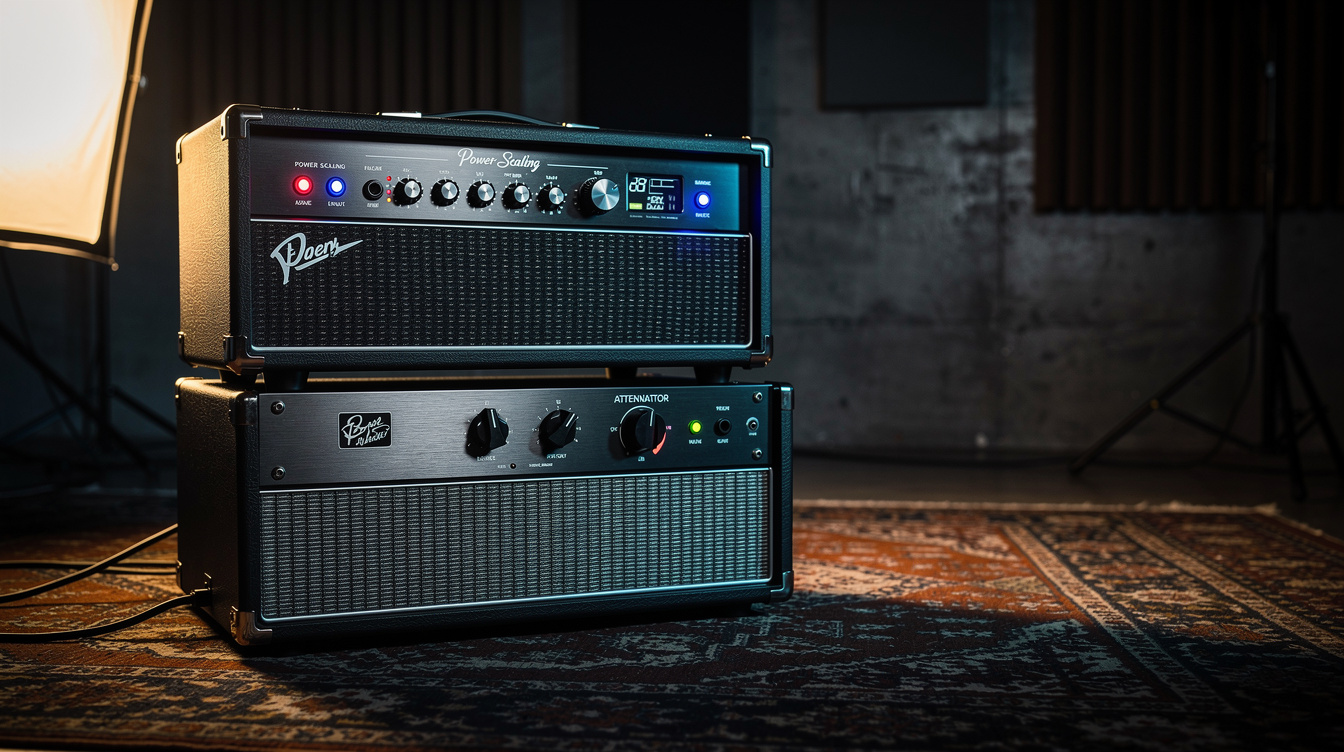
The attenuator limits post identified 15dB as the practical ceiling for attenuator usefulness. Beyond that, neither reactive nor resistive designs preserve what makes a cranked tube amp sound like a cranked tube amp. Power scaling is the other approach, and it operates on a different principle entirely.
This post explains what each system actually does, where the meaningful differences are, and how to decide which one makes sense for your situation.
How They Work
Attenuators
An attenuator sits between the amplifier's speaker output and the speaker cabinet. It absorbs power from the amp and either dissipates it as heat (resistive attenuator) or absorbs it through an inductor-capacitor network that mimics speaker behavior (reactive attenuator).
The amp operates at full power. The attenuator reduces what reaches the speaker.
The limitation: the amp's power tubes are doing full work, but the signal reaching the speaker is reduced. At 12dB of attenuation, roughly 1/16th of the amp's output power reaches the speaker. The power tubes are saturating exactly as they would at full volume (which is the good part), but the speaker receives a much smaller signal, and the room interaction, speaker cone excursion, and physical air movement that are part of a loud amp's character are absent.
For detail on how reactive and resistive designs differ, see reactive vs. resistive attenuators. The short version: reactive attenuators maintain a speaker-like impedance curve across frequency, which preserves more of the power stage's frequency-dependent behavior. Resistive attenuators present a flat resistive load, which can alter the power stage's response.
Power Scaling
Power scaling, developed by Kevin O'Connor at London Power, modifies the amplifier's internal power supply voltage. Reducing the B+ voltage to the power stage reduces the power output directly, without changing the operating conditions of the tubes proportionally.
The key distinction: power scaling changes what the power tubes are doing, not what reaches the speaker. At 50% power scale, the power tubes are operating at reduced voltage, which changes their saturation behavior. The speaker still receives the full output of the amp. There's no attenuation between amp and speaker.
This produces a fundamentally different result. The speaker moves with the full energy of whatever the amp is producing. The room interaction is preserved. But the power tube saturation character changes because the tubes are no longer operating at their full designed voltage.
How They Sound
The honest comparison: a well-implemented reactive attenuator at moderate reduction (6–9dB) sounds closer to a cranked amp than power scaling at the same apparent volume reduction, because the power tubes are actually doing the same work they'd do at full volume.
Power scaling sounds different (not worse, but different). With the B+ voltage reduced, the power tubes reach saturation at a lower threshold. The amp gets "hairy" sooner, with a slightly compressed, harmonically rich character that isn't the same as the power tubes saturating at full voltage. Players who want the character of a power-scaled amp sometimes prefer it to the full-volume version; it can be a more consistently musical distortion. Players who want the specific character of a cranked amp at bedroom volume will be disappointed.
The crossover point: at reductions greater than 12dB, attenuators begin changing the amp's response in ways that start to resemble what power scaling does. The power tubes are doing full work, but the speaker's response and the room interaction are so reduced that the result sounds more processed. At that depth, the advantage of attenuation over power scaling narrows.
What Each Requires
| Power Scaling | Reactive Attenuator | Resistive Attenuator | |
|---|---|---|---|
| Installation | Internal amp modification | External, plug in | External, plug in |
| Warranty impact | Voids most amp warranties | None | None |
| Cost | $200–$600 (mod service or kit) | $250–$800 (Fryette, Two Notes) | $50–$200 (Palmer, simple pads) |
| Tonal character at high reduction | Power tube character changes | Preserves power tube saturation | Alters power stage response |
| Speaker interaction | Full speaker excursion preserved | Speaker receives attenuated signal | Speaker receives attenuated signal |
| Reversibility | Difficult without rework | Disconnect and done | Disconnect and done |
Power Scaling: The Practical Obstacles
Power scaling requires opening the amplifier and modifying internal components. London Power sells kits designed for specific amp platforms (Marshall, Fender, Vox), and there are technicians who specialize in the modification. But:
- Most amp manufacturer warranties are voided by internal modification
- Not all amplifier topologies accept power scaling cleanly; some require additional circuit changes to operate reliably at reduced voltage
- The modification is not easily reversed if you decide it isn't what you wanted
For a vintage or valuable amplifier, this is a significant consideration. For a budget amplifier that you bought specifically to modify for bedroom use, the calculus is different.
Attenuators: The Practical Ceiling
An attenuator requires no modification and can be disconnected and sold. The tradeoff is the 15dB ceiling. At deeper reductions, the tonal character changes in ways that defeat the purpose. See tube amp bedroom volume behavior for why the power stage alone doesn't explain everything happening at high volume, and why bedroom use is inherently a compromise regardless of approach.
Which to Choose
Choose a reactive attenuator if:
- You need bedroom-to-moderate-volume use (6–12dB reduction)
- You want zero warranty risk and easy removal
- You want to preserve the specific character of the amp's power tubes at saturation
- You're not sure this approach will work for you and want a reversible experiment
Choose power scaling if:
- You want consistent playability across a very wide volume range
- You like the compressed, harmonically rich character of power-scaled operation (it's a legitimate tone in its own right)
- You own or are building an amp that you're comfortable modifying
- You want full speaker excursion and room interaction at very low output levels
Consider a lower-wattage amp if:
- You need reductions greater than 15dB regularly
- You're spending more on attenuation or modification than a second smaller amp would cost
- The amp you're attenuating costs more than the character it adds at bedroom volume is worth
Consider a load box if:
- You need to play or record with no acoustic sound in the room at all
- You're going direct to an interface or PA and taking your cab sound from an impulse response
- You want full power-tube saturation without a moving speaker and are comfortable getting the cab voicing from an IR
The London Power website has the most thorough documentation of power scaling theory and compatibility charts for common amplifier platforms. The reactive vs. resistive attenuators post covers the hardware selection decision in more detail if you're going the attenuator route.
Where the Load Box Fits
Power scaling and attenuators both assume you still want a speaker moving air. A load box doesn't. It replaces the speaker with a dummy load — resistive or reactive — so the amp runs at full power into something that produces no sound, and you take a line-level signal off it into an impulse response or a separate cab elsewhere. The power tubes saturate exactly as they would at full volume, because as far as the amp knows, it is at full volume.
That makes the load box the right tool for a different problem than the other two. An attenuator is for "I want a quieter speaker in the room." Power scaling is for "I want a wide volume range from one amp." A load box is for "I want no sound in the room at all" — silent recording, late-night practice in headphones, or a fully direct rig where the cab tone comes from an IR rather than a microphone. Many modern load boxes are reactive and include built-in IR loading, which blurs the line between a load box and the power-amp-in stage of a modeler.
The tradeoff is that you've removed the speaker and the room entirely, so everything a real cab and a real room contribute now has to come from the IR. For a deeper comparison of the load box against attenuation specifically, see reactive load box vs. attenuator. The short version: if you ever need the amp to be genuinely silent, neither an attenuator nor power scaling gets you there — only a load box does.