Somewhere in a back room in Austin there is a shelf of speaker frames with nothing in them — Jensens, Oxfords, a CTS or two, each with its paper torn out and its date code still stamped clean on the basket — waiting on somebody to decide whether they are worth a new cone. That shelf exists in every serious repair shop, and the decision it represents comes up for every owner of an old Fender sooner or later, because paper cones give out and the speaker in a sixty-year-old amp is living on borrowed time.
The usual framing is recone versus replace, as if the two were opposite ends of originality. The more useful question is what a recone actually keeps, and what it quietly swaps out, because the answer is not the one most people assume.
What a Recone Kit Replaces, Part by Part
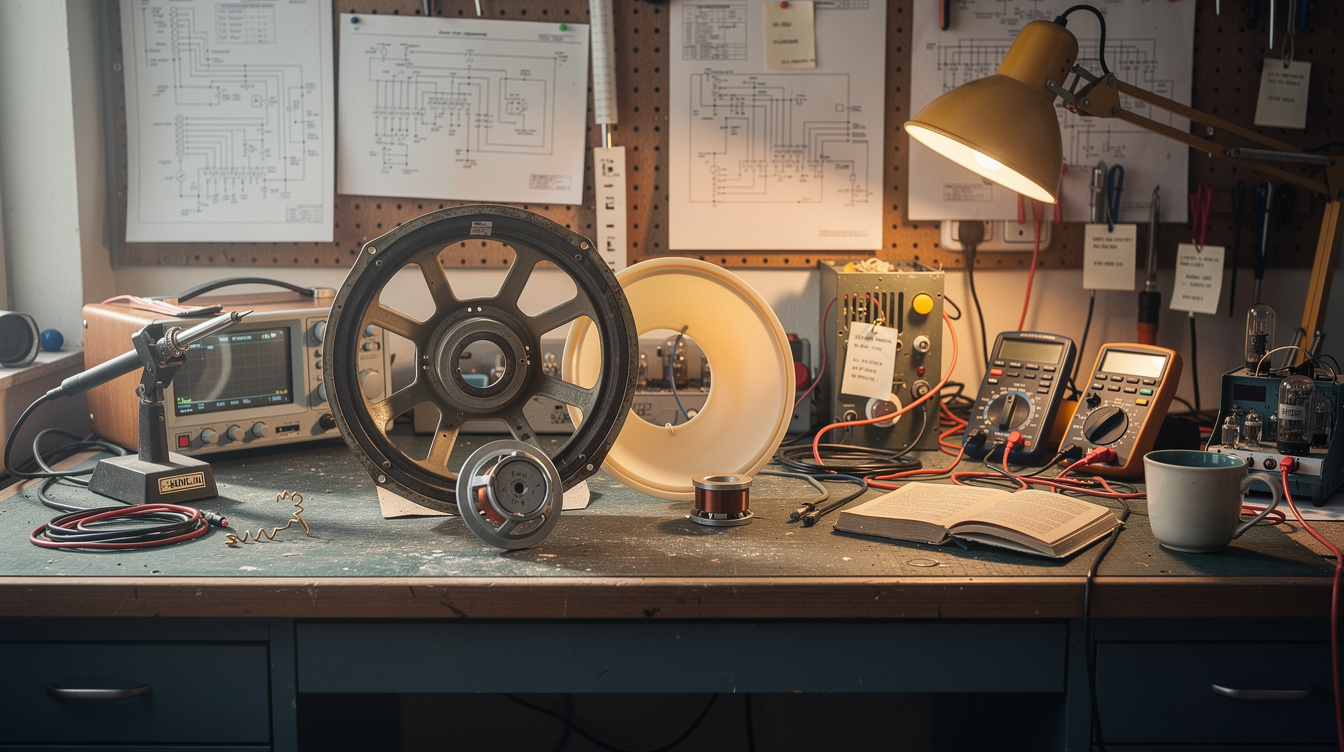
A recone kit is a moving assembly in a bag. Reconing Speakers' kit for the Jensen P12N, to take one model-specific example ($69 street as of October 2026), lists:
| Part | As listed | What it does |
|---|---|---|
| Cone | 12 in, 3.33 in deep, 8 ribs, single roll, all paper | The radiating surface; on vintage-style speakers the surround is the cone's own paper roll |
| Voice coil | 1.522 in inside diameter, 1.0 in form, 0.375 in wind, 8 Ω | The motor's moving half |
| Spider | Cup style, 4.133 in outside diameter | The lower suspension that centres the coil |
| Dust cap | Paper dome, flat top, 1.8 in | Seals the gap and adds a little mass |
| Gasket | 12 in paper, four-sector | Seals the cone edge to the baffle |
| Lead wires, shims, instructions | Included | Shims centre the coil while the glue sets |
Glue and epoxy are sold separately, which tells you what is not in the box: the frame, the magnet, the pole piece and the top plate. Every model-specific kit in that catalogue follows the same pattern, differing in spider size, cup height and coil-form length rather than in what is included.
So the parts that stay are the parts people point at when they talk about vintage speakers: the stamped frame with its 220 or 465 code, the alnico or ceramic magnet, the bell and the label. The parts that go are everything that moves.
The Part I Had the Wrong Way Round
I expected a recone to be a kind of half-measure — keep the important half, replace the wear item. The physics says the opposite, and it says it in the speaker's own published figures.
Start with resonance. A speaker's resonant frequency is set by two things only: the mass of everything that moves, and the compliance (the springiness) of the suspension holding it. Both live in the kit. The magnet does not appear in the equation at all. Whatever resonance your reconed Jensen has, it got from the cone, the coil, the spider and the paper surround that arrived in the bag.
Sensitivity is not quite as total, but close. A speaker's efficiency scales with the square of its motor strength (BL, the gap's flux density times the length of coil wire sitting in it), divided by the coil's resistance and by the square of the moving mass. Of those terms, a recone keeps exactly one — the flux in the gap, which belongs to the magnet and the pole pieces. The length of wire in the gap, the coil's resistance and the moving mass are all new.
How much can that matter? Jensen publishes enough to put a number on it. In the comparison in Alnico or Ceramic, Same Cone, the C12R carries a 17 percent heavier moving assembly than the P12R (29.5 g against 25.2 g). Holding motor strength equal, mass alone is worth:
| Change in moving mass | Effect on sensitivity, motor held equal |
|---|---|
| +5% | −0.4 dB |
| +10% | −0.8 dB |
| +17% (Jensen C12R vs P12R) | −1.4 dB |
Computed from the simplified efficiency relation, efficiency ∝ BL²/(Re·Mms²); it ignores inductance and tolerance, so read the figures as scale rather than precision.
And the same kind of spread turns up inside a single model name. Jensen's current C12N is published at 29.9 g of moving mass in its 8 Ω version and 25.6 g in its 16 Ω version — a 17 percent difference between two versions of one model that differ in their coils, with resonance moving from 113 Hz to 110 Hz along with it. A recone kit wound to a different spec than the factory's moves the same numbers in the same way.
That is why two reconed "originals" can differ from each other more than two brands do. We found the inside-Jensen spread to be the larger variable in the Oxford-or-Jensen piece — 5.8 dB and 27.5 Hz between the current C12Q and C12K — and a recone puts the speaker right back into that territory, with the kit maker's choices standing in for the factory's.
What the Trade Says About Value
The vintage market has been arguing about this for decades, and on the record it is less hostile to reconing than the forums suggest. Two positions are worth knowing:
| Source | Position |
|---|---|
| Dave Boze, in the Blue Book of Guitar Values' amp buying guide | "Reconed speakers are highly variable," depending on the voice coil and paper used; original speakers are "almost always a determining factor in price." |
| Ed Hoffman, Premier Guitar (2009; he represented Jensen) | Jensen, Celestion and Eminence agree a blown speaker is best replaced; for an amp kept as a collectible, reconing can make sense; a reconed speaker will never sound exactly like the original. |
Read together, they agree. Original and untouched is worth most. A disclosed recone is a known, priced condition. A speaker reconed with a substitute kit that does not match the original is where the money and the sound both drift.
How to Decide
The decision turns on what the amp is for, and on the fact that a speaker swap is the most reversible repair in the whole instrument.
| Your situation | What to do | Why |
|---|---|---|
| Collectible amp, original speaker blown or rubbing | Recone with a model-specific kit, from a reconer who will name the parts, and keep the receipt | Keeps the dated frame in the amp; the record of what went in is what a future buyer will price |
| Amp you gig, original speaker blown | Fit a new speaker; bag and label the original, unrepaired | Fully reversible, cheaper to predict, and costs the amp nothing in originality |
| Original speaker working but tired | Leave it alone | A recone resets every part that has settled in; there is nothing to fix |
| Already reconed, unknown history | Ask what kit went in; if nobody knows, treat its sound as its own, not as "a C12N" | The label describes the frame, not the moving parts |
Two practical notes. Ask the reconer for the old cone back — it costs nothing, and a dated original cone in a bag is part of the amp's story. And remember the new suspension needs playing in, the same as any new speaker's; our speaker break-in piece covers what changes and how long it takes, so do not judge a fresh recone on its first afternoon.
If You Play Through a Modeler or IR
The same logic applies to captures. An impulse response labelled with a vintage speaker's name was captured from one particular example, in whatever state its cone and suspension were in that day — original, tired, or reconed. Treat the name as a description of the frame, and choose the capture by how it sits, not by what it is called. Our Helix cab and IR pairing guide lists which captures came from which amps.
The frame and the magnet tell you where a speaker came from. Since the first recone, they have not told you how it sounds.