The quick version: Humbuckers hit overdrive pedals harder and in a different frequency range than single-coils. The Tube Screamer stacks its midrange peak on top of the humbucker's midrange peak and produces congestion. The Klon's input gain structure becomes too hot but is fixable. The RAT's soft-clipping circuit handles the extra input level well and often works with minimal adjustment.
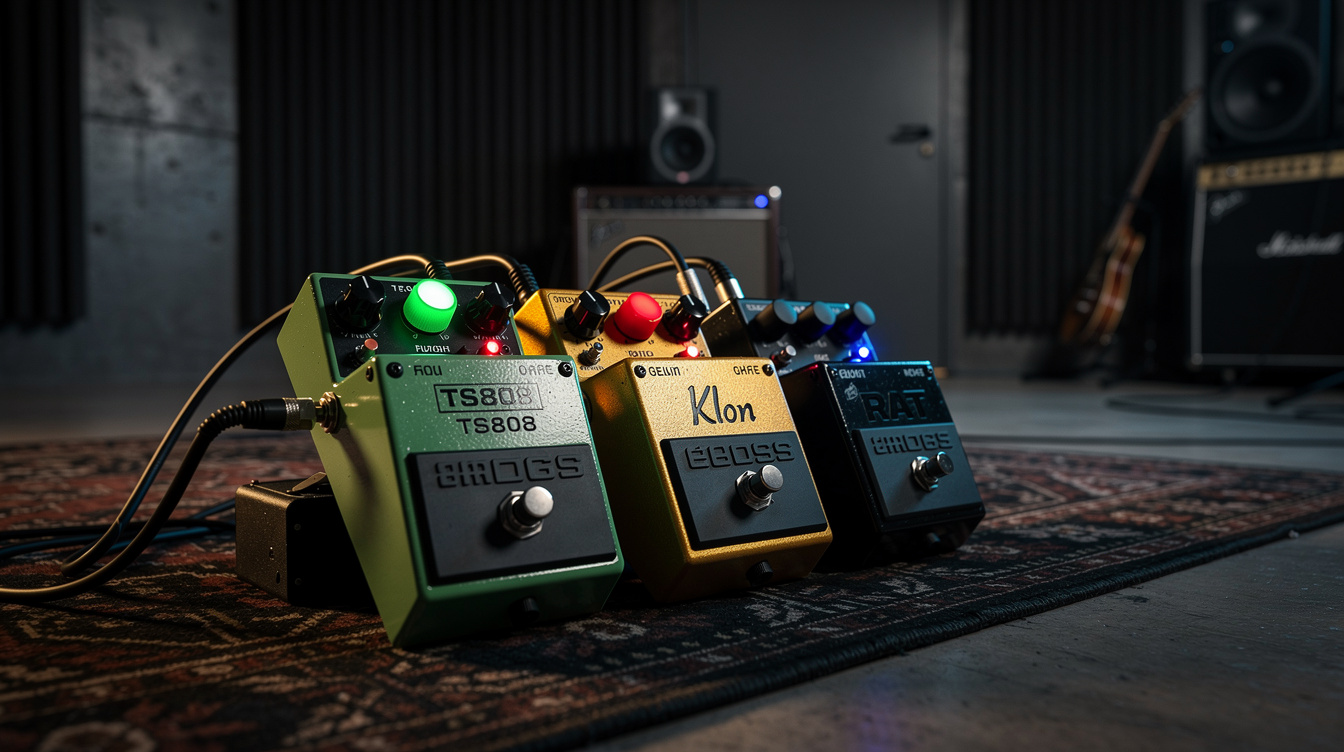
The three most influential overdrive circuits in guitar history (the Tube Screamer (TS808), the Klon Centaur, and the ProCo RAT) were all shaped in part by how they interact with single-coil pickups. Ibanez developed the TS808 to push Fender clean amps. The Klon was designed around the dynamic response of a Stratocaster into a clean amp. The RAT's circuit has always been more tolerant of pickup output variation.
When you move any of them to a humbucker guitar, you're working against those design assumptions. Here's what changes and how to compensate.
The Starting Setup for This Comparison
To make the differences meaningful, these results are based on a consistent reference:
- Guitar: Les Paul-style with PAF-spec humbuckers (Seth Lover/Gibson Burstbucker spec, medium output, approximately 8.5kΩ DC resistance)
- Amp: Fender-style clean platform (blackface style, clean channel, just below breakup)
- Baseline: Each pedal set to what would be a neutral, slight-boost starting point on a single-coil guitar
The goal is not to show that these pedals "fail" with humbuckers. It's to show how the gain structure, frequency response, and output character of each circuit interacts with the higher output and different midrange character of a humbucker, and what adjustments make each one work.
The Tube Screamer (TS808)
Why It's Difficult With Humbuckers
The Tube Screamer is the most problematic of the three when switching from single-coil to humbucker, and the reason is frequency stacking.
A standard-output humbucker has a midrange peak that typically falls between 700Hz and 1.2kHz, depending on the coil design, number of winds, and magnet type. The Tube Screamer's internal clipping circuit and tone stack have their own midrange boost centered around 720Hz. When a humbucker feeds that circuit, these two peaks overlap precisely.
The result is a tone that is:
- Congested and slightly honky in the 700–1kHz range
- Compressed in a way that reduces pick clarity
- Difficult to clean up by adjusting the guitar's volume pot, because rolling back doesn't remove the frequency overlap; it just reduces it
I expected the TS to behave the same way it does with a Strat, just louder. What I found instead was that the frequency interaction mattered more than the level change. Even with the Drive backed all the way down to 7 o'clock, the midrange congestion was present. Level wasn't the issue; the stacked peaks were.
Adjustments That Help
-
Lower the drive to 7–8 o'clock. This barely clips the signal but preserves dynamics. You're using the TS primarily as a mid-boost and buffer rather than a clipping device.
-
Roll the Tone back to 9–10 o'clock. The standard "noon Tone" advice comes from single-coil applications. With a humbucker, the combined midrange of pickup and pedal is already heavy, so pulling Tone back prevents the worst of the congestion.
-
Use a different TS variant. The TS9 has a slightly different output op-amp topology that rolls off more of the mid-forward character. The Maxon OD808 (the original design) colours the midrange a little less than the Ibanez issue. Some players use the TS as a "front-end booster" specifically for high-gain amps, where the midrange stack actually helps, but for clean-platform use, those alternatives perform better.
Verdict: Works, but requires significant adjustment and still has a characteristic midrange character that doesn't suit all styles. If you're regularly switching between a Strat and a Les Paul with the same TS setup, you'll need two different Drive and Tone positions. The TS is not the most adaptable circuit in the humbucker context.
The Klon (Centaur or KTR)
Why the Gain Structure Changes
The Klon has a two-stage input structure. The first stage boosts the signal significantly before the clipping section. The clipping section uses a combination of hard and soft clipping with a germanium-style response that produces the Klon's characteristic "bloom" quality.
With a single-coil pickup, this gain architecture produces a clean boost at low gain settings that gradually adds harmonics as the Gain control is raised. With a humbucker, the same gain architecture starts at a higher effective gain point; you're beginning the session with the single-coil's midpoint gain setting, not its zero point.
This means:
- The "clean boost" range shrinks; you get less clean headroom before clipping begins
- The Klon's "transparent" character (at low Gain settings, it's supposed to add almost no harmonic color) becomes slightly more colored because the input is already overdriving the first stage
- The treble characteristic of the Klon (it famously cuts low end through the clipping path and adds it back through a parallel clean path) can exaggerate the humbucker's natural mid-presence
Adjustments That Help
The Klon is more adjustable than the TS in this context because the Gain and Treble controls interact differently.
-
Lower Gain more than you expect. On a single-coil, Gain at 9 o'clock is a very gentle boost. On a humbucker, that same 9 o'clock position is driving the first stage harder. Back off to 7 o'clock for clean-boost territory. If you want the Klon's characteristic harmonic bloom, 8–9 o'clock on a humbucker produces what 11 o'clock would on a single-coil.
-
Roll back the Treble. The Klon's Treble control is more of a high-frequency presence cut/boost than a full-bandwidth tone control. With humbuckers, Treble at noon can feel overly bright. The same setting that adds air and presence to a single-coil adds a slightly harsh upper-mid edge to humbuckers. 10–11 o'clock tends to be more natural.
-
Set the Output for true unity before A/B testing. The Klon's output structure means perceived volume can change depending on the gain and frequency balance. Set it for true bypass-matched volume before evaluating the tone character. This is harder to hear on a humbucker because the two states (bypass and engaged) sound more similar than on a single-coil.
Verdict: Adjustable and effective, but the "transparent" quality that the Klon is famous for is more apparent on single-coils. On humbuckers, it's a good pedal that adds presence and harmonics, but it's just not the chameleon some expect it to be. The Klon works best with medium-output PAF humbuckers. With high-output pickups (Seymour Duncan JB, DiMarzio Super Distortion), even Gain at 7 o'clock may be too much input.
The ProCo RAT
Why It Handles Humbuckers Best
The RAT uses a LM308N op-amp in a hard-clipping configuration that's fundamentally different from the TS's soft-clipping, mid-boosting circuit. Rather than boosting a specific frequency range before clipping, the RAT clips more symmetrically and then uses its Filter control (which is effectively a high-frequency cut running from bright at minimum to dark at maximum) to shape the result.
The RAT's approach is: gain everything aggressively, then cut back the high end to taste. This means there's no inherent frequency peak that will stack with the humbucker's midrange. The input hit differently? The RAT just generates more clipping.
The practical result on a humbucker:
- The gain structure is more tolerant of high input levels; the LM308N clips in a consistent way regardless of whether the input is a 130mV single-coil or a 280mV humbucker
- The Filter control becomes more useful; backing it off (clockwise = darker) corrects for the extra low-mid body a humbucker brings, the same way you'd adjust a tone control
- The character of the RAT on a humbucker is actually more defined than on a single-coil in some contexts; humbuckers bring out a "singing" quality in the upper-mid harmonics that works with the RAT's aggressive clipping
The Expected Adjustment (And Why It Works)
Going in, the expectation was that the RAT would need significant adjustment for a humbucker. What happened instead was that a small Distortion reduction and a Filter adjustment forward (slightly brighter than single-coil baseline) produced an immediately usable tone. The RAT didn't fight the humbucker; it adapted to it more naturally than the other two circuits.
The one area where adjustment matters: very low Distortion settings. At minimum Distortion settings (using the RAT as a clean-ish boost), humbucker input can produce inconsistent clipping behavior; the LM308N starts clipping before you want it to. If you want a low-gain boost that leaves the signal broadly where it found it, the RAT is not the right circuit for humbuckers. That's the Klon's territory.
Verdict: The most naturally compatible of the three with humbucker pickups. The symmetric hard-clipping circuit and the Filter-based tone shaping don't have the same frequency-stacking issue as the TS, and the gain structure handles the higher input level more consistently than the Klon. For players who regularly switch between single-coil and humbucker guitars, the RAT requires the least adjustment.
Side-by-Side Comparison
| Circuit | Input Tolerance | Mid-Frequency Interaction | Adjustment Required | Best Humbucker Context |
|---|---|---|---|---|
| TS808 | Low; overdrives easily | High; stacks with humbucker mid peak | Significant; Drive and Tone both need adjustment | Medium-gain blues/rock, classic rock, boost before amp breakup |
| Klon | Medium; clean headroom shrinks | Moderate; treble characteristic may exaggerate mids | Moderate; Gain and Treble need backing off | Low-to-medium gain clean boost and edge-of-breakup |
| RAT | High; handles high input consistently | Low; hard clipping distributes harmonics evenly | Minimal; mostly Filter adjustment | Medium-to-high gain rock, leads, consistent overdrive character |
What About High-Output Humbuckers?
The above settings are based on PAF-spec medium-output humbuckers (~8.5kΩ). High-output pickups (Seymour Duncan JB ~16kΩ, DiMarzio Super Distortion ~13kΩ, EMG actives) will push these circuits further still.
With hot humbuckers:
- The TS becomes nearly unusable as a stand-alone overdrive; the congestion is significant. It works better as a clean boost into an already-overdriving amp.
- The Klon's clean headroom essentially disappears. Even at minimum Gain, you're getting harmonic content from the clipping stage. Not necessarily bad, but it's not a "transparent" application anymore.
- The RAT remains the most usable. Back the Distortion down to 8–9 o'clock and adjust Filter. Hot humbuckers into a RAT at moderate Distortion produce a singing, mid-forward lead tone that's responsive to picking dynamics despite the high input level.
Magnet Grade Decides Which Problem You Have
The section above sorts humbuckers by how hot they are, which is the obvious axis and only half the story. The other half is what the magnet is made of, and it is the variable most likely to make this post's settings wrong for your guitar.
Published bar-magnet figures put Alnico II at roughly 530 to 590 gauss, Alnico V at 710 to 770, and ceramic up near 1250 to 1300. That is more than a two-to-one spread inside pickups that all get called humbuckers.
What it does to the three circuits:
| Magnet in the humbucker | Effect on the pedal | What to change |
|---|---|---|
| Alnico II | Lower, softer midrange peak; least stacking | The TS becomes usable as a real overdrive rather than only a boost |
| Alnico V | The reference case for everything above | Use the settings as published |
| Alnico VIII or ceramic | Close to double the field; hottest, hardest peak | Treat it as a high-output pickup even if the DC resistance says otherwise |
That last row is the trap. DC resistance is the number everyone quotes and it only measures the coil. A ceramic-magnet humbucker at 8.5 kΩ reads as medium output on paper and behaves like a hot pickup at the pedal, because the magnet is doing work the resistance figure cannot see. If a set that measures PAF-spec is congesting your Tube Screamer at settings this post calls clean, check the magnet before you conclude the pedal is broken. The full magnet comparison covers what each grade costs you in clearance as well as in output.
Coil-Splitting Does Not Give You the Single-Coil Settings Back
A reasonable-sounding idea: split the humbucker, get a single-coil, use the single-coil settings that all three of these pedals were designed around.
It does not work that way, and it is worth knowing why before you spend an evening chasing it.
Splitting a humbucker drops the output by a large margin and thins the low end, which does remove the level half of the problem. But the coil that remains is still sitting in the humbucker's position on the body, still fed by the humbucker's magnet, and still wound to a humbucker's turn count for half a pickup. Its peak does not relocate to where a Strat pickup's peak lives. You get a quieter version of roughly the same frequency character, not a different pickup.
In practice that means the split position wants its own settings — usually more Drive than the humbucker position and less Tone rollback, because the stacking has eased but the pickup has also lost the body that was masking the top end. On a Tube Screamer specifically, the split position is often the one place a TS sounds genuinely good on a humbucker guitar.
The workable approach, if your guitar splits and you use both: set the pedal for the humbucker position, which is the harder problem, and use the guitar's volume and tone controls to manage the split position rather than resetting the pedal. Two positions, one pedal setting, no crouching between songs.