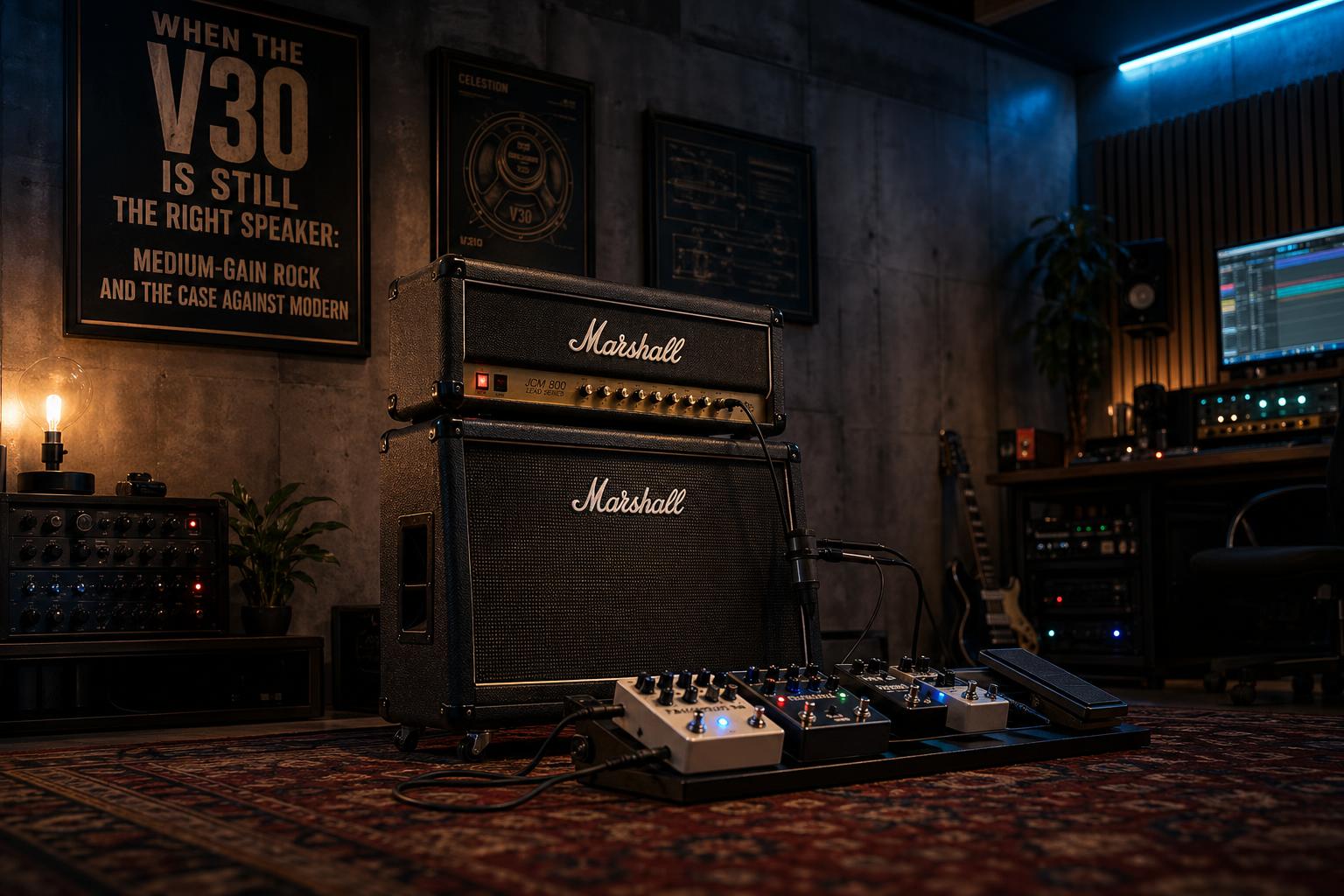
The short version: The V30's 2.5–3.5 kHz presence peak is a problem in modern djent because it stacks with already-aggressive preamp EQ. In the medium-gain rock zone (a Marshall pushed into natural breakup, a Twin Reverb hit by a Bluesbreaker, an AC30 with the Top Boost circuit doing its thing, a Plexi clone with a Klon in front), that same presence peak is the reason the speaker exists. It puts the cut where vocals don't fight it, it gives sustained chords the harmonic ring that defined classic rock, and it does this with a frequency stamp no neutral speaker can replicate. This is when the V30 is still the right call.
The V30 fatigue post made the case for why modern djent rigs sound harsh through V30s. That argument holds. What it didn't say (what no single post can say without doubling its length) is that the same speaker characteristics that work against a Fortin Nameless capture or a tightly-EQ'd Quad Cortex high-gain rig are exactly what makes a V30 the right choice for a Marshall JTM45 with a Tube Screamer in front of it.
I have been thinking about this since the original post ran. I keep a Two Notes Torpedo Captor X with three V30 IRs and three alternatives loaded, and I've been A/B-ing them against my Deluxe Reverb-pushed-into-breakup setup all week. The conclusion is what I expected when I started: in the medium-gain rock context, the V30 wins more often than it loses, and the reason it wins is the same reason it loses in modern metal; the frequency profile is doing distinct work. The work matches one context and clashes with the other.
The V30 in Two Different Conversations
| Context | What the V30 does | Verdict |
|---|---|---|
| Modern djent / Fortin / 5150 III / Diezel | Stacks 2.5–3.5 kHz with already-emphasized preamp EQ; produces ear fatigue | Wrong tool |
| Marshall plexi pushed into breakup | Adds upper-midrange cut where the amp is naturally darker; makes chord work present | Right tool |
| Bluesbreaker → blackface Fender | Sharpens the upper midrange in a way the Fender circuit doesn't reach on its own | Right tool |
| AC30 (Top Boost circuit) | The original Celestion Blue alnico does this differently; V30 is a workable substitute but not identical | Workable |
| Modern boutique low-watt (Friedman Pink Taco, Carr Mercury) | EL84 amp character + V30 presence = forward, present, classic rock voice | Right tool |
| Clean Fender Twin / Princeton headroom playing | V30 presence peak is unwanted in the headroom range | Wrong tool |
| Modern progressive metal | Same problem as djent | Wrong tool |
This isn't a defense of the V30 universally. It's a defense of the V30 in the contexts where the speaker's frequency stamp is doing complementary work to the preamp instead of additive work. The distinction matters more than the speaker brand or model name.
What the Presence Peak Does in a Medium-Gain Context
A medium-gain amp running into natural breakup has a specific tonal challenge. The preamp is producing harmonic content, the power tubes are softening attacks, and the result is a sound that's full of emotion but can lose articulation if the upper midrange isn't supported.
A Marshall plexi pushed into breakup is the canonical example. The preamp design is darker than a modern high-gain amp; the gain stages are voiced for warmth more than aggression, the tone stack rolls off some upper mid by default, and the natural compression of the cathode-bypassed gain stages takes some bite off the pick attack. Without something to put the bite back, you can end up with a chord voice that feels three-dimensional but doesn't cut against a band.
The V30's presence peak puts the bite back. The 2.5–3.5 kHz emphasis is exactly where the human ear hears the leading edge of a chord, the part that says "this is a guitar, this is the moment of attack, this is where the note begins." A G12T-75 or a G12K-100 is more neutral in this range; they let the amp's natural voice through without coloration, which sounds great in isolation and disappears in a band mix.
I am explicitly arguing that the V30's coloration is a feature here. The speaker is making an editorial choice about what frequencies to amplify, and that choice happens to be exactly the choice a medium-gain rock player needs the speaker to make. A neutral speaker is the wrong answer when the amp is asking for partnership rather than transparency.
This is the part that the modern-djent argument gets backwards. In a high-gain context where the preamp already has its own 3 kHz emphasis, the V30 doubles down on something the amp is already overdoing. In a medium-gain context where the preamp is voiced darker, the V30 supplies what the amp is asking for. Same speaker, opposite outcome. The amp tells you what the speaker should do.
The Bluesbreaker → Blackface Combination
This is the example I keep coming back to. A Marathon Bluesbreaker (or a Marshall Bluesbreaker reissue, or any Bluesbreaker-style pedal) hitting the front of a Fender blackface combo creates a specific medium-gain sound that's been on hundreds of records: slightly compressed, midrange-pushed, harmonically rich without being aggressive.
Through a stock Fender combo with a Jensen C12K (a brighter speaker with a gentler upper-mid character), the result is articulate but can sit too far back in a mix. The Bluesbreaker's compressed character meets the Fender's headroom and the result is dimensional but lacks the cut that makes the tone sit on top of a song.
Swap the Jensen for a V30 (this is a common modification on Deluxe Reverbs that get used as gigging amps) and the entire character of the rig shifts. The V30's presence peak puts the upper-midrange forward in a way the Fender circuit alone wasn't producing, and the chord voice gains the clarity it was missing. The compressed character of the Bluesbreaker stays, the Fender's headroom stays, but the upper-mid voice now has authority.
I tested this directly last week. My Deluxe Reverb has its stock Jensen but I have a 1×12 cabinet loaded with a V30 that I run as an extension when I want a different voice. The Bluesbreaker into the Jensen cabinet is rounder. The Bluesbreaker into the V30 cabinet is more present. For most chord work (the kind of medium-gain rhythm playing that lives in the verse of a rock song), the V30 voice is the one that wins.
Why This Matters for Modeler Users Especially
Most of the high-gain modeler users I know default to V30 IRs because that's what comes loaded in the factory presets and that's what the influencer YouTube videos use. In a high-gain rig context, those defaults often work against you (see the modern djent argument).
In a medium-gain context, those same V30 IRs are usually the right call, and the surprise is that you don't need to look for a "better" alternative. The default is the right answer for medium gain. The mistake is using the same default for a different gain context.
When I'm building a Helix preset for a medium-gain rhythm tone, say a Plexi-style amp into a 1×12 cab, I'll usually start with the factory V30 IR (the Helix has a few; Cab 4×12 V30 and Cab 1×12 V30 are the common defaults), and the result is usable from the first chord. I might tweak the mic position or blend a second IR to taste, but I'm not fighting the speaker choice. The voice I want is roughly what the IR delivers.
For high-gain work in the same Helix, my workflow now is to immediately swap the V30 IR for a G12T-75 or a Greenback IR before I touch any other parameter, because I know the V30's stack with the high-gain preamp is going to be the first thing I'd want to fix anyway. The default doesn't fit the use case.
This is the practical takeaway for modeler users: the V30 IR isn't bad. It's matched to a specific context, and the context where it's matched is medium-gain rock, not modern metal. Use the right IR for the right gain structure and the speaker debate solves itself.
The AC30 Caveat
The Vox AC30 is the famous exception that complicates this story. The original AC30s shipped with Celestion Blue alnico speakers (not V30s), and the Blue's frequency response is meaningfully different from the V30's. The Blue has a smoother upper midrange, less of a sharp presence peak, and a different breakup character that contributes to the AC30's specific chime.
A V30 in an AC30 is a workable substitute but not an identical sound. You'll get more aggressive upper-midrange bite, less of the sweet bell-like ring above 4 kHz, and a slightly more compressed character on sustained chords. For some players this is fine; for purists it's a significant tonal compromise.
If you have an AC30 and you're thinking about reloading the cabinet, the Celestion Blue (or a Blue-spec alternative like the Wharfedale Super 12) is the right answer for the original character. The V30 is a workable choice if you can't afford or source the Blue, but go in knowing it's a different sound, not just a "more durable" version of the same sound.
For this reason I've kept the AC30 conversation out of the V30 debate as much as possible in this post. The AC30 is its own story and the V30 substitution is a compromise worth discussing in its own right.
When NOT to Use the V30 in a Medium-Gain Context
Even in the broad medium-gain zone, there are specific situations where the V30's character works against you:
Clean platform amps (Fender Twin, Princeton, Deluxe at low volumes). The V30's upper-midrange peak is unwanted when the amp is being asked to deliver headroom-rich cleans. The speaker adds cut to a tone that's supposed to be flat. Use a Jensen, a Weber, or an Eminence Cannabis Rex for these.
Stacked-pedal medium gain (multiple drives in series, building up to high-gain levels). Once you're stacking a Klon and a Tube Screamer and a Bluesbreaker into a clean amp to reach what's effectively high-gain rhythm tone, you're back in the territory where the V30 stack is going to feel fatiguing. Treat stacked-pedal high gain as high gain for speaker selection purposes.
Country chicken-pickin' through an AC15 or Princeton. The genre wants a bright, snappy speaker with clarity above 5 kHz that the V30's rolloff doesn't deliver. A Jensen C12N or a Celestion G12H Anniversary handles this better.
Anything where you want neutral monitoring. If your goal is to hear what the amp is actually doing without speaker coloration (maybe you're dialing in tones for FRFR live use and want the cab to be transparent), the V30 is the wrong answer because the V30 is never transparent. Use a clean-voiced speaker or run direct into a flat-response cab.
The medium-gain rock case for the V30 isn't universal. It's specific to a particular gain range, a particular voicing context, and a particular use case (typically chord-heavy rhythm work or singing lead lines in the rock vocabulary). Outside that zone the speaker can work against you the same way it works against modern djent.
What the A/B Test Actually Showed
I expected this exercise to confirm my prior, which was that the V30 is the safe default speaker for any rock-oriented tone and you don't need to think too hard about it. What I found instead was more nuanced and I think more useful.
The V30 isn't a default. It's an editorial choice. The speaker is making an active claim about what frequencies the amp should emphasize, and that claim is correct in some contexts and wrong in others. The mistake isn't using the V30; the mistake is using it without thinking about whether the gain structure the speaker is paired with actually wants the V30's contribution.
When I A/B'd the V30 IR against a G12T-75 IR through my Bluesbreaker-into-Deluxe-Reverb modeler chain, the V30 was the obvious winner. The chord voice was forward, the cut was right, the tone sat in a mock band mix the way a rock guitar should sit. When I A/B'd the same two IRs through a high-gain Fortin-style chain, the G12T-75 won decisively for exactly the reasons the modern djent post laid out. Same speakers, different verdicts, and the variable that changed was the preamp, not the speaker.
The takeaway, which I want to repeat because I think it's the most important thing here: the speaker doesn't have a universal verdict. The speaker has a context. Match it to the right one and the V30 will earn the reputation it had in the 1990s. Use it in the wrong context and you'll wonder what people were ever excited about. Both reactions are correct. The variable is the use case.
One more variable worth naming: the cabinet itself colors the V30 as much as the speaker choice does. A sealed 4×12 tightens the V30's low end into a focused thump, while an open-back combo lets it breathe and spread — the open-back vs. closed-back decision sits underneath the speaker decision, and the sealed vs. ported question changes how that low end behaves before the V30's voice ever enters the picture.
If you're choosing a speaker for a medium-gain rock rig, and you've been told V30s are the wrong answer because the modern djent crowd has moved on, let me put it this way: the speakers that defined the rock guitar sound from 1990 to 2010 were V30s, and the players who built that sound knew exactly what they were doing. The criticism of the V30 in modern high-gain contexts is correct on its own terms. It does not transfer to the medium-gain context, and using it as a reason to avoid the speaker for plexi-style rhythm work is the kind of small mistake that compounds over years of preset-building. The V30 is right for what it's right for. Match it to the use case and trust the speaker to do its job.