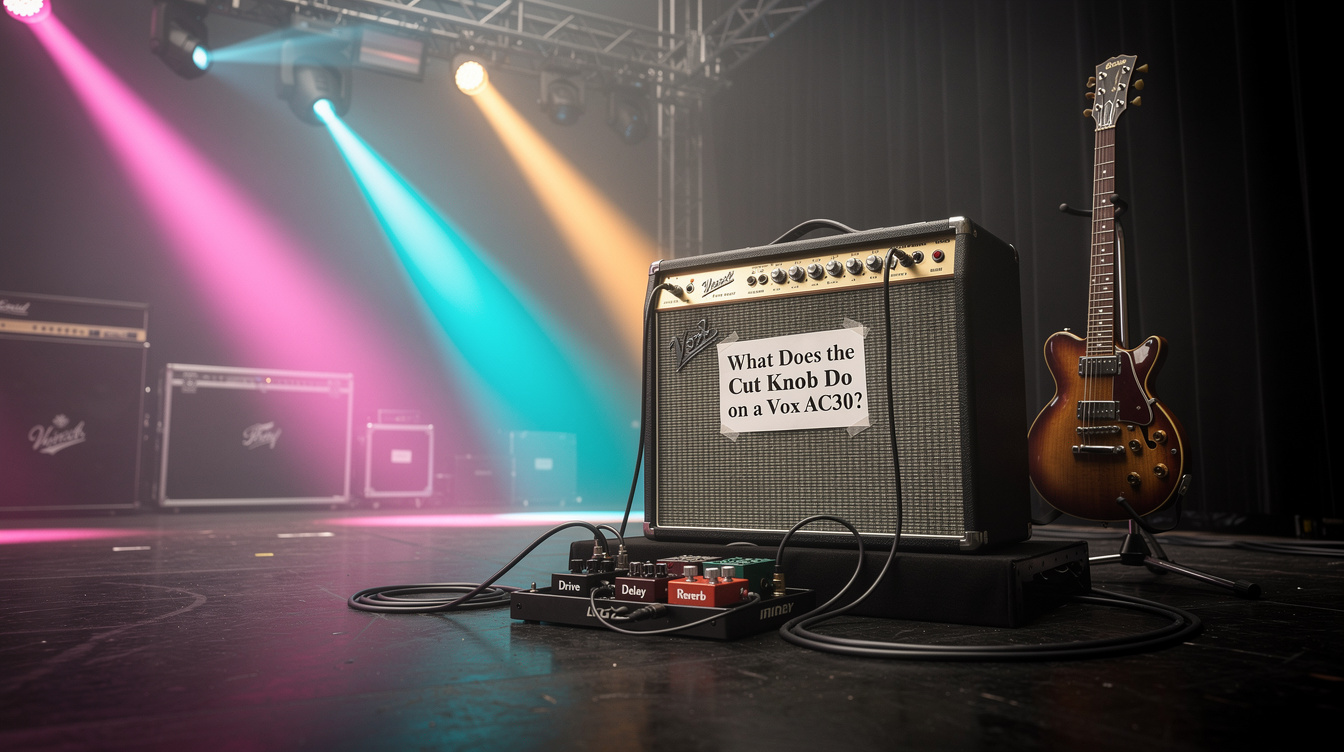
Direct answer: The Cut knob on a Vox AC30 is a treble-cut filter wired in parallel with the output stage, not a tone control in the usual sense. Turned fully clockwise, it removes high frequencies. Turned fully counter-clockwise (fully off), it has no effect and the amp is at its brightest. This is the opposite of how nearly every other amp's tone control works.
| Cut position | What it does | When to use it |
|---|---|---|
| Fully counter-clockwise (0) | No filtering; amp at maximum brightness | Single-coils, bright rooms, jangling rhythm parts |
| 9–10 o'clock | Mild high-frequency reduction | Humbuckers, slightly taming pick attack |
| Noon | Moderate cut, noticeably warmer | Most Tele/Strat bridge-pickup applications |
| 2–3 o'clock | Significant treble reduction | Neck pickup, warm leads, dark room acoustic |
| Fully clockwise (10) | Maximum treble cut; very dark | Rarely useful; fixes unusually bright rig |
Why This Confuses Everyone
Most guitar amps use a tone control that adds treble when turned clockwise. Turn the knob up, get more brightness. This is intuitive: more means more.
The AC30's Cut control does the opposite. It's a passive treble-cut filter in parallel with the amp's output transformer. When you turn the Cut knob clockwise, you're increasing the amount of high-frequency signal that gets shunted away from the output. More Cut = less treble.
The origin of this design is the original Top Boost channel that Vox added to the AC30 in the early 1960s, a circuit modification that became standard on all subsequent versions. The Cut was implemented as the only means of taming the Top Boost channel's inherent brightness, and it was wired in a way that made sense to an engineer working with the existing circuit but is counterintuitive to anyone approaching it as a standard tone control.
After a while playing through the AC30, this inverted relationship becomes completely natural. You just have to know it's inverted before you start trying to dial in a tone.
The Practical Setting Range
For the way most guitarists use an AC30, the Cut knob lives between 9 o'clock and noon. Here's the breakdown:
Fully counter-clockwise (zero, no cut): The amp is at its brightest natural character. This is where the AC30's famous chime lives: the glassy, ringing top end that makes arpeggiated clean chords on a Rickenbacker 12-string or a Vox-flavored Strat sound like themselves. For this setting to work well, the guitar should be warm enough to balance it: neck pickup, volume rolled back slightly, or a humbucker-equipped instrument.
9–10 o'clock (slight cut): The most versatile starting point. Takes the edge off the brightest single-coil tones without softening the chime noticeably. If you're playing a Strat with fresh strings through the AC30's Normal channel, this is where you might start.
Noon (moderate cut): This is the sweet spot for most bridge-pickup playing and for guitars with brighter pickups. The chime is still there but the high-frequency sizzle is reduced enough that the amp sits in a mix without sounding harsh. For worship applications (where the guitar shares high-frequency space with keys and cymbals), noon Cut is a reasonable default.
2–3 o'clock (significant cut): For neck-pickup lead tones, for rooms with reflective high-frequency surfaces, or for guitars that are already bright (bridge humbuckers on a Les Paul into the AC30 can get scratchy at higher volumes without some cut here). This setting makes the amp sound warmer and rounder, but you start to lose some of the AC30's characteristic brightness.
How It Interacts With the Top Boost Controls
The AC30's Top Boost channel has separate Treble and Bass controls in addition to the Cut. These are standard-operation tone controls: Treble clockwise is brighter, Bass clockwise is bassier.
The Cut interacts with these controls additively. If you've already boosted the Treble significantly on the Top Boost channel, you may need more Cut to compensate. The Cut doesn't selectively cancel the treble boost from the Top Boost; it cuts all treble above its filter frequency, including whatever the Top Boost has added.
A working approach for the Top Boost channel:
- Set Treble and Bass to noon as a starting point
- Dial in the Cut to achieve the overall brightness level you want
- Then fine-tune Treble and Bass from there
Don't try to dial in the brightness with the Top Boost Treble control and then use Cut to pull it back. You'll find yourself chasing a moving target. Let Cut be the primary high-frequency control, Treble the secondary.
The Normal Channel Has No Cut Control
The AC30 has two channels: Top Boost and Normal (sometimes labeled "Brilliant" in older literature). Only the Top Boost channel has access to the Cut control. If you're running through the Normal channel, the Cut knob still affects the output stage and will still cut treble, but you're not getting the Top Boost EQ controls at all.
For players who run both channels simultaneously (linked together with a short jumper cable, which is a classic AC30 technique), the Cut acts on both channels' combined output.
FAQ
Why does the Cut knob work backwards compared to other amps? It's a passive filter wired in parallel, not a standard active tone control. Turning it clockwise increases the filter's effect on the output. The name "Cut" describes what it does (cut treble) rather than using the convention of "Tone" with clockwise = brighter.
My AC30 is too bright even with the Cut fully clockwise. What else can I do? Check the Treble position on the Top Boost channel. If it's above noon, try pulling it back. Also check your guitar volume: AC30s respond to guitar volume in a way that can produce harsh-sounding treble at full volume on bright pickups. Rolling the guitar volume to 7–8 can smooth the high end significantly.
Does the Cut control affect bass frequencies? No. It's specifically a treble-cut filter, acting on frequencies above roughly 3–4kHz depending on the position. Bass frequencies are not affected by the Cut control.
What does the AC30's Treble control do if the Cut is already doing the treble shaping? The Top Boost Treble control is a shelving boost/cut centered around 2–3kHz, so it works on the midrange and upper-midrange as well as the true treble. The Cut is a simpler filter acting on a higher frequency range. They shape different parts of the frequency spectrum and work together rather than being redundant.