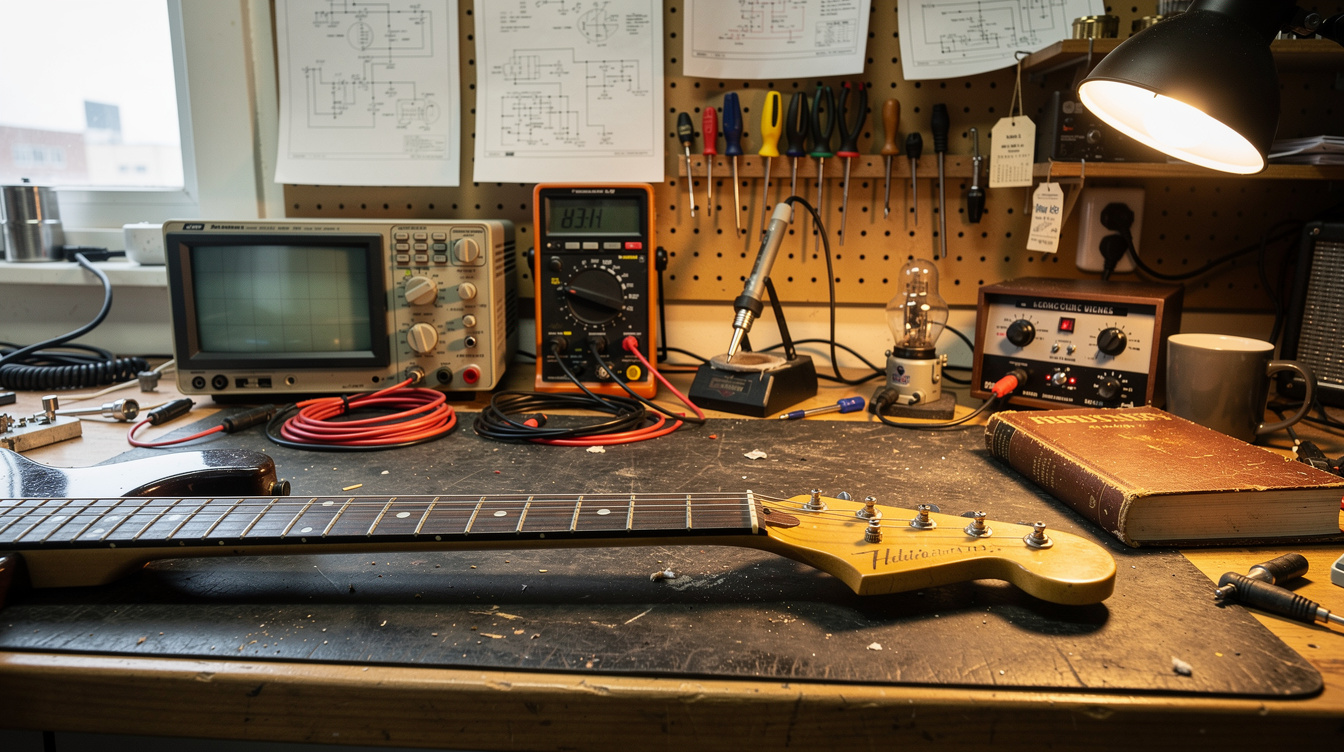
Somebody brings you a guitar and says it will not stay in tune, and nine times out of ten what they mean is that it plays in tune at the bottom of the neck and turns sour somewhere around the seventh fret, most often on the G, most often on a chord shape they have played their whole life and can hear going wrong. They have already tuned it four times. They have watched two videos about setting intonation and adjusted the saddle, which made it worse in a different place. Now they want a bench appointment.
The thing is that the guitar is often fine, and the strings on it are not, and the failure they are hearing has almost nothing to do with the failure that every article about string changes describes. Search for when to change your strings and you will get an unbroken wall of content about brightness and feel — how long until they sound dull, how long until they feel sticky, whether professionals change before every show. Useful enough, in its way. But none of it addresses the specific thing that makes a guitar unplayable in the middle of the neck while still sounding perfectly acceptable strummed open, which is a string that has gone false.
That is a different failure, on a different clock, and it has a test.
What "False" Actually Means
A vibrating string produces a pitch determined by three things: its length, its tension, and its mass per unit length. Every bit of guitar setup you have ever done is an exercise in controlling the first of those precisely. The saddle position, the nut slot depth, the neck relief — all of them exist to make the effective length of the string agree with where the frets are.
Mass per unit length is the one nobody adjusts, because on a new string it is a constant. The manufacturer draws the wire to a diameter and holds that diameter for the whole run, and the string behaves the same at every point along it.
A false string is one where that has stopped being true. The thickness, and therefore the mass, has become uneven along the length, and the moment that happens the relationship between where you put your finger and what pitch comes out gets skewed. Not randomly, exactly — the string is still obeying the physics. It is just obeying it with different numbers in different places, which from the player's chair is indistinguishable from randomness.
Which is why no saddle adjustment fixes it. The saddle sets one length, for one string, and it makes one correction. A false string needs a different correction at the fifth fret than it needs at the twelfth, and there is no hardware on a guitar that does that.
How a Good String Turns Into a Bad One
New strings from a decent maker are consistent. It is not a hard specification to hold and the industry holds it. Falseness in a fresh string does happen and it is a manufacturing defect, and if you have ever opened a new set, installed it, and found one string that would not intonate no matter what, you have met one — it is rare enough to be startling and common enough that any repair person has a story about it.
Ordinary falseness is wear, and the mechanism is dull and mechanical. The string touches the frets. Every time you fret a note you press a hard piece of wire against a harder piece of wire, and over a few thousand repetitions the underside of the string flattens. That flat spot is a local reduction in diameter, and a local reduction in diameter is a local change in mass per unit length. Do that in a dozen places, at the positions you actually play, and you have manufactured a false string yourself, one chord at a time.
Corrosion works the other direction and gets you to the same place, adding material unevenly rather than removing it. Skin chemistry varies wildly between players — this is genuinely a thing, and the guy whose strings go green in a week is not doing anything wrong — and the deposits do not land evenly along the length.
Bending accelerates all of it. A bent string is dragged across the fret under load, which is the flattening mechanism at maybe ten times the rate.
The Test That Actually Separates the Two Causes
Here is where most advice gets it wrong, and it gets it wrong by stopping one step early.
The standard intonation check is the 12th fret: play the harmonic, play the fretted note, compare. That check is fine as far as it goes, and it is how you set a saddle. What it cannot do is tell you whether the string deserves the adjustment you are about to make, because a false string will fail that check and so will a misplaced saddle, and they fail it in ways that look identical if you only look in one place.
Add positions and the two causes separate immediately.
- Tune the open string carefully. Use whatever you trust; the accuracy of the tuner matters more than most players think, and if two people in the room are working from different tuners you have a second problem hiding behind the first. We went through that particular mess in tuning two guitars to each other.
- Fret at the 12th and read the pitch. Note how far off it is and in which direction, in cents if your tuner shows them. Fret normally — the pressure you would use playing, not the pressure you would use proving a point.
- Fret at the 5th and read it. Then the 7th. Then the 19th.
- Look at the pattern, not the numbers.
A saddle in the wrong place produces a consistent error. It grows as you move up the neck, because the proportional length error grows, and it always leans the same direction. Sharp at 5, sharper at 12, sharper still at 19. That is an adjustment, and it is a fifteen-minute job you can do yourself.
A false string produces an inconsistent error. Fine at 5, badly sharp at 7, roughly right at 12, flat at 19. The error changes size, and often changes sign, because you are sampling different segments of a string whose properties are no longer the same from one end to the other. That is not an adjustment. That is a nine-dollar packet.
Run it on all six. The pattern tells you which conversation you are in.
The Plain G, Every Time
I went into this expecting the wound strings to be the problem children, because they are the ones that look destroyed first — the low E on a well-used set has visible grime packed into the windings, it goes dull well before anything else on the guitar, and dullness is the failure everyone is trained to notice.
They are not the problem children. The plain G goes false long before the low E goes dead, and once you start checking for it deliberately you find it on nearly every guitar that comes through the door with an intonation complaint.
There are three reasons stacked on each other. The plain G is the thickest unwound string on a standard set, and a thick unwound string is stiff, and stiffness produces inharmonicity — the overtones climb faster than they should relative to the fundamental, which is why a plain G is the hardest string to intonate even brand new and why the effect gets worse the further up the neck you go. It also takes more bending than any other string, because it is where most of the expressive playing lives on a blues or rock guitar. And it sits under fret contact in essentially every chord shape in open position.
Take a string that starts with the smallest margin for error, give it the most abuse, and it will be the first one to leave. That is not a mystery, it is just arithmetic that nobody bothers to do.
The practical consequence: if a guitar plays sour in the middle of the neck and only one string is really guilty, check the G before you check the guitar. If a player has moved to a wound G, which is common enough on jazz and older-style sets, this whole problem changes shape — a wound G intonates more predictably and needs less saddle compensation, at the cost of a different feel under a bend.
When It Is the Guitar After All
Not every intonation problem is a string problem, and the point of the multi-position test is to know which one you have before you spend money. The errors that survive a fresh set are real, and the usual suspects are:
- Nut slots cut too high, which makes everything sharp in the first three frets and gets progressively less noticeable as you move up. This one is easy to mistake for a string problem because it is worst exactly where beginners play. The slot geometry side of it is in nut slot width by string gauge, and if the string is also binding you will hear it before you measure it — see the string pings at the nut diagnostic.
- Saddle position, the ordinary case, consistent and directional as described above. On a locking tremolo this is a per-saddle job with its own procedure, laid out in Floyd Rose intonation saddle by saddle.
- Neck relief and action, because a string pressed further to reach the fret is a string stretched further, and that is sharp everywhere, worse higher up.
- Fret wear, where a divot in a fret changes the actual contact point. Rare on a young guitar, common on an old workhorse, and it presents very much like falseness because it is also position-specific — the difference is that it stays put when you change strings.
The order matters. New strings first, because they are cheap and because every other measurement you take on a false string is a measurement of nothing.
What to Do Tomorrow
Change the G. Just the G, if you are not ready to do the whole set — it costs almost nothing and takes four minutes, and it will tell you more about the guitar than an hour of adjusting will. Then run the four-position check on it and see whether the pattern went consistent.
If it did, you have learned something about your own wear rate, and the useful thing to do with that is stop tracking the calendar. The advice that circulates about changing every three months, or every two weeks, or before every show, is all describing someone else's hands. A player who bends hard for two hours a night will destroy a plain G in ten days. A light strummer will get a season out of the same set and be perfectly happy. Neither number tells you anything about you.
The test does. Two minutes, four positions, once a month. That is the whole discipline, and it will save you a bench appointment you did not need — and, occasionally, it will tell you to book one you did.