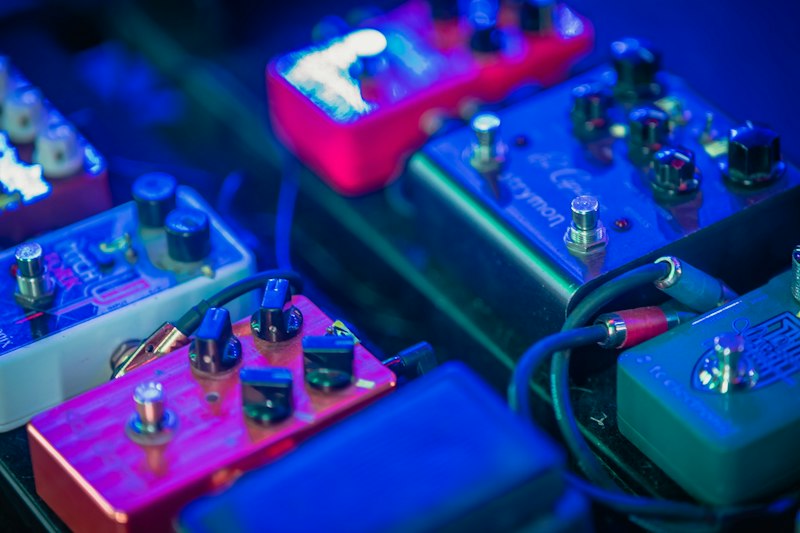
Boss announced the EX-4 Effects Expander at Guitar Summit on September 25. It is a compact multi-effects stompbox with 120 effect selections, up to four running simultaneously, a 2.4-inch color display, four dedicated FX buttons, two dual-function footswitches, TRS MIDI in and out, and four audio jacks. It is $299.99 and it ships in October 2026.
Every write-up is leading with 120. I understand why — it is the big number, and it includes the Boss catalog people actually want, overdrive and modulation and delay and reverb plus oddities like Slow Gear and Slicer.
But 120 is a menu, not a rig. You are not going to run 120 effects. You are going to run four. So the number I want to talk about is four, because four is a number I know something about.
Four Is the Number I Landed On Too
I run an HX Stomp on my coffee table. It holds six blocks. When I first got it I filled all six, every preset, because six was what I was given and it felt wasteful not to use them.
Then I actually looked at what those six were doing. Two of them were an amp and a cab. Those aren't effects — they're the room. Which means the HX Stomp, the unit everybody points to as the compact modeler, gives you four effects once you've paid for a sound to put them in front of.
Four. The same number as the EX-4.
I eventually cut my presets down to four presets, too, for a reason that has nothing to do with DSP: four is what I can hold in my head at 9 PM with headphones on and twenty minutes before I'm too tired to be useful. The block-budget math is the same argument that decides HX Stomp versus Helix LT, and it lands here too. Boss did not pick four because four is generous. They picked four because four is what a pedalboard player actually turns on.
So the honest framing of this pedal is not "a cheap modeler." It's this: if you already own an amp you like, the EX-4 gives you the effects half of an HX Stomp for half the money, and skips the half you don't need.
$299.99 versus $599 for the Stomp. You lose the amp and cab models, the direct-to-FOH capability, and the headphone rig. You keep the four effects and you get a real amp in the room. If you have an amp you're happy with, that trade is good. If you don't have an amp — if you're a headphone player like me most nights — it's a bad trade and you should buy the Stomp.
The Spec That Decides Whether It Fits Your Board
Here is the part I had to read the press release twice to catch, and I haven't seen anyone else mention it.
The EX-4 has four audio jacks. Boss says they are "mono or stereo capable," and that two of them can be configured as an effects loop for an external pedal.
Do the arithmetic. Four jacks total:
- Stereo in, stereo out = all four jacks spent. No external loop.
- Mono in, mono out, plus a send and return = all four jacks spent. No stereo.
You get stereo or you get the external loop. Not both.
That is not a flaw, it's a $299 pedal with a small enclosure and there are only so many holes you can drill. But it is the single spec that determines whether this thing works on your board, and it is buried under the 120.
Sort yourself into one of two camps before you order:
Camp one: you play in mono into one amp. Take the loop. Put your one irreplaceable analog pedal — the fuzz, the boutique overdrive, the thing you'd never model — in the EX-4's send and return, and now you can turn it on and off with the same footswitch system and save it into presets. That is genuinely useful and it's the feature I'd actually use.
Camp two: you run stereo, or you run two amps. Give up the loop. Your analog pedal goes in front, always on or always off, and you manage it with your foot like you did before.
If you're not sure which camp you're in, you're in camp one. Most of us are.
The Four Blocks I'd Actually Put In It
Here's the preset I'd build first, and why each slot earns its place. This is the same reasoning I used when I cut my Stomp down.
Slot 1 — a compressor or a clean boost. Not because you need compression, but because slot 1 is where you fix input level, and everything downstream behaves better when the signal arriving at it is consistent. Set it light: enough to even out your picking hand, not enough to hear. If you can hear the compressor working, it's doing too much — that's the whole failure mode.
Slot 2 — one overdrive. One. Not two stacked. If you're running the EX-4 in front of an amp you like, the amp is doing the character work and the drive is just pushing it. Level around unity, gain low, tone to taste.
Slot 3 — delay. This is where the EX-4 earns its money over a single analog pedal, because a digital delay with presets means your dotted-eighth and your slapback are two footswitch presses apart instead of two knob turns.
Slot 4 — reverb. Last in the chain, and keep it smaller than you think you want. Reverb sounds correct in headphones and oversized in a room.
Notice what isn't in there: a second drive, a modulation, a pitch block. Those are the blocks you swap slot 3 or 4 out for when a specific song needs them — not the ones you keep loaded. Four slots means every slot is a decision, and the pedal is better for it.
The Utility Blocks Are the Sleeper Feature
Boss lists foot volume, noise suppressor, send/return, and divider/mixer as utility blocks. These are unglamorous and they are the reason this pedal is more interesting than a normal multi-FX.
A divider/mixer means you can run something in parallel instead of in series. A foot volume block plus the expression pedal input means you get a volume pedal without buying a volume pedal or giving up board space for one. And a noise suppressor placed before your drive rather than after it is the difference between a gate that works and a gate that chops your note tails — same principle as gating in front of the distortion, not behind it.
One warning, though: utility blocks presumably count against your four. Boss's release says "up to 4 simultaneous effects" and lists utilities in the same architecture. If a noise suppressor and a foot volume eat two slots, your four musical effects just became two. Nobody has confirmed this either way yet, and it is the first question I'd ask a dealer before I put money down.
What I'd Actually Do
If you have an amp you love and a board that's out of space: this is a real answer at a real price, and the external loop in camp-one configuration is the feature that makes it worth $300.
If you're playing through headphones after bedtime like I usually am: this isn't your pedal. You need amp models, and that means the Stomp or a Mustang Micro-class headphone rig instead.
And if you're staring at the number 120 and feeling like you're getting a bargain — you're getting four. Four is enough. It just isn't 120.
Sources: Boss press release, Guitar.com, Andertons Guitar Summit 2026 round-up.

