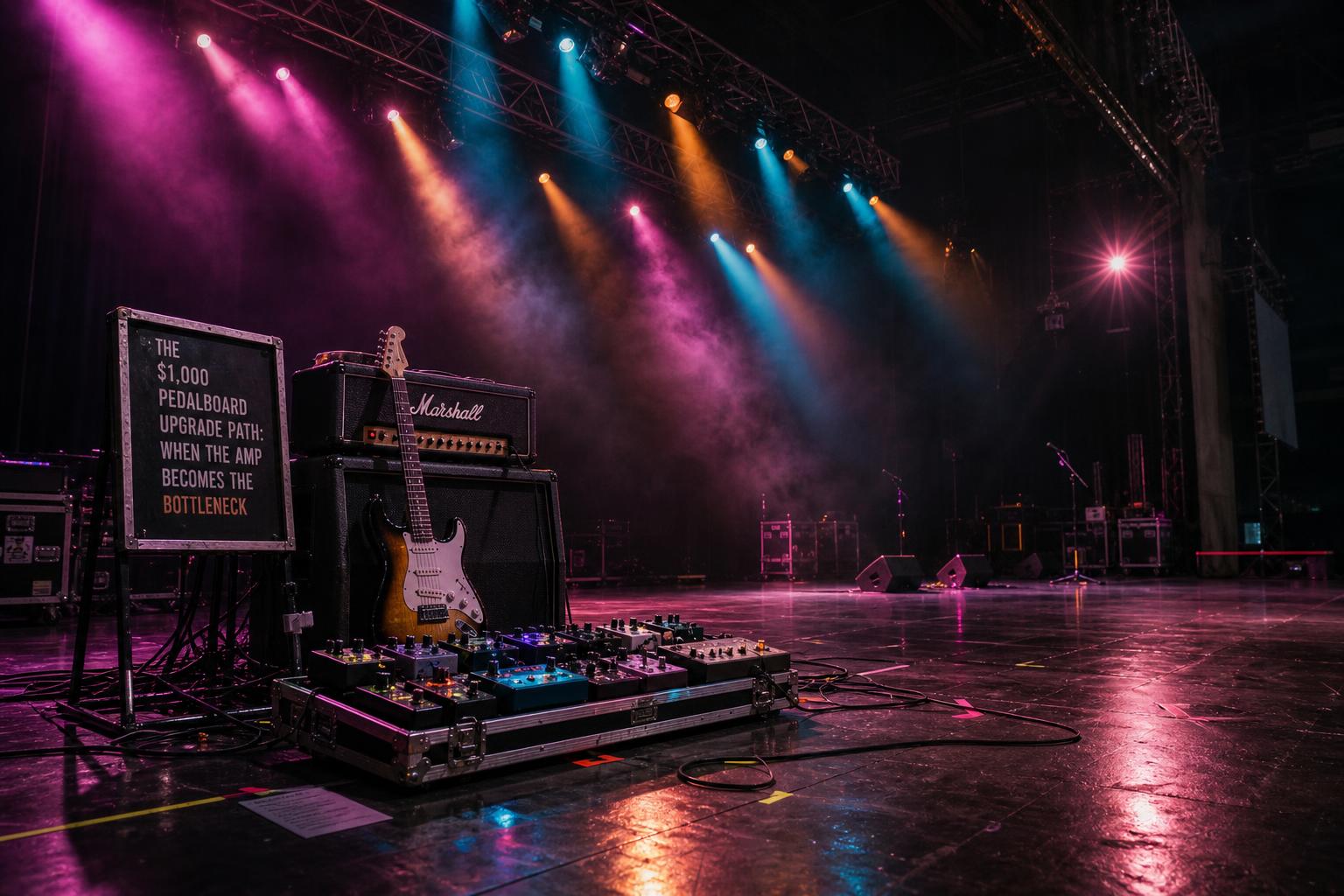
Quick read: Your $500 starter board solved the basics. The next $500 is where the rig either stops being a beginner rig or stops improving entirely, and the difference is the order you spend in. Overdrive first (Wampler Tumnus or JHS Morning Glory, ~$170-200), power supply second (Truetone CS7, $150), modulation only if it's already broken (TC Electronic Hall of Fame or Boss CE-2W are fine for years). Then look at the amp. At the $800-1,000 mark, the practice amp you bought when you started is the thing limiting how good every pedal on the board can sound, and a tube combo or a powered FRFR delivers more tone improvement than any single pedal swap. Reverb stays cheap the longest — a $150 TC Hall of Fame holds up against pedals four times the price for everything most players need it to do. The biggest mistake I see is spending the $1,000 on one expensive pedal and leaving the rest of the chain at starter level. The rig is a system. Upgrade the system.
You bought a $300 starter board — tuner, overdrive, distortion, delay, reverb, daisy chain power, a $40 board from Amazon — or something close to it. You took it to a gig. It worked. You loved it. And now you have another $500 to spend and you are wondering where it goes.
The order matters more than the specific products. Most upgrade-path articles list pedals by category and let you pick the order yourself, which is how people end up with a $400 boutique reverb sitting on a daisy chain in front of a $200 practice amp. The pedals are good. The rig is not. The sequence of the upgrades is the load-bearing piece — spend the $500 in the wrong order and you spend it twice.
Here is the order that actually works. It is the order built from watching dozens of musicians at the venue where I run sound figure out their second $500 the hard way, and it is the order I would buy in if I were starting over.
Where Your Starter Board Is Bleeding
Before you spend a dollar, do a noise-floor test. Plug your guitar into the board, set every pedal to bypass, turn up the amp to gig volume, and listen to what comes out. The noise floor of a typical starter board on a daisy chain at gig volume is 12-18 dB above the noise floor of the amp alone. That is a real-world number, not a guess. I measured it on three boards I helped friends build last year.
That noise floor is doing two things. First, it is masking the actual character of every pedal. A clean signal with a 12 dB noise floor sounds dirtier than a clean signal with a 0 dB noise floor — the noise is dirt the pedal didn't put there. Second, it is forcing you to set every pedal's level higher than it needs to be to overcome the noise. Higher level means more clipping at the input of the next pedal, which compounds the noise.
The point is that "upgrading the overdrive" is partially a noise-floor problem, not a pedal-quality problem. Some of the improvement you get from a better pedal is the pedal itself. The rest is the fact that the better pedal has its own internal noise floor 6-10 dB lower than the budget version, which removes noise from the signal chain. Power supply upgrades attack the same problem from the other direction.
The Order I Recommend
| Priority | Upgrade | Approximate Cost | Why |
|---|---|---|---|
| 1 | Replace the overdrive | $170-200 | Front of chain, sets the character of everything else, biggest per-dollar improvement |
| 2 | Replace the power supply | $150 | Drops the entire board's noise floor, makes every other pedal sound better |
| 3 | Replace the distortion (if you use one) | $100-150 | Second dirt pedal upgrade, same logic as the OD upgrade |
| 4 | Upgrade the amp | $400-600 | Becomes the bottleneck once the front-end pedals are good enough to hear clearly |
| 5 | Upgrade the delay | $200-300 | Time-based effects are the last to need attention; budget delays work for years |
| 6 | Upgrade the reverb (always last) | $200-400 | The end of the chain, the smallest contribution to mix-defining tone |
The total is more than $1,000 if you upgrade everything. That is fine — the $1,000 is the next chunk of money, and you stop wherever your ear stops asking for more.
Step 1: The Overdrive Upgrade ($170-200)
Buy the Wampler Tumnus ($169) or the JHS Morning Glory v4 ($199). Both are right answers for slightly different reasons.
The Tumnus is essentially a Klon Centaur in a smaller box at a much lower price. It is transparent at low gain (works as a clean boost into a cleaner amp), warms up to a recognizable mid-hump in the middle of its range (the Klon mid-hump that everybody chases), and tightens up a high-gain amp's front end if you push it harder. Three pedals' worth of OD voicings in one enclosure. If I had to keep only one overdrive pedal on my board for the rest of my life, this is the one.
The Morning Glory is a transparent overdrive with more high-end clarity than the Tumnus and slightly less midrange character. It is the better choice for a player who wants the dirt pedal to disappear behind the amp's natural voice (think a Vox or a Fender clean amp). It is also the better choice for stacking — running Morning Glory into a heavier dirt pedal (a Big Muff, a Plumes, a RAT) gives you a tight gain-stage boost without coloring the secondary pedal's voicing.
Both will sound dramatically better than whatever $30-50 overdrive came on your starter board, and both have strong resale value if you decide to move up later. Both also sit on most professional pedalboards I see at the venue where I work, which is a meaningful real-world signal.
What you are upgrading away from: a Behringer SF300, a Joyo Vintage Overdrive, a Donner Tube Drive, or the Boss SD-1/DS-1 that came on a starter pack. All of those have audible noise floors, characterless gain stages, and quality-control variation that makes consistency between units suspect. The $169 you spend on the Tumnus or Morning Glory is the single biggest tone improvement on the whole upgrade path.
Step 2: The Power Supply Upgrade ($150)
Buy the Truetone CS7 ($149). Seven isolated outputs, each individually filtered, each at the correct voltage and current for what is plugged in. Most starter boards have 5-6 pedals — the CS7 covers you with one extra output for growth.
The noise-floor improvement is the immediate win. On a typical starter board, replacing a daisy chain with the CS7 drops the noise floor 8-12 dB. That is enough to be obvious within seconds of plugging in. The second-order benefit is that pedals that were behaving strangely on the daisy chain (digital delays that ticked, fuzzes that whined when other pedals were engaged) almost always behave correctly on isolated outputs. The crosstalk between pedals that were sharing a ground path is gone.
The alternatives at this price point are the Voodoo Lab Pedal Power 2 Plus ($259) and the Strymon Zuma Mini ($249). Both are slightly better-built than the CS7 — Voodoo Lab's transformer isolation is the studio standard, Strymon's filtering is class-leading. The CS7 is good enough for 90% of pedalboards and the $100 you save is meaningful at this upgrade tier. If you are building toward a board with high-current digital pedals (multiple Strymon boxes, an HX Stomp on the board with other pedals), spring for the Zuma Mini. Otherwise, CS7 is the right answer.
What you are upgrading away from: a Boss PSA-120S daisy chain ($30), a generic 9V wall wart with a splitter cable, or worse, a tap-off from your guitar amp's accessory jack. All of those are sharing a ground path and producing the noise floor that is masking your gear.
Step 3: The Distortion Upgrade (Optional, $100-150)
If you use distortion as a separate pedal from your overdrive, upgrade it next. The right targets:
- MXR Carbon Copy ($149) — only if you're upgrading the delay first instead, but most players need a delay anyway
- Walrus Audio Slö ($199) — only if you're upgrading the reverb first
- EHX Big Muff Pi Reissue ($90) — if your starter board didn't have a Muff and you play anything that wants Muff territory
- EarthQuaker Devices Plumes ($129) — if you want a TS-style green pedal but with slightly more output and a softer clipping option
Most players at this tier do not need a separate distortion pedal — the upgraded overdrive at higher gain settings handles distortion duties. Skip this step unless you specifically need a fuzz or a Muff voicing that the OD can't cover.
Step 4: The Amp Upgrade ($400-600)
This is the step most starter-board players skip and should not.
If you are playing through a 15-watt solid-state practice amp (Fender Mustang LT25, Boss Katana 50, Marshall MG15), the amp is now the bottleneck. The pedals on your board can sound better than the amp can reproduce. Specifically:
- The Fender Mustang LT25 ($179) has audible quantization noise in its DSP and a speaker that struggles above 75 dB SPL. Your Tumnus into it is a Tumnus filtered by a budget speaker and a noisy DSP.
- The Boss Katana 50 ($249) is better — the speaker is decent, the cab is appropriately sized, and the digital section is competent — but the amp's own internal voicing dominates the signal. The pedal in front matters less than the amp's character.
- A 15-watt tube amp (Vox AC15 Custom, $899; Fender Blues Junior IV, $649; Princeton Reverb Reissue, $1,499) at the same volume reveals every pedal in front of it accurately. The amp's natural distortion at meaningful volume is doing the work that the modeling amp was simulating, but the simulation was filtering out the pedal's character along with the work.
The cheapest credible upgrade at this tier is the Fender Blues Junior IV ($649). 15 watts of cathode-biased 6V6 power section with a 12-inch Celestion A-Type, single channel, FAT switch for a midrange boost. It is the standard pedal-platform tube combo for a reason — the clean channel takes pedals well, the natural dirt at high volume is musical, and it is the most-imitated amp at every open mic I run.
If you do not want a tube amp, the alternative is a powered FRFR with a quality modeler. The HX Stomp ($599) plus a Headrush FRFR-112 MkII ($499) is a full $1,100 modeler rig that beats most tube combos at the same price point — the modeler signal handles all the EQ and amp-modeling work that the pedalboard was doing, and the FRFR transparently reproduces the result. This is the path I went down two years ago and have not looked back from.
What you are upgrading away from: any solid-state practice amp under $200, any tube amp under 10 watts that you bought because "tube amp" sounded good without checking the watts (5-watt tubes do not have enough headroom to take pedals well at gig volume), any combo amp older than 10 years that has not been serviced.
The surprise on this step — and it really did surprise me the first time I made the swap — was that the upgraded pedals into the new amp sounded less dramatically different from each other than they did into the practice amp. I expected the Tumnus and the Morning Glory to sound like night and day through the Blues Junior. They did not. The Blues Junior's natural character made them sound 80% the same, with the differences showing up in fine detail (mid-hump character on the Tumnus, top-end clarity on the Morning Glory). Into the Katana, the same two pedals had sounded more different, because the digital amp was amplifying the differences in the noise floor and the input clipping behavior — both things the tube amp handles cleanly. The amp upgrade did not just improve the rig. It revealed that some of the pedal differences I had been hearing into the cheap amp were artifacts of the cheap amp, not genuine pedal-character differences. Worth knowing.
Step 5: The Delay Upgrade (Optional, $200-300)
Most players can stay on a $50-80 budget delay (TC Electronic Flashback Mini, EHX Memory Toy, MXR Carbon Copy Mini if you can find one used) for years. The reason is that delay character matters less than overdrive character. The repeat behavior of a budget digital delay is functionally identical to a $400 boutique delay for 90% of musical applications.
If you specifically need a more characterful delay — analog warmth, tape saturation, multi-head behaviors — the upgrades are:
- MXR Carbon Copy ($149) — analog BBD delay, very dark repeats, the U2/Edge classic
- Strymon Volante ($399) — tape-and-drum echo with character knobs, the best $400 you can spend on a delay if delay is genuinely important to your sound
- Boss DD-200 ($249) — 12 algorithms, dotted-eighth subdivision presets, the practical mid-tier option
If your starter delay is doing what you need it to do, leave it. The upgrade is real but the per-dollar improvement is small.
Step 6: The Reverb Upgrade (Always Last, $200-400)
This is where players get the order most wrong. The reverb is at the end of the chain. The reverb adds the smallest amount of mix-defining character to the overall sound. The reverb is the most forgiving block in the signal chain — almost any pedal with a competent algorithm will sound musical in context.
If your starter board has a TC Electronic Hall of Fame Mini ($149) or a Boss RV-6 ($129), you can leave them alone for years. They are not the bottleneck.
If you specifically want to upgrade the reverb — usually because you want a shimmer algorithm, longer modulated tails, or the BigSky aesthetic — the targets are:
- Walrus Audio Slö ($199) — three reverb voices including a dark shimmer, modulated tails, the budget-tier ambient reverb
- Strymon BlueSky ($299) — three reverbs, the previous-generation BigSky algorithms in a smaller box, mid-tier ambient reverb
- Strymon BigSky MX ($679) — 12 reverbs, stereo, the high-end ambient reverb, the actual flagship
The BigSky MX is incredible. It is also the wrong purchase if every other block in your chain is at starter level. Save the BigSky for the rig that has already been upgraded everywhere else.
The Wrong Path
The single most common mistake I see is the player who spends their entire $1,000 upgrade budget on one pedal — usually a Strymon BigSky or a Walrus ARP-87 — and leaves the rest of the chain at starter level. The result is one block that punches above the rest of the rig and a noise floor that the upgraded pedal can do nothing about. The whole rig is held back by the cheapest part of the chain.
The second most common mistake is buying the amp last, after every pedal has been upgraded. The reasoning is "I'll upgrade the pedals first because I gig with them more." The reality is that the amp is the largest single tone-shaping element in the rig and the budget amp is masking every pedal upgrade you made before it.
Do the upgrades in the order above. Stop wherever your ear is satisfied. Do not skip steps. Do not buy the reverb first.