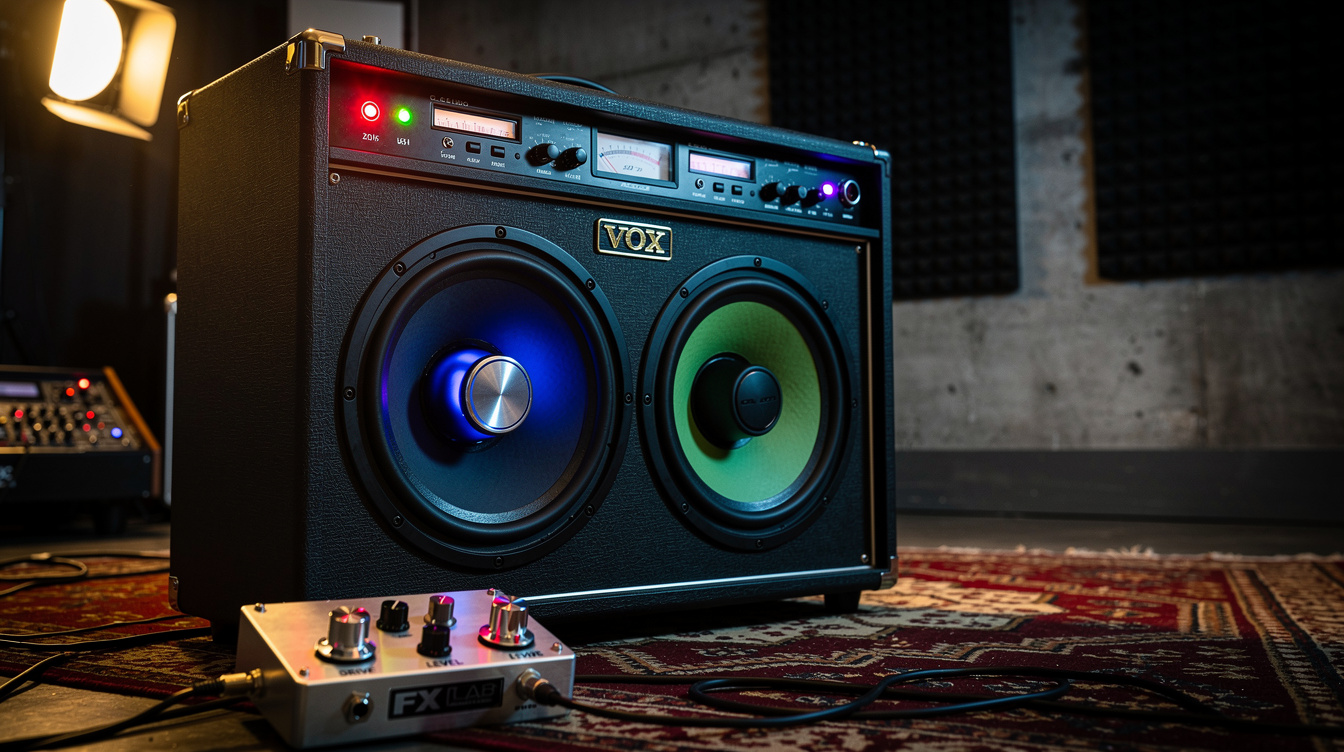
Two guitarists play the same Vox AC30, the same settings, the same worship song, and one of them chimes like a struck bell while the other sits warm and woolly under the band. Nothing changed but the speaker — one running Celestion Alnico Blues, the other running Greenbacks — and that single choice moved the tone further than any knob on the front panel could. In an AC30, the speaker is not an accessory. It is half the amp.
That matters more in worship guitar than almost anywhere else, because the AC30 is the platform under so much of the modern sound — the chime behind Hillsong, the wash behind Bethel — and which speaker sits in the cab decides whether you are getting the bright, sparkling version of that platform or the warm, thick one. Let me walk you through the two, and then tell you how to pick.
The Alnico Blue: The Sound of Chime
The Celestion Alnico Blue is the original AC30 speaker, and everything people love about a chiming Vox lives in it. Vox spec'd these alnico-magnet Celestions back in the late 1950s — the blue bell on the magnet is where the nickname comes from — and they were expensive and a little fragile even then, rated around 15 watts apiece, which is why a cranked AC30 pushing four of them was always living near the edge of what the speakers could take.
That fragility is part of the tone. An alnico magnet compresses earlier and more sweetly than a ceramic one — the low end softens a hair under a hard strum, the top blooms, and the whole speaker has a springy give that a stiffer speaker does not. What you hear is a bright, glassy, bell-like top end that keeps ringing a beat after you would expect it to stop. It is the jangle behind a Rickenbacker into an AC30, the shimmer under a swelled chord, the reason What a Beautiful Name and Way Maker both live on this speaker and not the other one.
The trade is in the low end and the durability. A Blue does not thud. Palm-muted low notes stay polite where a bigger ceramic speaker would slam. And they are the speaker most likely to complain if you run a hot high-gain rig through them for years — they were built for chime, not for abuse.
The Greenback: The Sound of Grind
The Celestion G12M Greenback is a different animal from a different decade. Celestion introduced the G12M-25 around 1968 — the green magnet cover is the nickname — and it became the speaker in a thousand rock records, the woody midrange bark you hear in the back of half the British amps ever cranked. It is a ceramic-magnet speaker, handles about 25 watts, and it breaks up later and darker than a Blue.
Put a set of Greenbacks in an AC30 and the amp changes character completely. The chiming top rolls off — think of a wool blanket thrown over the top two strings — and a thick, honking midrange steps forward in its place. Notes get woody. Chords get denser. The whole thing gains weight and grit and loses sparkle. It is the AC30 as a rock amp instead of a jangle machine, and it is exactly why Goodness of God runs a Greenback cab where its siblings run Blues — that song wants warmth and body under the mix, not chime on top of it.
The Greenback also fixes the Blue's two weaknesses. It handles more power, and it is far more forgiving of a bright room or a hot pickup, because it simply does not have the searing top end to turn harsh in the first place.
The Discovery That Flipped My Assumption
I went into this believing the Blue was always the right call for worship — the whole point of that lineage is chime, so give it the chimey speaker and be done. Then I heard a good player run a Blue-loaded AC30 through a bright, unforgiving FOH system in a hard-walled room, and the top end I loved in the studio turned into an ice pick by the third song. Every swelled chord had a glassy spike on it that the front-of-house could not tame without gutting the whole guitar.
The same rig with Greenbacks, in that same room, sat down and behaved. The rolled-off top that I had written off as "warm but dull" was the exact thing keeping the guitar out of the congregation's ears in a bad-sounding room. That is the lesson worth keeping: the Blue's sparkle is a gift in a controlled space and a liability in a bright one. The speaker that measures brighter is not automatically the one that sounds better where you actually play.
How to Pick
Here is the decision, stripped down.
| Choose the Alnico Blue if... | Choose the Greenback if... |
|---|---|
| You want chime, sparkle, and shimmer | You want warmth, body, and grind |
| You play single-coils or bright pickups | You play humbuckers or a dark guitar |
| You record, or play a controlled room | You play a bright, harsh, or loud room |
| The guitar is texture — pads and swells | The guitar sits in a dense, full-band mix |
| Your tone leans on ambient reverb on top | Your tone needs to stay dark under vocals |
If you are still not sure, the honest default for a new worship player in a room they do not control is the Greenback — it is harder to make sound bad. The Blue rewards a good room and punishes a bad one. The Greenback just shows up and does the job.
On a Modeler, It Is a Cab Block
Now, I am a tube-and-speaker man — I would rather swap a real speaker and hear the cabinet move air. But most players reading this are on a Helix or something like it, and the good news is you do not need a soldering iron to have both. The choice that costs a hundred dollars and an afternoon in the real world is a menu selection in a modeler.
On the Helix, the 2x12 Blue Bell cab models the Alnico Blue and the 4x12 Greenback 25 models the Greenback. Load one, listen, load the other, and A/B them on the same amp block — you will hear the exact split I have been describing. Set the high cut around 8.5 kHz for the Blue to keep its sparkle, and roll it back to about 7 kHz for the Greenback to sit in its lane. That, and nothing else, is the difference between the chime version and the warm version of the same worship tone. More on why two cabs on one amp diverge this hard is in our Helix cab models breakdown.
The Short Version
The Blue chimes and the Greenback grinds, and in an AC30 that is most of the tonal decision you will ever make. Pick the Blue when you want sparkle and you trust the room. Pick the Greenback when you want warmth, or when the room and the PA are working against you. And if you are on a modeler, audition both on the same amp before you commit — the answer is often not the one you would have guessed from the spec sheet.
Dialing in a worship rig from the ground up? The worship pedalboard guide covers the chain that feeds this cab.