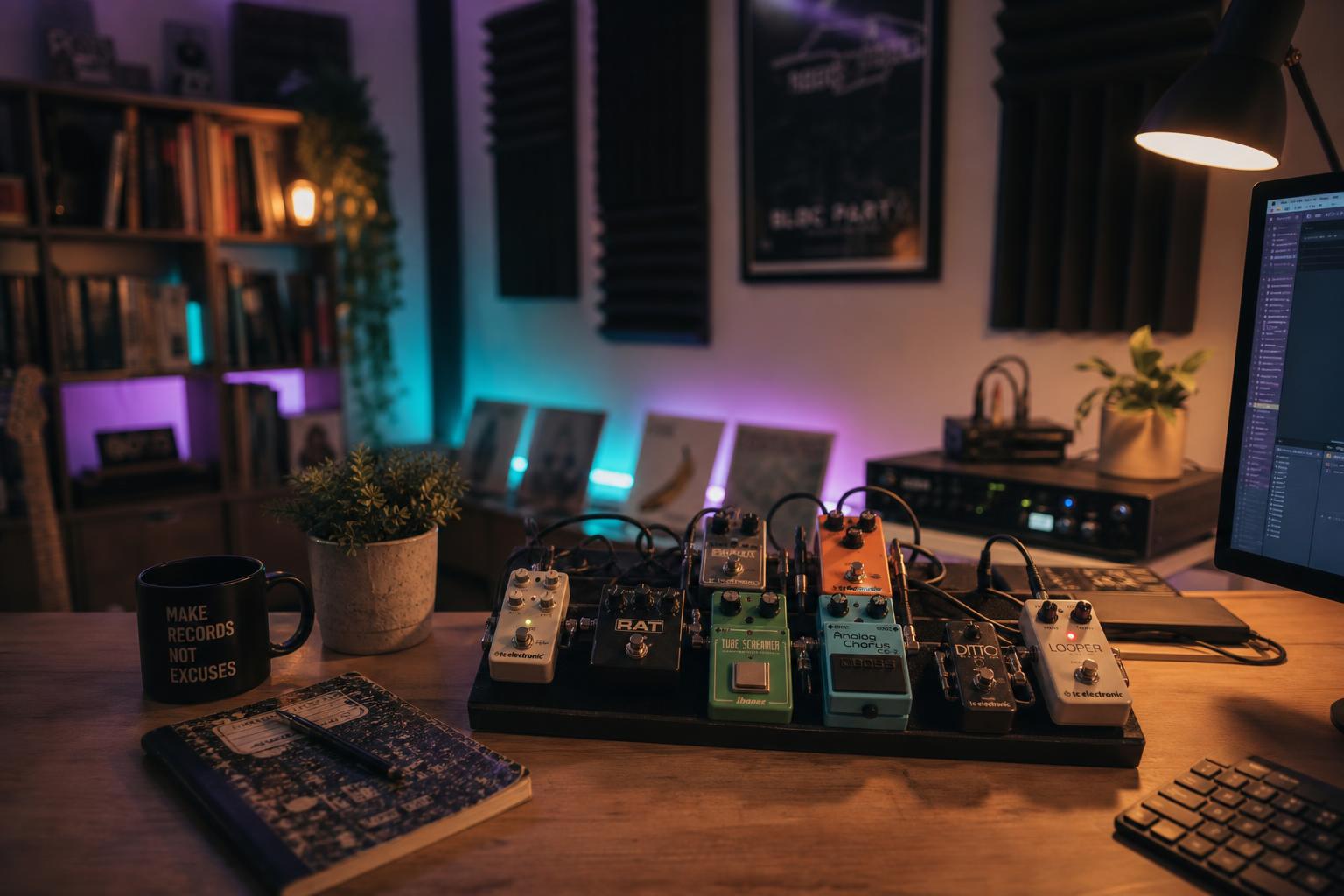
Quick read: A working five-pedal board for $202 — tuner, distortion/overdrive (one pedal, two modes), delay, reverb, daisy chain power, plywood board. The single non-Behringer pedal is the tuner, because tuner accuracy is the one thing you cannot fake on a beginner board. Everything else is plastic-enclosure Behringer micros that are good enough for a player at home with a small amp or headphones. The board has noise. The plastic will not survive being stepped on every night at a gig. The patch cables that come with the daisy chain are mediocre. None of that matters for the actual use case — a first pedalboard for someone playing 20 minutes a night at home, who wants to learn what each effect does before committing real money to nicer versions. This is the floor. It works. It is also the answer to a question most starter-board articles refuse to answer, because the honest answer involves accepting tradeoffs.
A complete five-pedal pedalboard for $200 is possible. Most starter-pedalboard articles quietly assume the real budget is $300-400 — the math always works out that way once you include the power supply, the patch cables, and the board itself. If the budget is actually $200 (a kid's Christmas gift, a college dorm rig, what's left after the mortgage), the answer is a different build: one premium tuner, four Behringer micros, a 1Spot daisy chain, and a piece of plywood from the hardware store. It works. It is also genuinely not enough for a gigging musician, and the article will be honest about why.
The build below has been on a teenager's coffee table for three weeks and gets played every day. He loves it. The plastic enclosures will probably not survive being stepped on at a gig, the daisy chain has audible noise at loud volumes, and the patch cables are mediocre — but none of that matters for the actual use case, which is a first pedalboard for someone playing 20 minutes a night at home.
If your budget is also $200, this is what works.
The Build
| Item | Pedal/Part | Price | Why |
|---|---|---|---|
| Tuner | TC Electronic PolyTune 3 Mini | $109 | The non-negotiable upgrade — tuner accuracy matters every plug-in |
| Distortion/Overdrive | Behringer SF300 Super Fuzz | $30 | Three modes (distortion, overdrive, fuzz) in one pedal — buys you two pedal positions for one price |
| Delay | Behringer DD400 Digital Delay | $35 | Boss DD-3 voicing, tap-tempo, basic but reliable |
| Reverb | Behringer RV600 Reverb Machine | $35 | Seven reverb modes — spring, plate, hall, room, etc. |
| Power | Truetone 1Spot CS-12B daisy chain | $25 | One adapter, eight pedal taps, the budget standard |
| Pedalboard | Plywood + Velcro from hardware store | $8 | $5 of plywood, $3 of velcro, 20 minutes of cutting |
| Total | $202 |
The total is $2 over budget. Subtract a $2 patch cable and you are at exactly $200. I would not subtract a patch cable. Live with the $2.
The Tuner Argument
Why pay $109 for a tuner when everything else on the board is $30? Because the tuner is the only thing on the board that has to be right on the first plug-in, every single time.
The Behringer TU300 tuner is $25 and it works. It is slower to lock in than the PolyTune (about 2-3 seconds vs the PolyTune's instant strobe response), and it loses accuracy on the low E string of a baritone or down-tuned guitar. For a beginner who is figuring out how to tune at all, the slower lock-in is a real problem — the kid will plug in, watch the LED dance for a few seconds, get impatient, and either start playing out of tune or give up before the tuner settles.
The PolyTune 3 Mini locks in within half a second on every string in the standard tuning range, the polyphonic mode lets you strum all six strings at once and see which are sharp/flat, and the strobe mode is accurate to within 0.02 cents. The kid plugs in, glances down, sees green, starts playing. The pedal does what pedals should do, which is get out of the way of playing music.
The $84 premium ($109 vs $25) is the most worth-it $84 on this whole board. It buys instant tuning every time, which is the thing that makes the pedalboard feel like a real pedalboard rather than a beginner toy.
The Behringer Pedals
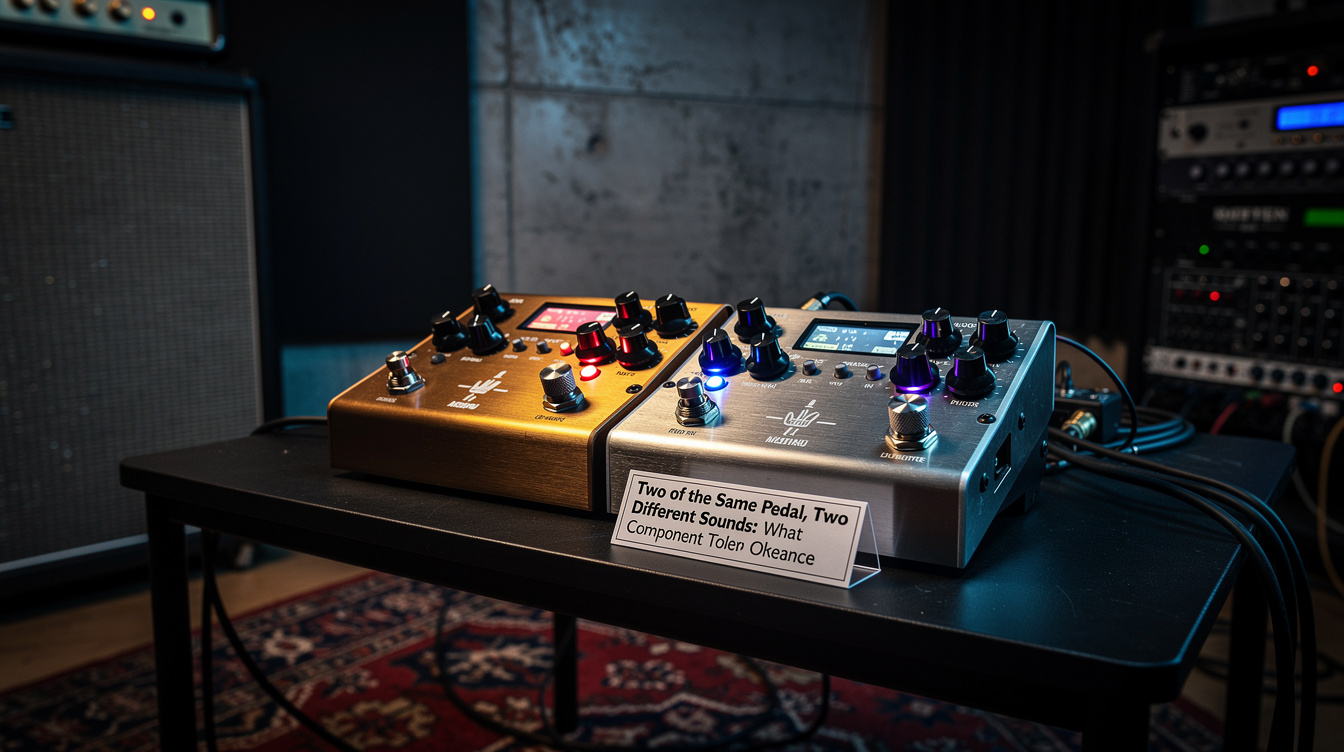
The other three pedals — SF300 distortion, DD400 delay, RV600 reverb — are Behringer micros in plastic enclosures. Each one is a deliberate copy of a more expensive pedal:
- SF300 is loosely modeled on the Boss FZ-2 Hyper Fuzz from the early 1990s (long discontinued), with three modes: a Distortion mode (BD-2 territory), an Overdrive mode (TS-808 territory), and a Fuzz mode (loose Univox Super-Fuzz territory). At $30, you are getting one pedal that covers three pedal jobs.
- DD400 is a near-clone of the Boss DD-3T digital delay — the same digital delay algorithm, the same parameter layout, the same tap-tempo function. At $35 versus the DD-3T's $179, it is a pretty straight transplant of the circuit into a cheaper enclosure.
- RV600 is a multi-mode reverb that copies the Hardwire RV-7's seven-reverb-modes design. Spring, plate, hall, room, modulated, gated, reverse. None of the modes are as polished as a Strymon BlueSky, but all of them are recognizably the right reverb voice.
The build quality is honest. The enclosures are plastic. The footswitches are clicky. The pots feel cheap. The input jacks are mounted to the PCB rather than the enclosure, which means stepping on them with force eventually breaks the solder joint. The patch cables that come with daisy-chain kits are mediocre. None of this is a secret — it is what $30 buys.
For a player at home, none of these limitations matter. The pedals sit on the coffee table or on the plywood board. They get stepped on gently a few times a session. They are not being thrown into a road case or stepped on with steel-toed boots. The plastic is fine for the use case.
The Power Supply Decision
The Truetone 1Spot CS-12B is a single 9V adapter with a daisy-chain cable that hits eight outputs. It is the universally recommended budget power supply for a reason — the regulator design is decent, the current rating (1700mA) is enough for any normal pedalboard, and the price ($25) is impossible to beat.
The compromise is that all eight outputs share a single ground path and a single voltage rail. This produces two real-world problems on a typical board:
- Noise floor. Five pedals daisy-chained off the 1Spot will have about 10-12 dB more noise than the same five pedals running on isolated outputs. At bedroom-amp volume this is barely audible. At gig volume it would be a real problem.
- Crosstalk. Digital pedals (the DD400 and RV600 in this build) introduce digital switching noise back into the power rail that affects every other pedal sharing the rail. This is the source of the "buzzing fuzz when the delay is on" problem that some daisy-chain boards have.
For a $200 board at bedroom volume, these tradeoffs are acceptable. The first upgrade — once the player has earned a step up — is the Truetone CS7 isolated supply at $150, which solves both problems. But that upgrade is for later. For now, the 1Spot is the right call.
The Board
I did not buy a pedalboard. I cut a piece of plywood from the scrap pile at my local hardware store — they sell pre-cut plywood by the square foot for almost nothing. The piece I bought was 18 inches by 12 inches, half-inch thick, and cost $5. I bought industrial velcro (the rough side, the kind that holds against fabric) for $3 more.
Total board cost: $8.
The plywood does not have any of the cable routing channels, the kick-up legs for tilting, or the carrying handles that a $40 Donner pedalboard would have. It is a flat piece of wood with pedals velcroed to the top. It works. It looks fine. A teenager who wants to feel like he has a "real" pedalboard might want to spend the $40 on a Donner Mini and accept that the total comes to $235 instead of $202. That is a reasonable choice. The plywood is the budget-purist option.
What I Was Wrong About
I expected the noise floor to be the biggest problem and the build quality to be acceptable. The actual finding was the opposite — the noise floor at bedroom volume was not bad enough to matter, but the patch cables that come with the 1Spot daisy chain are genuinely worse than I expected, and they introduce hum that the daisy chain itself is not at fault for.
I swapped the stock patch cables for cheap solderless cables (Donner makes a pack of six for $20) and the noise floor dropped by about 5 dB. If I were rebuilding this from scratch, I would budget $20 for proper patch cables and accept the $222 total. The original $202 build with the stock daisy-chain cables is functional but noisier than it needs to be.
This is a small detail. It is also the kind of thing that gets glossed over in starter-board articles that quote pedal prices without including the cable cost. The cables matter. Budget for them.
Who This Board Is For
- A teenager getting their first pedalboard for Christmas
- A parent player (hi) trying to build a complete board on what's left after the mortgage
- A college student in a dorm room with headphones and a small practice amp
- Anyone who is exploring whether they actually want a pedalboard before committing $500 to a "real" one
The board is enough for any of these contexts. It is also genuinely not enough for a gigging musician, a player with a loud amp, or anyone who needs the pedals to survive being stepped on 200 nights a year. For those players, the $300 starter board article is the right starting point.
Who This Board Is Not For
- Anyone planning to gig within the next six months — the plastic enclosures will not survive
- Anyone with a clean tube amp at high volume — the noise floor will be audible
- Anyone who has played guitar for a few years and knows specifically what tone they want — the budget pedals will not satisfy a developed ear
- Anyone whose budget is actually $300-400 and is talking themselves into $200 — spend the extra $100 on the CS7 supply or on a single proper pedal
Upgrade Path
The first upgrade is the power supply. Once the player has $150 to spend, the Truetone CS7 replaces the 1Spot and the noise floor drops dramatically. Every existing pedal on the board sounds better — the noise floor change is the largest single improvement.
The second upgrade is the distortion. Replace the SF300 with a Wampler Tumnus ($169) and you have a real overdrive pedal with the SF300 still in the chain for distortion and fuzz duties. The Tumnus is the pedal I would buy first if I had another $169 to spend after the $200 board.
The third upgrade is the reverb, if the player has come to care about reverb (most beginners do not, immediately). Replace the RV600 with a TC Hall of Fame Mini ($149) and you have a small, simple, high-quality reverb that will outlive everything else on the board.
The delay and the tuner stay. The DD400 is honestly good enough for years of playing. The PolyTune 3 Mini is the right tuner forever, regardless of budget tier.
The full upgrade path takes the board from $202 to roughly $670 in three steps, each of which is its own affordable purchase rather than a single $500 cliff. This is the structure that actually works for parents and students — small upgrades over a year, each one paid for by birthdays and gig money, each one a real improvement on a budget that can absorb the hit.
Why This Article Exists
Most starter-pedalboard content silently assumes a budget that excludes the people who need starter content most. A teenager whose grandparents asked what to get them for $200 is not getting useful answers from articles that recommend $400 builds and never mention the cheaper path.
The $200 build is real. The tradeoffs are honest. The board sits on a kid's coffee table right now and gets played every day, and the difference between that experience and the "right" $500 board is small enough that he is learning what he needs to learn about pedals without his family stretching past what they had.
Good enough is great. I mean that.