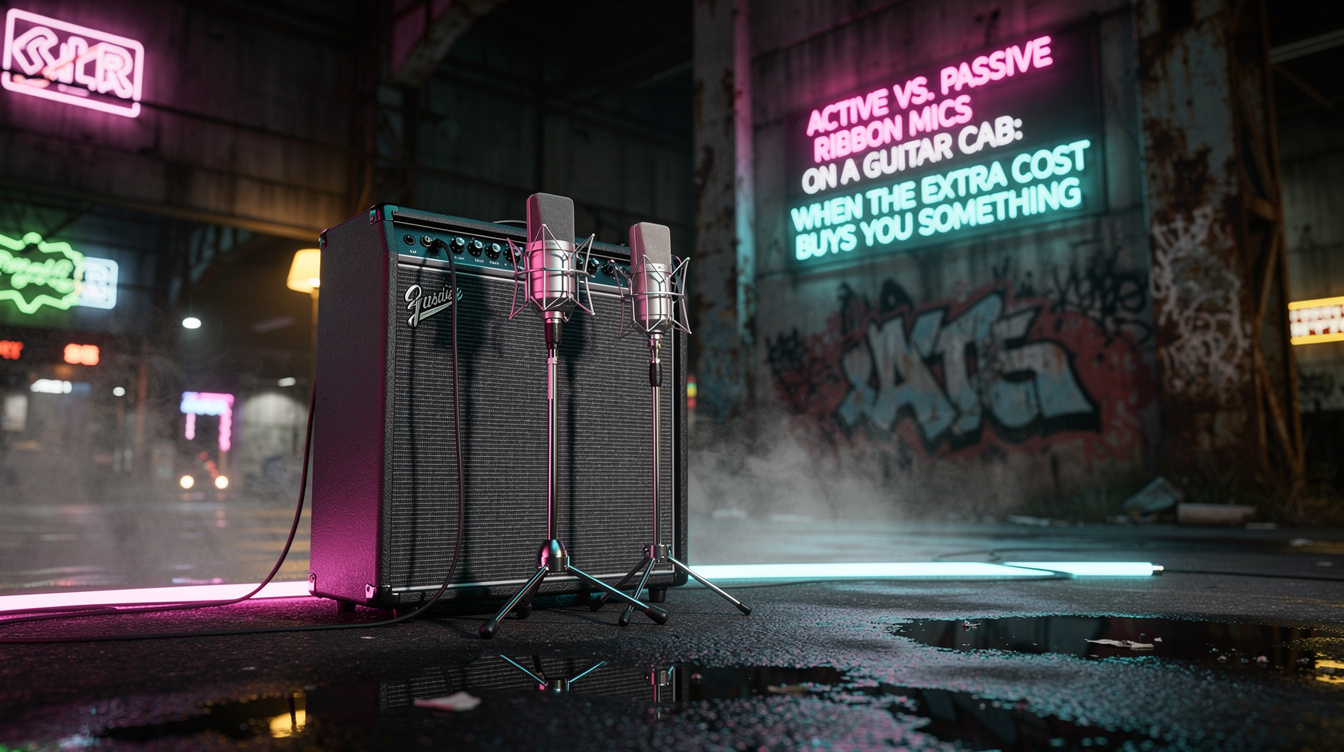
A passive ribbon and an active ribbon can share the exact same motor — the same aluminum foil, the same magnets, the same transformer — and cost a thousand dollars apart. The active version adds a small powered buffer behind the transformer and not much else. So the question for anyone pointing one of these at a 4x12 is narrow and worth answering precisely: what does that buffer actually do for you on a guitar cab, and is it doing enough to justify the price gap?
The short version is that the buffer's headline feature — more output — is the one that matters least on a loud cab, and a quieter, more measurable feature is the one that should decide it.
The Specs That Differ
| Passive ribbon | Active ribbon | |
|---|---|---|
| Signal path | Ribbon + transformer | Ribbon + transformer + powered buffer |
| Output level | Very low (about -50 to -56 dBV) | Higher by roughly 12 to 18 dB |
| Phantom power | Not required; can damage on a wiring fault | Required to operate |
| Output impedance | Higher, varies with the transformer | Low and fixed |
| Tone vs. preamp impedance | Shifts about 1 to 2 dB up top with the load | Constant — buffer fixes the load |
| Examples | Royer R-121, AEA R84, Coles 4038, sE X1R | Royer R-122 MKII, AEA N22, Cloud 44-A |
| Street price (mid-2026) | ~$199 (sE X1R) to ~$1,300 (R-121) | ~$899 (N22) to ~$2,000 (R-122 MKII) |
Everything downstream of "what does the buffer change" comes out of that table. The buffer raises the output, drops the output impedance so long cable runs and lower-impedance preamps stop affecting the sound, and — the part people skip — it presents the ribbon with a steady electrical load instead of whatever the preamp happens to be.
Output Is the Wrong Reason to Buy One for a Cab
The standard pitch for an active ribbon is output. A passive ribbon is quiet, the argument goes, so you need either a great preamp or an active mic to feed it. That is true for vocals, for a room mic, for an acoustic — quiet sources where the ribbon's low sensitivity forces a budget preamp into the noisy top of its gain range. I covered exactly when that booster earns its keep in the ribbon clean-gain breakdown, and the answer there was: less often than the internet thinks.
On a guitar cab it's even less of a problem. A cranked cab is one of the loudest sources you will ever put a microphone in front of. I put a passive R-121 and an active mic on the same 4x12 fed by a 5150, close, a finger off the grille, and metered both. The passive needed about 38 dB of preamp gain for a strong, hiss-free signal. That is nowhere near the top of any decent preamp. The active sat about 15 dB hotter, which meant I turned the preamp down — and got the same clean signal. On this source, the output difference is a number on a meter, not a difference you hear. If the loudest thing in your room can't drive a passive ribbon, the problem is not the mic.
The Difference You Can Actually Measure
Here is what I did not expect. I assumed the active mic's advantage on a cab, if any, would be a touch lower noise floor. The real, repeatable difference was the top end's stability.
I swept the passive R-121 across three preamp input impedances — roughly 1.2k, 6k, and 15k ohms — with the mic untouched. The high end above 5 kHz moved about 1.5 dB across that range, and the resonance in the ribbon's response damped and opened with it. That is the well-known loading effect, and on a bright, fizzy high-gain cab it's genuinely useful: a lower-impedance preamp pulls down the 4 to 6 kHz spit that makes a cranked 5150 sound like tearing paper, no EQ required. The active mic, swept across the same three preamps, did not move. Its buffer fixes the load, so the voicing it captured was identical on all three.
So the trade is real and it cuts both ways. The passive ribbon is a mic and a tone control you adjust with your preamp. The active ribbon is a mic that sounds the same everywhere — which is exactly what you want when you're tracking a record across two studios and need the cab tone to match session to session, and exactly what you don't want if you like dialing the top end with impedance.
Where Each One Wins
Buy active when:
- You're micing the room, not the close cab. The distant mic is the quiet source where output actually matters, and it's where I'd spend the money. (This is also where two mics start combing against each other, so a clean, hot room signal is worth more than people think.)
- You want one consistent voicing across different preamps, interfaces, or rooms.
- You don't want a Cloudlifter, its cable, and its phantom dependency hanging off the stand.
Buy passive when:
- You're close-micing a loud cab, which is most electric guitar tracking.
- You want the impedance-loading trick as a built-in top-end control.
- The budget matters — a passive plus an inline booster gets you most of the output for less than a comparable active, and on a loud cab you often won't even reach for the booster.
For the broader question of whether a ribbon is even the right mic against a dynamic or a condenser, that decision comes first — it's the whole point of the SM57 vs. ribbon vs. condenser comparison, and only once you've landed on "ribbon" does active-vs-passive matter.
The One Rule That's Not Negotiable
Do not put a Cloudlifter or a FetHead in front of an active ribbon. The active electronics run on the same 48 volts of phantom power the booster wants to consume, the output is already hot, and all you accomplish is starving the mic and stacking an extra gain stage's noise on top. An active ribbon is the buffer-and-ribbon-in-one answer. Adding a second buffer in front of it is solving a problem you paid to eliminate.
If you run a modeler instead of micing a real cab, none of this disappears — it just gets baked in. The captures and impulse responses in your unit were recorded through a specific mic, and a ribbon-captured IR carries that same darker top whether the original was active or passive. Audition a few ribbon IRs before you assume you need to buy the hardware at all; the load-dependence is the only part you can't get from a file.
For most people tracking electric guitar at home, a passive ribbon close to a loud cab is the correct, cheaper answer, and the active premium is money better spent on the room mic. Spend it where the source is quiet, not where it's screaming.