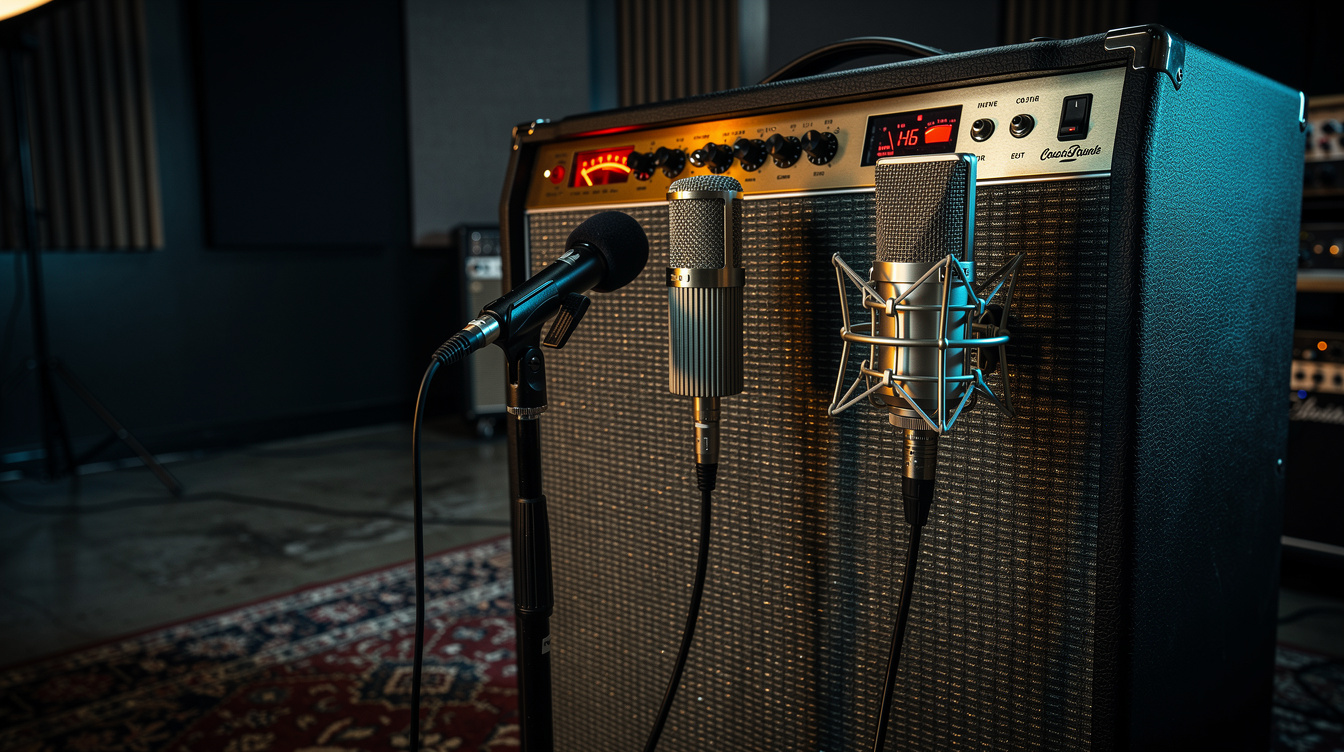
Three mics walk up to the same speaker and you get three different guitar sounds. Same amp, same room, same player. A dynamic, a ribbon, and a condenser each hear the cab their own way, and once you know what each one does you stop guessing and start choosing. This is not about which mic is best. It is about which mic is right for the tone in front of you — and which one quietly saves an amp you were about to fight with an EQ.
The Short Answer
| Mic type | What it does to the tone | Best on | Watch out for |
|---|---|---|---|
| Dynamic (SM57) | Mid-forward, hard attack, bump near 5 kHz | Crunch rhythm, anything that has to cut | Bright high-gain — it can hand you fizz |
| Ribbon (Royer-style) | Rolls off the highs, fattens the low mids | Bright or fizzy amps, leads, big rhythm | Darker out of the box. Never hit a passive one with phantom power |
| Condenser (large diaphragm) | Most detail, most air, extended top | Cleans, fingerstyle, room mic | Up close on a loud cab it can turn brittle. Needs phantom and SPL headroom |
If you own one mic, own an SM57. If you keep fighting your amp's top end with it, the next mic you buy is a ribbon. The condenser is for cleans and room, not for taming a loud Marshall.
The Dynamic: It Bites
The SM57 has been on more loud guitars than every other mic combined, and it is not nostalgia. It is built right for the job. It shrugs off volume, it rolls off the deep lows that would mud up a close-mic'd cab, and it has a presence bump around 5 kHz that shoves the guitar forward. That bump is why a 57 track cuts through a dense mix without you touching a fader.
Think of the snap on the rhythm guitars on Back in Black. That hard, mid-heavy attack — pick hitting string, speaker shoving back — is what a dynamic does naturally. It is the sound of a mic that throws away the parts of the spectrum a rock guitar does not need and leans on the parts it does.
The flip side is the same bump. Put a 57 dead-on a bright, high-gain amp and that 5 kHz lift can turn into an ice pick. Now you are cutting EQ to undo what the mic added. That is the moment a different mic earns its place.
The Ribbon: It Smooths
A ribbon hears the world differently. The top end rolls off on its own, gently, the way the air in a big room takes the edge off a loud amp by the time it reaches the back wall. The low mids come up fuller. Nothing about it is hyped.
What that buys you is fizz control at the source. The harsh, papery garbage that loud amps spray above 3 or 4 kHz — the ribbon just doesn't capture much of it. You get the body of the note and the grind, and the ice stays out of the recording instead of getting baked in for you to carve out later. On a lead it is gorgeous. The note sounds thick and finished, like it already went through a console.
Most ribbons are figure-8, which means they hear behind themselves as much as in front. Point that rear lobe at a good-sounding part of the room and it is a feature. Point it at a refrigerator and it is a problem. And the old rule that scared everybody off ribbons for years: do not put phantom power on a passive ribbon. It can stretch or snap the element. Modern active ribbons want phantom and say so — read the box. The robust ones are built to sit in front of a screaming 4x12 all day, so the fragility myth is mostly retired, but the phantom rule is real.
I'll be straight about how I came around on this. I figured a ribbon was a fragile, expensive studio toy and a 57 would always cut better. Then I tracked a bright JCM into Greenbacks that was throwing a nasty 3.5 kHz spit no amount of EQ would fix without dulling the whole thing. Put a ribbon on it — even a cheap one — and the spit was just gone, and the body got fatter at the same time. The 57 made that amp worse. The ribbon made it sound like the record I was hearing in my head. I was wrong about the toy.
The Condenser: It Details
A condenser is the sensitive one. It hears the most — the pick texture, the string detail, the air around the cab, the sound of the room itself. That sensitivity is the whole point and the whole risk.
On a clean tone it is the right answer. A chimey Tele or a fingerpicked Strat through a black-panel amp wants the detail and the extended top a condenser gives. The thing sparkles and you hear every nuance of the right hand. As a room mic, several feet back, a condenser captures the size of the space a dynamic never will.
Up close on a loud, distorted cab, that same detail works against you. The extended top end that flatters a clean tone turns brittle and edgy on high gain, and the mic's sensitivity means it hears everything, including the stuff you'd rather it didn't. You can do it — check the max SPL rating, hit the pad — but most of the time, on a loud dirty amp, the condenser belongs in the room, not on the grille.
The Combo That Earns Its Cliché
The classic move is an SM57 and a ribbon on the same speaker, blended. People roll their eyes at it because every studio does it. Every studio does it because it works.
The 57 brings the attack and the cut. The ribbon brings the body and the smooth top. Blend them and each one covers the other's weak spot — the ribbon fills in the lows and tames the highs the 57 over-cooks, the 57 adds the bite the ribbon is too polite to deliver. You get a tone neither mic makes alone.
One warning, and it is the whole game with two mics: phase. Two mics at slightly different distances hear the same note a hair apart, and summed, that gap carves a hole in your tone. Line them up before you commit. The why and the fixes are their own write-up, and if you are not ready to manage two mics, one good one is the better call — that case is made here.
On a Loud Stage, Aim the Dead Spot
Picking the mic is half of it. The other half is where you point the part that doesn't hear. Every one of these has a null — an angle it's deafest to — and on a live stage that angle is worth more than the front. The 57 is a cardioid: its null is straight off the back, so swing the back of the mic at the loudest thing bleeding in, usually the snare. A ribbon is figure-8: dead on both sides, so face the speaker and rotate a side null at the kit. Get the pattern's dead spot on the problem and the close mic stops arriving with half the drum kit attached. The full angle-by-angle version — including the trap where a supercardioid's dead-back isn't dead — is here.
How to Choose Without Buying All Three
Here is the part that costs nothing. Every one of these mics has been captured as an impulse response. A modeler's cab block, or a third-party IR library, lets you put a 57, a ribbon, and a condenser on the same virtual speaker and switch between them in a second. You can hear exactly what a ribbon does to your fizzy amp before you spend $150 on a real one. What an IR is and why the capture holds up is covered in the IR guide, and the library roundup points you at packs that label the mic on every capture.
Audition them the way you'd audition the real thing. And remember the choice underneath all of it — which speaker you point at on a multi-speaker cab matters as much as which mic you point with.
The mic is not magic. It is a filter with a personality. The dynamic cuts, the ribbon smooths, the condenser details. Match the personality to the tone you're chasing and the recording does half the work for you. Pick the wrong one and you'll spend the night with an EQ trying to talk a microphone out of being what it is. Your ears already know which is which — give them the right tool to listen with.