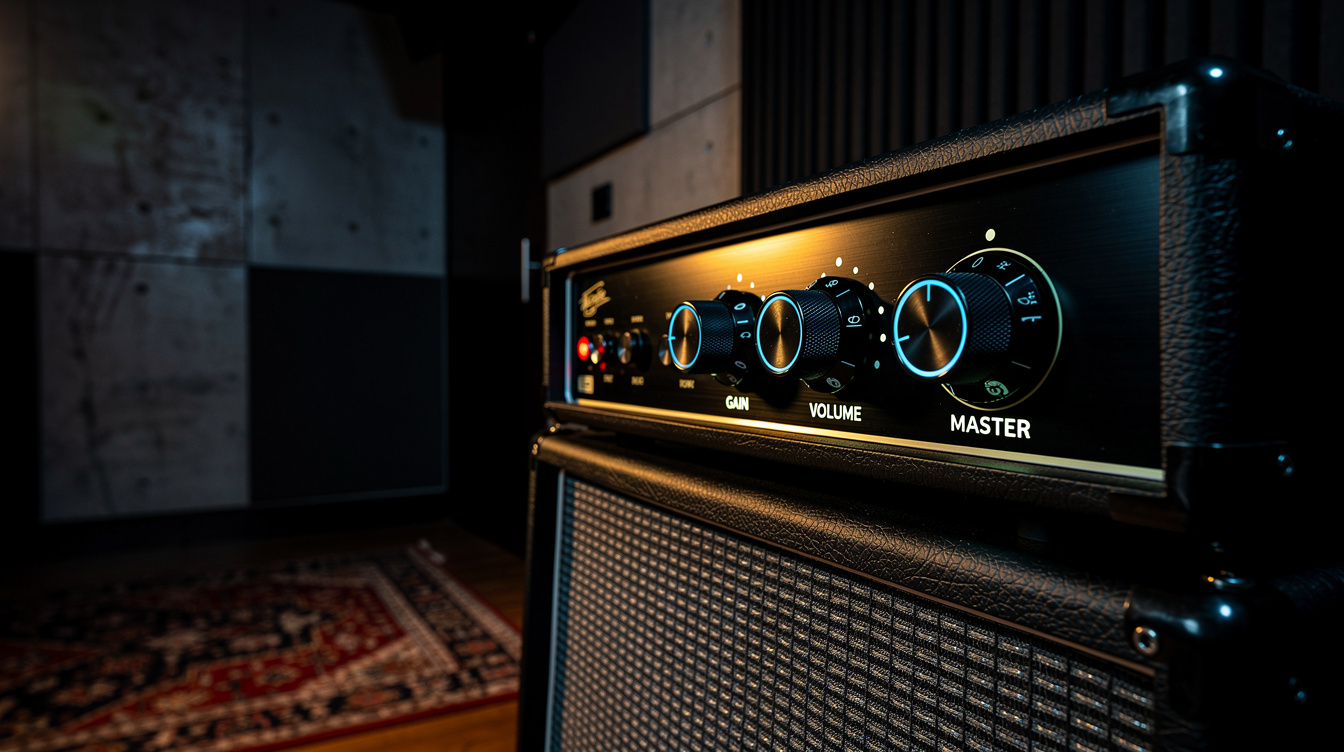
A kid walked into my shop in 1996, plugged a Les Paul into a JCM800, and cranked every knob to 10. Then he asked me why it sounded like a swarm of bees. He didn't understand what each knob was doing. Most people still don't.
Gain, volume, and master volume are three different controls. They are not the same thing. They don't do the same thing. And if you don't understand how they work together, you will spend years chasing a sound you could have dialed in on the first afternoon. I've watched it happen more times than I can count.
This piece is about what each of those knobs actually does, what happens when you combine them, and how to use all three deliberately to get the tone you're actually after. It is still the most important thing a guitarist can learn about their own rig.
Start Here
- Gain controls how much amplification is happening in the preamp stage. Higher gain means preamp saturation and distortion before the signal ever reaches the power amp.
- Volume (also called "Channel Volume" or "Output") controls how much of the preamp signal gets sent into the power amp. It determines power amp saturation and overall loudness simultaneously.
- Master Volume controls final output after the power amp. Turning it down lets you run preamp and power amp hard while keeping the room volume manageable.
- On older non-master-volume amps (the ones worth owning, in my opinion; original Marshalls, blackface Fenders), there is no master. You get tone by driving the whole amp up together.
- These three controls interact. The order in the circuit determines what each one shapes.
What Does the Gain Control Actually Do?
The gain control goes by a lot of names. "Drive," "Preamp," sometimes just "Gain." Whatever it says on the faceplate, it sits at the front of the preamp stage and determines how hard the input signal hits the first tube. Turn it up, and the preamp starts to clip. The sound thickens. You feel the notes push back against your pick. The amp starts to growl when you dig in and clean up when you back off. That growl, that feel, is what people mean when they talk about an amp's "gain sound."
I've owned amps across the whole spectrum of gain design. A Mesa Boogie Mark series, an EVH 5150, a Peavey 6505; these are amps built around cascading gain stages in the preamp, each tube clipping into the next, stacking harmonics until you get that dense, compressed wall of sound. A gain control at 3 o'clock on a 5150 is a different universe from a gain control at 3 o'clock on a Princeton Reverb. The circuits have fundamentally different intentions, and you can hear it the second you start playing.
Here's something that trips people up every single time: on a high-gain modern amp, the gain control alone can produce significant distortion with the volume at zero. You could be saturating three preamp stages and hear nothing at the speaker because the volume knob (which comes after the gain stage) hasn't opened the gate yet. Gain without volume is distortion with nowhere to go. I tell every kid who walks into the shop the same thing: the gain knob is not a loudness knob.
Where Gain Shapes Tone (and Where It Doesn't)
Gain shapes harmonic character. It shapes pick attack response. It shapes how your guitar's volume knob cleans things up. A properly set gain lets you roll back the guitar volume and go clean without touching the amp. What gain does not directly control is your overall output volume, and it does not by itself determine how hard the power amp is working.
High gain through a low volume setting gives you preamp saturation into a quiet, relatively unloaded power amp. That's one sound. The same gain through a high volume into a lowered master gives you preamp saturation feeding a stressed power amp. That's a different sound, and the difference is not subtle.
What Does the Volume Control Do?
This is where terminology gets genuinely messy. I've been arguing about this with amp builders since the '70s, because "volume" means different things on different amps, and manufacturers have not exactly been consistent about it over the decades. But on most modern two-channel amps (the kind built after about 1975), "Volume" or "Channel Volume" refers to a control that sits after the gain stage and determines how much of that preamp signal gets handed off to the power amp section.
Think of it as a gate between the preamp and the power amp. Turn it down and you can have a fully saturated preamp running into a power amp that isn't receiving much signal and therefore isn't working very hard. Turn it up and you're feeding that power amp stage a strong signal; it starts to work, starts to sag, starts to add its own compression and harmonic content to whatever the preamp already did.
Power amp saturation sounds different from preamp saturation. Preamp distortion tends to be faster, more defined, higher-fidelity in a sense; it's distortion at low power before the signal has been amplified to any serious voltage. Power amp saturation involves the output transformer, the power tubes under load, the way the whole back half of the amp responds when it's being driven hard. It's slower, rounder, and arguably more "organic" in whatever subjective sense you want to apply to that word. It's also the thing you lose when you use a master volume to keep the overall SPL down.
The Gain-to-Volume Ratio Is the Core of Modern Amp Tone Shaping
If you understand nothing else from this piece, understand this: the relationship between your gain setting and your volume setting is where your amp's fundamental character gets determined. More gain than volume skews you toward preamp distortion with power amp headroom. More volume than gain biases you toward natural power amp breakup. The exact ratio, and the exact position of both controls, gives you the range of tones available from a given amp.
On a Marshall JCM800, which has a single gain control and a single master volume, the classic approach is gain moderately high (around 2 to 3 o'clock) and master wherever the room allows. That amp was designed so the gain stage does most of the heavy lifting. If you want to understand how the JCM800's gain topology works compared to other circuit families, that context is worth having.
What Does the Master Volume Do?
The master volume sits at the end of the signal path, after the power amp stage, before the speaker output. It controls how much of the fully amplified signal actually gets delivered to the cab. And while that sounds simple (it is simple), the implications are significant.
Before master volume controls existed, getting a driven amp sound meant driving the whole amp. You cranked a non-master-volume amp to get the power tubes working, and the power tubes working meant you were playing at the volume the power tubes wanted to run at, which was loud. The original Marshall Super Lead (the Plexi) running at full tilt in a club in 1968 was somewhere north of 100dB at stage position. That wasn't a side effect of the tone. That was the tone, because the power amp saturation you got at those volumes was inseparable from the sound.
Marshall added a master volume to their lineup around 1975 and 1976, and the result was the 2203 (100 watt) and 2204 (50 watt) models, which gave players access to preamp saturation at stage volumes that didn't require ear protection and a certain resignation to early hearing loss. The tradeoff, which players argued about then and still argue about now, is that master volume amps sound different from cranked non-master-volume amps. You can get close to the preamp sound, but you're not getting the full picture of a Plexi pushed to 10 through a 4x12 in a room.
What You're Trading When You Use Master Volume
When you turn the master volume down to keep things manageable, you're not getting the power amp at full saturation. The output tubes, the output transformer, the way the whole back end of the amp compresses and sags when it's genuinely loaded; that isn't happening the same way at lower master volumes. You're getting the preamp sound relatively faithfully, and you're getting some of the power amp character, but you're not getting a fully loaded power amp at speaking volume.
This is not a criticism of master volume amps. It's a circuit reality, and it's why modern amps designed for high-gain sounds (Mesa Boogie, EVH, Revv) have largely moved toward sophisticated preamp gain stacks that sound intentional at manageable volumes, rather than trying to approximate a cranked Plexi through an attenuated master.
Practical Settings: How to Use All Three Together
The following tables lay out starting points for common playing approaches. These are not final answers (your guitar, your cab, your room, and the specific amp you're using will all shift things), but they're precise enough to get you somewhere real.
What's a Good Clean Tone Setting?
Fender-style clean with genuine headroom. The amp should be present and full, with pick transients that bloom rather than clip.
| Control | Position | Notes |
|---|---|---|
| Gain | About 8 to 9 o'clock | Barely cracked; you want no preamp saturation |
| Volume (Channel) | Around noon | Enough signal to wake the power amp without stressing it |
| Master | Room-appropriate | This is your output control; set it last |
| Bass | About 10 o'clock to noon | Depends on your guitar and cab |
| Mid | Around noon | Don't scoop this; you'll lose body |
| Treble | About noon to 1 o'clock | Back off if the room is bright |
At this setting, you should be able to dig in hard and hear the amp get slightly louder and more present without actually distorting. Clean does not mean lifeless. The amp should breathe with your playing.
How Do You Get Classic Rock Crunch Without a Non-Master-Volume Amp?
The Plexi sound in a room that won't let you run a 100-watt Marshall at 10. On a master-volume amp, you're approximating the preamp portion of that sound.
| Control | Position | Notes |
|---|---|---|
| Gain | Noon to about 2 o'clock | You're looking for crunch, not saturation |
| Volume (Channel) | About 2 to 3 o'clock | Push some signal into the power amp |
| Master | Lower than you'd think | Start at 9 o'clock and bring it up to room volume |
| Bass | About 10 o'clock | Plexi-style tone is tighter in the low end than people expect |
| Mid | About 1 to 2 o'clock | This is where the crunch lives |
| Treble | Around noon | Enough bite without getting harsh |
The surprise here, for a lot of players who've only run high gain settings: this amount of gain sounds like too little on the bench. But at volume, with a guitar that has some output, noon to 2 o'clock on most MV amps gives you considerably more dirt than you'd expect. Try it before adding more.
What Are the Right Settings for High-Gain Modern Metal?
Mesa Boogie, EVH 5150, Peavey 6505-style. Amps designed around the preamp doing the distortion work.
| Control | Position | Notes |
|---|---|---|
| Gain | About 3 o'clock or higher | The preamp is the engine here |
| Volume (Channel) | Around noon | You don't need to push the power amp hard |
| Master | Room-appropriate | Set last, after the gain and volume are balanced |
| Bass | About 9 to 10 o'clock | High gain with too much bass goes to mud fast |
| Mid | About 10 o'clock to noon | Scoop carefully; you can go too far |
| Treble | Around noon | Match to your cabinet |
At these settings, the character of the gain is coming from the preamp. The power amp is running relatively cleanly. This is not worse or better than power amp saturation; it's a different tool with different strengths. The sustain and definition of a well-designed high-gain preamp is genuinely impressive and intentional.
How Do You Get a Blues Amp to Break Up From Pick Attack?
The Fender approach. The amp breaks up from how hard you hit the strings, not from the gain control. Your dynamics become the distortion control.
| Control | Position | Notes |
|---|---|---|
| Gain (if present) | About 9 to 10 o'clock | Low; you're not using the gain stage for distortion |
| Volume | About 2 to 3 o'clock | High enough to stress the power amp with a hard pick attack |
| Master | Lower than you'd expect | Start at 9 o'clock and find the balance |
| Bass | Around noon | Fullness without flub |
| Mid | About noon to 1 o'clock | This is what makes the clean tone feel present |
| Treble | Around noon | Adjust to taste |
At this setting, play softly and the amp is clean. Dig in, and you'll hear the power amp push back. The guitar's volume knob becomes another way to manage the breakup. The amp responds to you rather than sitting at a fixed distortion level regardless of what your right hand does. This is the thing that made old Fenders great and still makes them great. Not the brand name, but the circuit topology that puts dynamics first.
The Gain Stack: Using a Pedal In Front of the Amp
One of the more misunderstood techniques in electric guitar, and one worth getting right: running an overdrive pedal (specifically a Tube Screamer-type) in front of an amp that's already set for crunch or gain. The common assumption is that you're adding distortion. The reality is more interesting than that.
When you run a Tube Screamer in front of a Marshall with the drive low and the level high, you're boosting the signal hitting the amp's preamp input while simultaneously cutting some of the low-end content that would otherwise turn into mud. The amp's gain stage does the distortion work; the pedal is tightening and focusing what goes into that stage. This is how the Black Album Metallica sound was built: a Tube Screamer or similar with a moderate gain amp, the pedal doing frequency shaping and compression rather than distortion.
Level around noon or slightly above on the pedal, drive around 9 o'clock or lower, tone around noon. Hit the amp's preamp with that signal and listen to what tightens up. This is the interaction (pedal into gain stage) that produces sounds neither the pedal nor the amp can quite achieve alone.
The Control You Did Not Count
There is a fourth knob in this stack and it is not on the amp.
Your guitar's volume control sits ahead of everything described above, which makes it the first gain stage in the chain and the only one you can reach without stopping playing. Whether it does anything useful depends entirely on the decisions in the sections above.
Set the amp so the distortion is coming from a hard-driven preamp with the power amp relaxed, and the guitar knob mostly changes loudness. Cascaded preamp gain clips hard and stays clipped across a wide range of input levels, so feeding it twenty percent less signal returns a slightly quieter version of the same distortion. Set the amp so the distortion is coming from a working power amp — moderate gain, high channel volume, master used to set room level — and the same knob sweeps from crunch to nearly clean, because power tube clipping is a soft ceiling that the signal backs away from proportionally.
That is the practical payoff of understanding these three controls as separate stages rather than as three volume knobs. The ratio you pick does not just choose a distortion flavor. It decides whether your right hand and your guitar's volume knob are connected to anything. Players who describe an amp as dynamic and players who describe the same amp as static are frequently describing two different gain distributions on the same chassis.
There is one more variable that only shows up on the other side of the jack: a volume pot rolling back also loses top end against your cable's capacitance, so the darkening and the cleanup arrive together. On a modeler, where the room is not feeding the guitar and most presets are built preamp-dominant by design, this all plays out differently — why your volume knob cleans up on a tube amp and not on a modeler takes that apart stage by stage.
Understanding these three controls separately is table stakes. Understanding how they interact with each other, and with your guitar's output level, your cabinet's efficiency, and whatever is in front of the amp, is where the real tone work happens. The controls aren't just volume controls at different points in the chain; they're shaping tools. Using them as shaping tools rather than as knobs that go to 10 is the difference between dialing in a sound and accidentally stumbling onto one.
If you want to go deeper into how overdrive and distortion pedals interact with these stages, or how to get the most out of a specific amp like the JCM800, those pieces cover the adjacent territory.