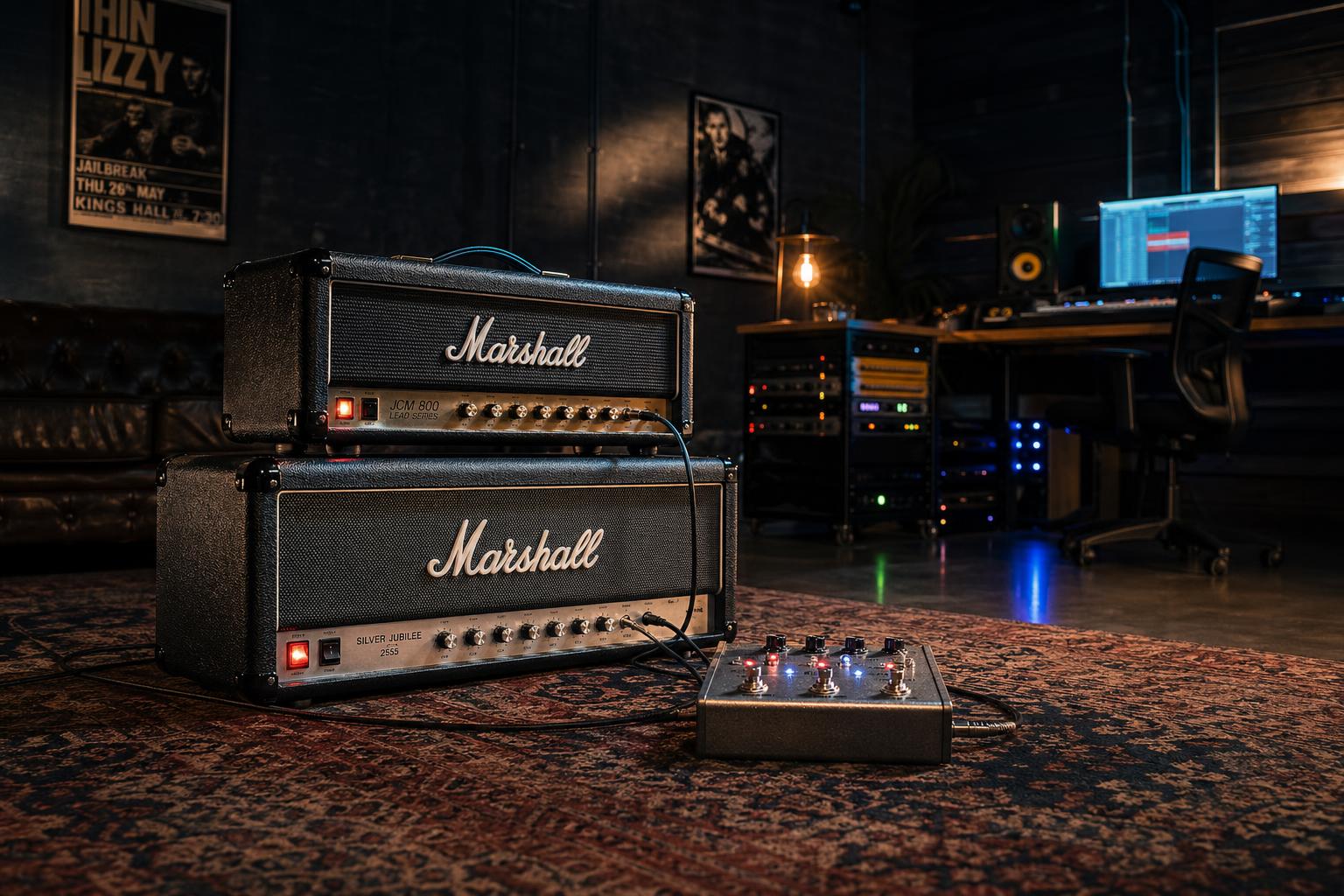
Quick read: The Silver Jubilee 2555 (and its 50-watt head sibling, the 2550) was Marshall's 25th anniversary amp, built in 1987 only and reissued multiple times since. It is not a JCM800 with chrome paint. It uses a three-cascaded-gain-stage preamp instead of the JCM800's two stages, has a pull-clip and pull-output-stage modes, and the EL34 power section runs hotter than the typical JCM800. The result is more gain on tap, more compression, and a thicker midrange. If you want AC/DC, get a JCM800. If you want Slash's Appetite-tour lead sound or Frusciante-era Chili Peppers grind, get a Jubilee.
| Feature | JCM800 2203 | Silver Jubilee 2555 |
|---|---|---|
| Year introduced | 1981 | 1987 (anniversary year) |
| Preamp gain stages | 2 cascaded | 3 cascaded |
| Power tubes | EL34 ×4 (100W) | EL34 ×4 (100W) |
| Output mode switch | None | Pentode/Triode (100W/50W) |
| Pull modes | None | Rhythm Clip, Output Stage |
| Master volume | Single | Single + Lead Master |
| Channel switching | None (single channel) | None (single channel, two voicings via switches) |
| Original price (1987) | ~$900 | ~$1,200 |
| Used market 2026 | $1,800-3,000 (original) | $3,500-6,000 (original 2555) |
Why the Jubilee Doesn't Get Talked About
The Silver Jubilee was made for one year. Marshall reportedly built around 3,000 of the 100-watt 2555 head and a smaller number of the 50-watt 2550 head and the 2554/2558 combos. It was an anniversary amp (not part of the regular product line, not heavily promoted past the launch year) and replaced in the catalog by the JCM900 in 1990.
That short production window is the main reason most players don't know what a Jubilee actually does. The JCM800 was in the catalog for nine years and got into thousands of bands' rigs. The JCM900 was in the catalog for ten years and became the default Marshall of the early 90s. The Jubilee fell into the gap between them, sat on used shelves at fair prices through the 90s, and then got expensive when guitarists figured out what they had.
Slash didn't record Appetite for Destruction through a Jubilee — that was a hot-rodded Super Lead rented from S.I.R. — but he switched to Jubilees for the Appetite tour and they've been his live backbone ever since, all the way to his 2555SL signature. John Frusciante ran a 2555 as the dirty half of his Chili Peppers stadium rig. Joe Bonamassa runs a wall of them. None of those facts make it into the average "best Marshall amps" listicle because the listicle writer didn't grow up around an amp that wasn't on the shelf at Guitar Center.
I bought my Jubilee in 1992 from a guy in Knoxville who needed cash for a divorce lawyer. Paid $750 for the 2555 head. It sat next to my Super Lead for fifteen years before I started reaching for it more than the Super Lead. The Jubilee does something the Super Lead and the JCM800 don't, and once you hear it you understand why Slash hauled three of them on every tour for thirty years.
The Three-Stage Preamp
The single biggest difference between the Jubilee and the JCM800 2203 is the preamp.
The JCM800 2203's preamp has two cascaded gain stages. You hit the input, the signal passes through a single 12AX7's first triode for the input gain stage, then through the second triode of the same tube for the second gain stage, then into the tone stack. That's it. The preamp is a slightly modified version of the JCM800's predecessor (the 2203 Master Volume), and the two-stage design is what gives the JCM800 its specific character: a fast, focused, midrange-forward distortion that cleans up well when you roll back the guitar volume.
The Jubilee adds a third gain stage. The signal passes through three triodes in series before hitting the tone stack. Three stages produce more gain, more compression, and more harmonic complexity than two. The result is a thicker, more saturated distortion at any given gain knob position, with more sustain and less of the JCM800's "open" quality.
The Jubilee also has a "Rhythm Clip" pull switch on the gain knob. Pulled out, the switch engages a clipping diode in the gain circuit that adds another layer of distortion before the signal hits the tone stack. This gets you into Slash Appetite territory at moderate volume. Without the diode engaged, you need to push the master volume to get the same level of saturation.
Net result: the Jubilee at gain noon, Rhythm Clip pulled, sounds about like a JCM800 at gain max. Past noon with Rhythm Clip pulled, you're in territory the JCM800 cannot reach without pedals in front.
The Output Stage Switch
The Jubilee also has a pull switch on the master volume that engages an "Output Stage" mode that toggles between pentode and triode operation on the EL34 power tubes. Pentode (pushed in) is the standard Marshall full-power configuration, ~100 watts on the 2555. Triode (pulled out) reduces the power section to about half output and changes the harmonic content of the power tube saturation.
Triode mode is not just an attenuator. The triode wiring shifts the EL34s' transfer characteristics: softer compression, more even-order harmonics, slightly darker top end. At apartment volume on the 100-watt 2555, triode mode is the only way to get the power section involved in the tone at all without measuring the SPL with a meter.
For comparison: a JCM800 has no equivalent switch. The 2203 is full-power EL34 pentode mode at all times. To get a similar character on a JCM800 you need to either crank it (loud) or use an external attenuator (which we covered in the reactive vs resistive attenuator post).
The Output Stage switch is the second-most-important feature of the Jubilee after the three-stage preamp. It is also the feature most aftermarket emulations and reissue circuits get wrong; many sims drop it entirely or implement it as a simple volume attenuation that doesn't include the harmonic content shift.
Settings: Where Each Amp Lives
The two amps are at their best in different parts of the gain knob.
JCM800 2203: Hard Rock Rhythm
| Control | Position | Notes |
|---|---|---|
| Pre-amp Gain | About 2 o'clock | Past noon is where the saturation gets useful |
| Bass | About 3 o'clock | Marshall tone stacks are bass-cut by design |
| Middle | About 1 o'clock | The 2203's character lives in the mids |
| Treble | About 11 o'clock | Below noon; these amps get bright fast |
| Presence | About 9 o'clock | Treble's louder cousin; less is more |
| Master | As loud as you can stand | The 2203 needs the master pushed to come alive |
This is the AC/DC, classic Van Halen, early Slash setting. Use it with a Strat or an SG into the high input, no pedals between. Roll back to volume 7 on the guitar for cleaner verses.
Silver Jubilee 2555: Appetite-Era Lead
| Control | Position | Notes |
|---|---|---|
| Pre-amp Gain | About noon, Rhythm Clip pulled | The pull switch is the secret |
| Lead Master | About 1-2 o'clock | This is the per-channel volume |
| Bass | About 1 o'clock | Less than JCM800; three stages already add low end |
| Middle | About 2 o'clock | Push the mids hard |
| Treble | About 10 o'clock | Three-stage saturation adds upper harmonics; cut treble |
| Presence | About 9 o'clock | Same: less is more |
| Master Volume | Match Lead Master, Output Stage pushed in (Pentode) | Pentode for full character |
This is the Slash Appetite-tour setting. A Les Paul into the high input. Wah optional. The Lead Master controls the channel volume independently of the master, so you can balance against rhythm settings without changing the overall room volume.
Silver Jubilee 2555: Bedroom-Volume Tone
| Control | Position | Notes |
|---|---|---|
| Pre-amp Gain | About 1 o'clock, Rhythm Clip pulled | Compensate for less power section involvement |
| Lead Master | About 9 o'clock | Apartment-friendly |
| Bass | About 11 o'clock | Less bass at low volume (Fletcher-Munson curve) |
| Middle | About 2 o'clock | Mids carry the tone |
| Treble | About noon | Slightly brighter; bedroom listening is darker than stage listening |
| Presence | About 10 o'clock | A touch more |
| Master Volume | About 9 o'clock, Output Stage pulled (Triode) | Triode mode for low-volume saturation |
The Jubilee sounds noticeably better at low volume in Triode than in Pentode. The Triode mode's softer compression compensates for the lack of power-tube push at apartment volumes. This setting is what kept my Jubilee in regular rotation when I moved to a smaller place in 2009.
Which One to Buy
For most players asking "JCM800 or Silver Jubilee?", the honest answer is: get the JCM800 first if you can.
The 2203 is in production via the Marshall Studio Classic line (the SC20H is a 20-watt version of the same circuit, about $1,500 new), and the Jubilee is reissued twice over: the full-size 100-watt 2555X (about $2,400 new) and the 20-watt Studio Jubilee 2525H. The reissues are excellent and capture most of the original character. The JCM800 reissue at $1,500 gets you into the Marshall sound for about $900 less than the full-size Jubilee reissue, and it does the AC/DC, Van Halen, classic-rock-rhythm work that most players actually want from a Marshall.
Get the Silver Jubilee if:
- You specifically want Appetite-tour-era Slash, Frusciante-style grind, or Bonamassa-style sustained lead tones
- You play in a residential setting and want the Triode mode's low-volume saturation
- You already own a JCM800 and want a different Marshall voice on your second rig
- You found an original 2555 in good shape at a fair price (under $4,500 for a serviced unit)
For new buyers in 2026, the 2555X reissue is the smarter purchase than chasing an original. The transformer iron, capacitor brands, and tube quality on the reissue are higher than what you'd get from a 1987 unit that hasn't been recapped. The original's value is collector-driven, not tone-driven. If you want the sound and not the patina, the reissue is the better deal.
What the Modelers Get Wrong
The Jubilee shows up in some modelers and not others: Helix has the "Brit 2204" and "Brit Plexi Brt" but no Jubilee model at all (don't be fooled by the "Brit J-45" — that models the JTM-45, a different animal entirely). On Helix, the closest you'll get is the Brit 2204 with the gain pushed past 7. Quad Cortex's "Marshall 2555 Silver Jubilee" capture (factory) is closer than any Helix workaround I have A/B'd.
Where almost all of them fall short: the Output Stage switch behavior. A real Jubilee in Triode mode has a soft compression character that the modelers either skip entirely or implement as a Sag parameter. The Sag parameter helps, but it does not fully replicate what's happening when you change from pentode to triode wiring on a real EL34 push-pull pair. If you want the Triode mode's sound, the real amp is meaningfully better than the model.
The Rhythm Clip switch translates more directly. A clipping diode in front of an amp model is a clipping diode in front of an amp model, and the modelers handle this well. Stacking a Tube Screamer (gain at 0, level maxed) in front of any modern Marshall sim approximates the Rhythm Clip diode's behavior closely. Our TS-into-Marshall post covers this stacking technique in detail.
FAQ
Are the 2555 (100W) and 2550 (50W) the same circuit?
Same preamp, same tone stack, same pull switches. Different output transformer and different power tube count (4× EL34 in the 2555, 2× EL34 in the 2550; the 2554 and 2558 are the 50-watt combo versions). The 50-watt version sounds slightly looser in the low end and saturates the power section at a lower volume, which makes the 2550 the more practical choice for residential use, when they show up.
What about the JCM Slash Signature 2555SL?
Marshall released the 2555SL as a Slash signature in 1996. Same circuit as the 2555 with cosmetic changes (silver chassis, Slash signature plate). It is not a different amp tonally. Used 2555SL units sell for the same range as the original 2555 (sometimes higher because of the signature association). The amp inside is identical.
Is the Silver Jubilee 2525 Mini the same circuit?
The 2525H Mini Jubilee (released 2016, later folded into the Studio range) is a 20-watt implementation of the Jubilee preamp circuit running a pair of EL34s, switchable down to 5 watts. It captures the three-stage preamp character and keeps the original's power tube type; the compromise is a smaller output transformer and less headroom, not a tube change. It's a great apartment amp and a reasonable Jubilee experience for $700-900 used — a small Jubilee in the same sense that the SC20H is a small JCM800.
Will a Tube Screamer in front of a JCM800 give me the Jubilee sound?
Closer than the modeler path, not identical. A TS pushes the JCM800's two-stage preamp into harder saturation and compresses the input. That gets you toward the Jubilee's gain quantity, but not the harmonic complexity that comes from three actual cascaded gain stages. A boost into a JCM800 is a great sound. It is not the Jubilee sound. They are different paths to similar SPL and visually similar saturation, with measurably different harmonic content.
Why do original 2555s cost so much more than original 2203s?
Production volume and survivorship. Marshall built thousands of JCM800 2203 heads over nine years; reportedly about 3,000 Silver Jubilees were built in one year. Add the Slash association driving collector demand, and you get a pricing situation where the Jubilee trades at almost twice the JCM800 despite being six years newer and a similar power rating. The reissue addresses this. Marshall produces the 2555X precisely because the secondhand market ran out of available original units.