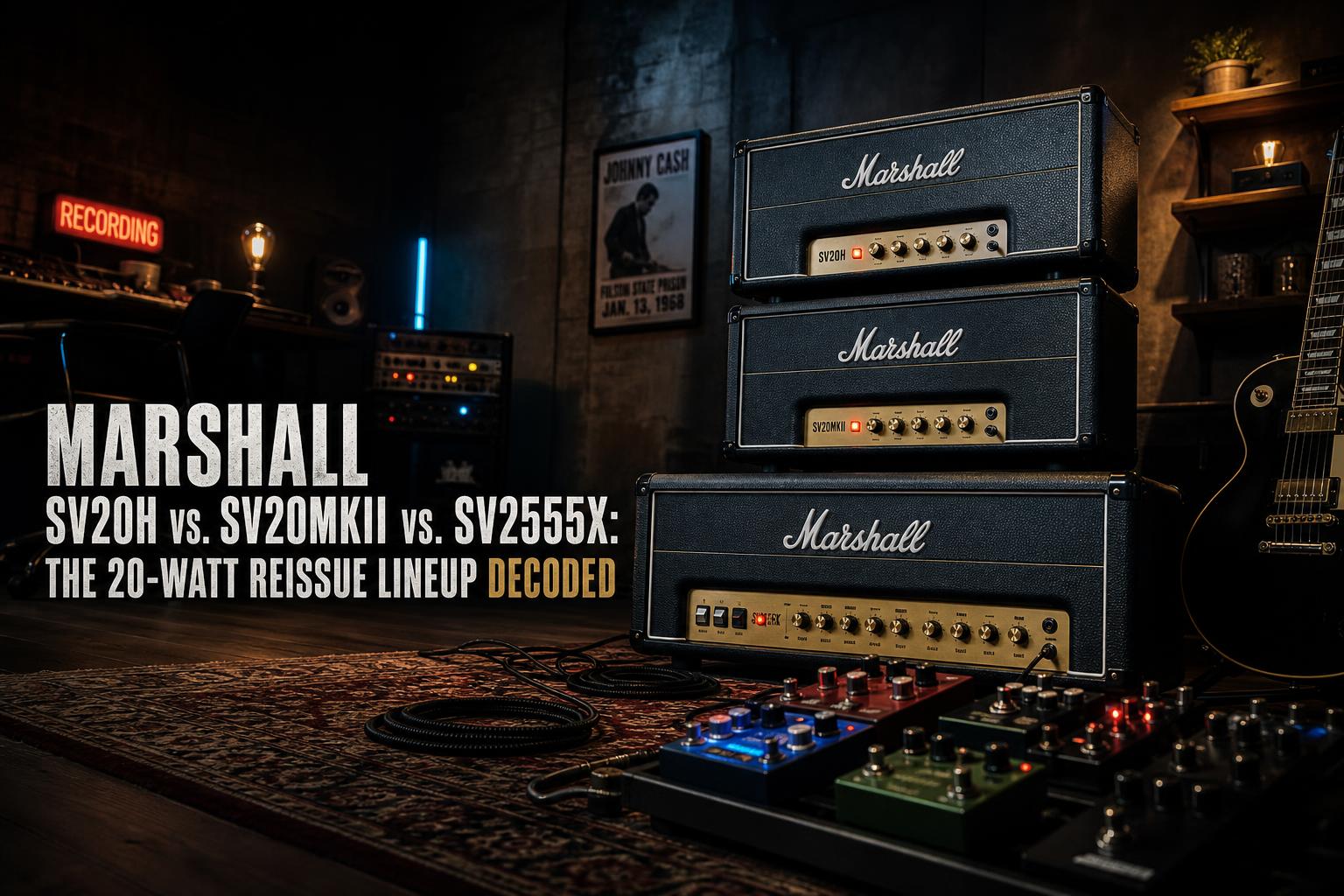
Quick read: The Marshall Studio Vintage line is three different 20-watt heads with three different preamps, all built around the same chassis and the same pair of EL34s. The SV20H is the JCM800 2203 reissue: two-stage preamp, the AC/DC and Van Halen sound. The SV20MKII is the Plexi 1959 SLP reissue: single-channel, four-input, the Hendrix and Free sound. The SV2555X is the Silver Jubilee 2555 reissue: three-stage preamp with the Rhythm Clip and Output Stage pull switches, the Slash Appetite sound. They are not three voicings of one amp. They are three different amps in matching enclosures, and which one you buy depends entirely on which Marshall sound you actually want.
| Model | Based on | Year of Original | Preamp | Pull Modes | Channels | Street Price (2026) |
|---|---|---|---|---|---|---|
| SV20MKII | 1959SLP Super Lead Plexi | 1965 | 2 stages, no master | None | 1 (4 inputs) | $1,400 |
| SV20H | JCM800 2203 | 1981 | 2 stages, master volume | None | 1 | $1,500 |
| SV2555X | 2555 Silver Jubilee | 1987 | 3 stages, master + lead master | Rhythm Clip, Output Stage | 1 (2 voicings) | $2,400 |
What "Studio Vintage" Actually Means
Marshall introduced the Studio Vintage line in 2019 with the SV20H and the SC20H (the JCM800 head and the matching 1×12 combo, both 20 watts). The SV20MKII followed in 2022 as the Plexi version. The SV2555X arrived in 2024 as the Silver Jubilee variant. All three share the same 20-watt power section (a pair of EL34s in push-pull, switchable between 20 watts and 5 watts via a back-panel switch) and the same lightweight chassis. The differences are entirely in the preamp circuit.
The 20-watt power section is the whole reason this line exists. The original 100-watt Plexi and JCM800 heads only sound right with the master volume at noon or above, which means stage volume in a small club at the lowest. The 20-watt Studio Vintage versions get you the same power-tube saturation at apartment volume, and on the 5-watt setting, at headphone-level SPL through an attenuator or load box. This is the Marshall sound at a volume you can actually live with. That's the whole pitch.
I have spent enough time with all three at the Nashville store I work out of part-time to have opinions about which one fits which player. The short version: most people buy the wrong one because they assume "Marshall is Marshall" and the cheapest option is the safest pick. It isn't. These amps sound different from each other in ways that matter.
The SV20H: JCM800 Sound
The SV20H is the cheapest of the three at $1,500 new. It is also the one I recommend most often, because the JCM800 sound is what most players actually mean when they say "Marshall."
The preamp is two cascaded gain stages, master volume, three-band tone stack, presence. Single channel, no pull switches, no clipping diodes. The signal path is identical to the original 2203: same component values, same tone stack frequencies, same input impedance. This is not a "voiced like" reissue. This is the JCM800 circuit on a 20-watt power section.
What the SV20H gets you:
- AC/DC rhythm tone with a Strat or SG into the high input
- Early Van Halen brown sound with a humbucker guitar
- Classic Slash and Zakk Wylde rhythm tones
- A clean tone that breaks up around volume 4 (usable but not the amp's strength)
What it does not get you:
- High-gain modern metal (you will need a Tube Screamer or a Maxon OD808 in front, gain at 0, level at max, to tighten the low end and push the input)
- Plexi-style edge of breakup at clean (the master volume circuit changes the dynamic response)
- Three-stage saturation (the second gain stage taps out around 2 o'clock on the gain knob)
I A/B'd the SV20H against an original 1982 JCM800 2203 I keep at the shop for reference work. The reissue's clean tone is slightly tighter (modern filter caps, lower output transformer impedance) and the breakup is marginally less spongy. Past the gain knob noon position they are within 90% of each other, and that 10% is the kind of thing only people who have spent 40 years listening to JCM800s will identify. For someone who has never owned the original, the SV20H is the JCM800 sound, full stop.
The SV20MKII: Plexi Sound
The SV20MKII is the 1959 SLP Super Lead Plexi reissue, scaled to 20 watts. This is the oldest circuit in the lineup (the original 1959SLP was Marshall's first 100-watt head, designed in 1965) and the most fundamentally different from the other two amps.
The biggest difference is structural: there is no master volume. The 1959SLP is a "non-master" amp, which means the only way to get the preamp into saturation is to push the channel volume. On the 100-watt original, that meant stage volume in an arena. On the 20-watt SV20MKII at the 5-watt setting with an attenuator, you can get the saturation at bedroom volume.
The four-input front panel is also classic Plexi: two Normal channel inputs (high and low), two Bright channel inputs (high and low). The standard trick (and it is a real technique, not just a vintage curiosity) is to jumper the Normal and Bright channels together with a short patch cable, plug into the high input on one channel, and adjust both channel volumes to blend the two voicings. This is how Hendrix, Page, and most of the late-60s British rock crowd actually used these amps, and the SV20MKII handles the jumpered configuration the same as the original.
What the SV20MKII gets you:
- Hendrix, Cream, Free, early Led Zeppelin tones
- Edge-of-breakup cleans that cleaning up beautifully when you roll back the guitar volume
- The "Plexi crunch": a specific midrange-forward saturation that modern high-gain amps cannot replicate
- The jumpered-channel sound that a master-volume amp simply cannot do
What it does not get you:
- High-gain modern rock or metal (you will need a fuzz or distortion pedal in front)
- Quiet bedroom playing without an attenuator (the SV20MKII at 5 watts is still loud, and the saturation requires the channel volume past 6)
- A tight low end at maximum saturation (the Plexi gets warmer and looser as you crank it; that's the character)
The SV20MKII is the right amp if you want the sound of British rock from 1965 to 1972. It is the wrong amp if you want anything that came out after that.
The SV2555X: Silver Jubilee Sound
The SV2555X is the Silver Jubilee reissue and the most complex amp of the three. It is also $2,400, which is $900 more than the SV20H and $1,000 more than the SV20MKII. The price reflects the additional preamp circuit and the additional features: three-stage gain, Rhythm Clip pull switch, Lead Master volume, Output Stage pentode/triode switch.
The three-stage preamp is the headline. Where the SV20H runs the signal through two cascaded gain stages and the SV20MKII runs it through two stages with no master, the SV2555X uses three cascaded stages. Each stage adds gain, harmonic complexity, and compression. The result is more saturation at any given gain knob position, with a thicker, more sustained character than either of the other two amps.
The Rhythm Clip pull switch (pulled out, it engages a clipping diode in the gain circuit) adds another layer of distortion before the signal hits the tone stack. With Rhythm Clip pulled and the gain knob at noon, the SV2555X sounds about like an SV20H with the gain at maximum. Past noon with Rhythm Clip pulled, you are in territory the SV20H cannot reach without pedals in front.
The Output Stage pull switch toggles the EL34s between pentode and triode operation. Triode mode reduces the power output by about half and shifts the harmonic content of the power-tube saturation: softer compression, more even-order harmonics, slightly darker top end. At apartment volume on the 20-watt SV2555X with the 5-watt switch engaged and the Output Stage in triode, you can get power-section saturation at speaking volume. This is the configuration that justifies the price for residential players.
What the SV2555X gets you:
- Slash Appetite for Destruction lead tones
- Joe Bonamassa modern blues lead with the Lead Master pushed
- Kerry King Slayer rhythm with Rhythm Clip pulled and Bass at 1 o'clock
- The lowest practical bedroom-volume Marshall saturation of the three
What it does not get you:
- The pure JCM800 character (the third gain stage adds saturation that the JCM800 does not have)
- The pure Plexi character (the master volume and additional gain stage take it out of Plexi territory)
- A clean tone (the SV2555X does not really do clean; its clean channel is a dirty channel with the gain rolled back)
I keep coming back to the SV2555X for residential playing. The Triode mode at 5 watts is the only one of the three Studio Vintage amps that lets me get power-tube saturation in a Nashville apartment building without an attenuator. That alone is worth the price difference for anyone who wants a Marshall but cannot push 20 watts of EL34 into a 4×12 in the living room.
Settings: The Sweet Spot for Each Amp
Each amp has a position on the gain knob where it sounds like itself. Past that position, you are pushing the amp into territory it was not designed for and you should reach for a pedal instead.
SV20H: Hard Rock Rhythm
| Control | Position | Notes |
|---|---|---|
| Gain | About 2 o'clock | Past noon is where the saturation becomes useful |
| Bass | About 3 o'clock | Marshall tone stacks are bass-cut by design |
| Middle | About 1 o'clock | The 2203's character lives in the mids |
| Treble | About 11 o'clock | Below noon; these amps get bright fast |
| Presence | About 9 o'clock | Less is more; presence is treble's louder cousin |
| Master | As loud as you can stand | The 2203 needs the master pushed |
This is the AC/DC, classic Slash, Van Halen rhythm setting. Strat or SG into the high input, no pedals between the guitar and the amp. Roll back to volume 7 on the guitar for cleaner verses.
SV20MKII: Plexi Edge of Breakup
| Control | Position | Notes |
|---|---|---|
| Volume I (Normal) | About noon | Jumpered to Volume II via short patch cable |
| Volume II (Bright) | About 1 o'clock | Push slightly past Normal for upper harmonics |
| Bass | About 2 o'clock | The Plexi tone stack is more bass-friendly than the JCM800 |
| Middle | About 1 o'clock | Where the Plexi crunch lives |
| Treble | About 10 o'clock | Cut early; Plexis are bright |
| Presence | About 9 o'clock | Same |
Plug into the high input on Channel I (Normal), jumpered to Channel II (Bright). This is the Hendrix and Cream setting. For a cleaner sound, roll the guitar volume back to 5; for full break-up, leave the guitar at 10 and dig in with the pick.
SV2555X: Slash Appetite Lead
| Control | Position | Notes |
|---|---|---|
| Pre-amp Gain | About noon, Rhythm Clip pulled out | The pull switch is the secret |
| Lead Master | About 1-2 o'clock | The per-channel volume |
| Bass | About 1 o'clock | Less than JCM800; three stages already add low end |
| Middle | About 2 o'clock | Push the mids |
| Treble | About 10 o'clock | Three-stage saturation adds upper harmonics |
| Presence | About 9 o'clock | Cut |
| Master Volume | Match Lead Master, Output Stage pushed in (Pentode) | Pentode for full character |
Les Paul into the high input. Wah optional. The Lead Master is independent of the Master Volume, so you can balance lead-level against rhythm without changing the room volume.
SV2555X: Apartment-Volume Tone
| Control | Position | Notes |
|---|---|---|
| Pre-amp Gain | About 1 o'clock, Rhythm Clip pulled | Compensate for less power section involvement |
| Lead Master | About 9 o'clock | Apartment-friendly |
| Bass | About 11 o'clock | Less bass at low volume (Fletcher-Munson curve) |
| Middle | About 2 o'clock | Mids carry the tone at low SPL |
| Treble | About noon | Slightly brighter; bedroom listening is darker than stage listening |
| Presence | About 10 o'clock | A touch more |
| Master Volume | About 9 o'clock, Output Stage pulled (Triode), 5-watt switch engaged | Triode mode for low-volume saturation |
This is the configuration I run in a small room. The 5-watt switch reduces power output to about 5 watts, and Triode mode shifts the EL34s into the softer-compression mode. Together they get the power section involved at conversational volume.
Why the SV2555X Keeps Winning at Bedroom Volume
I expected the SV20H to be the obvious recommendation for most players. It is the cheapest, it is the JCM800, and the JCM800 is the Marshall most people want. What I did not expect was how often I end up steering buyers toward the SV2555X instead.
The reason is bedroom volume. Half the players who walk into the shop asking about a Marshall are residential; they live in apartments, they have neighbors, they cannot push a 100-watt JCM800 head. The SV20H at 5 watts in pentode is still loud enough that the master needs to be at 9 o'clock or below in a small room, and at 9 o'clock the master, the power section is barely involved. The amp sounds thinner than it should because you are not getting the EL34 saturation that defines the Marshall character.
The SV2555X at 5 watts in triode is meaningfully louder before it gets thin. The triode wiring softens the compression and lets the power section reach saturation at a lower SPL than pentode does. For a residential player, that $900 price difference is the difference between a Marshall that sounds right at apartment volume and a Marshall that sounds compressed and small.
If you live in a house with a basement or a detached garage, get the SV20H. If you live in an apartment, the SV2555X is worth the upcharge. This is not a marketing claim; it is the difference in how the two amps behave in actual rooms.
Which One to Buy
The decision matrix:
Get the SV20MKII if:
- You want Hendrix, Cream, Free, early Zeppelin tones
- You are willing to use pedals for everything past 1972
- You have an attenuator or a load box for residential playing
- The non-master "you have to crank it to get it" character is the appeal
Get the SV20H if:
- You want classic JCM800: AC/DC, Slash, Van Halen rhythm
- You play in a band or a venue where 20 watts is not too loud
- You want the cheapest entry into the Studio Vintage line
- You already own pedals to expand the gain range
Get the SV2555X if:
- You want Slash Appetite lead tones, Bonamassa modern blues, or Kerry King rhythm
- You play in a residential setting and need the Triode mode for apartment volume
- You want the most versatile amp of the three (it can approximate JCM800 territory with the gain rolled back, but the SV20H cannot approximate Jubilee territory)
- The $900 price difference is acceptable
For most players, the SV20H is the right answer. For apartment-dwelling players who want a real Marshall sound at livable volume, the SV2555X is the right answer. The SV20MKII is the specialist's pick; if you specifically want the Plexi sound and you know what that means, get it; if you are not sure, you probably want one of the other two.
For modeler players who want to compare the Studio Vintage character to what their modeler does, see our JCM800 vs Silver Jubilee comparison, which covers the same circuit differences in more depth, and our Helix amp model cheat sheet, which maps the Marshall family across the modeler's amp blocks.
Bottom Line
Three amps, one chassis size, three completely different voices. The SV20H is the JCM800: the working-class Marshall, the right answer for most players. The SV20MKII is the Plexi: the specialist amp for players who want the 1965-72 British rock sound. The SV2555X is the Silver Jubilee: the most expensive, the most versatile, and the only one that truly works at residential volume thanks to the Triode mode.
If you have been waiting for Marshall to make a 20-watt version of the head you actually want, they finally did. Pick the right one.