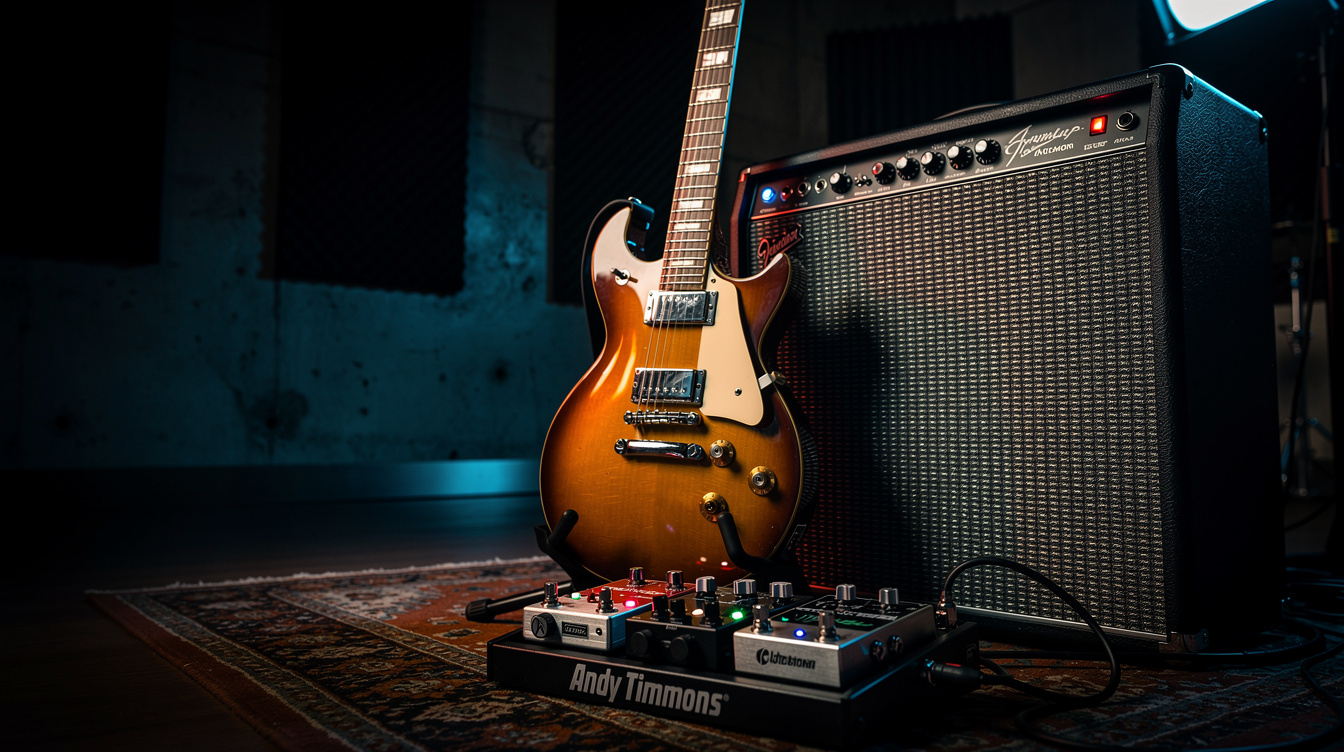
Start Here: What the Timmons lead tone actually requires — and what you can substitute:
- Two overdrives stacked, not one at high gain — character pedal into a push pedal, not maximum distortion
- The Timmy is the center — but any low-gain, high-headroom OD can approximate it; the Wampler Tumnus works, the Klon clone works, a TS9 with the drive backed off works
- Clean amp, not pushed — the drives do the distortion; the amp provides foundation
- Light compression before the stack — this is the touch-sensitivity piece; a used CS-3 or MXR Dyna Comp is fine
- The vibrato is technique, not gear — no settings table replicates it; the gear creates an environment where it can happen
Quick Reference: Budget Signal Chain
| Element | Timmons Rig | Budget Substitute | Used Price |
|---|---|---|---|
| Compressor | Carl Martin Compressor/Limiter | Boss CS-3 or MXR Dyna Comp | $30 to $60 |
| Character OD | Paul Cochrane Timmy | Wampler Tumnus, Xotic EP Boost, or TS9 drive backed off | $80 to $180 |
| Push OD | Ibanez TS808 or second Timmy | Boss SD-1, MXR Timmy (if budget allows), or any TS-style | $30 to $50 |
| Amp | Mesa Boogie Mark V, Dumble-style | Any clean/edge-of-breakup amp — Fender Deluxe Reverb, Boss Katana, Helix clean model | Varies |
| Chorus | Custom boutique | TC Electronic Corona or Boss CE-2w | $60 to $130 |
| Delay | Various tape units | Boss DD-7, TC Electronic Flashback | $80 to $120 |
| Reverb | Room-style external | Built-in amp reverb or TC Electronic Hall of Fame | $50 to $100 |
Total realistic budget: $250 to $500 used, compared to $1,500+ for the original components. The tone principles translate; the price tag doesn't have to.
What Is the Timmons Tone, Precisely?
Before you substitute gear, it helps to be precise about what you're actually trying to replicate. "Andy Timmons tone" describes something specific: extended single notes that sustain without becoming harsh, a midrange character that reads as vocal rather than instrumental, and a harmonic complexity that makes individual pitches feel orchestrated rather than plucked.
The sound is built around touch response. Notes bloom differently depending on how hard you pick, how you apply vibrato, what your left-hand pressure does to the sustain character. The gear creates conditions for this to happen — it doesn't produce it automatically.
The full signal chain breakdown, with Timmons' actual settings and signal chain philosophy, is in the Andy Timmons lead tone recipe. What this post addresses is the substitution question: which of those components can be replaced without losing the character that makes the sound work, and at what price.
The Timmy: What It Does and Why Substitutions Work
The Paul Cochrane Timmy is a low-gain, high-headroom overdrive with a semi-parametric tone stack — separate Bass and Treble controls that can boost or cut independently, which is unusual at its price and size. This lets you dial the Timmy's frequency response without the usual trade-off where brightening the tone also thins the low end.
At the gain settings Timmons uses — Timmy Drive around 9 to 10 o'clock — the pedal is adding saturation and harmonic complexity rather than obvious distortion. Single notes have more bloom. Chords separate rather than mash together. The circuit contributes a specific character that persists through the rest of the chain.
The reason substitutions work: at low gain settings, the character differences between overdrive pedals narrow significantly. A Timmy at Drive 9 o'clock and a TS9 at Drive 7 o'clock are both adding a small amount of even-harmonic saturation to a clean signal. The Timmy does it more cleanly and with more control over the frequency response, but the tonal distance between them at low gain is much smaller than it would be at high gain.
Timmy Substitutes That Actually Work
Wampler Tumnus ($180 new, $120 to $150 used): The closest to the Timmy's character — wide gain range, Tone control that responds similarly, high headroom. At low gain, it's nearly indistinguishable from a Timmy in a mix. The Tumnus Deluxe ($200 new) adds a second tone control for more Timmy-adjacent frequency management.
Klon clone (KTR, Archer, Tumnus — any): The Klon's clean blend design means even at low drive settings, there's a transparency the Timmy doesn't quite share — the Klon mixes clean signal with the driven signal at a ratio you don't control directly. For Timmons' stacking approach, the Klon/clone works as the character layer if you run the Drive low. Different character but in the same tonal territory.
Ibanez TS9 with Drive at 7 to 8 o'clock: This is not the same as the Timmy — the TS9's midrange hump is more pronounced and the tone stack is a single control that cuts highs only. But at very low gain, the TS9 is adding harmonics and saturation without the obvious TS-coloring that comes from higher gain settings. Used TS9 units run $50 to $70. If you already own one, try running it at minimum gain before buying anything else.
Xotic EP Boost ($150 new): The Xotic EP Boost is not technically an overdrive — it's an EQ and boost based on the Echoplex preamp circuit. But run as a low-level push into a clean amp, it adds harmonic presence in a way that serves the Timmons approach. Works better as the first element of a two-overdrive stack than as the character OD by itself.
The Push OD: Less Critical Than You Think
The second overdrive in Timmons' chain — the TS808 or second Timmy running as a "push" — is doing a simpler job than the character layer. It's adding volume and a small amount of additional gain into the character pedal, which saturates it slightly further and creates more compression and sustain.
For this role, a Boss SD-1 ($50 new, $25 to $35 used) works well. The SD-1 is a TS-style overdrive — asymmetrical clipping, similar midrange presence — that's often overlooked because it's cheap and yellow and doesn't carry boutique cache. Run at Drive minimum, Level at 2 o'clock or higher, it pushes the character pedal in front of it without coloring the tone substantially. This is the job.
An MXR Timmy — the compact version of the Cochrane Timmy at $100 new — is an excellent push pedal if you have more budget. Running two TS-style ODs (SD-1 into a TS9, or SD-1 into a Tumnus) with the first at higher gain and the second at lower gain also produces the stacking character, just with less boutique precision.
The Amp: The Most Forgiving Substitution
Timmons' rig includes high-end, expensive amplifiers — Mesa Boogie Mark V, various custom and boutique builds. These provide a specific harmonic richness when pushed toward breakup that's hard to replicate exactly.
What they're providing in the context of his lead tone is a clean or edge-of-breakup foundation that lets the overdrive stack do its work. The amp contributes openness, dynamic response, and a basic tonal character, but it's not the primary distortion source — that's the pedals.
This is the substitution that works most broadly. A clean Fender-style amp — Deluxe Reverb, Blues Junior, Champion 40 — provides the foundation the overdrive stack needs. A Vox AC30-style amp at clean settings works similarly. A solid-state amp with a good clean channel (Boss Katana, Fender Mustang) is a legitimate substitute at lower budgets.
On a modeler: Helix's US Double Nrm model (Fender Twin-based) or the Soup Pro model (Supro-based) at clean or edge-of-breakup settings provides the right foundation. Run the modeler's output level at a setting that gives the overdrive blocks something to work against rather than running at minimum gain. The dial-in modeler tone guide has amp block setup principles that apply here.
Compression: The Piece Most Players Skip
Carl Martin makes a compressor/limiter that Timmons has used for years — it's not cheap and it's not always easy to find. But the compression role in his chain is something a $40 used Boss CS-3 can approximate.
What compression is doing here: evening out pick attack so that quieter notes bloom at roughly the same sustain rate as louder notes. This creates the sense that every note is equally full — part of why the tone feels vocal, because a voice doesn't have the same attack variation that an uncompressed pick stroke produces.
Settings for the substitution compressor:
| Control | Setting | Notes |
|---|---|---|
| Ratio (if adjustable) | 3:1 to 4:1 | Light — musical, not limiting |
| Attack | Medium to slow | Let the pick attack through before clamping down |
| Release | Medium | Sustain without pumping |
| Level | Unity or very slightly above | Don't use compression for gain staging — that's the OD's job |
The Boss CS-3 has a narrow bandwidth of useful settings but the settings that work sound good. Sustain at about 9 o'clock, Level at about 11 o'clock, Tone at noon. It doesn't have separate attack and release controls, but the Sustain knob adjusts both. Keep it subtle.
The Part That Budget Can't Solve
There's a quality in the Timmons lead tone that resists gear substitution. You can hear it in his attack — the way a note enters at medium-pick intensity and then the vibrato starts and the note seems to grow rather than decay. It gets louder and wider and more harmonically complex over its sustain rather than simply fading.
That's technique. The vibrato is deliberate and wide — not a narrow finger wobble but a genuine pitch movement that uses the forearm and elbow as well as the finger. The pick angle and depth affect how the compression pedal responds to the initial attack. The left-hand pressure on the fret determines how much of the note's full sustain the amp and pedals can access.
None of this is captured by a settings table. The gear creates an environment where it can happen: enough saturation to sustain, enough headroom to respond dynamically, enough compression to smooth out attack variation. But the actual technique requires practice, and the sound of Timmons' lead playing at its most distinctive is substantially about how he approaches those notes physically.
The budget chain above gets you the right tonal environment. What you do inside that environment is your work.
Where to Start if You Have $200
Priority order:
- Character OD first. TS9 used ($50 to $70) or Boss OD-1 ($40 to $60) if you find one, or save up for a Tumnus ($120 to $150 used). This is the most important substitution.
- Clean amp or modeler clean model. Any amp with a decent clean channel. The Katana has one. Your practice amp probably does.
- Push OD second. Boss SD-1 ($25 to $35 used). Done.
- Compression later. Boss CS-3 ($40 used). Optional but useful.
Skip the delay and reverb until you have the core drive stack working and sounding right. The bloom and vocal quality of the core tone should be apparent before any time-based effects. If the drive stack isn't producing note bloom and dynamic response, adding reverb won't fix it.
FAQ
Can I get the Timmons tone from a modeler with no external pedals? Yes. Use the amp model at clean/edge-of-breakup, two overdrive blocks (TS-style at different gain levels), a light compression block before the ODs, and then time-based effects. Helix's Minotaur (Klon model) and Tube Screamer (TS808 model) stacked work well for the character/push dual-OD approach. The Helix amp models guide has specific amp block suggestions.
Do I need the semi-hollow guitar (AT10P) for this tone? No. A solid-body guitar with a humbucker in the bridge position produces the Timmons tone convincingly, especially once the drive stack is dialed in. The AT10P's semi-hollow construction adds natural resonance and a certain bloom quality, but it's not what most players are hearing when they hear the "Timmons sound" — that's the drive stack, the amp foundation, and the vibrato technique.
Is the Timmy worth the price over a TS9? Yes, but not at full retail ($180 for a used Timmy) if you're on a tight budget. The Timmy's independent Bass and Treble controls matter when you're stacking two ODs and need to balance the frequency response of the stack precisely. A TS9 at low gain approximates it but requires more careful amp EQ compensation. If the budget allows one good OD, spend it on the Tumnus or Timmy.
What's the most important thing I can do for free to improve this tone? Slow down your vibrato and make it wider. The Timmons vibrato has more pitch range and more deliberateness than what most players default to. It's slower and more intentional. Start there — it changes how the overdrive responds to sustained notes more than any pedal substitution.