The Quick Settings
Control Position Notes Amp gain / volume Wide open or just at the edge The P-90 handles the dirt; the amp provides headroom Amp bass Noon Amp mid Noon to 1 o'clock P-90 is already mid-forward; don't stack Amp treble About 10 o'clock The P-90 bites; no extra treble needed Guitar volume 7–10 for leads, 5–6 for rhythm Rolling back cleans up fast Guitar tone 7–8 Full 10 can get spiky with a cranked amp
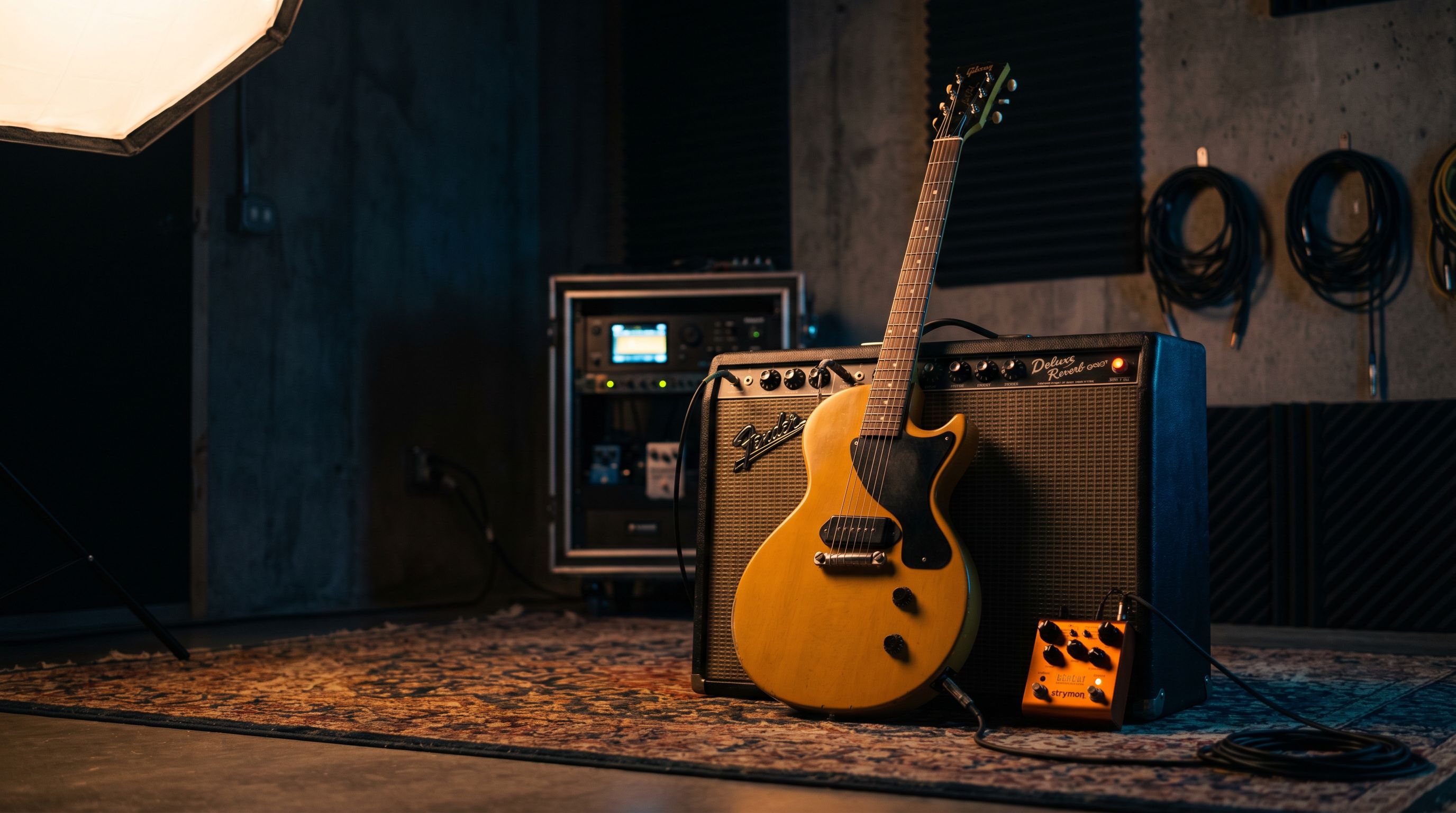
The Les Paul Junior was Gibson's budget model. A slab mahogany body, a single P-90, a stoptail bridge. No neck pickup, no selector switch, no Tune-O-Matic. It came out in 1954 and cost $99.50.
It also sounds like this: Billy Joe Armstrong, Mick Jones, Bob Marley's rhythm section (he played one early on), Dave Davies. Not a budget tone at all. A specific tone, one that you can't get any other way.
What Makes the Junior's P-90 Different
The Les Paul Junior's P-90 is a bridge pickup in a slab mahogany body with no neck pickup to balance against. That context changes how you hear it. There's no "reference clean position." Everything you do starts from a single, hot, mid-forward pickup that's 3 inches from the bridge.
The P-90's character: more output than a vintage Strat single coil, softer and warmer than a humbucker, with a midrange push that sits right where the guitar cuts in a mix. It's not bright the way a Strat is bright. It's not thick the way a PAF is thick. It does something those pickups don't.
The bridge position adds snap and definition. On a standard two-pickup guitar, you can dilute the bridge pickup by blending in the neck or rolling off the treble. On a Junior, the bridge P-90 is what you have. You work with it.
Amp Pairings
The P-90 is mid-forward enough that you want an amp with real headroom. If the amp breaks up before the guitar does, you lose control of the dynamic range, and the guitar's volume knob stops being a clean-up tool and becomes just a level control.
Fender Deluxe Reverb: the classic pairing. The Deluxe's 6V6 power stage has enough headroom to let the P-90 run wide open without immediate breakup. The reverb adds space without muddying the P-90's definition. If you have one, start here.
Vox AC30: a different character but works well. The AC30's cathode-biased EL84s compress naturally and add their own harmonic content. Combined with the P-90's output, the result is early and musical breakup that you control with the guitar volume. Keep the amp's Cut control high (counterintuitive: the Cut control is a treble cut, so high Cut = less treble) to prevent the P-90 from getting harsh.
Marshall JCM800 (volume low, no master volume): at rehearsal volume with the amp barely cracked, the P-90 into the front of a JCM800 is brutal in the good way. This is the Dave Davies approach, roughly: a hot single-coil pickup into a British amp at the edge of power-tube saturation. Not a recording setting. A live setting that makes the room move.
Blues Junior: if it's what you have, it works. Keep the FAT switch off; the P-90 doesn't need the mid boost, and the combination gets muddy. Reverb moderate.
The Guitar's Volume Knob Is Half the Rig
A P-90 responds to the guitar's volume control differently than a humbucker does.
Roll the volume to 6 and the P-90 rolls off some of its high-end edge and reduces output simultaneously. The result is cleaner and softer. Roll it back to 4–5 and you have a warm, clean rhythm tone. That's one end of the range.
At 10, the P-90 dumps everything it has into the amp. With a clean amp, this is punchy and present. With an amp at the edge of breakup, this is where the sustain opens up.
The volume knob sweep isn't dramatic the way a Strat's is; there's no extreme high-end clarity on a Strat that rolls off smoothly. The Junior's P-90 has a shorter dynamic range, but the usable part of that range is longer. 5 through 10 are all musical. Only below 4 does the guitar get thin.
The tone knob: set it to 7–8 and leave it. Full 10 on a hot P-90 into a bright amp adds a spiky edge that most playing situations don't need.
The One Thing I Expected to Miss
When I played a Junior for the first time (a friend's '58 Special, same pickup configuration), I expected to spend the whole session missing the neck pickup position. I play the neck pickup a lot on my SG. The neck position is where most of my lead tone lives.
It didn't happen. The bridge P-90 at moderate guitar volume, with the amp's treble backed off a couple of positions, covered enough of the "neck pickup warmth" territory that I stopped thinking about what wasn't there. Not the same tone (different), but it did the job. The guitar pushed me toward a different way of getting there.
What the neck pickup does on a two-pickup guitar is soften and warm the tone when you need it. The Junior gets there with the guitar volume and the amp EQ instead. Different tool, same result.
Getting the Junior Tone in a Modeler
The P-90's character in a modeler comes from three things:
-
A mid-forward amp model. Fender Tweed Deluxe (Helix: "Tweed Blues Nrm"), Vox AC30 Top Boost (Helix: "Brit Trem Nrm"), or a clean Marshall at low gain.
-
EQ that preserves the mids. P-90s are 500–800Hz oriented. Don't scoop the mids. Use a slight presence cut (above 3kHz) to remove the harshness that the actual guitar's mahogany body naturally absorbs.
-
Pickup position emulation. If your modeler has a pickup position parameter or a cab mic placement option, position toward the treble side rather than center. The bridge P-90's character comes from its physical position, not just its coils.
No single modeler pickup setting fully replicates the physical response of a slab mahogany body, but you can get close enough to use for tracking and reference.