The Short Version Go to /tone-chat, sign in, pick your rig, and describe the sound you want — an artist, a song, a feel, or a problem. Axl hands back a real signal chain with exact settings for your platform, drawn from 195 tested tone recipes. If the tone isn't built yet, he files a request so it gets made.
Most tone hunting starts in the wrong language. You know the sound — the thick, slightly compressed lead that Stevie Ray Vaughan gets on the slow blues, or that ringing clean that sits underneath a chorus without stepping on the vocal. What you don't know is which of the 80-odd amp models in your Helix gets you there, whether the drive goes in front of it or after, and what the mid knob should read.
That translation problem is what Ask Axl exists to solve. It's an AI tone tech living at /tone-chat, and the interaction is exactly what it sounds like: you describe the sound in plain English, it hands back a signal chain with numbers on it, in the block names your specific rig actually uses.
What Axl Is (and What It Isn't)
Axl is a chat assistant with a specific job — guitar tone — and a specific source of truth. Every question you ask retrieves matching recipes from the Fader & Knob archive: 195 tone recipes, each one a researched breakdown of an iconic tone with the original rig documented and verified translations for Helix, Quad Cortex, Fractal, Kemper, TONEX, Boss Katana, and pedalboard.
Those retrieved recipes go into the answer. That's the whole architecture, and it's the part worth understanding, because it's the difference between an assistant that invents a plausible-sounding block name and one that reads you a setting somebody actually tested. When Axl names a recipe, it's a link. You can click through to the full settings page and check the work.
Axl is also, unambiguously, AI. The in-product voice is a road-dog guitar lifer — forty years, four thousand shows, ruthlessly specific about numbers — and that's a persona, not a résumé. Nobody is sitting behind the chat window. It's part of the open experiment we run in public: trust your ears over any setting on a screen, and when Axl gets one wrong, tell us and the fix ships where you can see it.
How to Use It: The Four-Step Version
1. Sign in. The chat requires a free account. That's partly so the endpoint doesn't get scraped into oblivion, and partly so your daily message count is yours.
2. Pick your rig. There's a dropdown next to the message box: Helix / HX, Quad Cortex, Fractal, Kemper, TONEX, Boss Katana, Pedalboard, or "Any rig." Do not skip this. It's the single biggest lever on answer quality — the rig you choose biases which recipes get retrieved and determines whether you get "add a tube-screamer-style drive" or "add a Scream 808 with Drive at 2."
3. Describe the sound. Four kinds of input work:
| What you type | What comes back |
|---|---|
| An artist ("Gilmour lead tone") | The signal-chain architecture plus the closest tested recipes |
| A song ("Comfortably Numb solo") | The specific recipe if it exists, with exact settings for your rig |
| A feel ("clean but with some hair on it, not sparkly") | A built-from-scratch chain — no recipe required |
| A problem ("my high gain sounds fizzy") | A diagnostic and the specific block or setting to change |
The problem-shaped questions are underrated. "My clean patch disappears the second the band comes in" gets you a more useful answer than "best clean tone," because there's a symptom to work backwards from.
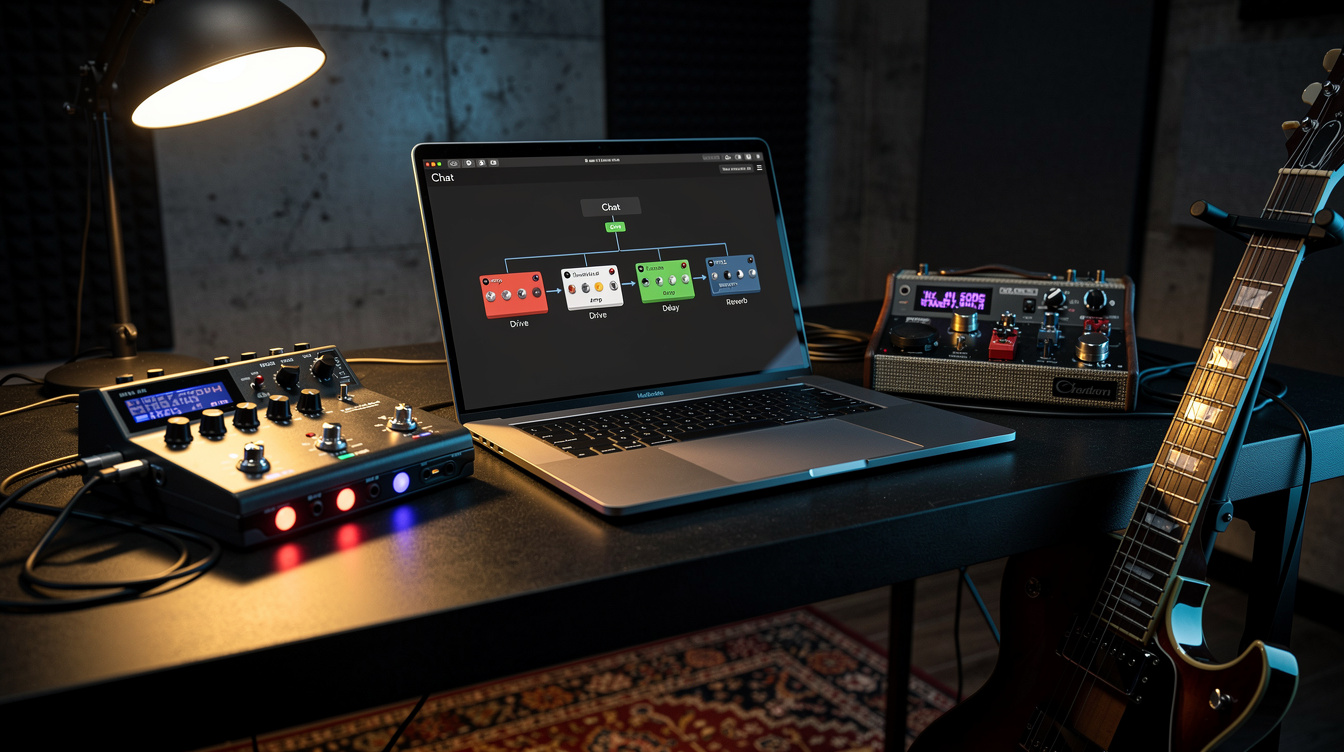
4. Read the chain card. When Axl prescribes concrete edits, they render as an interactive schematic — blocks in signal order, real knobs, actual values — instead of a paragraph you have to parse. The numbers live on the diagram; the prose just tells you why.
A Worked Example
Type this, with the rig set to Helix:
SRV Texas Flood slow blues lead on my Helix
That query matches SRV's Texas Flood slow blues lead in the archive, so what comes back isn't invented — it's that recipe's verified Helix translation:
| Position | Block | Key settings |
|---|---|---|
| 1 | Volume Pedal | Expression control for real-time swells |
| 2 | Deluxe Comp | Threshold −36, Ratio 2, Mix 74 |
| 3 | Scream 808 | Drive 2, Tone 5, Level 8 |
| 4 | US Deluxe Vib | Drive 8, Bass 5, Mid 5, Treble 5, Presence 5, Master 1 |
The instructive detail is in row 3. The Scream 808 — the Helix's TS808 — is set with the Drive nearly off and the Level nearly maxed. That's the opposite of how most players run a Tube Screamer, and it's the actual mechanism behind that tone: the pedal isn't the distortion, it's a clean level push that drives the amp into breakup. You could stare at a Helix menu for an hour and not arrive at Drive 2 / Level 8 on your own.
That's the general shape of a good answer here: a chain you can build in five minutes, with at least one setting that isn't the obvious one.
When the Tone Isn't in the Archive Yet
195 recipes is a lot of tones and nowhere near all of them. When you ask for something that isn't covered, Axl doesn't fake it. He says so, gives you general advice anyway — amp family, drive stacking, EQ moves, pickup choice — and then offers a request card. Tap it, and the tone goes into the build queue.
That handoff is the part most tone chatbots don't have. A miss isn't a dead end; it's an input. The tone gets researched, built with verified platform translations, and published as a recipe page — which then becomes something Axl can answer from the next time somebody asks.
The Limits, Stated Plainly
- Free accounts get 10 messages a day. Pass raises it to 200 and runs on a stronger model, which mostly shows up in long troubleshooting threads rather than single questions.
- Axl only names blocks he's confident exist on your platform. When a recipe has no verified translation for your rig, you get the tone architecture and a link to the recipe page rather than a guessed block name. That's deliberate — a wrong block name wastes more of your time than a general answer does.
- It's a chat, not an article. Answers are tight by design. For a full walkthrough of a concept, the blog is still the right surface — Axl will link you there.
- It won't replace your ears. Every setting is a starting point that assumes a guitar, a pickup, and a room you don't have. Expect to move two or three knobs after you build it.
What to Try First
Open /tone-chat, set your rig, and ask about a tone you've already tried to dial in and failed. That's the highest-information first question, because you'll immediately recognize which of your assumptions was wrong — the drive placement, the mid setting, the cab. If you'd rather start from the reference material, the modeler EQ guide and the Helix amp model cheat sheet cover the two things players most often get wrong before they ever open a chat window.