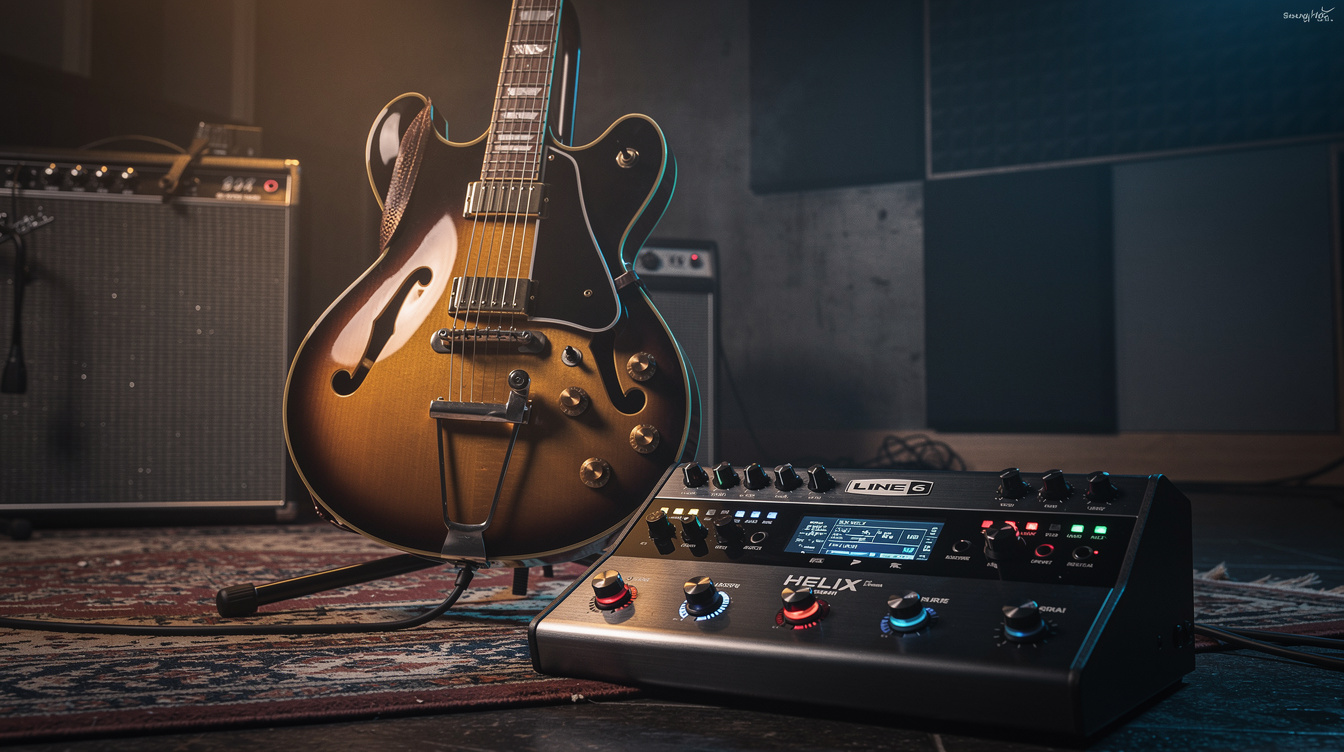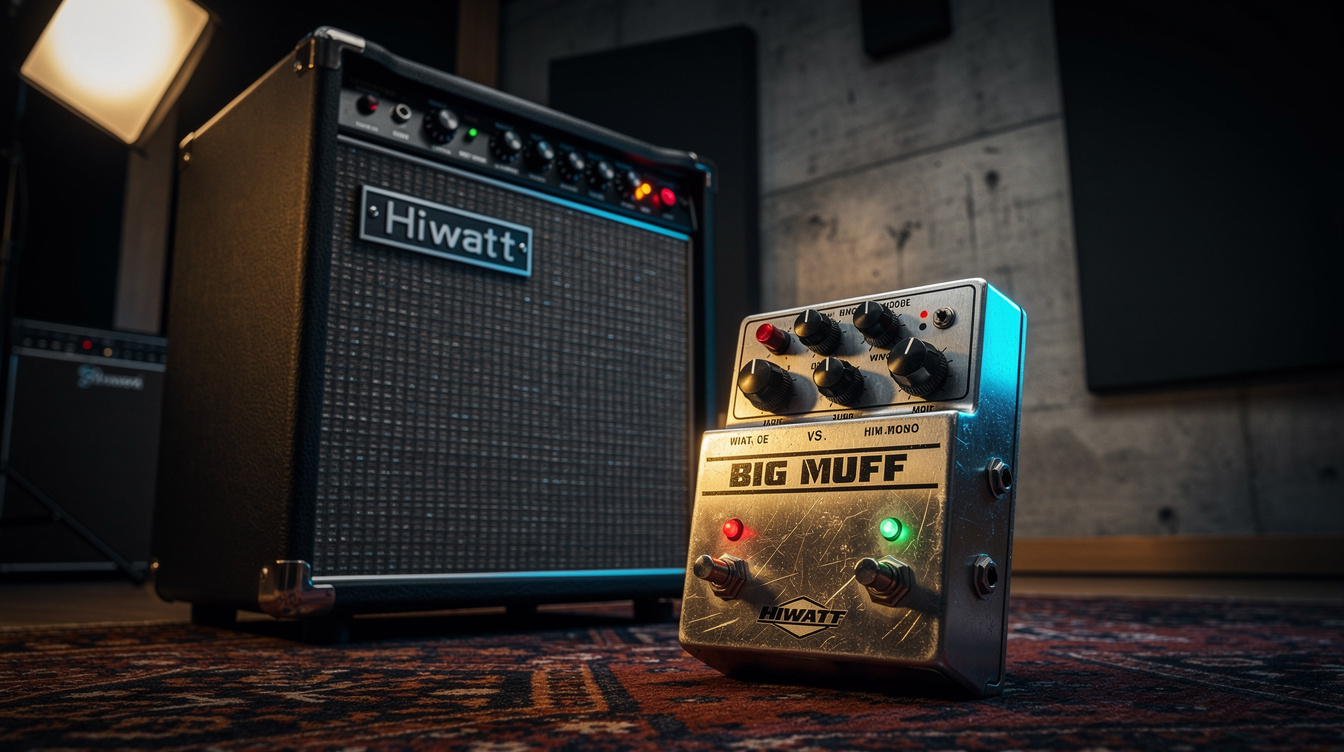
Start Here: The Comfortably Numb solo tone comes from a specific interaction between Gilmour's Big Muff Pi (set at a surprisingly restrained level), his Hiwatt DR103 running at high volume, and his neck pickup position on a black Stratocaster. Neither the Big Muff nor the Hiwatt does the work alone; the tone is what happens when they work together. The settings that recreate it are in The Settings That Get You There. The explanation of why those settings work is below that.
The Most Studied Solo Tone in Rock
There's a specific quality to the Comfortably Numb solo that gets into your nervous system. It's not fast. It's not technically complicated. It just sounds like someone is singing through the guitar in a way that makes you feel things you weren't prepared to feel. Every note has weight. The sustain blooms rather than decays. There's a thickness that isn't quite distortion, a smoothness that isn't quite clean.
For years, the standard explanation was: Big Muff Pi, Hiwatt, done. Plug in the fuzz, crank the amp, somehow arrive at that sound.
The problem with that explanation is that it produces a tone that sounds nothing like the record.
The Big Muff Pi at full fuzz into a Hiwatt is a wall of compressed distortion with a specific buzzy quality (powerful for shoegaze and doom applications, but not particularly singing or expressive). The Comfortably Numb tone doesn't sound like a wall. It sounds like a voice.
What's actually happening is more nuanced, and understanding it changes how you approach not just this tone but lead tone in general.
What Gilmour's Rig Actually Looked Like
For The Wall tour and the Live at Pompeii 1974 Comfortably Numb performances (which predate the studio album), Gilmour's signal chain for lead tones was built around:
- Guitar: Black Fender Stratocaster (0001 serial number), neck pickup, tone rolled back slightly
- Fuzz: EHX Electric Mistress (flanger) and Big Muff Pi (the Ram's Head version on the record, the NYC version on later tours)
- Amplifiers: Hiwatt DR103 (100-watt), sometimes paired with a Yamaha RA-200 rotating speaker cabinet
- Speaker cabinets: WEM Super Starfinder 200 4x12 (an unusual British cab with different frequency response characteristics than Celestion-loaded cabs)
The Big Muff's controls on the recording were almost certainly set with the Sustain well below maximum, probably around 7 o'clock to 9 o'clock on a 0-to-10 scale (closer to one-third travel than the maxed-out setting most players try first). The Tone control was warm, somewhere around 8–9 o'clock, pulling the ice-pick frequencies down. The Volume was set to push the Hiwatt's input stage.
The Hiwatt DR103 is important because it's not a Marshall. The Hiwatt's clean headroom is exceptional; it doesn't break up the way a Marshall does at moderate volume. What this means is that the Hiwatt's job in Gilmour's rig was not to add distortion: it was to add power amp compression and cabinet resonance to a signal that was already shaped by the Big Muff.
The Hiwatt was running loud. Not cranked to the point of distortion, but loud enough that the power tubes were compressing and the speakers were contributing their own character to the output. The WEM cabinets have a warmer, more mid-forward low-end response than Marshall 4x12s; they don't produce the scooped, scooped Marshall sound.
The Interaction That Makes the Tone
Here's the thing that most Comfortably Numb analyses miss: the Big Muff at moderate sustain settings does something different than at maximum.
At maximum Sustain, the Big Muff produces heavy compression, significant midrange scooping (the "smiley face" frequency profile that's characteristic of the circuit), and a compressed sustain with a specific buzzing quality. It's a lot of fuzz.
At the Sustain setting Gilmour actually used (roughly 30–40% of the control's travel), the Big Muff produces a very different character. The clipping is less complete. There's more of the original guitar signal blending through with the fuzz circuit's output. The midrange scoop is less severe. The result is a tone that's thick and sustaining but still has some of the Stratocaster's inherent voice in it.
The Hiwatt at high volume then adds two more elements: power amp compression (a smooth squeezing effect that's different from the Big Muff's compression; less hard, more elastic) and cabinet resonance. The WEM cab's particular frequency response shaped the final output in a way that a direct recording of the same settings through studio monitors would not replicate.
The bloom on each note (the way it swells slightly after the initial attack and then sustains) is partly Gilmour's technique (his vibrato and pick angle), partly the Big Muff's sustain characteristic, and partly the Hiwatt's power section doing its compression work at volume.
The Settings That Get You There
These settings are calibrated for the recorded The Wall version. They're a starting point; your amp, your guitar, and your pickups will require adjustment.
Big Muff Settings
| Control | Position | Notes |
|---|---|---|
| Sustain | 8–9 o'clock | ~25–35% of full travel. This is the key non-obvious setting. |
| Tone | 8–9 o'clock | Warm side of center. Pulls the harshness, preserves mids. |
| Volume | 3 o'clock | Output set to push the amp's input stage. |
Big Muff variant: The Ram's Head Big Muff (the violet/maroon version from 1973–76) is closest to the studio tone. The NYC Reissue is the closest affordable equivalent. The Russian Big Muff has a slightly different character (more mid-forward, which isn't wrong here). The Nano Big Muff works in a pinch.
Amp Settings (Hiwatt DR103 or equivalent)
| Control | Position | Notes |
|---|---|---|
| Gain/Input | High sensitivity input | Hiwatt has two inputs; use the high sensitivity (brighter, more responsive) |
| Normal channel volume | 6–7 | This is louder than it sounds; the DR103 is a loud amp |
| Brilliant channel volume | Off or very low | If blending channels, keep brilliant low |
| Bass | 5 | Flat |
| Middle | 6 | Slight presence boost |
| Treble | 4 | Slightly rolled back |
| Presence | 5–6 | Moderate |
If you don't have a Hiwatt: This tone works best with amps that have exceptional clean headroom: Fender Twin Reverb, Fender Deluxe Reverb (though it saturates faster), Vox AC30 (different character but similar headroom). The amps to avoid are those that break up early (lower-wattage Marshalls, many Fender Blues Juniors at the required volume). You want the amp relatively clean at moderate-to-high volume so the Big Muff does the distortion work.
The volume issue: The Hiwatt tone at its full character requires volume. If you're playing at bedroom levels, the power amp compression that contributes to the bloom isn't happening. This is the honest limitation of replicating this tone quietly. On a modeler, use the amp's "volume" or "sag" parameter to simulate this without the acoustic volume.
Guitar
| Parameter | Setting | Notes |
|---|---|---|
| Pickup | Neck | Warmer, more vocal quality. The middle pickup works but is slightly thinner. |
| Tone control | 6–7 | Slightly rolled back, not full bright |
| Volume | 10 | Full |
Approximating This on a Modeler
For Helix or Quad Cortex players, the approach changes slightly because the amp model and cab/IR combination simulate the real amp's behavior without requiring high volume.
Helix starting point:
- Amp: Hiwatt-based model (labeled "Brit Hiwatt" in Helix); use the clean channel
- Cab: WEM or British 4x12 cab with a mix of ribbon and dynamic mic models (the WEM cab isn't in Helix's stock library; a British 4x12 with a ribbon mic angled off-axis approximates its warmth)
- Big Muff: Use the Triangle Fuzz or Rams Head Fuzz block; set Fuzz at 30–35%, Tone at 40%, Level at 70%
Quad Cortex starting point:
- The Neural Amp Modeler has some captured Hiwatts in the community library
- Run a Big Muff effect block before the amp capture at the same settings above
Critical modeler note: Set the amp model's master volume (sag/compression parameter) higher than you might instinctively set it. The Hiwatt character that makes this tone work happens when the power section is being driven. Modeling that without acoustic volume means using the software's simulation of that compression.
What Your Ears Are Actually Hearing
Breaking down the specific sonic components:
The bloom: Power amp compression. The note starts, the power section of the amp responds, and there's a slight compression that makes the sustain feel elastic. On a modeler, use the amp's "sag" or dynamic response parameter.
The warmth without muddiness: Neck pickup + rolled-back Tone control + Big Muff Tone at warm setting. Three warmth sources, none of them scooping the mid-forward character that keeps the tone articulate.
The sustain that isn't buzzy: Big Muff Sustain at 25–35% of travel. At this setting, the fuzz sustain is present but not so compressed that it flattens the note's dynamic character. The note can still breathe.
The vocal quality: Gilmour's vibrato technique: slow, wide, and applied after the initial attack rather than from the moment of picking. The technique is not reproducible by settings alone. But the sustain that lets the vibrato work is set up by the moderate fuzz level and the amp's responsiveness.
FAQ
What Big Muff variant is on the record? The Ram's Head Big Muff Pi, the version produced by EHX between approximately 1973 and 1976, is the most cited source. It has a slightly different clipping character and tonal profile compared to the later NYC version or current reissues. The Ram's Head is reproduced in various clones; the Stomp Under Foot Ram's Head and the JHS Muffuletta are frequently recommended.
Does the guitar matter that much? The neck pickup of a Stratocaster (particularly a vintage-spec model with an Alnico V pickup) has a specific warmth and sustain characteristic that other guitars approach but don't match precisely. A humbucker-equipped guitar will produce a thicker, more compressed version of the tone. A Telecaster neck pickup is close but brighter. The Strat neck pickup into this chain is the authentic source.
Can I get this tone at bedroom volume? Approximately, yes. At bedroom volume, the power amp compression that contributes to the bloom is absent, so the tone has less of that elastic sustain character. This is best compensated for on a modeler by increasing the amp's sag or compression simulation, or by using a compressor pedal after the Big Muff to add some of that character back.
Is the Electric Mistress flanger on the Comfortably Numb solo? Not prominently. The studio version of the Comfortably Numb solo has the Electric Mistress at a very low mix setting, adding a very subtle thickening rather than an obvious flange effect. You can ignore it and not notice the absence.
What's the most important thing I'm probably doing wrong? Setting the Sustain too high. Most players hear "Big Muff" and assume maximum fuzz. The tone falls apart at maximum sustain; you get compression and buzz but you lose the vocal expressiveness. Pull the Sustain back and be surprised at what comes through.