There's a moment with a great reverb pedal where the room you're standing in stops being the room. The decay extends past the walls. The chord you played five seconds ago is still in the air, but it's been processed — pitch-shifted, modulated, ducked behind your next note — and it's become part of the composition rather than a side effect of it.
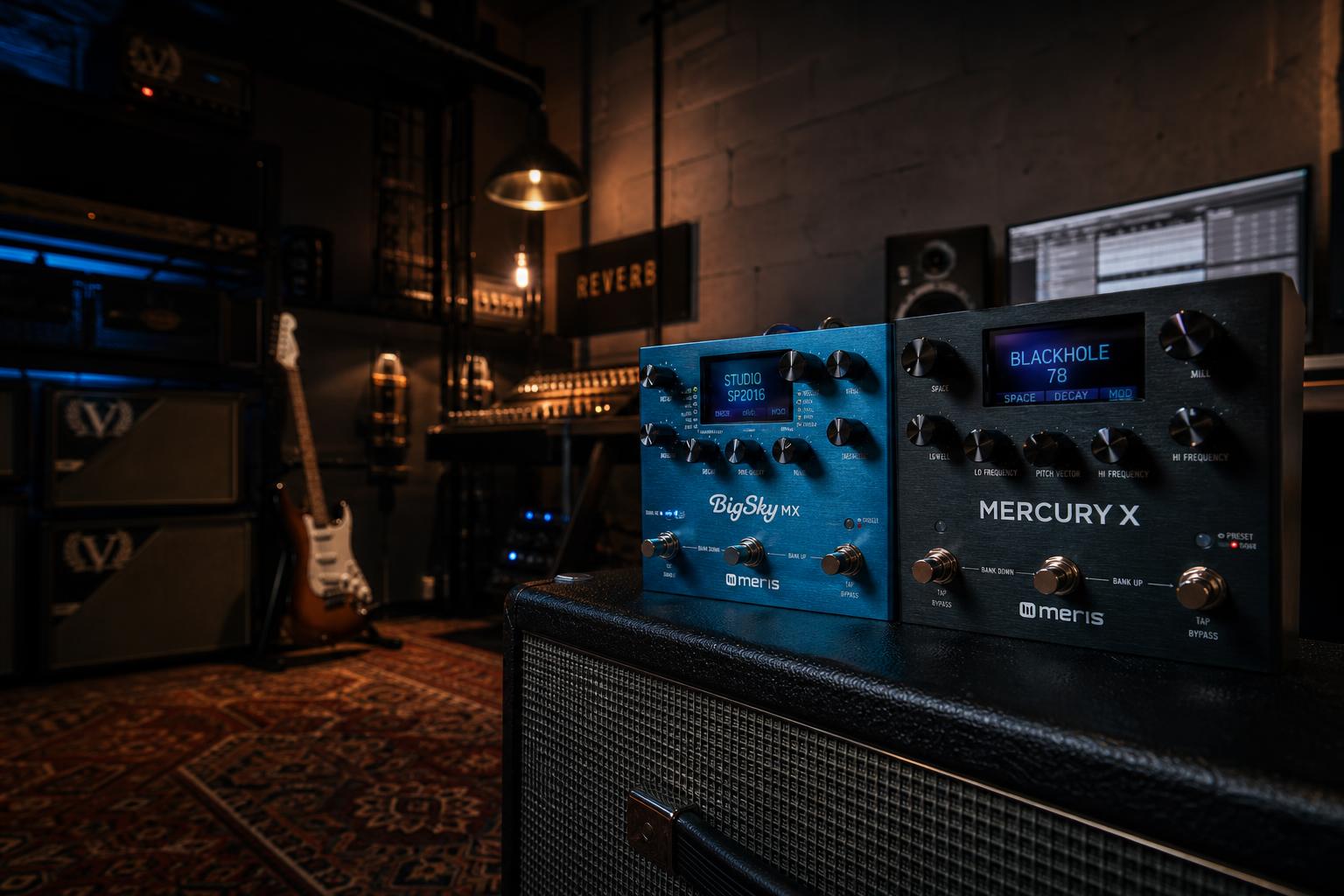
Both the Strymon BigSky MX and the Meris MercuryX get you there. They're the two most serious large-format reverb pedals on the market in 2026, and at $679 and $599 street respectively, they're priced within $80 of each other. But they get you there along different routes, and which route you prefer depends on whether you think of reverb as the space the song lives in or as a compositional voice that contributes to the song itself.
I've been running both for the last six weeks. Here's how they actually differ.
What you're getting at a glance
| BigSky MX | MercuryX | |
|---|---|---|
| Algorithms | 12 (Room, Hall, Plate, Spring, Cloud, Chorale, Shimmer, Magneto, Impulse, Bloom, Chamber, Nonlinear) | 8 (Ultraplate, Cathedra, Spring, 78 Room, 78 Plate, 78 Hall, Prism, Gravity) |
| Stereo | Full stereo I/O | Full stereo I/O |
| Presets | 300 (100 banks × 3) | 99 |
| MIDI | Yes (5-pin and TRS) | Yes (5-pin and TRS) |
| Modulation routing | Per-algorithm fixed | Per-algorithm modular slots |
| Editor | Strymon Nixie | Meris Preset Editor |
| Street price (May 2026) | $679 | $599 |
The headline difference is modulation routing. Strymon ships each BigSky MX algorithm with a fixed signal flow — the Chorale algorithm has a vocal-formant filter, the Magneto algorithm has a tape-modulation block, the Plate has a built-in modulation depth control, and that's that. You can't put chorus before the Plate reverb tank. Meris lets you. Every MercuryX algorithm has a Process block where you stack modulation, filters, and dynamics in any order before they hit the reverb.
That flexibility is both the MercuryX's superpower and its tax. The BigSky MX sounds like music the moment you turn the encoder. The MercuryX sounds like potential.
The Strymon house voice
Strymon's reverbs have a recognizable fingerprint — slightly polite, harmonically smooth, with a high-frequency rolloff that flatters single-coil guitars without making them feel processed. The BigSky MX inherits all of it.
If you've heard the original BigSky in a worship rig, a singer-songwriter's pedalboard, or a Julien Baker record, you've heard the voice. The MX widens the canvas without redrawing the picture. The Hall is still the same Hall, just with more headroom and a smoother decay curve at long times. The Shimmer is still the same Shimmer, with the pitch-shift voicing tightened up and more interval flexibility for stacked voicings than the original offered.
Chamber and the Impulse IR loader are the two machines built specifically for the MX, and — together with carryover algorithms like Bloom and Nonlinear that most original-BigSky owners never explored — they're where the MX earns its name as a different product. Bloom is a swell-and-sustain algorithm with a built-in volume-pedal response curve that fades the reverb tail in over the decay. It's a one-knob version of what worship guitarists have been chaining volume pedals into reverbs to achieve for fifteen years. Chamber is a small-room modeled space with the kind of early-reflection density that makes a guitar feel like it's in a tracking booth, not a concert hall. Nonlinear is a gated reverb — '80s drum-room ambience for guitar, which is more useful than it sounds.
What you don't get with the BigSky MX is surprise. I expected one of the new algorithms to do something I hadn't heard before. What I found was that they all do recognizable things very well. That's a feature, not a bug — Strymon's whole identity is the gap between marketing claims and what you actually get, and the gap has always been narrow in their favor.
The Meris design philosophy
The MercuryX is a different proposition. Its eight algorithms are deeper, but the depth is in the architecture, not the count. Open the Cathedra algorithm and you find: a prefilter (low-pass and high-pass), a Process block (pitch, chorus, flanger, swell, or ducker — choose one), a reverb engine with three character modes, a post-filter, and a wet-level envelope that responds to your playing dynamics.
The first time I sat down with the Cathedra algorithm and pushed the Process block into Ducker mode with a fast attack and slow release, I had the experience that justifies the MercuryX's existence. The reverb pulls itself out of the way of every note I play and floods back in during the gaps. It's the kind of compositional effect you usually have to set up with sidechain routing in a DAW. On the MercuryX it's two button presses.
The 78 Room, 78 Plate, and 78 Hall algorithms are inspired by the Lexicon 224 — the digital reverb from 1978 that defined the studio reverb sound for thirty years. They're denser than the Strymon equivalents and have a slightly grainier, more colored high end. I'd describe the difference as the distinction between a great natural-room recording and a great studio plate — both beautiful, but one of them is making a statement about what reverb is for. The MercuryX is making a statement.
The Prism algorithm is the MercuryX's shimmer, and it's the most flexible shimmer I've used. You can dial in three independent pitch intervals with different feedback levels, which means you can build a major-third-plus-fifth voicing in the reverb tail while the dry signal plays melody underneath. The BigSky MX's Shimmer is the same kind of effect at a slightly more single-purpose level.
Where the BigSky MX wins
Workflow. Strymon's encoder-and-page-navigation paradigm is the cleanest in flagship reverb. You can scroll through algorithms with one knob, edit the three most-used parameters on the front panel, and dive deeper through the OLED screen only when you need to. The MercuryX's three-knob-plus-menu interface is more powerful but more taxing — every patch wants you to make decisions you don't always want to make.
Default-state musicality. Plug a Telecaster into a BigSky MX with the factory-default Plate algorithm and the sound is a finished record. Do the same with the MercuryX's 78 Plate and the sound is a starting point. The MercuryX almost always wants editing before it earns its place in a song.
Mono behavior. The BigSky MX's mono fold-down is one of the better-considered features in the product. Strymon designed each algorithm with a phase-coherent mono image in mind, so when you run it into a single amp the reverb doesn't smear or comb-filter the way some stereo reverbs do. The MercuryX in mono is fine but loses some of the lateral character that makes the wide stereo image so compelling.
Preset count. 300 vs. 99. If you're a player who builds preset libraries for specific songs, the BigSky MX gives you three times the room to grow.
Where the MercuryX wins
Modulation per algorithm. This is the big one. The Process block on the MercuryX is a flexible audio effects slot inside the reverb, and there is nothing in the BigSky MX that competes with it directly. If you want pitch-shifted reverb tails that descend in fifths while the chorus modulates the wet signal, the MercuryX does it natively. The BigSky MX would need an external pitch pedal in a feedback loop.
Ducking. The MercuryX's Ducker mode is a sidechain compressor on the wet signal, triggered by your dry input. It's the difference between a reverb that sits behind your playing and one that ducks out of the way and floods back in. Worship guitarists, ambient players, and post-rock guitarists will all find a use for it within five minutes of trying it.
Stereo width at default. The MercuryX's room and hall algorithms model lateral early reflections more aggressively than the BigSky MX's equivalents. Played in stereo through two FRFR cabs or a wide-field monitor pair, the MercuryX feels about 20 percent wider at default settings. The BigSky MX gets to the same width with manual tuning, but it doesn't start there.
Spring depth. The MercuryX's Spring algorithm models tank length, decay damping, and drip independently. You can dial in a surf-rock spring with a long decay and almost no drip, or a vintage Fender spring with a short tank and a hard splat. The BigSky MX's Spring is a faithful single voice; the MercuryX's Spring is a modeling synthesizer.
The compositional question
Here's where I land. The two pedals occupy different points on the same spectrum, and the question isn't which is better — it's which question you want the pedal to answer for you.
If the question is "what reverb makes the song sound complete the moment I turn the knob," the BigSky MX wins. Its default state is a finished record. Its workflow rewards muscle memory. Its voice is the voice Strymon has spent fifteen years refining, and that voice flatters more guitars and more genres than any single reverb I've used.
If the question is "what reverb gives me a compositional voice I can use the way a producer uses a synth patch," the MercuryX wins. The Process block, the Ducker, the per-algorithm modulation slots, and the deeper editing menus aren't features — they're an invitation to treat the reverb as part of the writing process rather than as a finishing touch.
A jazz player who wants the reverb to be the room the song lives in will be happier with the BigSky MX. A post-rock or ambient guitarist who wants the reverb to be the song will be happier with the MercuryX. Worship guitarists are split — the BigSky MX is the safer Sunday-morning choice, the MercuryX is the better recording-session choice for the worship album.
I own the BigSky MX. I keep finding reasons to borrow the MercuryX. That's probably the most honest review I can give.
Settings to try on each
BigSky MX — Bloom for ambient swells
This is the swell setting I've been using for ambient verses — the volume-pedal response curve fades the reverb in over the natural decay, which means a chord played at full volume blooms into a tail that's about 30 percent louder than the dry signal at peak. Pair it with a clean Tele or Jazzmaster on the neck pickup.
MercuryX — Cathedra with Ducker
This is the ducked-cathedral patch I keep coming back to. The reverb gets out of the way of every note and floods back during the gaps. Try it on a slow chord-and-melody passage on the bridge pickup of a semi-hollow — the way the reverb pulls itself back during the melody and rebuilds during the chord changes is the kind of effect that makes you write differently.
Buying advice
If you're new to flagship reverbs and you want the pedal that will get you to a great sound fastest with the least menu time, buy the BigSky MX. It's the pedal I'd put on a worship guitarist's board, a touring indie band's pedalboard, or a singer-songwriter's home rig. It does the most thing the most times.
If you're already an experienced reverb player who finds yourself reaching for external pitch shifters and compressors to build the sounds you want, buy the MercuryX. You'll spend the first month editing every preset to taste, and at the end of that month you'll have a reverb that thinks the way you do.
If you can afford both — and a few players can — they're complementary, not redundant. The BigSky MX on the always-on section of the board, the MercuryX on a switched send for the moments that need to be more than ambience. That's a $1,300 reverb section and it's worth every dollar.
For most players, though, it's one or the other. The decision isn't about which pedal sounds better in absolute terms. It's about which compositional question you want the reverb to answer for you.