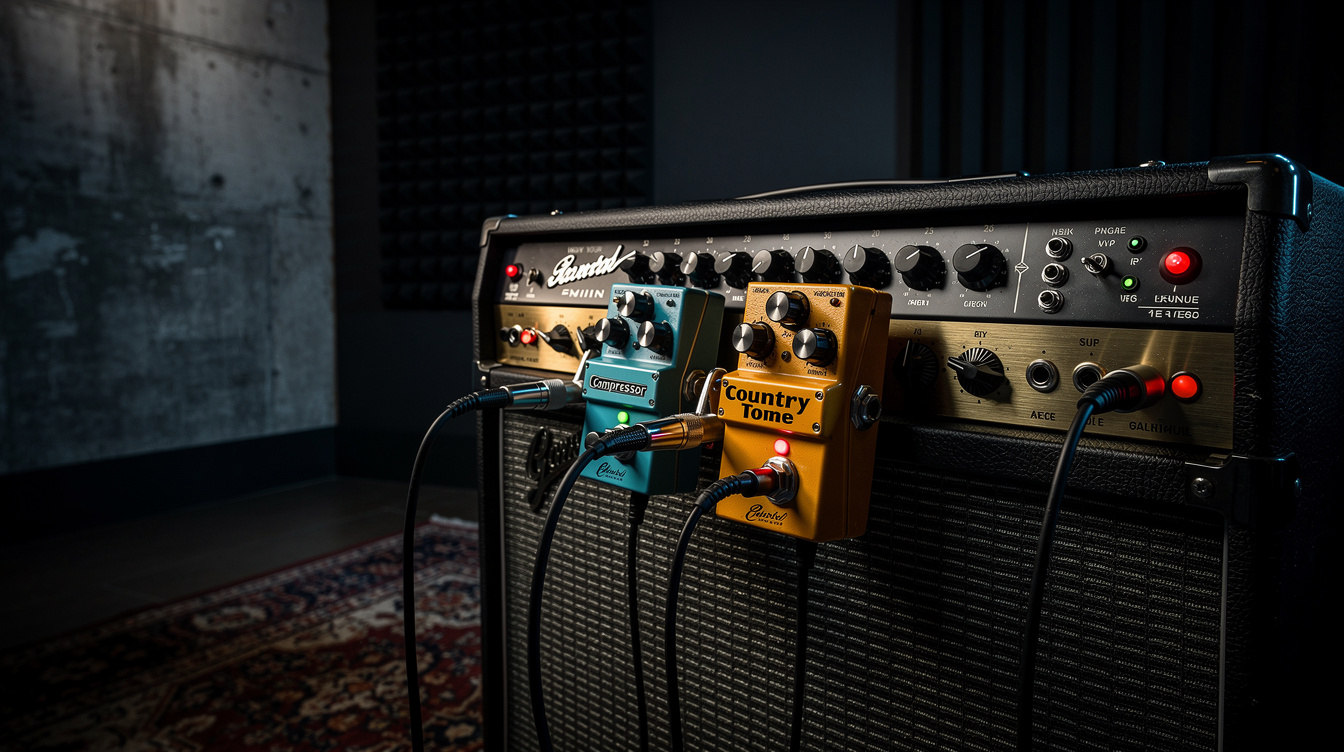
The problem in one sentence: Country guitar tone depends on the sharp, percussive snap of a Telecaster bridge pickup attacking a slightly compressed clean amp, and a compressor set incorrectly kills exactly that snap by hitting the attack too fast, squashing the transient before it can land.
The compressor is the right tool for country guitar. Brad Paisley uses one. Brent Mason uses one. The Nashville session sound has had one in the chain since Chet Atkins was making records at RCA Studio B. But there's a specific way compressors get set wrong that removes the thing country tone needs most: pick definition.
This is the diagnosis and the four corrections.
What Country Compression Is Supposed to Do
Before the four problems, it helps to understand what a correctly functioning compressor does in a country chain.
The goal of a compressor in country guitar is sustain and evening, not squash. The snap of the pick attack needs to land at full level, uncompressed. After that attack, the compressor steps in to bring up the body of the note and the sustain, so the string rings evenly rather than decaying quickly. The result is a note that hits hard (the uncompressed transient), sustains long (the compressor raising the body), and has a clean, defined decay.
The Telecaster bridge pickup aids this because it has a naturally bright, focused transient. The compressor's job is to exploit that rather than smooth over it.
The Four Problems and Their Fixes
Problem 1: Attack Is Too Fast
What happens: The compressor is set to a fast attack (under 5ms, sometimes under 1ms). It catches the pick transient before it fully passes and attenuates it along with everything else. The snap disappears. The note starts softer than it should and sustains longer than it should, but the initial impact is gone.
Why it matters: Country tone is almost entirely built on that initial attack. The "chicken pickin'" sound (the percussive, muted string attacks and the ring-out that follows) depends on the transient being the loudest thing. Without it, the chicken is just a blur.
The fix: Set attack to at least 10ms for country applications. Most Nashville-style chicken-pickin contexts want 15–25ms. The attack setting isn't "how fast does the compressor react" in a practical sense; it's "how much of the initial transient do you let through before the compressor kicks in." Longer attack = more transient passes = more pick snap.
Reference settings for common compressors:
| Pedal | Attack Setting for Country |
|---|---|
| Keeley 4-Knob Compressor | Attack at about 2 o'clock |
| Wampler Ego Compressor | Attack at about 2–3 o'clock |
| Boss CS-3 | Attack fixed; compensate by backing off ratio instead |
| Strymon OB.1 | Attack at about noon or slightly above |
| Diamond CPR-1 | Attack at about 1–2 o'clock |
Problem 2: Ratio Is Too High
What happens: A 4:1 or higher ratio is a common starting point pulled from general recording wisdom. For country guitar, it tends to sound stiff and "printed." The dynamic range between light and aggressive picking is compressed out, and the expressive variation that makes a chicken-pickin pattern sound like a human playing it disappears.
Why it matters: Country guitar styles use dynamic variation as a musical tool. The difference between a lightly played muted note and a full snap strum is expressive. High ratios remove that range.
The fix: For most country applications, stay between 2:1 and 3:1. A 2:1 ratio is gentle enough to let playing dynamics breathe while still producing the evening effect and sustain lift you want. Go to 4:1 only if you need very consistent studio-recording level matching. Above 4:1, you're limiting rather than compressing, which is a different tool for a different job.
Problem 3: Too Much Level Boost
What happens: Players use the Output or Level knob to compensate for the compressor's gain reduction, and then over-shoot. The result is a compressor that's not obviously squashing the tone (the level sounds right) but has an unpleasant, overly "printed" quality. Everything is loud and every note is about the same volume. There's no dynamics.
Additionally: Running too much level boost into a clean amp can push the amp past its clean headroom, introducing amp breakup that you may not have wanted. This is the sound of a country tone that "blossoms" into light overdrive when you're trying to stay clean. This is often traced to compressor Output set too high.
The fix: Match the output level of the compressor to bypass level by ear. With the compressor engaged and bypass toggled, you should hear the sustain and tonal character change but the loudness should be approximately the same. Once you're level-matched, it's easier to evaluate whether the compression character is working correctly.
Problem 4: Compressor Placed After the Overdrive (or After Other Gain Stages)
What happens: Putting the compressor after an overdrive or dirt pedal compresses the already-processed signal. The overdrive's gain structure has already changed the transient characteristics of the signal; the compressor is now shaping a signal that no longer has the original pick transient intact. You lose the Telecaster's natural snap, and the compression sounds artificial.
Why it matters: The Telecaster bridge pickup's transient is the thing worth compressing around. That transient shape is only available before any gain stage has processed it. Once you've added overdrive or distortion, the pick attack has already been shaped by the drive circuit.
The fix: Compressor before any dirt in the signal chain, always, for country tone. Guitar → compressor → (optional overdrive for the few notes that need a push) → amp. The compressor captures and shapes the raw Telecaster snap. The overdrive (if used) then pushes the already-evened signal into the amp's breakup zone.
The Correct Settings Framework
Here's the starting framework for a country compressor:
Release: Often ignored in country contexts, but it matters. Too fast a release (under 80ms) causes the compressor to "pump." You'll hear it breathe on fast picking patterns. Too slow (over 400ms) causes it to clamp down for too long after a loud attack, making the next quiet notes even quieter before the compressor releases. For country picking patterns with both loud snap notes and quiet muted notes in close succession, aim for 150–250ms.
When to Bypass Entirely
The compressor is not mandatory for all country contexts. Several situations where bypass is the right call:
- Single-note lead lines over a live mix. If the amp and pickup are delivering the natural dynamics you want, a compressor can reduce the expressive variation that makes a live solo feel human
- Acoustic-to-electric hybrid rigs. Compressors that work well on a Telecaster signal can respond differently to feedback from acoustic resonance; check for pump artifacts in low-frequency open-string passages
- Loud stage volumes where the amp is already compressing. At stage volumes where your amp is producing natural preamp compression, adding a compressor pedal can stack compression effects in ways that sound over-processed
The compressor's job is to make the Telecaster snap more consistent and to give notes more sustain without changing the fundamental character of how you play. If the character is already there and consistent, the compressor isn't helping.