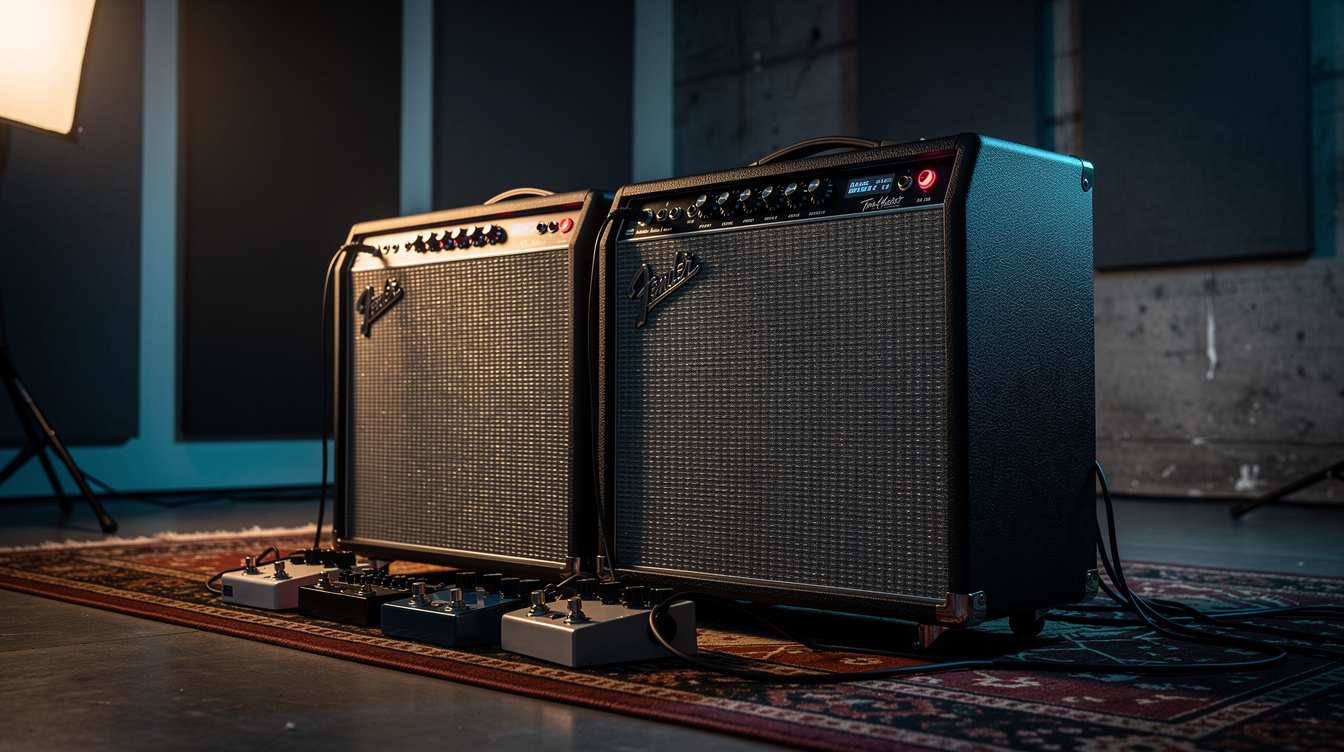
Quick answer: The ToneMaster Deluxe Reverb matches the tube original at low volumes and in clean territory more closely than it has any right to. At high volumes, with the amp being pushed into real breakup, the tube amp does something the ToneMaster can't replicate — not because of mythology, but because of physics. Both are excellent amps for most players most of the time.
| Parameter | Tube Deluxe Reverb | ToneMaster Deluxe Reverb |
|---|---|---|
| Volume sweet spot | 4–7 | 5–8 (slightly stiffer at low end) |
| Clean headroom | More at identical knob positions | Less — clips sooner at same setting |
| Push-to-breakup behavior | Gradual, responsive, dynamic | More abrupt transition |
| Speaker response | Depends on OEM / aftermarket | Same speaker (Jensen C12K) |
| Weight | 42 lbs | 23 lbs |
| Reverb character | Spring tank (physical) | Digital spring simulation |
| Street price (as of April 2026) | $1,199–$1,399 | $999 |
A Word Before We Start
I've owned a 1964 Fender Deluxe Reverb for seventeen years. Black panel, original Jensen C12N, transformers that have never been touched. It is, along with the gold Klon, one of the few pieces of gear I expect to be buried with.
That means I'm not a neutral evaluator here. I know that. But it also means I know this circuit well enough to recognize exactly where the ToneMaster earns its price tag and where it doesn't, and I can describe the difference in specific terms rather than vague gestures toward "mojo."
I ran this comparison over two sessions — one at home, one at a rehearsal space — using the same guitar (a '62 Strat, original pickups), identical knob positions on both amps, and both amps going through the same external 1x12 cabinet with a Celestion Alnico Blue. I didn't use the ToneMaster's onboard speaker for this test, which removes one major variable: both amps through identical speakers. If the comparison is about the amp, it should be about the amp.
What the ToneMaster Gets Absolutely Right
Clean Tones at Conversation Volume
Run both amps with the volume at 4, tone controls at noon, treble around 6, and the reverb at 3. Plug in the bridge pickup on a Strat. Play a chord.
I expected to be able to distinguish them immediately. I could not. Not at first. The attack, the string separation, the way the chord blooms and decays — it was close enough that I stopped and looked at which amp I was playing through. At this volume and this gain setting, the ToneMaster's modeling does something genuinely impressive: it captures the input impedance behavior and the first preamp stage interaction well enough that the note feels right. That's the hard part, and they solved it.
The reverb is a different story. Fender's spring reverb units have a specific drip — a tonal artifact of the physical spring tank where percussive transients cause the spring to slap back unevenly. The ToneMaster's digital spring simulation is cleaner and more even than the real thing. Whether you prefer this depends on what you're after. For recording, you might actually prefer the ToneMaster's reverb because it's more controlled. For the garage-band, Dick Dale surf sound, you want the real spring. The drip isn't a flaw; it's the character.
Gigging at Moderate Stage Volume
The ToneMaster's biggest practical advantage is the built-in attenuator, which lets you run the amp at one-quarter, one-half, or full power. A tube Deluxe Reverb at stage volume — real stage volume, where the amp is actually breaking up — is loud in a way that makes smaller venues difficult. The ToneMaster lets you run the amp model at its full-gain sweet spot and attenuate the output to a manageable level.
This is not a small thing. For players who do small-to-medium rooms without PA support, the ToneMaster's practical ceiling is meaningfully higher.
Where the Tube Amp Does Something Different
Pushed to Breakup
Here's where the comparison gets honest. Run both amps with the volume at 7 or above — where the output tubes in the Deluxe Reverb are actually working. The character of the breakup changes.
The tube amp at volume 7 with the bridge pickup has a specific sag to it. The notes don't all hit the same way. Pick harder and the amp responds differently than if you play lightly. There's a dynamic compression at work — not from a pedal, but from the output tubes running out of headroom asymmetrically depending on the signal they're receiving. The sound is slightly different on every note, in a way that sounds like music rather than processing.
The ToneMaster's breakup is consistent. It's not bad — it's modeled from the tube amp's behavior — but it lacks the moment-to-moment variation that the real output tubes produce. The transitions are more predictable, the feel is slightly stiffer, and when you dig in hard it doesn't give back the same way.
I expected this going in. What I didn't expect was how much it mattered at 7 versus how little it mattered at 5. Below the point where the output stage is saturating, the two amps are genuinely close. Once the tubes are working, the gap opens up.
Long-Term Room Feel
This is harder to describe without sounding mystical, so I'll try to be specific. A tube amp at moderate volume in a room produces a physical pressure from the speaker — low-frequency movement, driver displacement, cabinet resonance. The ToneMaster's speaker produces this too; it's not a headphone amp. But at equal volumes, the tube amp produces more energy in the 80–200Hz range due to the power transformer's response characteristics and the output tube interaction with the speaker. It feels louder at the same SPL.
Over a three-hour session, this difference is real. The ToneMaster is accurate but linear. The tube amp has more natural dynamics in the low end, which is either the entire point or an irrelevant artifact depending on what you're building a rig for.
Settings Comparison: Identical Knob Positions
Both amps were set as follows. Here's what each sounds like at those positions:
Knob Position: Volume 5, Treble 6, Bass 5, Reverb 3
| Tube Deluxe Reverb | ToneMaster | |
|---|---|---|
| Clean headroom | Full clean, slight edge-of-breakup with humbuckers | Full clean across all pickups |
| Pick attack | Slightly rounded, the amp is breathing | Clean and defined, a little more precise |
| Single-coil response | Glassy and open | Accurate, slightly tighter |
| Reverb character | Physical spring, slight asymmetric drip | Even, controlled spring simulation |
Knob Position: Volume 7, Treble 6, Bass 4, Reverb 2
| Tube Deluxe Reverb | ToneMaster | |
|---|---|---|
| Clean headroom | Gone — bridge pickup breaks up at this volume | Retained — breaks up less readily |
| Breakup character | Sags, compresses, variable note-to-note | More consistent, less dynamic |
| Pick dynamics | Very sensitive to pick angle and pressure | Moderate sensitivity |
| Sustain | Extended, tubes compressing the signal | Accurate decay but less bloom |
Which One Should You Buy?
Buy the ToneMaster if:
- You're playing small venues and need the attenuator
- You need to get the Deluxe Reverb's clean tone without carrying 42 pounds
- You record mostly at home or at low volumes
- Budget is a meaningful consideration ($200–$400 difference depending on where you shop)
- You care about the reverb being cleaner and more controlled
Buy the tube original if:
- You want the amp at volume 6–8 and the output stage behavior matters to you
- You plan to push this amp hard and the feel of the breakup is part of the reason you want it
- You might someday care about the resale value (tube originals hold value; modeling amps don't)
- The physical spring tank reverb character is specifically what you're after
The honest summary
The ToneMaster's designers clearly used a real Deluxe Reverb as the reference point, and the fidelity at typical playing volumes is good enough that most players in most situations won't hear a meaningful difference. It earns its price tag.
But the tube amp does something at the moment when the power section saturates that isn't fully captured yet. If you want that specific behavior — and if you've ever played a Deluxe Reverb at volume 7 in a room where you can hear what it does, you know the behavior I mean — you'll know it's missing.
For the player who needs a reliable Fender clean platform with reverb at a reasonable weight and price: the ToneMaster is excellent. For the player who bought a Deluxe Reverb specifically because of what happens when the output tubes start working: there's currently only one answer.
FAQ
Do the same settings on both amps produce the same volume level? Not exactly. The tube amp clips earlier at the same knob positions, so at volume 5 with humbuckers, the tube amp is louder because more of the signal is contributing to harmonic distortion (which registers as louder). At volume 3–4 with single coils, levels are closely matched.
Is the ToneMaster reverb as good as the tube amp's spring reverb? Different, not worse. The ToneMaster's reverb is more even and controlled. The tube amp's spring has physical artifacts — the "drip" on hard transients — that some players love and some find distracting. The ToneMaster is correct; the tube amp is characterful.
Can you use an effects loop with the ToneMaster? The ToneMaster does not have an effects loop. Neither does the tube Deluxe Reverb. Both share this limitation.
What's the reliability difference? The ToneMaster has no tubes to bias, no output transformer to worry about, and no physical spring tank to damage in transport. For gigging musicians, the reliability advantage of the digital amp is real and not trivial.
Does the ToneMaster work through a different speaker cabinet? Yes, and this is actually a recommended approach for comparison testing. Running both amps through the same external speaker removes the speaker variable and isolates the amp's electronic behavior. The ToneMaster's balanced XLR output also makes it useful for direct recording with an IR.