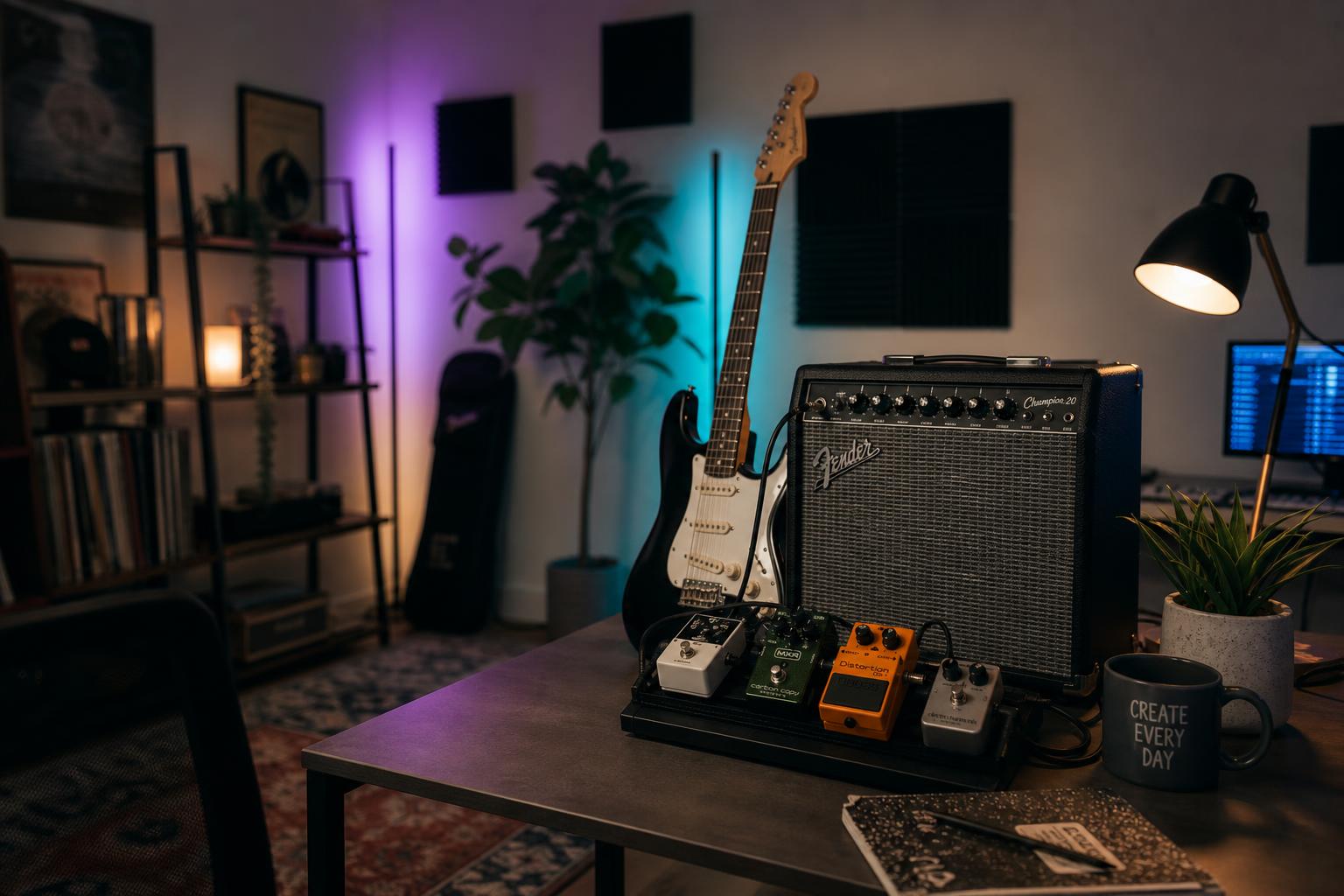
Quick read: A complete first electric guitar rig for a teenager at $500 splits the budget intentionally: $260 on the guitar (Squier Affinity Stratocaster or Squier Bullet Mustang), $150 on the amp (Fender Mustang LT25 or Boss Katana Mini), and the remaining $90 on the cable, the tuner, the strap, and a starter pick assortment. The ratios matter — spending more on the guitar than the amp is the right call at this tier because the guitar is the instrument the teenager is learning to play, while the amp's job at home volume is mostly to be quiet enough not to wake anyone up. Skip the pedalboard for year one. Skip the gig bag for year one. Skip the strap locks for year one. About six in ten beginners are still playing at month six, and the additional gear becomes a worthwhile purchase at that point. For year one, the teenager needs a guitar that plays, an amp that has a headphone output, a cable that works, and a tuner. That is the entire list.
The $200 pedalboard piece built a usable beginner board for a teenager who already had a guitar and an amp. This is the broader version of that question — the complete first rig, including the guitar and the amp, at a budget that makes sense for a parent who is not sure if the hobby will stick. The $500 number is intentional. Lower than that and the guitar setup problems usually drive the kid to quit. Higher than that and the parent has gambled too much on something that might not last.
I have bought one of these rigs for a 12-year-old in my extended family last summer, and watched it work — she is still playing eleven months later, the rig has held up, and the next upgrade question is around what pedal to add next. The math below is the actual breakdown I used, lightly adjusted for current 2026 prices.
The Budget Split
Three line items take most of the budget. The remaining items are small but matter.
| Item | Budget | Why |
|---|---|---|
| Guitar (Squier Affinity or Bullet) | $260 | The instrument the teenager is learning. Setup quality matters. |
| Amp (Fender Mustang LT25 or Boss Katana Mini) | $150 | Headphone output, multiple voicings, built-in tuner. |
| Cable (10ft instrument cable) | $20 | Cheap cables fail; this is a critical low-cost piece. |
| Tuner (Snark clip-on) | $25 | The single most useful accessory for a beginner. |
| Strap (basic woven) | $15 | Any strap works; do not overspend. |
| Picks (assortment) | $10 | Try multiple thicknesses; beginners need to find their feel. |
| Subtotal | $480 | Leaves $20 for sales tax or shipping |
The guitar gets the largest line item because the guitar is the instrument. The amp gets the second-largest because a teenager learning at home through headphones needs an amp that has a headphone output. The remaining $70 covers the cable, tuner, strap, and picks — all of which are necessary, none of which are worth overspending on at year one.
The ratio of guitar to amp at this budget tier is roughly 1.7:1. At higher budget tiers, the ratio shifts toward parity (a $1,500 guitar pairs well with a $1,500 amp), but at the beginner tier the guitar matters more. A bad-setup $150 guitar through a great $350 amp is a frustrating instrument to learn on. A well-setup $260 guitar through an acceptable $150 amp is a workable rig that does not get in the way.
The Guitar: Squier Affinity Strat or Squier Bullet Mustang
Two guitars are worth considering at $249 to $260. Both are made by Squier (Fender's budget line), both have been refined over multiple production years, and both pass the basic setup test out of the box more often than they fail it.
Squier Affinity Stratocaster ($249)
The Affinity series Strat is the entry-point Stratocaster — three single-coil pickups, a 5-way switch, a 25.5-inch scale length, a tremolo bridge that most teenagers leave alone, and a maple neck with a satin finish. The body is poplar, the neck is bolt-on maple, and the pickups are Squier-branded ceramic magnet singles.
The strengths: the 25.5-inch scale length is the standard adult electric scale. The 5-way switch gives the teenager access to all the classic Strat pickup combinations (bridge, bridge+middle, middle, middle+neck, neck) without explanation. The body shape is iconic — every teenager recognizes a Strat from album covers and music videos. The tremolo bridge is locked in place on most Affinity production runs (the springs are not adjusted for floating), which means the teenager will not detune the guitar by accident.
The weaknesses: the pickups are bright and somewhat thin sounding through a small modeling amp — they need some midrange EQ help to feel substantial. The bridge saddles are pressed steel rather than the higher-tier cast saddles, which means the saddles will eventually wear and need replacing, but not within the first year. The fret edges sometimes need a touch of filing at the factory setup — about one in eight Affinity Strats benefit from a $40 fret-edge dressing at a local shop.
The teenager who picks the Affinity Strat is going to be playing alongside a lot of Strat-style songs (John Mayer, Eric Clapton, John Frusciante, modern indie rock), and the guitar fits naturally into those contexts.
Squier Bullet Mustang ($199)
The Bullet Mustang is the smaller-scale option — a 24-inch scale length (shorter than the Strat's 25.5 inches), a slightly thinner body, a 3-way switch with two humbuckers, and a hardtail bridge with no tremolo. The body is poplar, the neck is bolt-on maple, and the pickups are budget Squier humbuckers.
The strengths: the 24-inch scale length is meaningfully easier on a smaller hand. Chord shapes are about 6% closer together than on a Strat, which makes stretches like the open D and the F barre easier for a younger player. The hardtail bridge means the guitar holds tune better than the Affinity Strat (no tremolo to detune by accident). The humbuckers are darker and warmer than single coils, which makes them more forgiving in a small amp — they do not pick up as much noise and they handle distortion better.
The weaknesses: the smaller scale means the strings are at lower tension than a 25.5-inch scale guitar, which gives a softer feel that some players prefer and others find slack. The humbucker tone is not the versatile Strat sound — the player gets two pickup options instead of five, and both options are darker rather than spanning the bright-to-dark range. The Mustang body shape is less iconic than the Strat and some teenagers do not connect to the look as quickly.
The teenager who picks the Bullet Mustang is more likely to be playing indie rock, alternative, garage rock, or shoegaze — the Jazzmaster-Mustang body shape is the signature of those genres, and the humbuckers fit the sonic palette.
How to Choose
If the teenager has played both at a music store, their preference is the right answer. If they have not, three diagnostics:
- Body size. If the teenager is under 5'4" or has small hands, the Bullet Mustang's 24-inch scale is the better physical fit. Over 5'4", the Affinity Strat's 25.5-inch scale is the standard adult instrument and the right choice.
- Genre interest. If they listen to indie rock, alternative, or grunge, the Mustang fits. If they listen to classic rock, blues, or modern country, the Strat fits.
- Tuning stability. If the teenager will be frustrated by retuning after every bend, the Mustang's hardtail bridge wins. The Strat's tremolo bridge introduces tuning issues that a beginner cannot diagnose.
The Amp: Modeling, Not Tube
Three amps are credible at $99 to $200 for a first electric setup. All are modeling amps, not tube amps, and that is the right choice at this budget tier.
| Amp | Price | Power | Headphone? | Why |
|---|---|---|---|---|
| Boss Katana Mini | $99 | 7W | Yes | Smallest, simplest, runs on batteries |
| Fender Mustang LT25 | $149 | 25W | Yes | Best balance of features and price |
| Boss Katana 50 MkII | $239 | 50W | Yes | Future-proofs into year two if budget allows |
The case for modeling amps over tube amps at this budget: a small tube amp has one sound. A small modeling amp has 30 sounds. A teenager exploring genres for the first year needs the variety. The Mustang LT25 has clean, crunch, lead, metal, and a dozen effects, plus a headphone output and a USB connection for recording to a phone or laptop. The Katana 50 MkII has similar voicings with a slightly more rock-leaning character and an effects loop for future expansion.
The headphone output is the critical feature. Teenagers practice at home, and the amp without a headphone output is the amp that creates household friction. The headphone-out lets the teenager practice at any hour without affecting siblings or parents, which directly extends the daily practice window from "after-school only" to "any time."
The built-in tuner is the second feature that matters. A teenager who can hit a button on the amp and tune their guitar in 30 seconds is a teenager who tunes the guitar before every practice session. A teenager who has to hunt for a separate tuner is a teenager who practices out of tune and develops a bad ear.
The USB connection on the Mustang LT25 and the Katana is the third feature worth mentioning. The teenager who records themselves playing into a phone or laptop hears their progress over time, and the USB connection makes that easier than mic'ing a small amp. Most teenagers will not use it in year one; some will.
For the absolute budget pick, the Boss Katana Mini at $99 covers the basic case. It is battery-powered (no power adapter needed), has a headphone output, and has three basic voicings (clean, crunch, lead). The trade-off is no effects beyond a simple delay, no USB recording, and only 7 watts. For a first-year setup where the teenager is exploring whether they like guitar at all, the Katana Mini is enough.
The $90 Worth of Smaller Things
The remaining $90 covers four small purchases that each matter more than their price suggests.
Cable (10-foot instrument cable, $20)
A cheap cable that fails after three months is a cable that ruins a practice session and a kid's mood. Buy a generic-brand 10-foot instrument cable with molded plugs (not the bargain-bin cables with crimped plugs). Brands that hold up: Pro Co, Hosa, Planet Waves, Live Wire (Guitar Center house brand). All are in the $15 to $25 range.
The 10-foot length is right for home practice. Longer cables coil into a tangle that the teenager will not undo. Shorter cables tether the player too close to the amp. Ten feet gives enough range to sit on the bed and play, which is where most teenagers practice.
Tuner (Snark clip-on, $25)
The Snark SN-5X or SN-8 clip-on tuner clips to the headstock of the guitar and reads the string vibration directly. The advantages over a pedal tuner at this stage:
- No additional cable, no pedalboard, no battery in the signal path
- Works whether the guitar is plugged in or not
- The teenager can see the tuner from playing position without looking at a pedal on the floor
- $25 is the same price as a cheap overdrive pedal but the tuner is the more useful purchase
Tuning is the single most overlooked aspect of beginner playing. A teenager who practices for six months on an out-of-tune guitar develops an ear that thinks the out-of-tune state is normal. The Snark on the headstock prevents this from ever happening.
Strap (basic woven, $15)
Any strap works. The classic Fender woven strap at $15, the Levi's leather strap at $25, or the Levy's nylon at $20 are all fine. Avoid the very cheap $5 straps with thin material — they fray within months and the strap button slot stretches.
A strap is necessary even if the teenager will play sitting down for the first year. The guitar still hangs from the strap when standing for the cover photo, when carrying from one room to another, and when posing for the inevitable "first guitar" snapshot the parent will want to take.
Picks (assortment of thicknesses, $10)
A $10 assortment of picks at three thicknesses — light (0.46mm), medium (0.73mm), and heavy (1.0mm) — lets the teenager find what feels right for their hand. Most beginners gravitate to mediums (0.73mm) after a few weeks of trying others. Heavy picks are harder for a beginner to control; light picks bend too much under a developing right hand.
Dunlop Tortex picks in the $10 assortment pack are the standard. The teenager will lose half of them in the first month. The other half lasts the first year.
What to Skip for Year One
Equally important is what does not belong in the first-year rig.
| Item | Why skip |
|---|---|
| Pedalboard | Year-one practice is about chord changes, not effects. Distraction more than help. |
| Gig bag | The guitar lives in one room. Buy a bag in year two when the kid wants to bring it to a friend's house. |
| Strap locks | Plain strap buttons hold the strap fine when sitting. Strap locks matter when standing for shows, which is year two or later. |
| Second cable | One cable is enough for one-room home practice. |
| Second amp | The teenager will not need a second amp until they are doing something the first amp cannot do, which is year two or later. |
| Capo | A useful tool, but the teenager will not know what to do with it until they have learned the basic open chords. Buy it in month six. |
| Music stand | If the teenager is using sheet music or a tablet, a music stand is useful. Most beginners learn from videos on a laptop or phone, which sits on the bed next to them. |
| Recording interface | Year two purchase. The amp's USB output covers basic recording for year one. |
The pedalboard skip is the one that surprises some parents. The instinct is "the kid wants to sound like their favorite song, and that song has a fuzz pedal, so the kid needs a fuzz pedal." The reality is that a year-one player cannot use a fuzz pedal usefully — they do not know when to engage it, they cannot recover when it makes a chord sound wrong, and the pedal becomes a distraction from learning the chord changes that actually move them forward. Wait for year two. The pedal is more useful then.
The gig bag skip is the second surprise. A teenager who does not leave the house with the guitar does not need a gig bag. The cardboard box the guitar shipped in is a perfectly fine storage option for year one. When the kid starts going to a friend's house with the guitar in month seven or eight, that is when the $50 gig bag becomes a worthwhile purchase.
The Math Compared to Other Common First-Rig Builds
Other budget tiers for comparison.
| Tier | Total | What you get | When right |
|---|---|---|---|
| $200 | $200 | No-name guitar + ultra-budget amp + cable | Wrong almost always — guitar setup is too bad |
| $350 | $350 | Squier Affinity + Boss Katana Mini + accessories | Acceptable; the amp is small |
| $500 | $500 | Squier Affinity/Mustang + Mustang LT25 + accessories | The right tier for most teenagers |
| $750 | $750 | Mexican Fender Player Strat + Mustang LT25 + accessories | Better guitar; amp is still LT25 |
| $1,000 | $1,000 | Player Strat + Boss Katana 50 MkII + accessories + small pedalboard | Future-proofed but a gamble at year one |
The $500 tier is the sweet spot because the guitar is at the threshold where setup is reliable, the amp is small enough for home but capable enough for genre exploration, and the total is not so high that the parent feels stuck if the teenager quits in month three. Each step up from $500 buys real improvements but the marginal benefit diminishes — the jump from $200 to $500 is much larger than the jump from $500 to $1,000 in terms of how the kid experiences the rig in year one.
The under-$500 builds are tempting but risky. A $200 rig with a no-name Amazon guitar usually has a bad setup that makes the strings hard to fret, the intonation drifts, and the kid quits because the guitar fights them. The $350 tier is acceptable if budget is tight — a Squier Affinity at $249, a Boss Katana Mini at $99, and a $25 cable get you to $373 with the small extras. The teenager will outgrow the Katana Mini in year two but will not outgrow the Squier.
What Surprised Me About the Rig in Practice
I expected the headphone-output amp to be a "convenience feature" that the kid would use occasionally. What I actually saw was that it became the primary way she practiced. After school, when both parents were working, headphones were the only option, and the amp without a headphone output would have been the amp that did not get used.
I also expected the modeling amp's many voicings to be confusing for a beginner — too many options, too much menu diving. The opposite was true. The kid found the clean and the crunch settings within a week, ignored the other 28 voicings for months, and only started exploring them when she had specific songs she wanted to match. The "too many options" concern was wrong because she was using only the two options that mattered to her, and the others were available when she eventually wanted them.
The tuner-on-the-headstock decision turned out to be the highest-leverage cheap purchase. She tunes before every practice. The guitar is always in tune. The ear she is developing is therefore developing against a correctly-tuned reference, which is the foundation everything else builds on. Twenty-five dollars, eleven months of cumulative impact.
The pedalboard skip was correct. She has not asked for pedals in eleven months. She has asked for a fuzz pedal twice and then forgotten about it. The amp's built-in distortion has covered every musical need she has had.
The Year-One Promise
This rig is enough for year one. If the teenager is still playing at month twelve — and about six in ten are, in my limited but observed sample — the year-two upgrades become easier to justify. A capo at year two. A real pedal or two at year two. A bigger amp at year two if they have outgrown the LT25's headroom for the genres they are playing.
If the teenager has stopped by month six (about four in ten), the rig holds its value on the used market. A used Squier Affinity sells for $150 to $180 on Reverb. A used Mustang LT25 sells for $90 to $120. The total resale on the year-one rig is about $260 to $300, which is roughly half the purchase price returned in cash. The downside risk is bounded.
The single most important purchase decision at this budget is the guitar — the instrument the teenager is learning. Spend the right portion of the budget on the guitar, accept the modeling amp as a smaller line item, and skip the pedals for year one. That is the entire decision, and it is what makes the rig work.
The Decision Path
Three questions resolve most of the configuration:
- What is the teenager's body size and hand size? Smaller hands and bodies → Squier Bullet Mustang ($199). Adult-size → Squier Affinity Strat ($249).
- Will the teenager practice late at night? Yes → the amp must have a headphone output. Fender Mustang LT25 or Boss Katana Mini are the right picks.
- Has the teenager already shown sustained interest in guitar (3+ months on a borrowed instrument)? Yes → consider the $750 tier. No → stick at $500 — the rig is good enough to test interest without overspending.
The teenager who has a rig built around these decisions has the gear they need for the first year, and the parent has not gambled the price of a vacation on whether the hobby sticks. That is the calculus that makes this budget work.