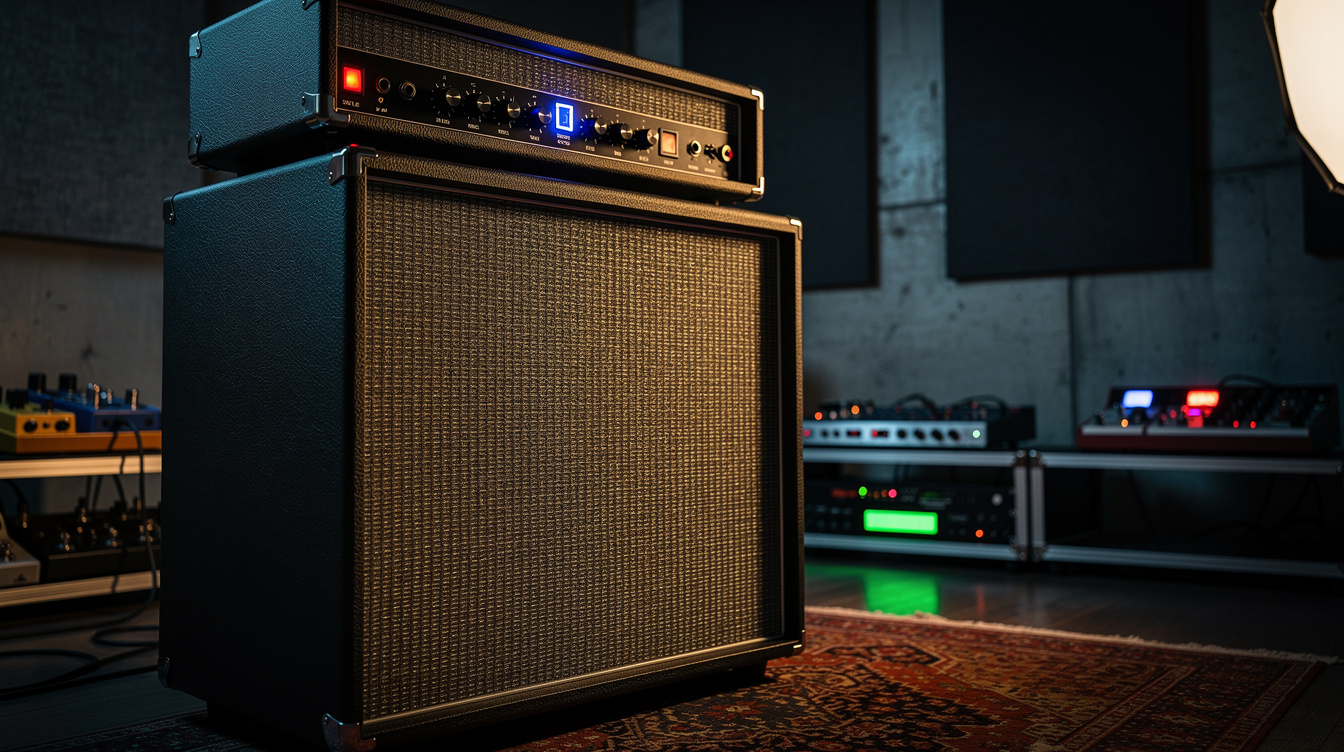
Two inputs, two sets of knobs, and almost nobody uses the left one. Ask a room full of Deluxe Reverb owners which channel they play and you'll get the Vibrato channel, every time, because that's where the reverb is. Fair enough. But the assumption underneath that answer is wrong, and it's worth correcting.
The Normal channel is not the Vibrato channel minus the effects. The Vibrato channel is the Normal channel plus an extra tube stage and a capacitor soldered across the volume pot. One of those channels has been modified. It isn't the one you think.
What's Actually Different
| Per channel | Normal | Vibrato |
|---|---|---|
| Reverb | No | Yes |
| Tremolo | No | Yes |
| Treble lift, Deluxe Reverb | None at all | 47 pF cap hardwired across the volume pot |
| Treble lift, Vibrolux / Pro / Super / Twin Reverb | Bright switch | Bright switch |
| Preamp stages, reverb models | 2 | 3 |
| Preamp stages, non-reverb models | 2 | 2 |
| Tone stack values | Same as Vibrato | Same as Normal |
That last row surprises people who assume the tonal difference has to come from the tone circuit. It doesn't. On a Twin Reverb both channels run the same parts — 1M audio volume, 250K audio treble, 10K midrange, 250K audio bass, with a 250 pF treble cap, a .047 µF mid cap and a .1 µF bass cap. Identical on both sides of the panel. Whatever you hear between the channels is coming from the two rows above it, not from the knobs.
On a Deluxe Reverb, the Cap Is the Whole Story
The Deluxe Reverb never got a bright switch. Neither channel has one — check a blackface panel and it goes straight from the inputs to Volume. What the amp got instead was 47 picofarads wired directly across the lugs of the Vibrato channel's volume control, permanently. The Normal channel didn't get anything.
A cap across a volume pot is a treble bypass. It gives high frequencies a path around the resistance, which means it does the most when the pot is turned down and the least when it's wide open. So the two channels are furthest apart at bedroom volume and closest together at gig volume. That's backwards from how most players discover the difference, because most players A/B the channels quietly in a shop and conclude the Normal channel is dull.
It isn't dull. It's the channel without a fixed treble boost on it, heard at the volume where a fixed treble boost matters most.
And here's the part I had wrong going in. I assumed the hardwired-cap-on-Vibrato arrangement was the blackface norm and the switches came later. It isn't. Pull up the panels and the Deluxe Reverb is the outlier — the Vibrolux Reverb, Pro Reverb, Super Reverb and Twin Reverb all list a Bright switch on both channels. On those four amps the treble lift is a variable you control on either side of the panel, which means you can switch both off, match the Volume settings, and hear what's actually left of the channel difference.
What's left is the third gain stage and the effects routing. Nothing else. That makes the Deluxe Reverb the amp where channel choice matters most, and the rest of the line the place where it's a smaller, cleaner decision than people assume.
The Third Tube Stage, and What It Is Not
On the reverb-equipped amps, the Normal channel runs two gain stages and stops. The Vibrato channel keeps going into a third, which is where the reverb return gets mixed back in.
That stage is a recovery stage. The reverb circuit costs signal — you're driving a spring pan and reading it back off a transducer — and something has to make up the difference. So the third stage isn't there to give the Vibrato channel more gain. It's there to get the Vibrato channel back to even after the reverb tank takes its cut.
Whether a given amp actually lands back at even is a coin flip. Rob Robinette's read is that the stage more than compensates, which would make the Vibrato channel the one that breaks up first. Plenty of owners measure the two channels as near enough identical. Both can be true in different amps — that's one 12AX7 and a handful of resistors, and tolerance stacks. The point for a player is that level is not the reliable difference between these channels. The cap is.
Which Channel Wants Your Pedals
Normal. Two reasons, and neither is subtle.
A pedal platform wants a flat, predictable front end. On a Deluxe Reverb the Vibrato channel has a treble lift baked in that gets stronger as you turn down, which means your overdrive's tone knob is fighting a moving target — the same pedal setting sounds different at Volume 3 than at Volume 6, and not only in the way you'd expect from the amp getting louder. The Normal channel doesn't do that, and on that amp you can't switch the Vibrato channel's cap out to get the same behaviour.
On a Vibrolux, Pro, Super or Twin the Bright switch on the Vibrato channel gives you the option, so this reason mostly evaporates. The second one doesn't.
And the Normal channel is a shorter path. Two stages instead of three, no reverb mixer in the signal. Fewer parts between your pedal and the power tubes. If you've got a fuzz that sounds harsh into the amp, or a Tube Screamer that's turning everything into a nasal midrange lump, try the other input before you try another pedal. Half the brittle-drive complaints about these amps are solved by a cable move to the left side of the panel, and the players making them have never tried it.
If you need reverb and pedals, you need a reverb pedal. That's the trade. Where to put a reverb pedal relative to the amp matters more on this kind of amp than on most.
Per Model, Because It Isn't Uniform
These are the blackface AB763 amps where the channel layout is confirmed against field guides and layout drawings:
| Model | Reverb + tremolo | Bright switch | Middle knob | Normal / Vibrato stages |
|---|---|---|---|---|
| Deluxe Reverb | Vibrato channel | Neither channel — 47 pF hardwired on Vibrato | None | 2 / 3 |
| Vibrolux Reverb | Vibrato channel | Both channels | None | 2 / 3 |
| Pro Reverb | Vibrato channel | Both channels | None | 2 / 3 |
| Super Reverb | Vibrato channel | Both channels | Vibrato channel only | 2 / 3 |
| Twin Reverb | Vibrato channel | Both channels | Both channels | 2 / 3 |
Panel layouts above are from Mojotone's Fender field guides, read per model rather than inferred from one amp to the next — which is how the Deluxe Reverb's missing Bright switch turned up.
The Super Reverb is the odd one and worth knowing if you own one. Its Vibrato channel is Bright switch, Volume, Treble, Middle, Bass; its Normal channel is Bright switch, Volume, Treble, Bass. So on a Super, switching channels takes a tone control away from you rather than just changing how the amp sounds. The Super and the Concert also use a .022 µF midrange cap where the rest of the line uses .047 µF, which shifts where the tone stack's notch sits.
Showman, Dual Showman, Concert, Bandmaster and Vibroverb aren't in that table. Their panels haven't been verified against a schematic or a field guide for this piece, and an unconfirmed channel layout is worse than no entry at all. The full accounting of which amps have a Middle knob at all is in Fender amps with no mid control, and what the missing knob actually costs you is in the Deluxe Reverb settings guide.
One Free Thing If You Only Use One Channel
If you genuinely never plug into the Normal channel, pull its preamp tube. On the reverb amps that's V1. It's doing nothing but sitting in the signal path contributing hiss, and taking it out drops the noise floor without changing your tone at all. Fender Guru recommends it and it costs nothing to try — if you don't like it, put the tube back.
Don't do this on an amp you might hand to someone else at a gig. A dead channel on an unfamiliar amp is a hard thirty seconds.
Doing This on a Modeler
Amp models give you one channel. Whichever one Line 6 or Neural captured, the bright cap is either in it or it isn't, and there's no input jack to move to. What you can do is build both voices from the one you got.
To get the Normal channel's character out of a Deluxe Reverb model: pull the Treble back a position and take some Presence out, and if your platform has a high shelf available in front of the amp block, a small cut above 3 kHz gets you closer than the tone knobs alone. To go the other way, a treble lift that's strongest at low Drive settings is what you're after — which is easier said than done, because most modeler EQ is level-independent and the real cap isn't.
That's the honest limitation. A modeled amp gives you the panel, not the wiring, and the channel difference on a blackface Fender lives in the wiring. The controls you do get are worth understanding on their own terms rather than as an attempt to recover a 47 pF cap.
Either way, if you own the real amp, the experiment is free and takes one cable move. Play the thing you always play, through the input you never use, at the volume you actually rehearse at. Not in a shop at Volume 2.