Start Here — Five Things to Know Before You Touch the Knobs:
- Volume is your tone control — on this amp, the real character lives between about 4 and 7, where the 6V6 power tubes start to sag
- The Vibrato channel is the main channel: it has the reverb and tremolo sends, and its hard-wired bright cap makes it the brighter, more responsive voice
- Reverb around 3 is enough — this spring tank has serious character, and it's easy to drown the guitar before you realize it
- There is no Middle knob — the blackface tonestack swaps the mid pot for a fixed 6.8k resistor, so the amp's mid scoop is baked in
- The Bass and Treble controls interact with volume: as you push the amp harder, perceived bass increases, so back off the Bass knob as Volume climbs
- This amp rewards patience — sit at Volume 4, then inch it up in half-turns and listen to the 6V6s slowly come alive
What Are the Best Fender Deluxe Reverb Settings?
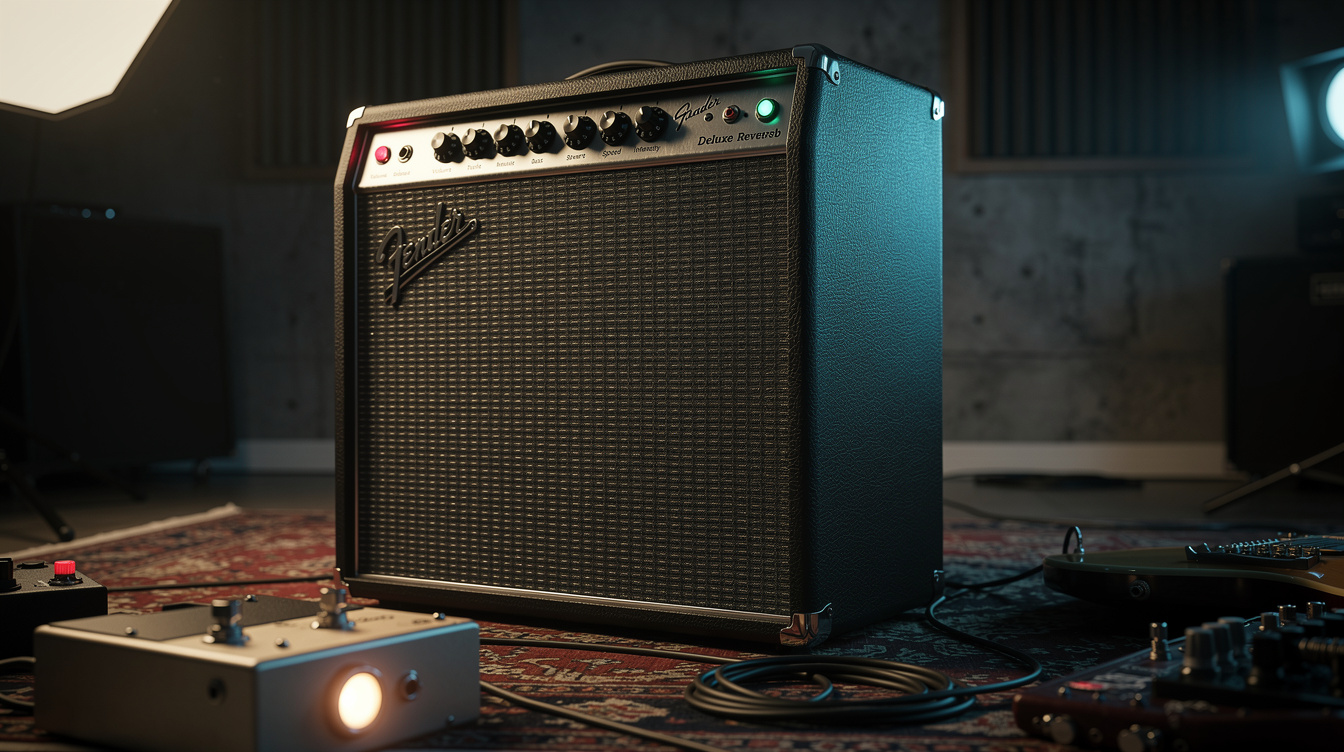
The Deluxe Reverb is a 22-watt, two-6V6 combo — small enough to carry with one hand, loud enough to fill a club when the knobs are up past 5, and capable of tones that have appeared on more recordings than most players realize. Here's a quick-start map before we get into the specifics.
Quick-Start Settings Table
| Style | Volume | Treble | Bass | Reverb |
|---|---|---|---|---|
| Crystal clean | About 3–4 | Around 6 | Around 5 | About 2–3 |
| Edge of breakup | About 5–6 | Around 5 | Around 4 | About 3 |
| Pushed crunch | About 6–7 | Around 5 | Around 3 | About 2 |
| Pedal platform | About 3–4 | Around 5 | Around 5 | About 2 |
Three knobs per channel, and that is the whole EQ section — there is no Middle control on this amp, which is a bigger part of its voice than most settings guides admit.
All positions described in relative terms — your guitar's pickups and output level will shift these. Think of these as the center of gravity, not the final word.
What's Actually Inside a Fender Deluxe Reverb?
Understanding the circuit helps explain why the settings behave the way they do — which is not always how you'd expect.
The Deluxe Reverb runs two 6V6GT power tubes in fixed-bias Class AB. The modest 22-watt 6V6 power section and its tube rectifier are what give the amp its characteristic sag and compression: when you push the Volume past the midpoint, the power section stops keeping up perfectly with the signal and starts to compress, cling, and bloom. It's a physical effect, not a software algorithm, and it's why the amp sounds fundamentally different at bedroom volume versus stage volume.
The preamp uses a combination of 12AX7 and 12AT7 tubes — the 12AT7s handling the phase inverter and the reverb driver, the 12AX7s doing the voltage gain. The tonestack is a passive Fender-style circuit with one important omission: Treble and Bass, and no Middle. The blackface AB763 tone circuit is the same design used in the Twin Reverb, with the Twin's 10k midrange pot replaced by a fixed 6.8k resistor. The midrange scoop that every passive Fender tonestack produces is therefore locked in place on a Deluxe Reverb. You cannot dial it out, and the amp's whole character depends on that fact. Treble and Bass still interact with each other and with the Volume knob — boosting Bass at high volume sounds different than boosting Bass at low volume — but the mid position is a soldered-in decision Leo Fender made for you.
The reissue — the '65 Deluxe Reverb Reissue, introduced in 1993 — uses the same basic circuit topology. The speaker differs: the original production runs carried Oxford, Jensen, and other American speakers depending on the year; the DRRI ships with a Jensen C12K. Different animals. The Jensen C12K in the reissue is brighter and more present in the upper midrange than a vintage Oxford 12K5-6. It rewards treble settings about half a notch lower than you might use on an original.
For a fuller picture of how this amp fits into the larger landscape of Fender and American designs, the complete guide to guitar amp types is worth a read.
What's the Difference Between the Normal and Vibrato Channels?
The Deluxe Reverb has two input channels: Normal and Vibrato. Most players choose one and forget the other exists. That's leaving something on the table.
The Vibrato channel is the primary channel. It's where the Reverb and Tremolo (labeled "Vibrato" on the panel — more on that naming confusion below) controls live. It also has a hard-wired 47pF bright cap on its volume pot that the Normal channel lacks, plus a smaller coupling cap that trims a little low end. The bright cap lets treble bleed through at lower volume settings, so single-coil guitars respond to the Vibrato channel with a bit more brightness and sparkle.
The Normal channel has no bright cap, and its larger coupling cap passes more lows. The result is darker and rounder — closer to a Twin's clean channel with the Treble at 4 than to the glassy top end people buy this amp for. Useful for jazz, for humbuckers that are already bright, or for players who want the amp to smooth out rather than sparkle.
There is a second difference that gets less attention and matters more than the caps for anyone running pedals. The Vibrato channel runs three preamp stages; the Normal channel runs two. That third stage is where the reverb return gets mixed back in, so it exists to recover what the spring tank costs rather than to add gain — but either way there is one more tube stage between your pedal and the power tubes on the Vibrato side, on top of a treble lift you cannot switch off because this amp has no Bright switch on either channel.
Which makes the Normal channel the better pedal platform on this specific amp, and it is the single cheapest experiment available to a Deluxe Reverb owner. If a fuzz sounds brittle or an overdrive turns nasal, move the cable before you change the pedal. The full per-channel breakdown across the blackface line covers which models have a Bright switch, which have the extra stage, and why the Deluxe Reverb is the outlier.
Both channels share the same EQ section and power amp. Players who run two guitars into separate channels and blend them (using both inputs simultaneously) discover a third sound that's somewhere between the two — a technique that works particularly well for dual-coil/single-coil guitar switching mid-set.
How Do the Fender Deluxe Reverb Controls Actually Work?
Volume
The most important knob on the amp, and the one most players misunderstand. Volume on the Deluxe Reverb is not a linear loudness control. Below about 3, it's a bedroom knob — the power tubes are barely working, the tone is thin, and the reverb sounds disconnected. From 3 to 5 is where the amp starts to wake up. From 5 to 7 is where the 6V6s begin to sag and compress. Above 7, you're past the sweet spot into ragged territory that either sounds glorious or unmanageable depending on your guitar and your ears.
I've had a 1964 Deluxe Reverb in my possession for the better part of thirty years. The number of players who've sat down and immediately tried to crank the Volume past 7 looking for "the tone" — and then been disappointed — is a story I've told more times than I can count. The sweet spot is not at the top. It's in the middle.
Treble and Bass (and the Mid Control That Isn't There)
The EQ section on the Deluxe Reverb is a passive tonestack that cuts rather than boosts, and it has two controls rather than three. With both at noon, the natural midrange scoop is already built in and there is nothing on the panel that will take it back out. Here's how to think about what you do have:
Treble controls the sparkle and pick attack definition. Higher treble settings get bright, glassy, and eventually harsh. Lower treble settings lose the attack first and the air second. The interaction with the Jensen C12K in the reissue is important: that speaker has a natural presence peak in the upper midrange, and a Treble setting of 7 on the reissue can get edgy in a way it wouldn't on an original Oxford-loaded amp. Start Treble around 5 and adjust from there.
The missing Middle is the control players reach for and don't find. The 6.8k fixed resistor sits where a Twin Reverb's mid pot would be — and it is worth being precise about where that leaves the amp, because the intuitive answer is wrong. A 6.8k resistor is 68 percent of that 10k pot's resistance, which is the upper part of its range, not the lower. A Deluxe Reverb is not a Twin with the Middle rolled off; it is a Twin with the Middle soldered somewhere around 7 or above, the exact dial equivalent depending on a pot taper that sources disagree about. The scoop you hear is the passive tonestack's own notch, which every one of these circuits has whether or not a knob is fitted, and the real limitation is that you cannot move it rather than that it is set low. Which Fender amps have the knob and which don't covers the full inventory and what the resistor value actually buys you. If a mix is swallowing you, the fix has to come from somewhere other than the panel: a mid-focused overdrive in front, an EQ pedal set to push 700 Hz to 1 kHz, a bridge pickup with a fatter mid character, or just the Bass control down a position, which raises the mids by removing what was covering them. That last one is free and it works more often than it should.
Bass is the control that requires the most active management as Volume changes. At low volume, Bass at 6 sounds full without losing the note's front edge. At high volume, Bass at 6 sounds boomy and undefined, because the power tubes are amplifying the low frequencies more aggressively. As a rule: every time you turn Volume up two positions, consider turning Bass down one.
Reverb
The reverb on the Deluxe Reverb is a two-spring Accutronics tank, driven by a 12AT7 tube. It's a big part of why this amp sounds the way it does — the spring reverb isn't decorative, it's structural. It adds a dimensional bloom to notes, a slight elongation of the decay, that the dry channel alone doesn't produce.
There's a deeper dive on how spring reverb differs from plate, room, and hall in the reverb types guide, which is worth reading if you're trying to match or replicate this quality in a modeler or effects pedal.
The practical point: this spring tank is more sensitive than you think. A setting of about 2–3 is already audible. A setting of 6 is swimming. A setting of 10 is the sound of a surf song recorded inside a submarine. Use it with restraint unless restraint is not what you're after.
Speed and Intensity (The Tremolo Circuit)
The controls labeled "Vibrato" on the Deluxe Reverb panel — Speed and Intensity — are actually tremolo, not vibrato. This has confused players for sixty years. The distinction: vibrato modulates pitch; tremolo modulates volume. The Deluxe Reverb tremolo uses an optical circuit — a neon bulb and photoresistor that rhythmically duck the signal level. (The earlier brownface Deluxe and the Princeton Reverb modulate the output-tube bias instead — a smoother, rounder pulse.) It does not change pitch.
Speed controls the rate of the pulse — from a slow, hypnotic throb at the low end to a choppy, stutter-like flutter at the high end. Intensity controls how deep the volume dip goes with each cycle. At Intensity around 2–3, the tremolo is a subtle pulse. At 7–8, the volume drops nearly to silence on each beat.
For most uses: Speed around 4–5 (a tempo roughly around 4/4 at medium pace) and Intensity around 3–4 produces a classic American rhythm-and-blues tremolo that works across country, soul, and rock.
What Are the Best Deluxe Reverb Settings by Playing Style?
Crystal Clean: Single-Coil Heaven
The Deluxe Reverb at clean settings is one of the great sounds in American guitar — open, chimey, harmonically complex, with the spring reverb adding space without cluttering the fundamental. The John Mayer Gravity recipe lives in exactly this territory — a clean Strat through a Fender amp with dynamics doing all the work.
| Control | Position | Notes |
|---|---|---|
| Volume | About 3–4 | Below the compression threshold; stays glassy |
| Treble | Around 6 | Bright but not cutting |
| Bass | Around 5 | Full without being boomy at this volume |
| Reverb | About 2–3 | Enough to add dimension without washing out notes |
Best with: a Stratocaster on the middle pickup or middle/neck blend. A Telecaster bridge pickup here is the sound of a thousand country records. For what a smaller Fender amp sounds like pushed into raw, garage-blues territory, the Dan Auerbach Lonely Boy recipe takes a Fender Champ in that direction.
Edge of Breakup: Where the 6V6s Start to Sag
This is the most sought-after territory on the Deluxe Reverb, and it's where the amp's personality is most fully expressed. The 6V6 power tubes are beginning to saturate under a hard pick attack; lighter playing stays clean, digging in gets a grain that arrives with the attack and clears by the time the note settles. The amp is responding to you dynamically, not running a preset gain stage.
| Control | Position | Notes |
|---|---|---|
| Volume | About 5–6 | Into the power tube compression zone |
| Treble | Around 5 | Back off from the clean setting; breakup adds its own brightness |
| Bass | Around 4 | Reduce slightly as the volume goes up |
| Reverb | About 3 | The reverb blooms nicely in this gain range |
This is the Stevie Ray Vaughan clean tone — or as close as a stock Deluxe Reverb gets to it. He had a lot of other things going on (Number One, .013s, his hands), but the essential dynamic of a Strat pushing a clean amp into gentle breakup is this territory. For the full SRV rig with a Tube Screamer pushing the amp harder, see the Pride and Joy tone recipe and the Little Wing tribute recipe.
Pushed Crunch: Bridge Pickup, Driven Hard
Above Volume 6 on the Vibrato channel, the Deluxe Reverb starts producing genuine crunch — compressed, harmonically saturated, the kind of tone that was the entirety of early rock and roll.
| Control | Position | Notes |
|---|---|---|
| Volume | About 6–7 | Full power tube engagement; amp will be loud |
| Treble | Around 5 | Keep it tame — the breakup adds its own edge |
| Bass | Around 3 | This is important: tight low end prevents mud |
| Reverb | About 2 | Less reverb at higher gain — it gets diffuse quickly |
This setting assumes a single-coil pickup. With a humbucker — PAF-style or higher output — reduce Volume by about a turn and a half and tighten the Bass further. The Deluxe Reverb was not designed around humbuckers, but it can handle them if you adjust accordingly.
Pedal Platform: Set Clean, Let the Pedals Work
The Deluxe Reverb is one of the best pedal platforms in the world. Clean, touch-responsive, with a linear response to whatever you put in front of it — it does not fight your drive pedals, it completes them.
| Control | Position | Notes |
|---|---|---|
| Volume | About 3–4 | Stay clean — let the pedal handle the gain |
| Treble | Around 5 | Neutral starting point |
| Bass | Around 5 | Full at this volume |
| Reverb | About 2 | Leave room for whatever reverb the pedal adds |
A Tube Screamer into this setting at low Drive and high Level — the classic boost technique — is described in detail in the Tube Screamer settings guide. For players who want to push a Klon-style overdrive into the clean platform, the Klon Centaur settings guide covers that interaction specifically; the Centaur's Treble control is particularly useful when setting the high-end balance between the pedal and the Jensen C12K.
Does the '65 Reissue Sound Like an Original?
Close. Different in ways that matter for settings.
The circuit topology is faithful — same fixed-bias 6V6 power section, same tonestack, same two-spring reverb design. The transformers are different, which affects the way the power section saturates and how much headroom you have before the tubes start to sag. The original transformers in a 1960s Deluxe Reverb are, for most ears, slightly warmer and smoother in saturation. The reissue transformer is slightly stiffer and the saturation is marginally harder. Not dramatically different — but audible if you've played both.
The speaker is the bigger variable. The Jensen C12K in the reissue is a modern Jensen made in Italy. Originals shipped mostly with a Jensen C12Q (1963–65) or an Oxford 12K5-6 (1966–67); the modern Jensen C12K in the reissue is a different, brighter animal. The vintage Oxfords that appeared in many 1960s Deluxes had a softness and low-end warmth that the modern Jensen doesn't quite replicate. For settings purposes: the DRRI benefits from Treble about half a notch lower than a vintage original, and the Bass control has a bit less low-end extension, which actually makes it easier to manage.
The practical verdict: the '65 DRRI is a legitimate instrument, not a compromise. The settings guidance in this post applies to both. Adjust Treble conservatively on the reissue — the Jensen C12K will let you know if you've gone too far.
How Do Single Coils vs. Humbuckers Change the Settings Recipe?
Single coils and humbuckers interact with this amp very differently, and the reason is output level and frequency content. A vintage-output Stratocaster single coil runs roughly 100–130mV output; a PAF-style humbucker runs roughly 200–250mV. That extra output hits the preamp harder, moves the Volume sweet spot down by one to two positions, and makes the Bass control more critical.
For humbuckers:
- Reduce Volume by about 1.5–2 positions from whatever the single-coil starting point is
- Roll Bass back to around 3–4 to compensate for the added low-end content
- Consider using the Normal channel instead of the Vibrato channel — with no bright cap and a larger coupling cap, it takes the edge off an already-bright humbucker and produces a more balanced tone
For single coils (the amp's natural pairing):
- Use the Vibrato channel; the bright cap and slightly brighter voicing complement the pickup character
- Treble can stay at 5–6 without getting harsh
- The full Bass range (4–6) is available at moderate volumes
How Do These Settings Translate to Modelers?
The Deluxe Reverb is one of the most modeled amps in the world, and the digital versions are genuinely good.
Helix: US Deluxe Vib
Line 6 Helix includes a US Deluxe Vib model, based on the '65 Deluxe Reverb (there's a sibling US Deluxe Nrm for the Normal channel). The parameters map closely to the real amp, with one control the hardware never had.
| Helix Parameter | Clean Setting | Edge of Breakup |
|---|---|---|
| Drive (Volume) | 4.5 | 6.5 |
| Bass | 5 | 4 |
| Mid | 5 (see below) | 5 (see below) |
| Treble | 5.5 | 5 |
| Master | 7 | 7 |
| Sag | 5 | 6 (increase for more sag feel) |
About that Mid knob. The real amp has no midrange control, so the one on the model is a modeling convenience rather than a reproduction of anything. Line 6 set it up as post-model midrange contouring with a neutral position at noon, which is where Helix Help's notes on the model tell you to park it — noon on Mid and Presence at 0 gives you the stock Deluxe voicing. Move it if you want the flexibility, but know that you have left the amp behind when you do. This is worth flagging because a lot of "the model doesn't sound like the amp" complaints trace back to a Mid setting that the hardware has no equivalent for.
Note that reverb is a separate block on Helix — add a Spring reverb block after the amp to recreate the onboard tank.
Pair with a 1x12 US Deluxe cab model, or a third-party Jensen C12K IR for the most accurate speaker voicing.
Quad Cortex: Fender Deluxe Reverb Model
The Neural DSP Quad Cortex carries a Deluxe Reverb model with parameters that correspond directly to the real amp. Settings from the table above translate roughly 1:1. The QC's gain response at the Drive parameter feels slightly more linear than the real amp — increase Sag and reduce Bias Excursion slightly if you want more of the spongy 6V6 behavior.
What to Change When the Amp Won't Give You Mids
The missing Middle control is the single most common reason a Deluxe Reverb owner ends up unhappy in a band mix, so here is the short decision tree.
- If you disappear under a second guitar: a mid-hump overdrive in front is the direct answer — that is exactly the shape a Tube Screamer imposes, and it is why the pairing became standard. Our Tube Screamer settings guide covers setting it as a mid boost rather than a gain stage.
- If the amp sounds boomy rather than scooped: turn the Bass down one position before you add anything. Removing low end raises the perceived midrange at zero cost, and on this amp it usually gets you most of the way there.
- If the guitar itself is the problem: the load on your pickup shapes where its peak sits before the amp ever sees it. The neck position through a dark cap lands in the mid register on purpose, which is what the bottom of the tone sweep is for.
- If you're on a modeler: you already have the Mid knob the amp doesn't, which is the one place where the model is more useful than the hardware. Just be honest with yourself that it is no longer a Deluxe Reverb once you use it.
The Deluxe Reverb is also a go-to worship clean — a rounder, American-voiced alternative to the AC30's chime for Sunday mornings. If that's your context, the worship guitar tone guide for the Helix shows how to build the full clean-to-lead snapshot set around this kind of amp.