Five Hundred Dollars, a Full Rig, and No Excuses
Five hundred dollars. Guitar, amp or modeler, cables, the works. A complete gigging rig that holds its own on a real stage in front of real people. The used market in 2026 is absurdly good for this. Gear depreciation is your best friend.
This isn't a fantasy shopping list. Every price here is based on what these things actually sell for on Reverb and Facebook Marketplace as of March 2026. Some weeks you'll find them cheaper. Some weeks you won't. But the math works if you're patient and willing to refresh your search alerts for a couple of weeks.
Two rigs. Two different philosophies. Same budget ceiling. One uses a traditional amp, the other goes full digital and skips the amp entirely. Both have been gigged. Both work.
The Guitar: Where Your Money Matters Most
Spend the biggest chunk here. A bad-feeling guitar will make you not want to play, which makes everything else pointless.
Squier Classic Vibe Telecaster or Stratocaster (~$200-250 Used)
The Classic Vibe line is the reason the "$1,000 minimum for a real guitar" myth is dead. The fit and finish on these is genuinely good -- rolled fretboard edges, alnico pickups, and necks that don't feel like they're punishing you. The Telecaster is the more versatile gigging choice (bridge pickup cuts through anything, neck pickup cleans up beautifully), but the Stratocaster gets you that middle position quack and a tremolo bar if you want it.
At $200-250 used, you're getting a guitar that was $450 new. They hold up. The tuning stability is solid, the intonation sets correctly, and the electronics don't crackle after six months. I've seen Classic Vibes on stages next to guitars costing five times as much, and the audience didn't know and didn't care.
Other options in this range: Epiphone Les Paul Standard '50s (~$250 used) if you need humbuckers. The G&L Tribute series shows up around $225-275 used and is criminally underrated. A used Squier Contemporary gets you hotter pickups for heavier stuff.
What to check when buying used: Fret wear (look at frets 1-5 and 12 especially), truss rod function (ask the seller to show adjustment), electronics (toggle every switch, roll every knob through its full range), and tuning stability (tune it, play aggressively for five minutes, check again).
Rig Option A: The Boss Katana 50 Route (~$250 Remaining)
This is the traditional approach: guitar into an amp, maybe one pedal, done. The Katana 50 is the default budget gigging amp for a reason -- it's loud enough for any club stage, it has usable built-in effects, and it weighs 25 pounds. That last part matters more than you think when you're loading in at 11 PM through a narrow hallway with a flight of stairs.
The Amp: Boss Katana 50 MkII (~$150 Used)
The Katana 50 MkII goes for about $140-160 used all day long. They're everywhere because Boss sold a million of them. That ubiquity is a feature, not a bug -- replacement parts are easy, the Tone Studio software is free, and there are thousands of community presets to start from.
For gigging, the Katana's 50 watts through a 12-inch speaker is plenty for any venue where you're not also running through the PA (and if you ARE running through the PA, you're using the Katana's line out and the stage volume barely matters). The built-in effects cover delay, reverb, modulation, and basic drive -- not the best versions of any of those, but functional enough that you can leave extra pedals at home.
Set up the Katana through Boss Tone Studio before the gig. Pick one clean tone and one dirty tone, save them to the panel memory. That's your rig. Soundcheck takes three minutes: plug in, check your clean, check your dirty, set your stage volume, done.
The Pedal: EHX Big Muff (Nano or Op-Amp Reissue, ~$50-60 Used)
You have about $50-60 left after the guitar and amp. One pedal. Make it count. The Big Muff gets you a wall of fuzz that the Katana's built-in drive models can't replicate -- that thick, sustaining, everything-is-distorted-including-the-air sound. The nano version fits in your pocket. The Op-Amp reissue (the Smashing Pumpkins one) is slightly more aggressive and cuts through a band mix better.
The Katana's own Crunch and Lead channels handle your standard overdrive and distortion needs. The Big Muff fills the one gap they can't: that massive fuzz tone for solos, hooks, or just making a statement. Sustain at about 2 o'clock, tone around 1 o'clock (higher if your pickups are dark), volume matched to your amp's clean level.
Rig A Signal Chain
Guitar (Squier Classic Vibe) --> Big Muff (on the floor, stomp it when you need fuzz) --> Boss Katana 50 (clean channel for cleans, crunch channel for drive, Big Muff for fuzz)
Cables and Accessories (~$25-40)
Two instrument cables (one guitar-to-pedal, one pedal-to-amp): $15-20 for used or budget cables. A clip-on tuner: $10-15 (Snark or the D'Addario). Extra picks and a spare set of strings: $10. A strap if your guitar didn't come with one: $5-10 used.
Total Rig A: ~$440-520
Rig Option B: The HX Stomp Route (~$250-300 Remaining)
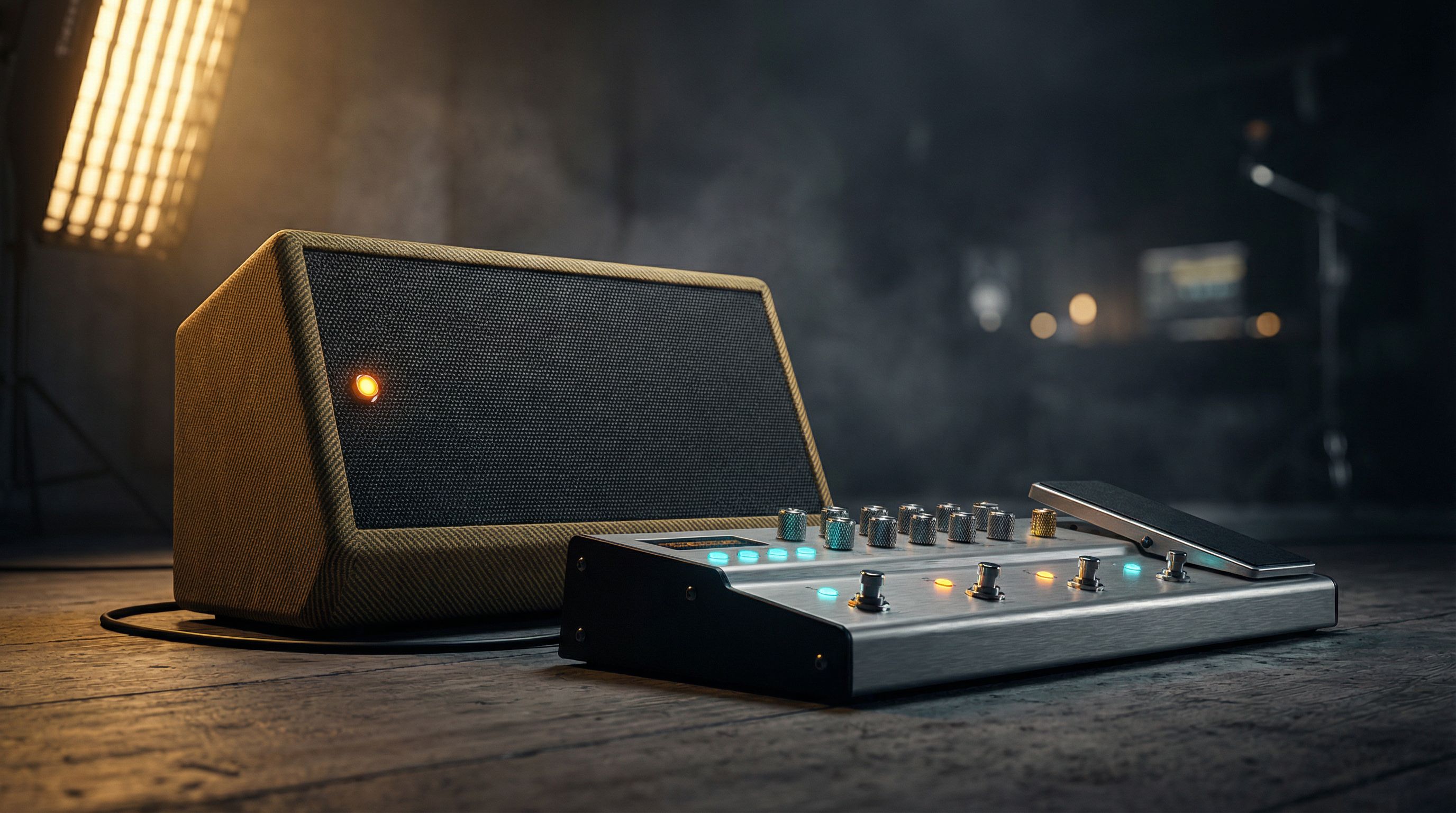
This rig skips the amp entirely. Guitar into an HX Stomp, HX Stomp direct into the PA or a powered monitor. It's lighter, faster to set up, and gives you access to amp modeling and effects that blow the Katana's built-in stuff away. The trade-off: the HX Stomp costs more, which means the budget gets tighter everywhere else.
The Modeler: Line 6 HX Stomp (~$300 Used)
The HX Stomp has been out since 2018 and the used market has caught up. They go for $280-320 on Reverb, sometimes lower on local marketplaces if someone's upgrading to a full Helix or Quad Cortex. At $300, this eats most of your remaining budget -- but it replaces your amp, your drive pedals, your delay, your reverb, and your modulation. It IS the rig.
I expected the HX Stomp to feel like a compromise -- a stripped-down version of the real thing that would leave me wanting more blocks, more switches, more everything. What I found was that three footswitches and six blocks is enough for 95% of what happens on a stage. Clean tone with reverb? One preset. Dirty rhythm with delay? Another preset. Lead boost? Stomp one switch. The limitation forced me to make decisions instead of endlessly tweaking, and my tones got better because of it.
For gigging, the HX Stomp runs direct into the PA through XLR, which means your sound goes through the house system -- consistent every night, no mic placement variables, no stage volume fights with the drummer. Load-in is a guitar, a small bag with the Stomp and cables, and that's it. You can be set up and soundchecked before the other bands have finished unloading their cars.
The Stomp's amp models are the same ones in the $1,700 Helix Floor. Same DSP, same quality. You're not getting a budget version of the modeling -- you're getting the full thing with fewer simultaneous blocks. For a detailed look at how to get the most out of a modeler's amp models, the approach translates directly.
Rig B Signal Chain
Guitar (Squier Classic Vibe) --> HX Stomp (amp model + cab IR + drive + delay + reverb, all internal) --> XLR out to PA (or a powered FRFR monitor if you need stage volume)
A typical preset: Compressor (subtle, just for evenness) --> Amp Model (your choice -- the Cali Texas Ch1 does great Fender cleans, the Brit 2204 nails Marshall crunch) --> Cab IR --> Delay --> Reverb. That's five of your six blocks. The sixth can be a drive for a lead boost, or a second amp model on a different snapshot.
The Budget Problem (and Solution)
Here's the math issue: $250 guitar + $300 HX Stomp = $550. That's over budget before cables. Two ways to fix this:
Option 1: Cheaper guitar. A Squier Affinity Telecaster goes for $120-150 used. It's not as nice as the Classic Vibe -- the neck is thinner, the pickups are ceramic instead of alnico, and the fret edges need some work out of the box. But it plays, it stays in tune, and it gets the job done. That brings your total to $420-450 plus cables.
Option 2: Patient shopping. HX Stomps occasionally drop to $250 when someone is desperate to sell. Set up alerts on Reverb and Facebook Marketplace and wait. I've seen them go for $230 in local cash deals. At $250, you're at $500 with the Classic Vibe and have room for cables.
Cables and Accessories (~$15-25)
One instrument cable (guitar to HX Stomp): $8-10. One XLR cable (HX Stomp to PA): $5-8. Clip-on tuner: the HX Stomp has a built-in tuner, so you can skip this. Picks, strings, strap: $10.
Total Rig B: ~$465-575 (depending on guitar choice and HX Stomp deal)
What to Spend On vs. What's a Waste
Budget rigs require knowing where every dollar matters. Here's the hierarchy:
Worth Every Penny
- The guitar itself. This is not the place to cut corners hardest. A guitar that feels bad makes you play worse. The Classic Vibe exists at the exact price point where "budget" stops meaning "compromise."
- A setup. Spend $40-60 at a local shop to get the action, intonation, and truss rod dialed. A properly set up $200 guitar plays better than a poorly set up $800 one. This is the single highest-value upgrade in all of guitar.
- One good instrument cable. Not a $50 cable. A $12-15 cable that won't crackle when you step on it. Hosa Pro, Planet Waves Classic -- anything with molded connectors and decent shielding.
Not Worth It at This Budget
- A pedalboard. You have one pedal (Rig A) or zero external pedals (Rig B). You don't need a board. Velcro the Big Muff to a piece of cardboard if you're worried about it sliding. Pedalboards are for when you have a pedalboard's worth of pedals.
- Expensive cables. The difference between a $12 cable and a $50 cable is inaudible in a live setting. Save that $38.
- A dedicated tuner pedal. Clip-on tuners work. The HX Stomp has one built in. A $100 Polytune is great, but not when you're at $500 total.
- Backup gear. Controversial, but hear me out -- at this budget, you can't afford redundancy. If your cable dies, borrow one. If a string breaks, change it between songs (carry a spare set, obviously). The $50 you'd spend on a backup cable and tuner pedal is better spent on a guitar that won't need a backup.
Gigging Reality Check
Theory is great. Here's what actually matters when you walk into a venue with a $500 rig.
Load-In
Rig A is two trips: guitar in one hand, Katana in the other, pedal and cables in your gig bag pocket. The Katana is 25 pounds -- manageable but noticeable if the venue has three flights of stairs (ask me how I know).
Rig B is one trip. Guitar on your back, HX Stomp and cables in a messenger bag. You look like you're going to a coffee shop, not a gig. This is not a minor advantage when you're playing four shows a week.
Soundcheck
Rig A: Plug into the amp, set your volume relative to the room, check clean and dirty channels, done. If you're going through the PA, someone mics the Katana or you use the line out. Three to five minutes.
Rig B: Plug into the snake or run your own XLR to the board. Tell the sound engineer you're running direct. They'll love you because they have complete control over your level in the house mix. Two minutes, including the tuner screen boot-up.
Reliability
Both rigs are tank-solid. The Katana is a Boss product -- those things survive being dropped down stairs. The HX Stomp is built like a small brick. Neither has tubes to replace, neither has moving parts that wear out fast. The Classic Vibe guitars are workhorses.
The weak link in any budget rig is cables. Carry one spare instrument cable. That's it. That's the insurance policy. The cable is the failure that ends the most sets, but it isn't the only cheap part that quits at the worst possible moment — a gig-bag reliability kit maps one item to every common way a set dies (dead 9V, broken string, dead tuner battery, loose strap button), and the whole thing costs less than a single boutique patch cable. Backup gear is for the next budget tier. Backup consumables are non-negotiable at any budget.
How It Sounds Out Front
Nobody in the audience knows what your rig costs. They know if the guitar sounds thin and buried in the mix (bad EQ and insufficient volume) or full and present (good EQ and appropriate volume). Both rigs deliver the latter if you set them up correctly. The signal chain fundamentals are the same whether your rig costs $500 or $5,000.
Which Rig Should You Build?
Build Rig A (Katana) if you want simplicity, you like having a real amp on stage pushing air behind you, or you want the option to add pedals one at a time as your budget allows. The Katana is also the better choice if you play in rooms without a PA -- its 50 watts through a 12-inch speaker can fill a small room on its own.
Build Rig B (HX Stomp) if you value portability, you play venues with a PA system, or you want the deepest possible tone-shaping for the money. The HX Stomp also grows with you -- if you eventually add an expression pedal and a couple of external switches, it becomes a complete pedalboard replacement that fits in a lunchbox.
Either way, you're walking into a gig with a rig that works, sounds good, and didn't require selling a kidney. That $500 guitar-plus-amp-plus-pedal combination will handle everything from a basement show to a 300-capacity club. The ceiling isn't gear -- it's practice time and stage experience.
Go play some shows.