There's a moment, usually around 9:30 PM, when the house finally goes quiet and I have a choice. I can either start the bedtime cleanup that will absorb the next 90 minutes, or I can pick up the guitar and play for twenty real minutes before I lose the day entirely. The math only works if "pick up the guitar" doesn't include "find the amp, plug in three cables, run a quick line check, and try not to wake the four-year-old."
That math is the whole reason headphone amps exist. The good ones make the difference between practicing for 20 minutes and not playing at all.
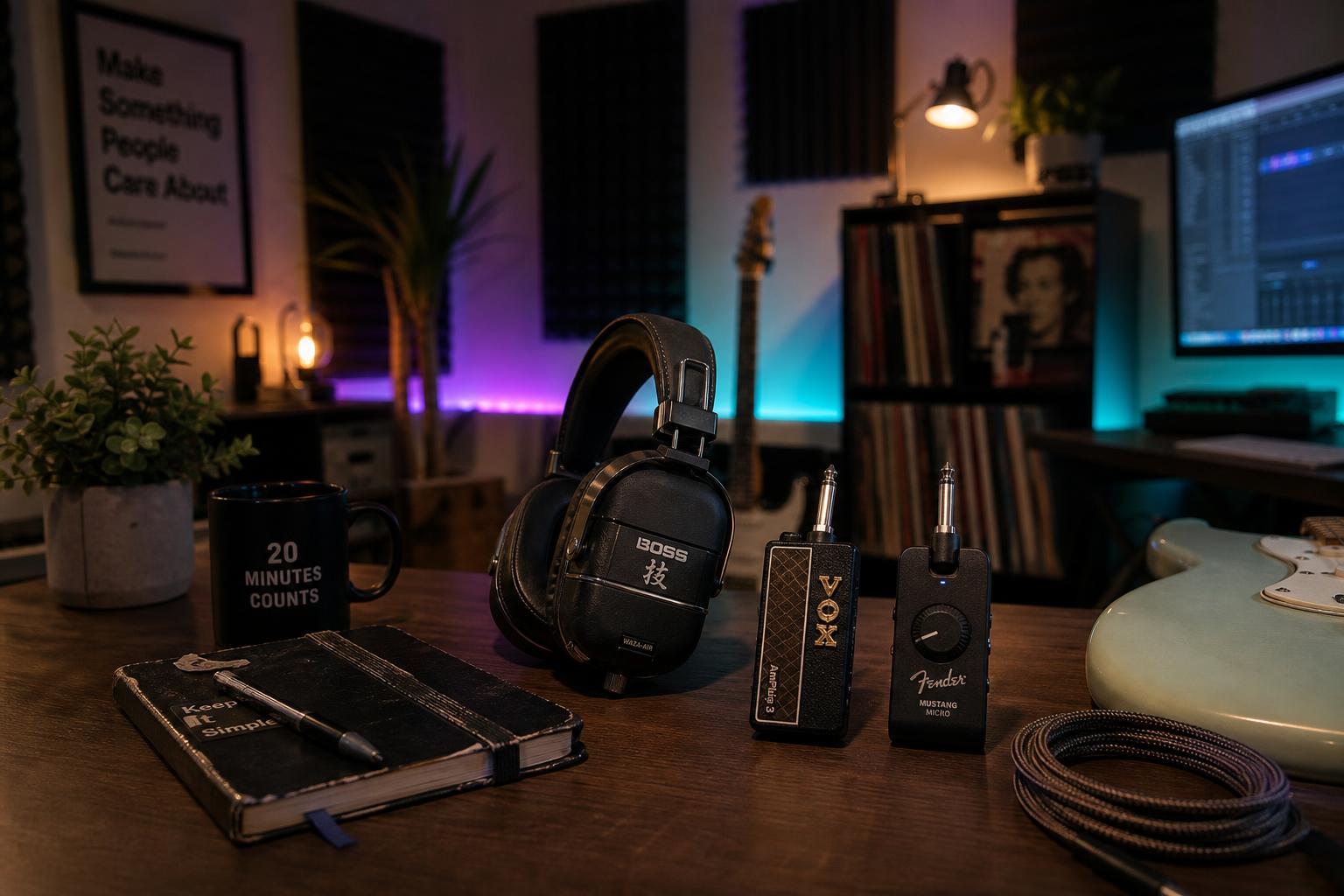
I've spent the last three months alternating between three of them — the Boss Waza-Air, the Vox Amplug 3, and the Fender Mustang Micro. They cover the price spectrum from $50 to $399, and they solve the same problem in different ways. Here's which one fits which situation.
The price-and-feature table
| Vox Amplug 3 | Fender Mustang Micro | Boss Waza-Air | |
|---|---|---|---|
| Price (May 2026) | $50 | $130 | $399 |
| Includes headphones | No | No | Yes |
| Wireless | No | No | Yes |
| Battery life | 17 hours | 4–6 hours via USB-C charging | 5 hours |
| Amp models | 9 | 12 | 5 amp + 50 effect combos |
| Effects | Reverb, delay, chorus, tremolo | Reverb, delay, chorus, modulation, compression | Yes — full Boss effect library |
| Bluetooth audio | No | Yes — for playing along to phone | Yes |
| App control | No | Yes — Fender Tone app | Yes — BTS app |
| Spatial audio | No | No | Yes — head-tracked |
The headline numbers are price and "does it come with headphones." The Amplug 3 and Mustang Micro both need you to bring your own headphones, which is fine because you probably already own a pair. The Waza-Air bundles tuned-for-guitar wireless headphones with the amp circuit baked into them, which is part of why it costs almost three times as much as the Mustang Micro alone.
The Vox Amplug 3: cheap and shockingly usable
The Amplug 3 is what the Amplug 1 and 2 should have always been. Vox finally added a real bluetooth-input version, modernized the amp models, and kept the form factor — a plug-shaped device that hangs off the guitar's output jack with a 1/8-inch headphone output on the back.
The amp models — Clean, Blues, Crunch, Distortion, Lead, Bass, Acoustic, Drive, and Liverpool — cover the obvious bases. The Liverpool model is the AC30 voicing that Vox put their name on the whole product for; it's the best-sounding model on the device by a meaningful margin. The Clean model is what I use most often for late-night chord-melody practice. The Distortion model is fine for the kind of '90s alternative-rock crunch I grew up on but doesn't have the bite of a real high-gain pedal.
What I didn't expect: the built-in reverb is actually good. Not great — there's only one reverb voicing and one knob to control it — but it's the difference between a guitar tone that sounds like a guitar tone and one that sounds like an amp simulation. Most products at this price point either skip reverb or include one that's worse than no reverb. Vox got it right.
What the Amplug 3 doesn't do: it doesn't have presets, it doesn't have an app, and it doesn't have any way to save your settings. If you find a sound you like, write the knob positions on a Post-it. The five-knob layout is genuinely simple, but it means your starting point is whatever you left it on last time, which after a few sessions becomes its own annoyance.
At $50, the Amplug 3 is the cheapest legitimate way to get a usable tone in your headphones. It's the headphone amp I'd give a 14-year-old who just started playing. It's the one I throw in my carry-on bag for trips. It's not the best tone on this list, but it's the best tone-per-dollar.
The Fender Mustang Micro: the one that almost made me sell my real amp
The Mustang Micro is a 2-inch-by-1-inch black brick that plugs into the guitar's output jack the same way the Amplug 3 does, but with a small OLED screen and four buttons on the front. It runs the same modeling engine as the larger Mustang amps, which means the amp models are good and the effects are useful.
The twelve amp models cover everything from a tweed Fender Champ to a Marshall Plexi to a high-gain Mesa Recto. The effects — reverb, delay, modulation, compression — are saveable in 9 presets that you can edit through the Fender Tone app on your phone. Bluetooth audio input means you can play along with a song on Spotify, which is the feature that turned my 20-minute practice sessions into 45-minute practice sessions more than once.
The amp model I keep coming back to is the '65 Princeton — clean, with the built-in spring reverb at about 30 percent. It sounds like an amp. Not a great amp, not a $3,000 amp, but a real $1,200 amp at moderate volume in a small room. That's better than the Amplug 3's Clean model in a way that's audible even through bad headphones.
I expected the Mustang Micro to be a slightly-better Amplug 3. What I found, after about a month of regular use, was that the Mustang Micro is the headphone amp that makes me play more, not less. The presets are the reason. I have a clean preset, a mid-gain breakup preset, and a high-gain preset, and the ability to toggle between them with one button means I practice songs across genres instead of getting stuck on one tone for the whole 20 minutes.
What it doesn't do well: the high-gain models still sound slightly digital. Not bad — better than any amp sim on a phone — but not as good as my HX Stomp at the same gain levels. If you play exclusively metal or hard rock, the Mustang Micro is acceptable; if you play across genres and want one device that handles all of them, it's the best $130 I've spent on guitar in years.
The Boss Waza-Air: when you want the practice to feel like a session
The Waza-Air is the strangest product in this category. It's not just a headphone amp — it's a pair of wireless over-ear headphones with an amp circuit baked into the right cup and a small wireless transmitter that plugs into your guitar. The transmitter sends audio to the headphones. The headphones run the amp model and the effects. Latency is unmeasurable in normal playing.
The trick that justifies the price is the head-tracking spatial audio. The Waza-Air uses an internal motion sensor to position the simulated amp in front of you in 3D space, and the audio shifts as you move your head. Turn your head left, the amp moves slightly to the right. Walk across the room, the amp stays where it was.
This sounds gimmicky on paper. In practice it solves the single biggest problem with headphone practice: the sound being trapped inside your skull. The Waza-Air puts the amp in the room. Not in the actual room — the actual room is a kitchen with a dishwasher running — but in a virtual room that your brain mostly accepts. After ten minutes of playing through Waza-Air, my brain stops noticing that I'm wearing headphones. After ten minutes of playing through the Mustang Micro, my brain still knows.
The amp models — five of them, all Boss tube-amp emulations — are good. The Tweed model is excellent. The British Stack model is acceptable but not as authentic as a real Marshall sim. The effects are the full Boss library through the BTS app, so you can build any pedalboard chain you'd build on a real Katana amp.
Battery life is the weakness: 5 hours of continuous use, which is enough for a week of 20-minute sessions but not enough for a full session-musician day. The headphones charge via USB-C. The dongle that goes into the guitar charges via the headphones, which is a clever bit of engineering but makes the charge management slightly fiddly.
At $399, the Waza-Air is expensive for a headphone amp. What it's selling is the experience of practice feeling more like playing in a room than like playing in your head. For a parent player whose practice sessions are stolen from the edges of the day, that experience can be the difference between picking up the guitar and watching another episode of something.
What I actually use and when
The Amplug 3 lives in my travel bag. It's the one I take to my mom's house for Christmas. It's also the one my husband uses to play once a month — he doesn't need presets because his repertoire is "the same three Pearl Jam songs."
The Mustang Micro lives in the kitchen drawer next to the coffee filters. It's the one I grab when I have 20 minutes after the kids fall asleep. The presets and the Bluetooth audio make those 20 minutes feel like real practice instead of fumbling around.
The Waza-Air lives on the shelf above my desk. It's the one I use on a Saturday morning when both kids are at activities and I have 90 unsupervised minutes. The spatial audio and the wireless freedom make the longer session feel like the kind of practice I used to do in college with a real amp at real volume.
If I could only keep one, it would be the Mustang Micro. It's not the best of the three at any individual thing, but it's the one that fits the most situations. The Amplug 3 is cheap enough that I'd keep it anyway. The Waza-Air is the indulgence I bought for myself for my birthday and don't regret.
Which one to buy
Buy the Amplug 3 if: Your budget is under $100, you're starting out, or you need a backup headphone amp for travel and visiting relatives. It's the cheapest entry into legitimate headphone tone.
Buy the Mustang Micro if: You want the best balance of tone, presets, and Bluetooth audio under $200. This is the headphone amp I'd recommend to a parent player who plays mostly at home and across multiple genres. It's the practical choice.
Buy the Waza-Air if: You play long enough sessions that the spatial audio's "amp in the room" effect matters, you don't already own a high-quality pair of headphones you'd rather use, and you have $399 to spend on something that's specifically a guitar practice tool. It's the experience choice.
What none of them are is a replacement for a real amp. They're not trying to be. They're trying to make the 20-minute practice session that happens at 9:45 PM possible, and at that job, all three of them succeed. The differences are in degree, not in kind.
If you're reading this on your phone with the baby monitor glowing on the nightstand, the answer to "which one should I buy" is "whichever one is in your budget tonight." The best headphone amp is the one that lets you play for 20 minutes instead of giving up and going to sleep.