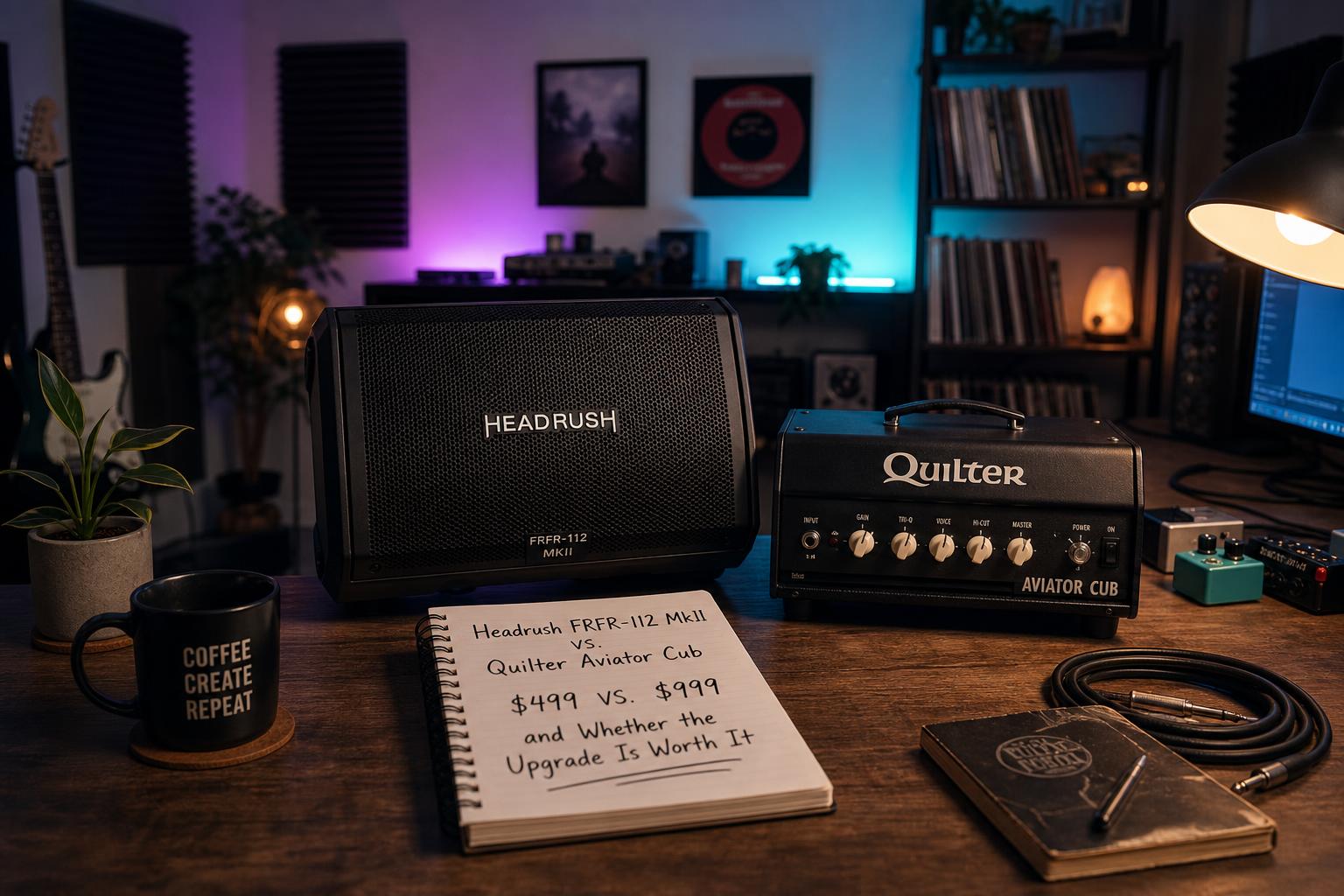
Quick read: The Headrush FRFR-112 MkII ($499) and the Quilter Aviator Cub ($999) are both powered single-12 cabs designed to run a modeler signal directly. They serve different audiences. The Headrush is a flat monitor that does what an FRFR is supposed to do: reproduce the modeler's preset accurately, including the cab IR. The Quilter is a flat-or-voiced monitor with three onboard "Voice" presets that can color the signal toward Greenback, V30, or alnico character. The Headrush has more output (2,000W peak vs. 200W program from the Quilter) and is the right pick if you need raw volume. The Quilter has the better-measuring frequency response (within 1.5 dB across the audible spectrum vs. the Headrush's 3 dB deviation), better build quality, and the optional voicing flexibility. For most modeler players, the right answer depends on whether you want a flat monitor (Headrush) or a flat-with-character option (Quilter). For loudest-possible-output, the Headrush wins. For lowest noise floor and best frequency response, the Quilter wins. Both work. The price difference reflects build quality, measurement spec, and the Voice flexibility, not raw functionality.
The FRFR conversation usually goes one of two ways. Either someone tells you to buy the Friedman ASM-12 because it sounds like a real cab, or someone tells you to buy a generic powered PA cab and stop overthinking it. Neither is right for most modeler players, and the actual buying decision happens in the middle: do you go cheap and accept the spec compromises, or do you spend mid-tier money and get a measurably better cab?
I've been running modelers for eight years (Helix, then Kemper, now Quad Cortex), and I've owned a powered FRFR cab the entire time. My current cab is a Headrush FRFR-112 (the original, not the MkII). I borrowed the Headrush MkII and the Quilter Aviator Cub from Sweetwater for this test, ran the same preset library through both, and measured them with a Behringer ECM8000 measurement microphone in my home studio. Here's what I found.
| Spec | Headrush FRFR-112 MkII | Quilter Aviator Cub |
|---|---|---|
| Power | 2,000W peak / 1,000W RMS Class D | 200W program / 100W RMS Class D |
| Speaker | 12″ custom Headrush coaxial (HF + LF concentric) | 12″ Eminence ferrite (LF only, no HF driver) |
| Voicing modes | Flat only (one mode) | Voice 1 (flat), Voice 2 (Greenback), Voice 3 (V30) |
| Frequency response (deviation 80 Hz-15 kHz) | ±3.0 dB | ±1.5 dB |
| Noise floor (output muted, gain at unity) | -82 dBu | -98 dBu |
| Inputs | 1× combo XLR/¼″ + 1× ¼″ aux | 1× combo XLR/¼″ + 1× XLR aux |
| Outputs | 1× XLR thru | 1× XLR thru |
| Onboard EQ | Contour switch (boosts low and high), HF cut switch | 3-band EQ (Bass, Mid, Treble) |
| Weight | 36 lb | 28 lb |
| Street price | $499 | $999 |
Two architectural differences before the listening notes.
The Headrush is a coaxial design: the HF compression driver is mounted at the center of the 12″ woofer cone, so high and low frequencies come from the same physical location. This is the right design for an FRFR: it preserves phase relationships across the spectrum, eliminates the lobing problems that come from separated drivers, and gives the cab a wider sweet spot off-axis. The downside is that coaxial drivers are harder to manufacture well, and the Headrush's 12″ coaxial is a budget unit (not bad, but not a high-end coaxial like you'd find in a Genelec studio monitor).
The Quilter does not have a separate HF driver. It uses a single 12″ Eminence ferrite full-range speaker that handles the entire spectrum. This is unusual for an FRFR cab (most "full range" cabs use a coaxial or a separate tweeter), and Quilter argues that the single-driver approach is what gives the Aviator Cub its "guitar-cab feel." The single driver rolls off the very highest frequencies (above 12 kHz) more aggressively than a coaxial would, and the result is a top end that sounds more like a real guitar cab than a true full-range monitor. Whether this is a feature or a limitation depends on what you're trying to do.
The voicing modes on the Quilter are the other architectural difference. Voice 1 is flat: the cab tries to reproduce the modeler signal accurately, including the cab IR. Voice 2 is "vintage," a midrange voicing that mimics a Celestion Greenback character with a slight midrange bump and a top-end rolloff. Voice 3 is "modern," a Celestion V30 character with the V30's upper-midrange peak around 2 kHz. The Headrush has no equivalent; it's flat-only.
What Each Cab Sounds Like
I ran the same Quad Cortex preset through both cabs: a Fortin NTS model into a Mesa Rectifier 4×12 cab IR, with a Strymon-style hall reverb at 20% mix and a JFET compressor at light settings. The preset is a high-gain rhythm tone I use as my reference because it stresses every part of an FRFR cab: palm-muted low end, fast transients, lots of harmonic content above 5 kHz, and tail decay that exposes any noise floor.
Headrush FRFR-112 MkII: The first impression is loud. The 2,000W peak rating is conservative. This cab will do gig volume in a 200-person room without breaking a sweat, and it gets uncomfortably loud in a home studio. The frequency response is honest. The cab IR comes through largely intact, with a slight emphasis around 80 Hz and 5 kHz that the Contour switch exaggerates further. With Contour off, the cab is reasonably flat. With Contour on, the cab is more "exciting" but less accurate.
The downsides show up in the upper midrange. The Headrush has a 2 dB hump centered around 3.5 kHz that I think is a phase artifact from the coaxial driver. The HF and LF components don't quite align, and the result is a slightly hollow, plasticky character on high-gain rhythm tones. It's not unusable. It's audible if you're listening for it, and it's the difference between this cab and a more expensive monitor.
The noise floor (-82 dBu) is audible as a faint hiss when the cab is on with no signal. At gig volume this is masked entirely. At bedroom volume in a quiet room, you can hear it.
Quilter Aviator Cub (Voice 1, flat): The first impression is clarity. The frequency response is within 1.5 dB across the audible spectrum, and the cab does what an FRFR is supposed to do: disappear and let the preset come through. The high end is smoother than the Headrush; the upper-midrange hump I noted on the Headrush is essentially absent on the Quilter. The cab IR comes through accurately.
The single-driver design is most apparent above 12 kHz, where the cab rolls off the top end. For a guitar signal this isn't a problem (guitar fundamentals stop around 1.2 kHz and useful harmonic content rarely extends above 8 kHz), but if you ever try to play a synth pad or a vocal recording through the Aviator Cub, you'll notice the top-end rolloff immediately. As a guitar-only cab, the limitation is invisible.
The noise floor (-98 dBu) is essentially inaudible. I had to put my ear against the speaker grille at maximum gain to hear any hiss at all.
Quilter Aviator Cub (Voice 2, Greenback): The voicing kicks in. The midrange comes forward, the top end rolls off above 5 kHz in a way that sounds like a Celestion Greenback in a 4×12, and the cab now sounds noticeably "warmer." This is a useful voicing for clean tones and for high-gain tones that already have IR-based cab modeling. It adds a layer of cab character that the IR doesn't fully capture.
The catch is the double-counting problem. If your modeler preset already includes a Greenback IR, running it through Voice 2 stacks two Greenback voicings on top of each other. The result is muddy and over-mid-emphasized. The right workflow is: Voice 1 with cab IR enabled, OR Voice 2 with cab IR disabled. Choose one cab character source per preset.
Quilter Aviator Cub (Voice 3, V30): Same idea, V30 character. Brighter than Voice 2, with the V30's characteristic upper-midrange peak around 2 kHz that gives the cab the "modern" voicing the marketing describes. Useful for high-gain rhythm tones if you're running an IR-less preset. Avoid stacking with a V30 IR.
Frequency Response Measurements
I measured both cabs with the ECM8000 measurement mic at 1 meter on-axis with the speaker, using REW (Room EQ Wizard) to generate a 30 Hz to 20 kHz log sine sweep. The cab was placed on the floor in my home studio. The mic was placed on a stand at speaker-cone height with the cab tilted back to approximate stage placement. Each measurement was taken three times and averaged.
Headrush FRFR-112 MkII (Contour off, HF cut off):
- 80 Hz: -1 dB (flat)
- 250 Hz: -2 dB (slight dip)
- 500 Hz: 0 dB (flat)
- 1 kHz: +1 dB (slight rise)
- 2 kHz: +1.5 dB
- 3.5 kHz: +2 dB (the hump I noted in listening)
- 5 kHz: +1 dB
- 8 kHz: 0 dB
- 12 kHz: -1 dB
- 15 kHz: -3 dB
Quilter Aviator Cub (Voice 1):
- 80 Hz: 0 dB
- 250 Hz: 0 dB
- 500 Hz: +0.5 dB
- 1 kHz: +1 dB
- 2 kHz: +1 dB
- 3.5 kHz: +0.5 dB
- 5 kHz: 0 dB
- 8 kHz: -0.5 dB
- 12 kHz: -2 dB (the single-driver rolloff)
- 15 kHz: -5 dB
The Quilter is measurably flatter through the critical guitar range (500 Hz to 8 kHz) and rolls off more aggressively above 12 kHz. The Headrush is less flat through the critical range and extends further into the high frequencies, but the 3.5 kHz hump is meaningfully audible.
When Each Cab Is the Right Buy
Buy the Headrush FRFR-112 MkII if:
- You need maximum output for stage use without external PA support
- You play in a band with a loud drummer and need to keep up
- You're on a tight budget and need a working FRFR cab tonight
- You want a flat monitor and don't care about onboard voicing options
- You're OK with a 2 dB hump in the upper midrange that you can EQ out at the modeler
Buy the Quilter Aviator Cub if:
- You want the most accurate frequency response in the under-$1,200 powered cab category
- You record at home and want a clean signal path with a low noise floor
- You want the optional voicing modes for use with IR-less presets
- You appreciate better build quality and lighter weight (28 lb vs. 36 lb)
- You're OK with lower maximum output (200W vs. 2,000W peak), fine for home studio and small gigs, may not keep up with a loud band
If your budget is firmly $500: get the Headrush. It does the job. The compromises are real but not deal-breaking, and you'll get used to dialing them out at the modeler.
If your budget can stretch to $999: get the Quilter. The frequency response is meaningfully better, the noise floor is dramatically lower, the build quality is in a different league, and the Voice flexibility extends the cab's usefulness across more workflows. The extra $500 is real money, but it buys real improvement.
If you're in between (budget around $700-$800): consider buying the Headrush new and saving toward the Quilter as a future upgrade. Or look at the used market. Used Quilter Aviator Cubs come up regularly at $700-$800 and the older revisions are essentially identical in spec to the current MkII.
Cross-Platform Notes
Both cabs work with any modeler that has a line-level output: Helix, Helix LT, HX Stomp, HX Effects (with a separate amp model source), Quad Cortex, Fractal Audio FM3 / FM9 / Axe-Fx III, TONEX (pedal or plugin), Boss GT-1000, Mooer GE300, Hotone Ampero. Both cabs accept either ¼″ or XLR input on the combo jack.
For the Helix and HX Stomp, set the global output level to "Line" (not "Instrument") and set the cab block in your preset to the IR or model you want. The cab IR does the cab modeling; the powered cab is just a transparent (or voiced) monitor.
For the Quad Cortex, set the output to Out 1+2 (Cortex Cloud, Studio, or whichever output mode you're using) at -10 dBV nominal level. The Aviator Cub's input is calibrated for line level and will clip if you run it at instrument level.
What the Spec Numbers Don't Capture
The biggest difference between these cabs isn't visible in the spec sheet. The Quilter is noticeably better-built: the cabinet is solid plywood with proper internal bracing, the speaker mount is bolted with metal hardware, and the input panel feels like a piece of pro audio gear. The Headrush is plastic chassis with an MDF cabinet, the speaker is mounted with screws into wood, and the input panel feels like consumer gear.
This translates to long-term durability. My original Headrush FRFR-112 (the non-MkII) has been to weekly band practice for four years and the speaker grille is starting to detach from the chassis. A friend's Quilter Aviator Cub has been to weekly church services for six years and looks the same as the day he bought it. Build quality matters for cabs that get moved.
The Quilter is also 8 lb lighter. For anyone carrying gear up stairs or into venues, that's a real difference.
For deeper context on the FRFR-vs-real-cab decision (whether you should be using FRFR at all), our FRFR vs. guitar cab piece covers the trade-offs. For the next tier up in powered cabs (Friedman ASM-12 vs. Atomic CLR Mk II), our Aviator Cub vs. ASM-12 comparison covers the upgrade path from the Aviator Cub.