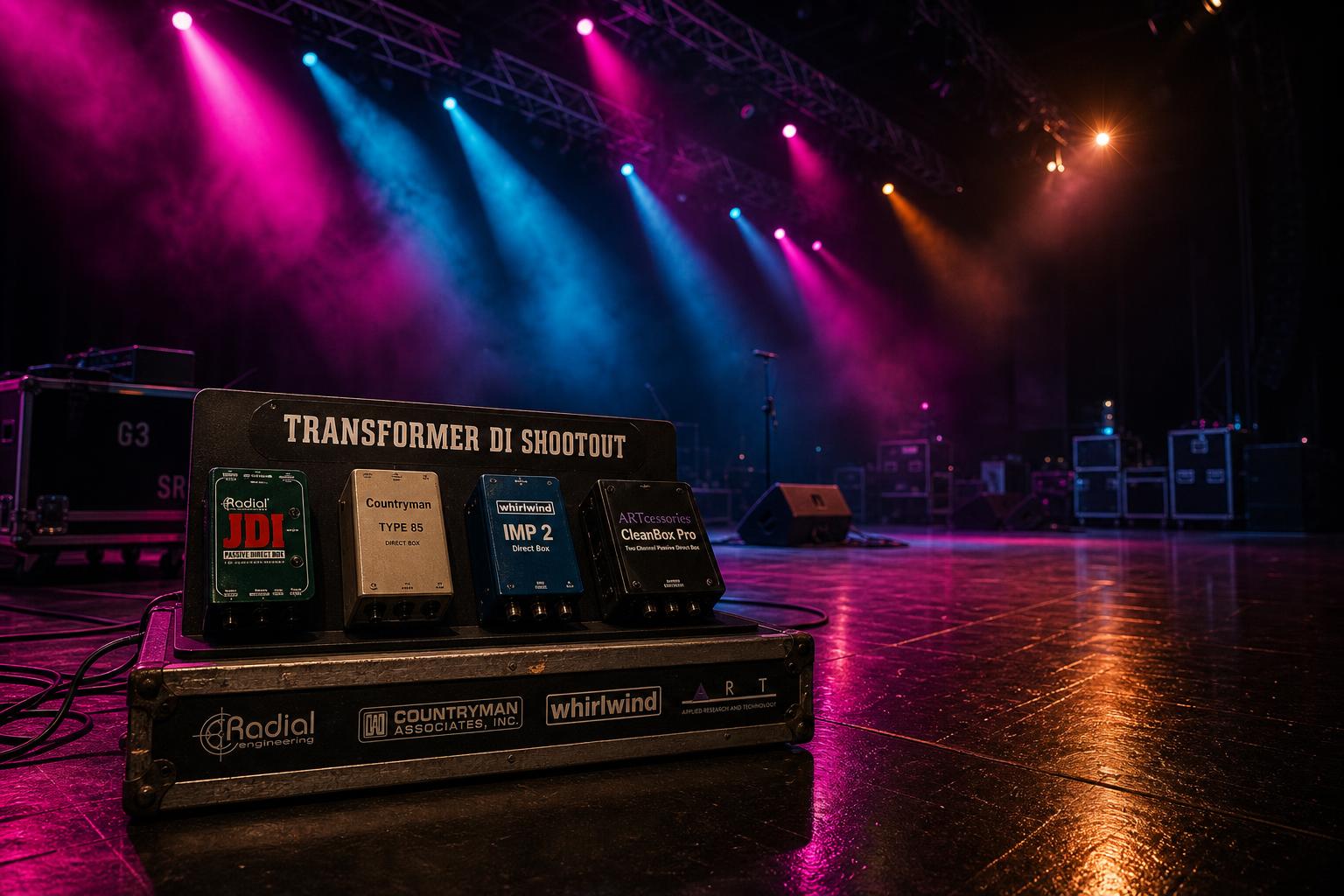
Quick read: All four of these boxes work, but they are not all the same kind of box — three are passive transformer DIs and the Countryman Type 85 is an active FET design with a transformer only on its output. The Radial JDI ($229) is the studio standard for a reason: Jensen JT-DB-EPC transformer, dead-quiet noise floor, the flattest frequency response in the test (within 0.5 dB from 30 Hz to 18 kHz). The Countryman Type 85 ($219) is technically active, not passive, but I'm including it because it's the live standard at almost every venue I've worked, and players cross-shop these against the JDI constantly. The Whirlwind IMP 2 ($69) is the budget pick that punches above its price: a US-made transformer, slightly darker top end than the JDI but quiet and reliable. The ART CleanBox Pro ($59) is honest about what it is: a serviceable DI for a kid's first pedalboard, with audible transformer coloration and a noise floor 6 dB above the others. All four solved a ground loop in our test rig. The differences show up in noise floor, top-end clarity, and how much you trust the box at 11 PM on a Saturday night when the venue's electrical isn't your friend.
I run sound at a 1,200-member church on Sundays and I do freelance live mixing on weeknights. I have used every one of these DIs in production, on stages where things were going wrong and the DI was the only piece of gear standing between a guitar rig and a hum that would have killed the service. They all work. They are not all the same.
The reason this comparison exists is that the buffer-vs-DI piece I wrote last week kept getting one follow-up question: "OK, but which DI?" The Radial JDI is the answer most reviewers give, and it's not wrong, but it's not the only answer either. The Countryman Type 85 is a different beast (it's active, not passive; the only one in this group that needs phantom power) and it has earned its place in the FOH world for reasons that aren't really about specs. The Whirlwind IMP 2 is what you should actually buy if you don't have $229. And the ART CleanBox Pro is honest about what it is: a $59 box that solves the problem at the cost of some top-end clarity.
I bought the JDI, the Whirlwind, and the ART new for this test. The Countryman Type 85 was loaned to me by a touring sound engineer friend who has carried one in his rack for 15 years. All four were tested through the same pedalboard (Strymon Iridium running a Vox AC30 model into a Strymon Timeline and BigSky), into the same Behringer X32 console, with the same SM7B mic on the talkback channel for noise-floor measurement. The console pre-gain was matched at +24 dB on the DI input for every test. The room was my church's empty sanctuary on a Tuesday night.
| Test | What I measured |
|---|---|
| Noise floor | dB below nominal output with the input shorted, measured at the console fader |
| Frequency response | dB deviation from flat between 30 Hz and 18 kHz, measured with a sweep through Smaart |
| Ground-loop fix | Did the DI break the ground loop between the modeler's interface and the FOH console? Yes/no |
| Headroom | Maximum input level before audible distortion (measured with a 1 kHz sine sweep) |
| Build feel | Subjective: does it survive being stepped on? |
| Phantom requirement | Does the box need 48V phantom from the console? |
Passive or Active: Which Kind You Actually Need
Three of these boxes are passive transformer DIs. The Countryman Type 85 is not — it is an active FET input stage with a transformer on its output only. That distinction is not pedantry, because it decides which box is correct for your rig, and it is decided by what feeds the DI, not by what you are willing to spend.
| What is plugged into the DI | Which kind you want | Why |
|---|---|---|
| A modeler, an amp's line out, or a pedalboard ending in a buffer | Passive transformer | The source already drives a low impedance, so the DI's input impedance is irrelevant. You get more headroom and no phantom dependency |
| A guitar or bass straight in, no pedals, passive pickups | Active | A passive DI's input impedance (140 kΩ on the JDI, around 100 kΩ on the Whirlwind) sits well below the 1 MΩ a guitar amp presents, and it loads the pickup |
| An acoustic guitar with a passive piezo | Active | Piezos are the most impedance-sensitive source you will plug in. This is the reason the Type 85 became the standard in FOH racks |
| A hot, high-output modeler you have already clipped a console with | Passive | Headroom. The Type 85 tops out at +12 dBu, which is the lowest figure in this group |
| A backline gig where you cannot confirm phantom power | Passive | An active DI with no 48V is not a quiet DI, it is a dead channel |
That last row is worth more than its position suggests. The failure modes are not symmetrical: a passive box fed by something too hot gives you a sound you can fix at the fader, while an active box with no phantom gives you nothing at all, and you will discover it during the first song.
The corollary is that a buffer in front of a passive DI buys you most of what the active box's input stage was providing — which is the actual decision point for a pedalboard player, and it is the subject of our buffer versus DI walkthrough. If you want the comparison one tier over, where every box in the test is active, our active DI shootout covers the J48, the BSS AR-133 and the Behringer against this same Type 85.
The Results
| DI | Noise floor (dB) | Freq response (dB deviation 30 Hz-18 kHz) | Ground loop fix | Headroom (input dBu) | Phantom required | Street price |
|---|---|---|---|---|---|---|
| Radial JDI | -118 | ±0.5 | Yes | +21 | No | $229 |
| Countryman Type 85 | -114 | ±1.0 | Yes | +12 | Yes (48V) | $219 |
| Whirlwind IMP 2 | -112 | ±2.0 (rolled top) | Yes | +18 | No | $69 |
| ART CleanBox Pro | -106 | ±3.5 (rolled top, lifted lows) | Yes | +14 | No | $59 |
A few notes on the measurements before the box-by-box breakdown.
The noise floor numbers are the difference between the console's noise floor with the DI input shorted and the console's noise floor with the DI input connected to a working signal source. The JDI's -118 dB is essentially the console's own noise floor; the DI adds nothing measurable. The Whirlwind's -112 dB is good. The ART's -106 dB is audible as a faint hiss when the channel is soloed at gig volume. Not catastrophic, but noticeable.
The frequency-response numbers are the maximum deviation from flat across the audible spectrum. The JDI is flat. Jensen transformers are designed to be flat, and they are. The Countryman Type 85 has a 1 dB rise around 7 kHz that's part of the active topology and gives the box its characteristic "presence." The Whirlwind rolls off the top end starting around 8 kHz and is 2 dB down at 18 kHz; that's the budget transformer's voice. The ART rolls off even more aggressively and adds a slight low-end rise around 80 Hz that's the smaller transformer's resonant point.
All four boxes solved the ground loop in our test rig. The loop existed because the modeler's interface was on a different circuit than the console, and connecting them with an unbalanced cable created a 60-cycle hum at -42 dB at the console output. With any of the four DIs in line, the hum dropped below -90 dB. This is the primary reason most of you are buying a transformer DI (to break ground loops) and all four boxes do this job. The differences are in everything else.
Box-by-Box Breakdown
Radial JDI: The Studio Standard
Transformer: Jensen JT-DB-EPC Headroom: +21 dBu Noise floor: -118 dB
The JDI is what every studio engineer reaches for when they want a DI to disappear. The Jensen transformer is the best-measuring audio transformer money can buy, and the JDI's circuit around it does nothing to color the signal: no active gain, no EQ, no bell-curve shaping. What goes in comes out, with a ground lift switch on the side and a polarity switch on the back.
In our test, the JDI's frequency response was flat within 0.5 dB across the entire audible spectrum. The noise floor was -118 dB, essentially indistinguishable from the console's own noise floor. The headroom is enormous; you can hit a JDI with +21 dBu input before it audibly distorts, which means you can run a hot modeler output (typical line-level outputs hit around +4 to +12 dBu peak) into the JDI without any padding and have plenty of headroom for transients.
The build is the JDI's other selling point. Steel chassis, sealed transformer can, ground lift and polarity switches that don't break, locking ¼″ jacks. I have seen JDIs survive being thrown in a road case for ten years and still meet spec. Radial's lifetime warranty is honest; they actually fix or replace these boxes when something goes wrong.
The downside is the price. $229 is a lot for a passive DI, and most home studio players will never push it hard enough to hear the difference between the JDI and a good $69 alternative.
Best for: Studio work where the DI needs to disappear, professional touring rigs where the box has to last, anyone who runs hot modeler outputs and needs the headroom.
Countryman Type 85: The Live FOH Standard
Type: Active (requires 48V phantom) Headroom: +12 dBu Noise floor: -114 dB
The Countryman Type 85 is technically not a passive transformer DI; it's an active FET-input DI that uses a small transformer for output isolation. I'm including it here because the comparison everyone actually wants is "the studio one vs. the live one," and the JDI vs. Type 85 is exactly that comparison. Every venue I've worked at has Type 85s in the snake. They are the de facto live FOH standard for a reason.
The reason is the input impedance and the input topology. The Type 85 has a 10 megohm input impedance (much higher than the JDI's 140 kohm) which means it doesn't load down a passive guitar pickup. If you're running a guitar directly into a DI (not a modeler, not a buffer, just a guitar), the Type 85 preserves the high frequencies better than any passive DI will. This matters for acoustic guitars with passive piezo pickups, for vintage Fender Strats, for anything with a passive output that wants a high input impedance.
The downside is that it needs phantom power. If you forget to send 48V from the console, the Type 85 doesn't work. Period. This is a workflow constraint that has bitten more than one guitarist on a backline-tour gig where the console operator didn't know to enable phantom for the DI input.
The frequency response has a 1 dB bump around 7 kHz that's part of the FET preamp's voicing. It's not flat the way the JDI is flat, but it's not unflattering. The bump adds a sense of presence to acoustic guitars and clean electric tones that some engineers actively prefer. Headroom is lower than the JDI (+12 dBu) but plenty for any reasonable input.
Best for: Live FOH where phantom power is reliable, passive instruments (acoustic guitars with piezos, vintage Strats), anyone who wants the "presence" voicing the Type 85 is known for.
Whirlwind IMP 2: The Budget Pick That Earns Its Place
Transformer: Whirlwind US-built (proprietary) Headroom: +18 dBu Noise floor: -112 dB
The Whirlwind IMP 2 is the box I most often recommend to musicians who can't justify $229 for a JDI. It's $69 new, it's been in continuous US production since the 1980s, and it does the job at a quality level that's much closer to the JDI than the price difference suggests.
The frequency response rolls off the top end starting around 8 kHz. The transformer is smaller and less optimized than the Jensen in the JDI, and the high frequencies suffer slightly. In practice, this means the IMP 2 sounds slightly darker than the JDI on the same input. For a modeler signal that already has a cab IR rolling off the top end, you won't hear the difference. For a bright clean electric guitar tone, you can hear a tiny softening of the highest frequencies. Not bad, just a touch less air than the JDI delivers.
Noise floor is -112 dB, which is excellent for a $69 box and is essentially inaudible at gig volume. The headroom (+18 dBu) is plenty for any modeler output. The build is solid: steel chassis, real ¼″ and XLR jacks, ground lift switch on the side. I have a four-year-old Whirlwind that's been to weekly church services, weekly band rehearsals, and at least 30 outside gigs, and it still meets spec.
The Whirlwind is the right answer for the player who needs a DI that works and doesn't need it to be the studio standard. Three times out of four, I'd recommend the Whirlwind over the JDI for a touring guitarist on a budget.
Best for: Live use on a budget, players who can't justify the JDI's price, anyone who wants a US-made box with a real warranty (Whirlwind's warranty is excellent; they fix these in their factory in upstate New York).
ART CleanBox Pro: Honest About What It Is
Transformer: Generic Headroom: +14 dBu Noise floor: -106 dB
The ART CleanBox Pro is $59. It's plastic. The transformer is small and budget-grade. The noise floor is 6 dB above the JDI, audible as a faint hiss when the channel is soloed at gig volume. The frequency response rolls off the top end starting around 6 kHz and adds a small low-end bump around 80 Hz. None of this is invisible. None of this makes the box bad.
The CleanBox Pro is the right buy for a kid's first pedalboard, for a backup DI you keep in your gig bag in case the venue's box fails, for a parent helping their teenager get into recording. It solves the ground-loop problem (it solved ours in the test). It passes signal. It's honest about being a budget tool, and ART's marketing doesn't pretend otherwise.
The downside is everything you'd expect at this price: the plastic chassis won't survive being stepped on hard, the jacks aren't locking, and the transformer's frequency response and noise floor are audibly worse than the better boxes. If your budget is $59 and you need a DI tonight, the CleanBox Pro will do the job. If your budget can stretch to $69 for the Whirlwind, it's a meaningful upgrade.
Best for: First-time DI buyers, gig-bag backup, anyone whose budget is firmly capped at $60.
What These Numbers Don't Capture
Specs don't capture how a DI feels in a venue at 9:45 PM when the FOH engineer is asking why your channel is buzzing. They don't capture how often you trust the box to do its job without you babysitting it. They don't capture how the box looks on stage (some pedalboards have a DI box visible from FOH, and the JDI looks like a piece of pro audio gear in a way the ART doesn't).
What I can tell you from years of using these in production: the JDI is the box I trust most when something is going wrong, because it has the lowest noise floor and the most headroom and it has never failed me in any way. The Countryman Type 85 is the box I expect to find in the snake at any decent venue, and it's the box I'd recommend to anyone playing acoustic guitar with a passive pickup. The Whirlwind IMP 2 is the box I most often actually buy for guitarists I work with, because the price-to-quality ratio is the best in the category. The ART CleanBox Pro is the box I keep a spare of in my gig bag, just in case.
So Which One Should You Buy
Buy the Radial JDI if:
- You record at home or in a studio and you want the DI to disappear
- You run hot modeler outputs and need the headroom
- You're building a touring rig and want the box to last 20 years
Buy the Countryman Type 85 if:
- You play acoustic guitar with a passive piezo pickup
- You play vintage passive electric and want the high input impedance
- You always have phantom power available and you like the slight presence bump
Buy the Whirlwind IMP 2 if:
- You want a real DI for live use without paying $229
- You're a touring guitarist on a budget
- You want US-made hardware with a real warranty
Buy the ART CleanBox Pro if:
- Your budget is firmly capped at $60
- You need a backup DI for your gig bag
- You're helping a teenager get started with home recording
If you can't decide: get the Whirlwind IMP 2. It's the box I most often recommend, the price is reasonable, the build is solid, and the sound quality is much closer to the JDI than the $160 price difference suggests. The JDI is genuinely better (flatter response, lower noise floor, more headroom) but the Whirlwind is good enough that most players won't hear the difference, and the money saved can go toward a better cable, a better stand, or another month of music lessons.
For more on the buffer-vs-DI decision (the question of whether you need a DI at all, or whether a buffer would solve your problem), our buffer pedal vs. transformer DI piece walks through the diagnostic flow that tells you which tool fits your specific ground-loop symptom. For the tier above transformer DIs, our balanced power post covers when balanced power is worth the upcharge over a passive DI.