Quick read: If your guitar goes out of tune after a bend, the nut is the first suspect, not the tuners. Nut binding happens when the slot is cut too tight, cut at the wrong angle, or has a corner catching the string. The fix is in three steps: lubricate first (pencil graphite or Big Bends Nut Sauce clears 60-90% of binding cases without filing), then file the slot wider with a gauge-matched file at the back-angle of the headstock, then check depth with a feeler gauge to make sure the slot is not so deep that the string buzzes open. The right files are gauge-matched ($90 for a starter set of three from StewMac), the wrong tools are anything that cuts a flat-bottomed slot. A proper recut takes 15 minutes per string and saves the cost of a tuner upgrade that was never going to fix the problem.
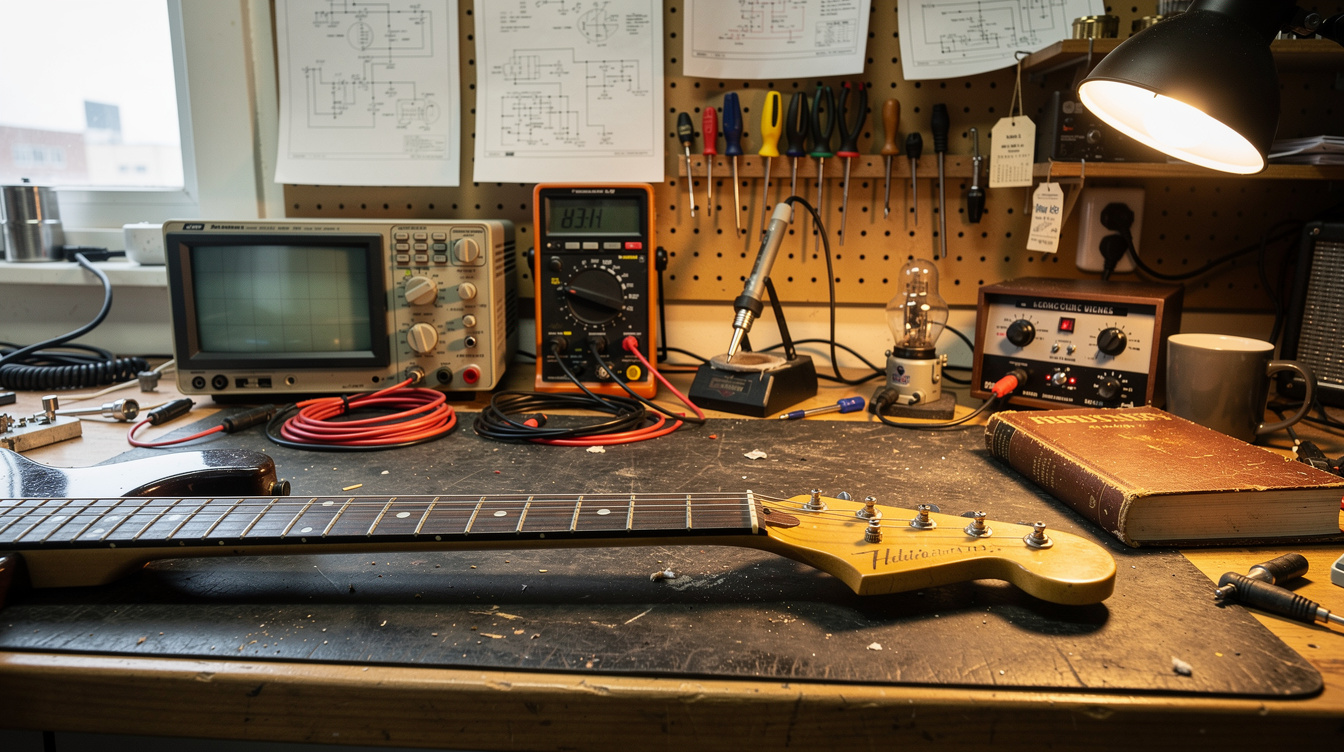
There is a Custom Shop Stratocaster on the bench that came in this winter for the third time in two years. Each time, the owner said the same thing — the G string goes sharp after a bend. Each time, he had added or changed something. A new bridge. Locking tuners (Sperzels, the good kind). A bone saddle instead of the original. Each visit the tuning problem persisted because the actual cause was untouched: the G slot in the bone nut had a corner catching the string at exactly the position where the wound-to-plain transition pulls the string forward under a bend.
Fifteen minutes with a file and a drop of Nut Sauce fixed what $400 in upgrades could not. That is the lesson worth repeating, because the same diagnosis applies to most of the tuning instability blamed on tuners. The nut is the place where the string changes geometry as you bend, and if the slot does not let the string slide back through cleanly, the string returns sharp every time. New tuners do not fix that. A correctly cut and lubricated slot does.
This piece is the procedure I use on every bench guitar that comes in with a tuning complaint. The steps are sequential — diagnose first, lubricate second, file third — and most guitars are fixed before the files come out of the drawer.
How to Tell If Your Nut Is Binding
Most tuning instability blamed on tuners has the same diagnostic signature. Pluck the open string at the nut. Bend the string a whole step up the neck. Release the bend. Watch the strobe tuner — or your ear — for what happens when the string returns.
| Symptom | Probable cause |
|---|---|
| String returns sharp by 3-8 cents | Nut binding (the string did not slide back through the slot) |
| String returns flat by 3-8 cents | Tuner slipping (the post backed off under tension) |
| String returns dead on zero | Nut and tuner both functioning |
| String goes flat over 30 minutes evenly across all strings | Strings stretching, wood acclimating — wait it out |
| String binds intermittently, only on the B or G | Slot corner catching at a specific point in the wind |
The sharp-return signature is the giveaway. When you bend a string, the portion of the string between the nut and the tuner stretches forward toward the bridge. If the slot is too tight or has a sharp corner, the string does not slide back through to its starting position when you release the bend — it sits a few thousandths of an inch ahead of where it started, which means slightly higher tension, which means slightly higher pitch.
The B and G strings are the most common offenders. The G is the worst because it is the largest of the plain strings on most sets (.017 to .024 depending on gauge), and the wound-to-plain transition is the spot where slot geometry matters most.
Step One: Lubricate Before You Cut
Filing should be the last step, not the first. Most binding cases are cleared by lubrication alone.
Take a #2 pencil with a freshly sharpened tip. Rub the lead across each nut slot — not just the top of the slot, but down into the slot itself. The graphite transfers to the slot walls and the bottom of the slot. Re-string. Play for ten minutes. Run the bend test again on the strobe tuner.
About six in ten binding cases clear at this step. The graphite is doing two things — it reduces friction between the string and the slot wall, and it fills the microscopic surface irregularities in the slot that are catching the string. If the slot is the right width and the right angle but just slightly rough, graphite is the fix.
If pencil graphite does not clear it, the next step is Big Bends Nut Sauce or a drop of a lightweight synthetic oil. A toothpick dipped in the sauce, worked into the slot before stringing, holds the lubricant in place through several string changes. About another three in ten cases clear here.
The remaining one in ten cases need the slot actually widened. That is where the file work starts.
Step Two: The Right Files
The difference between a good nut recut and a ruined nut is the file. The right tool is a gauge-matched nut file — a flat-faced file with a specific cutting edge that matches a particular string diameter. StewMac and Hosco both sell sets, typically in three- or six-file configurations covering the gauges from .010 (high E plain) through .052 (low E wound) on a standard set.
The cheapest viable starter set is three files at .013, .016, and .024. That covers:
- .013 — the B string slot on a 10-46 set
- .016 — the G plain string slot on a 9-46 set (or the lower edge of the .017 G on a 10-46)
- .024 — the wound D string slot
Plain E, A, low E, and the wound transitions are less likely to bind because the slots are either narrow enough to be inherently tight (high E) or wide enough that the string sits cleanly in the bottom (the wound strings). The slots that fail most often are in the .013 to .024 range.
The wrong tools are anything that cuts a flat-bottomed groove. A jeweler's flat file, a triangular needle file, a hacksaw blade, the back of a kitchen knife — all of these will cut a slot, but the slot will be V-shaped or square-bottomed instead of round-bottomed. The string sits at the top of a flat-bottomed slot rather than nestling into a U-shape, which means the contact area is a single line rather than a curved surface. The string slips forward and back across that line every time you bend, and the binding gets worse, not better.
A gauge-matched file is shaped to cut a U-shaped channel slightly wider than the string. The string sits at the bottom of the U with about 0.002 inches of clearance on each side. That clearance is what lets the string slide back through after a bend.
StewMac's three-file starter set is about $90. Hosco's six-file set is about $130. The cheap nut-file knockoffs sold on Amazon for $30 are not gauge-matched and will cut a slot but not the right slot. Buy the real ones.
Step Three: Filing the Slot
This is the part that requires patience. Cut twenty percent of what you think you need, then check. Cut twenty percent more, then check. Stop before you go too far.
The file is held at the back-angle of the headstock — the same angle the string takes as it leaves the nut and drops down toward the tuner post. On a Fender-style headstock with a string tree, the angle is shallow, about 5 to 8 degrees from horizontal. On a Gibson three-and-three headstock with no tree, the angle is steeper, around 13 to 17 degrees. The file points toward the tuner post, not perpendicular to the fingerboard.
The reason the angle matters is the slot corner. If you file straight down through the top of the nut (perpendicular to the fingerboard), the back edge of the slot has a sharp 90-degree corner where the string changes direction toward the tuner. That corner is the place where the string catches under tension. File the slot at the back-angle of the headstock and the back edge of the slot becomes a smooth ramp instead of a sharp corner. The binding goes away.
The technique:
- Loosen the string until it is slack. Lift it out of the slot and lay it to the side.
- Place the file in the slot with the tang pointing toward the headstock tip. The cutting edge of the file is at the slot bottom.
- Push the file forward toward the headstock at the back-angle of the headstock. Light pressure. The file does the work, not the hand.
- Pull the file straight back. Cut on the push, not the pull (most nut files are cut for one-direction action).
- Three strokes. Lift the file. Brush the slot clean with a small painter's brush.
- Drop the string back into the slot. Tune to pitch. Run the bend test.
- If the string still binds, three more strokes. Brush. Re-test.
The cycle is three strokes at a time. The reason is irreversibility — you can always remove more material, but you cannot put bone back. A slot that is cut 0.001 inches too deep will buzz open at the first fret, and the only fix is to replace the nut entirely.
A correctly cut slot has the string dropping in cleanly with no side-to-side rocking, the bottom of the string contacting the slot bottom along its full length, and the string sliding freely back and forth in the slot when you push it forward with a fingernail.
Step Four: Checking the Depth
The depth of the slot matters as much as the width. A slot that is cut too deep produces a string that buzzes against the first fret when played open. A slot that is cut too shallow produces a high action at the first fret that makes the first-position chords sound sharp because the string is being stretched as you press it down.
The measurement procedure:
- Fret the string at the third fret.
- Look at the gap between the bottom of the string and the top of the first fret crown.
- The gap should be just barely visible — about 0.020 inches on most guitars, which is roughly the thickness of a thin business card.
A feeler gauge confirms it. A 0.020-inch feeler should slide under the string at the first fret with light contact. A 0.025-inch feeler should not fit. A 0.015-inch feeler should slide through without resistance.
If the gap is too big (the slot needs to be filed deeper), file three more strokes and re-check. If the gap is too small (you have gone too far), the nut needs to be replaced or shimmed at the bottom, which is a separate job that I would take to a tech if you have not done it before. Bone is unforgiving in this direction.
The Custom Shop Strat I mentioned earlier had a G slot that measured 0.028 inches at the first fret — too high. After the recut, it measured 0.020 inches and the bend slip went from 6 cents to under 1 cent. The string did exactly what the customer thought new tuners would make it do.
A Word About Bone, Tusq, and Brass
Most factory nuts on Fender, Gibson, PRS, and the higher-tier Asian guitars are bone or Graph Tech Tusq. Both are workable with a standard set of nut files. Bone is harder than Tusq, takes a few more strokes to cut, and holds an edge longer once cut. Tusq is softer, cuts faster, and is more forgiving of slight angle errors during filing.
Brass nuts, found on some metal-leaning instruments and a few late-1970s Fenders, are a different category. Brass requires a brass file or a diamond-cut file — a standard hardened-steel nut file will skate across the surface without cutting. If your guitar has a brass nut and the slot is binding, this article is not the right procedure. Brass nut work goes to a tech with the right files. The procedure on bone and Tusq is what I am describing here.
Plastic nuts (the white nuts on the cheapest entry-level instruments) take any file fine but should usually be replaced with bone or Tusq instead of recut. Plastic compresses under string tension over time, and recutting a worn plastic nut is a temporary fix for a problem that comes back in six months. If your guitar is worth a $50 nut upgrade — and most are — replace the plastic nut with a Tusq blank, then cut new slots. The whole job is about the same effort as recutting the existing plastic slots, and the result lasts.
What Surprised Me on the Bench
The thing I did not expect when I started doing nut work seriously was how often a correctly cut nut would fix what the customer thought was a string issue. A player would come in convinced the G string he was using was bad — he had tried D'Addario, Ernie Ball, GHS, Elixir — and the G kept going sharp on bends. The actual problem was the slot. After the recut, his existing D'Addarios worked perfectly and the string brand was irrelevant.
The other thing I did not expect was how many guitars at the Custom Shop and Gibson Custom price points came out of the factory with slots cut at the wrong angle. The high-end factories are good at the visible work — finish quality, fretwork, electronics — but the nut is often cut by a less-experienced hand or by a CNC that does not adapt to the specific back-angle of the individual headstock. A $4,000 guitar can have a $50 nut problem from the factory, and the player blames the tuners or the strings rather than the slot geometry that is the actual cause.
When to Just Replace the Nut
There are three cases where filing is not the answer and the nut needs to come off the guitar entirely:
- The slot is already cut too deep. If the bend test passes but the open string buzzes at the first fret, the slot is below the working height and cannot be filed deeper. A new nut blank is needed, cut from scratch to the correct depth.
- The bottom of the slot is rough or chipped. Sometimes the bone has a hairline crack at the bottom of a slot, or a chip has come out of the back edge. The slot will keep binding regardless of how cleanly you re-file because the surface is not stable. Replace the nut.
- The nut is plastic. As above, plastic is a temporary material that compresses under tension. If you have a plastic nut with binding problems, the right move is to replace it with bone or Tusq and cut new slots. Recutting the plastic is wasted effort.
A nut replacement on a Fender-style flat-bottomed slot is a two-hour job for someone who has done it before — remove the old nut with light taps from a brass punch, clean the slot, fit a new blank, cut the slots, dress the top, glue with a single dot of cyanoacrylate. A Gibson-style angled slot is harder because the angle of the slot has to match the headstock geometry. If you have not replaced a nut before, this is the work to take to a tech.
The Underrated Fix
Tuner upgrades are the most common purchase made in pursuit of tuning stability. About half of those purchases are unnecessary. The slot at the nut is the unsung hero or the silent villain of every tuning issue, and a $90 set of files plus fifteen minutes per slot does more for stability than $230 worth of locking tuners on a guitar with a binding G slot.
The procedure is sequential. Lubricate first. File second, and only if lubrication did not clear the problem. Check the depth before you call the job done. Use the right files and resist the urge to cut more than three strokes between checks. Most nut binding on a Stratocaster, Telecaster, Les Paul, or SG can be fixed in fifteen minutes per slot once you have the files in your drawer.
The first time I did a nut recut on a binding G on a 1965 Strat, the bend slip went from 7 cents to under 1 cent in twenty minutes. The owner of the guitar had spent four months changing strings and considering tuner upgrades. The slot was the problem the whole time. It usually is.