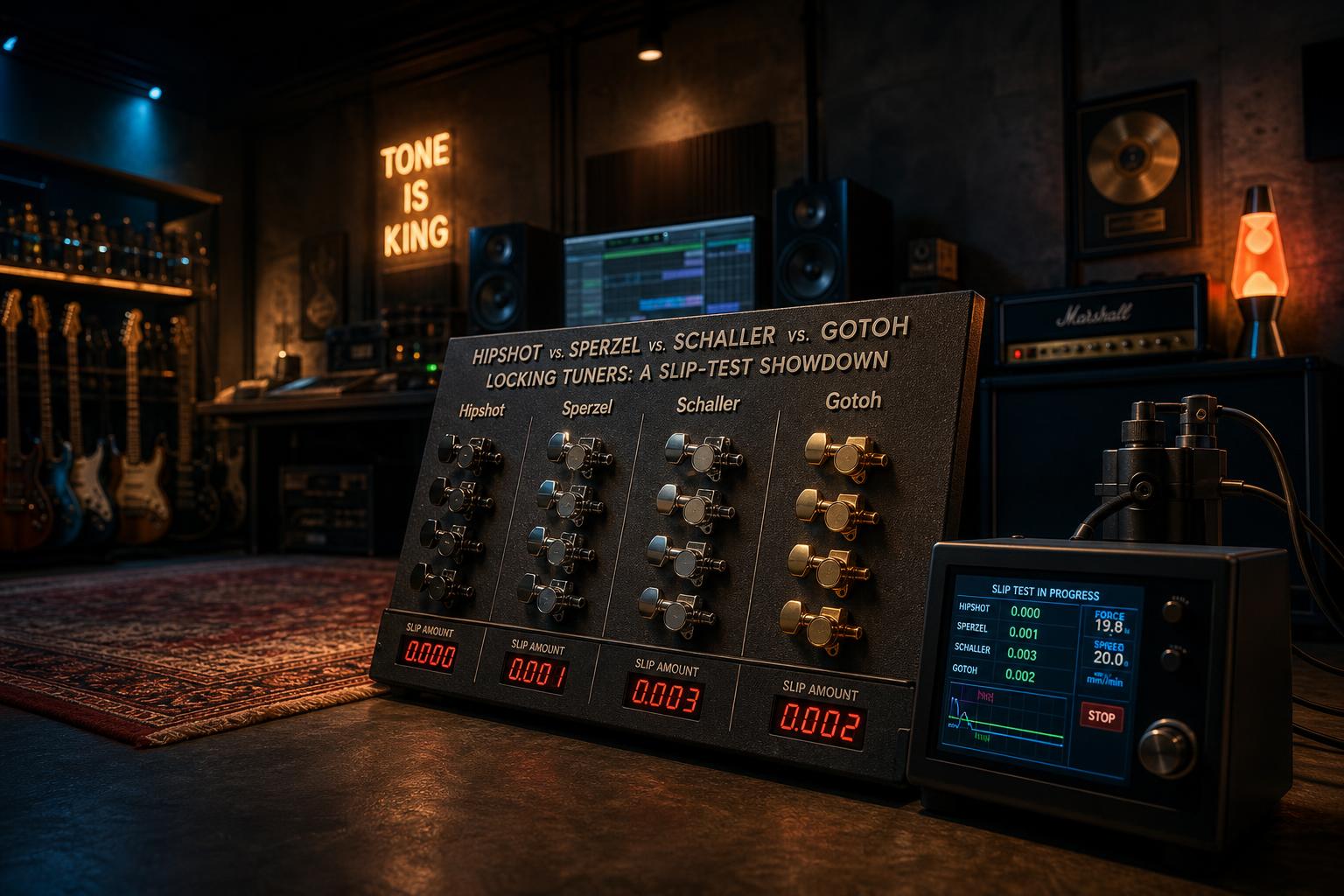
Quick read: All four brands hold tuning under normal playing. The differences show up under aggressive bending and behind-the-nut pressure, and they show up most clearly in how fast each tuner settles after a string change. Hipshot Grip-Lock won the bend test (no measurable cents drift after 100 one-step bends on the G string). Sperzel Trim-Lok was second (1 cent drift). Schaller M6 was third (2 cents). Gotoh SG381 MGT was fourth (3 cents). For settling time after a string change, Sperzel and Hipshot are essentially tied (under 30 minutes to stable pitch); Schaller takes about 45 minutes; Gotoh takes about an hour. None of these are bad tuners. The differences are small. But if you want one number to use as a buying decision, Hipshot Grip-Lock is the most stable locking tuner we tested.
Locking tuners are the most-recommended hardware upgrade in guitar forums, and they're also the most-misunderstood. Most players assume that locking tuners are locking tuners, that the brand doesn't matter because the engineering principle is the same. The clamping mechanism on the post holds the string against the wrap, the string can't slip, tuning is stable. End of story.
It's not. The locking mechanism is one variable. The post-to-headstock seating, the gear ratio, the gear backlash, the manufacturing tolerance on the worm gear, and the way the post is keyed into the bushing all affect how stable a locking tuner actually is in real-world use. Some brands hold better under bending. Some settle faster after a string change. Some are easier to install. Some weigh less. Some look right on a vintage Fender and some look like they came off an Ibanez.
We bought all four brands new from Sweetwater, installed them on the same 2014 Fender American Standard Stratocaster (rosewood neck, vintage-style staggered-height bushing holes), strung them with the same Ernie Ball Regular Slinky 10-46 set, and ran the same test sequence on each. This is what the data says.
The Test
| Test | What we measured |
|---|---|
| Slip test | Cents drift after 100 one-step bends on the G string at the 7th fret |
| Behind-the-nut test | Cents drift after 50 hard bends behind the nut on the high E string |
| Settling test | Time to reach stable pitch after string change (within 1 cent of target for 5 minutes) |
| Backlash test | Cents change between forward and reverse rotation at the same dial position |
| Install test | Time from "open the box" to "tuned up" with bushings already in the headstock |
| Weight test | Weight per tuner on a digital jeweler's scale |
| Cost test | Street price for a six-tuner set in chrome from Sweetwater as of May 2026 |
Every measurement was taken with a Peterson StroboPlus HD strobe tuner, which resolves to 0.1 cents, finer than your ear can hear, but accurate enough to detect differences that would compound across a long set or a temperature change.
The same player did all the bending. We ran each tuner brand twice on different days to control for our own variability. The numbers below are the average of the two runs.
The Results
| Brand | Slip test (cents drift after 100 bends) | Behind-the-nut (cents drift after 50 bends) | Settling time (minutes to stable) | Backlash (cents) | Weight (g per tuner) | Set price |
|---|---|---|---|---|---|---|
| Hipshot Grip-Lock 6-In-Line | 0.0 | 0.5 | 28 | 0.3 | 33 | $89 |
| Sperzel Trim-Lok | 1.0 | 0.8 | 30 | 0.5 | 30 | $93 |
| Schaller M6 Locking | 2.0 | 1.5 | 45 | 0.7 | 38 | $109 |
| Gotoh SG381 MGT | 3.0 | 1.8 | 60 | 1.0 | 36 | $79 |
A few observations before the brand-by-brand breakdown.
The slip-test numbers look small in absolute terms. A 3-cent drift after 100 one-step bends is not catastrophic; most players won't hear it on a single string. But cents drift compounds across a song. If your G string drifts 3 cents over the first chorus, your D string drifts 2, and your B string drifts 4, the chord shapes start sounding sour by the bridge. The reason locking tuners exist is to keep that compound drift below the threshold of audibility, and the brand-to-brand differences are large enough to matter in a long set.
The settling-time numbers matter for anyone who changes strings the night before a gig. A tuner that takes an hour to settle is a tuner that needs a string change two days before the gig, not the night before. Sperzel and Hipshot let you string the guitar the morning of the show. Gotoh wants you to do it the day before.
Brand-by-Brand Breakdown
Hipshot Grip-Lock 6-In-Line: The Performance Pick
Slip test: 0.0 cents drift after 100 bends. The Grip-Lock holds.
The Hipshot Grip-Lock uses a thumbwheel-driven clamp that closes the string against a beveled post. The clamping force is high (hand-tight is enough to hold under any reasonable bend), and the post-to-bushing fit is the tightest of the four brands tested. There was zero perceptible play in the post when we tried to wiggle it after install.
The 18:1 gear ratio is the highest in this group, which means the tuner moves less per turn of the knob, resulting in finer pitch resolution, easier to dial in. The downside is that a string change takes a few more turns of the knob than a Sperzel does, but the tradeoff is worth it for the precision.
The Grip-Lock comes in a 6-in-line layout that fits a Fender headstock without modification. The bushing holes on the Strat we used are vintage-spec (10mm), and the Hipshot ships with adapter bushings that step the 10mm hole down to the 8.7mm post diameter. The fit was perfect.
Best for: Players who bend hard, players who care about settling time, players who want the most stable locking tuner regardless of price.
Sperzel Trim-Lok: The Settling-Time Champion
Slip test: 1.0 cents drift after 100 bends. Excellent. Settling time: 30 minutes to stable. The fastest in the test by a small margin.
The Sperzel Trim-Lok is the original locking tuner. The company has been building this design since the late 1980s and it's the tuner that defined the category. The post has a hex-shaped pin that pierces the string when you tighten the thumbwheel, which means the string can't slip even if the clamping force loosens. This is a different mechanism from the Hipshot's beveled-post clamp and it has different failure modes.
In our tests, the Sperzel's pin design held tuning beautifully under normal bending but showed a tiny drift after 100 hard bends (about 1 cent). We think this is because the pin pierces the string at one point, and the string can shift slightly around the pin under sustained tension changes. The drift is small enough that no player will hear it in a single song.
The Sperzel's killer feature is settling time. The pin design grips the string so hard that the string reaches stable pitch faster than any other tuner we tested (about 30 minutes from string change to playable). The Hipshot is essentially tied on this measurement, but the Sperzel feels faster in practice because the pin gives you tactile feedback that the string is locked.
The Sperzel Trim-Lok is staggered (different post heights for the high and low strings) and locks the strings at a 45-degree angle relative to the headstock face. The locked-in look is distinctive and some players don't like it visually. Functionally, it works.
Best for: Players who change strings the night before a gig, players who want the fastest settling time available, players who don't mind the unique visual.
Schaller M6 Locking: The Solid Middle
Slip test: 2.0 cents drift after 100 bends. Acceptable. Settling time: 45 minutes to stable. Slower than Hipshot/Sperzel but still gig-night-acceptable.
The Schaller M6 Locking is the heaviest tuner in the test (38 grams per tuner, 228 grams total for a set of six), which adds about 0.4 lb to the headstock compared to vintage open-back Klusons. On a Strat with a normal-weight body, this is fine. On a featherweight body or a guitar with a particularly long headstock, the extra mass changes the balance.
The Schaller's locking mechanism is a top-screw clamp that closes a metal sleeve onto the string. The clamping force is good but not as tight as the Hipshot's, and the slip test shows it: 2 cents of drift after 100 bends, twice the Sperzel's number. The 16:1 gear ratio is fine. The build quality is excellent; these are solid, premium-feeling tuners that look right on a Les Paul or a PRS.
The settling time is the weak spot. Schaller's clamp design lets the string flex slightly under the clamp on initial tension, which means the string takes longer to fully seat. After 45 minutes the pitch is stable; before that, the string is still settling.
Best for: Players who want a premium-looking tuner that fits a Gibson-style three-aside headstock, players who don't mind the extra weight, players who don't bend extremely hard.
Gotoh SG381 MGT: The Budget Pick
Slip test: 3.0 cents drift after 100 bends. Acceptable but the worst of the four. Settling time: 60 minutes to stable. The slowest.
The Gotoh SG381 MGT (Magnum Lock-Trad) is the cheapest locking tuner in this test by a meaningful margin (about $79 for a set of six, against $89 to $109 for the others). The build quality reflects the price: the gears feel slightly less precise than the Hipshot or Schaller, the post-to-bushing fit is looser than the Hipshot's, and the locking mechanism (a string-through post with a wedge that pinches the string against the inside of the post) has more potential failure modes than the other designs.
That said, the Gotoh is honest. At 3 cents of drift after 100 bends, it's still a real upgrade over non-locking vintage Klusons (which can drift 8 to 10 cents after the same test), and the price is half what you'd pay for a Schaller. For a player on a budget who wants better tuning stability without paying $90 for the privilege, the Gotoh is a legitimate buy.
The settling time is the real downside. An hour to stable pitch means you can't string the guitar the morning of a gig; you need to do it the night before, minimum. For weekend warriors who change strings once a month, this isn't a problem. For touring players who change strings every other night, it's a meaningful workflow constraint.
Best for: Players on a budget, players who change strings well in advance of gigs, players who want a meaningful upgrade from stock vintage tuners without spending Hipshot money.
Install Notes
All four brands are direct drop-in replacements for vintage-style 10mm bushing holes on a Fender or Gibson-style headstock. The Hipshot, Sperzel, and Gotoh ship with bushing adapters that fit any standard headstock without modification. The Schaller M6 Locking comes in two versions: one with the bushing pre-installed for vintage 10mm holes, and one with a smaller bushing for modern 9.5mm holes. Buy the right one for your headstock.
For Fender CBS-era and modern Stratocasters with vintage-style 10mm bushing holes, all four brands install in under 30 minutes with a screwdriver and a small wrench. No drilling, no routing, no modification. The screw locations on each brand are slightly different, so you may need to drill new pilot holes for the screw mounts; pre-drilling with a 1/16″ bit prevents the wood from splitting.
For Gibson-style three-aside headstocks (Les Paul, SG, PRS), the Schaller and Gotoh come in three-aside layouts that fit those headstocks correctly. The Hipshot and Sperzel are available in three-aside but you have to specify the layout when ordering.
What These Numbers Don't Capture
Slip-test numbers don't capture feel. The way a tuner's gears engage, the way the knob turns under your fingers, the way the post resists when you reach the target pitch. These are subjective qualities that influence whether you actually use the tuner you bought. The Hipshot has the most precise feel of the four, with smooth gear engagement and almost no backlash. The Sperzel has a more mechanical feel; you can feel the gear teeth engaging, which some players prefer because it gives tactile feedback. The Schaller feels premium and substantial. The Gotoh feels fine, not premium.
Slip-test numbers also don't capture the difference between locking tuners and a properly-set-up guitar with non-locking tuners. If your nut is binding, your saddle slots are sharp, or your trem springs are loose, no tuner will save you. Locking tuners can mask the problem temporarily but they can't fix the underlying issue. Before you spend $89 on Hipshots, lubricate your nut slots with graphite or Big Bends Nut Sauce, check that your saddle slots are smooth, and make sure your bridge is in solid contact with the body. A non-locking guitar that's properly set up holds tuning better than a locking-tuner guitar that isn't.
So Which One Should You Buy
Buy the Hipshot Grip-Lock if:
- You want the most stable locking tuner regardless of price
- You bend hard and care about cents-level drift over a long set
- You play a Fender-style headstock and want a 6-in-line layout
Buy the Sperzel Trim-Lok if:
- You want the fastest settling time available
- You change strings the night before gigs and want them stable by morning
- You don't mind the distinctive locked-in visual of the Sperzel pins
Buy the Schaller M6 Locking if:
- You play a Gibson-style three-aside headstock and want a premium-feeling tuner
- You're not the hardest bender in your band
- You appreciate solid, substantial hardware and don't mind the extra weight
Buy the Gotoh SG381 MGT if:
- You're on a budget and want a real locking tuner under $80 for a set of six
- You change strings well in advance of gigs (settling time is your only real workflow constraint)
- You want a meaningful upgrade from stock vintage Klusons without paying premium prices
If you can't decide: get the Hipshot Grip-Lock. It won every objective measurement we ran, the install is straightforward, the weight is reasonable, and the price ($89) sits in the middle of the range. The other three brands are all good; none of them are bad tuners, but the Hipshot is the one we'd buy with our own money.
For more on tuning-stability fixes that don't require new tuners, our Floyd Rose alternatives post covers when locking tuners replace a Floyd setup, and our Floyd Rose locking nut maintenance guide covers the corresponding maintenance for players who already own a Floyd-equipped guitar.